Three dimensions are not enough
Why we understand the world better when we add three new dimensions: scale, value and multiplicity.
By Jacobus van Merksteijn · 10 min read · 23 May 2026
A sky with more axes than we are accustomed to seeing
From four to seven dimensions
We were raised with three spatial dimensions and one dimension of time. Four, then. For picking up a cup of coffee that is sufficient. For understanding the universe, a fusion reactor or a society it is not.
In my model three dimensions are added that we usually forget or quietly bury inside formulas.
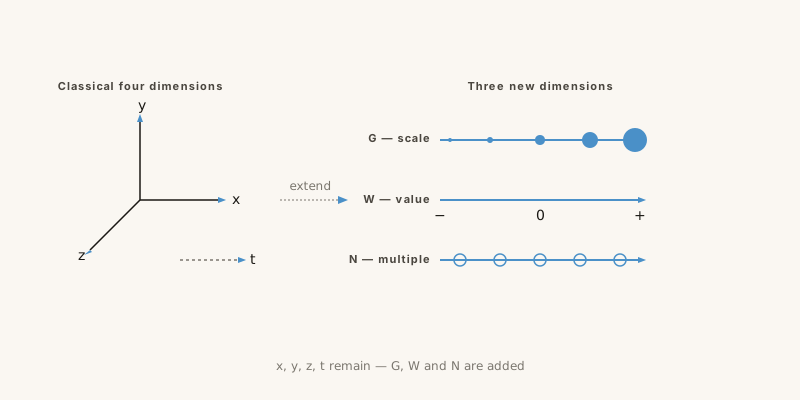
| Dimension | Symbol | In plain terms |
|---|---|---|
| Space | x, y, z | Where something is |
| Time | t | When something is |
| Scale | G | At which scale you look — atom, human, galaxy |
| Value | W | From antimatter to matter — what something "weighs" in terms of existence |
| Multiplicity | N | How many parallel versions of the system exist |
Scale, value and multiplicity
The same framework works for societies
Scale law in policy
A policy that works at municipal level may backfire at national level. That is no accident — that is a scale law. The same physics as the ant and the elephant.
Values that do not appear on the balance sheet
Respect, dignity and trust carry their own W-value that counts, even if it does not appear in a spreadsheet. Whoever counts only euros is missing an entire dimension.
Multiplicity as an experimental field
One country is one experiment. Twenty countries each choosing differently produce evidence. Uniformising legislation is then worse than competition between member states — N-value destroyed.
A framework, not a proven theory
Honest answer: it is a framework, not a proven theory. I developed it because the existing models require too many ad-hoc patches: dark matter, dark energy, fine-tuning of constants.
A good model explains much with little. My model attempts that by adding three missing axes. Whether it is correct, I cannot say with certainty.
"A new scientific truth does not triumph by convincing its opponents and making them see the light, but rather because its opponents eventually die, and a new generation grows up that is familiar with it."
— Max Planck
Three dimensions are not enough
You only begin to understand the universe, a fusion reactor, or a society when you add three missing axes: scale, value, and multiplicity.
We were raised on three spatial dimensions and one of time. Four in total — enough to pick up a cup of coffee; not enough to understand the universe. The 7D framework adds three more: G (size or scale), W (value — the spectrum from antimatter to matter), and N (the multiplicity of parallel systems).
G explains why an ant falls from a skyscraper unharmed while an elephant does not: the same law, a different outcome at a different scale. W explains why we cannot see what we call "dark matter" — it is ordinary matter with a different W-value, just as a radio transmitter on 100 MHz is invisible to a receiver tuned to 90 MHz. N acknowledges that a black hole may, from the inside, be an entrance to another system.
The same framework applies to societies. Policy that works at municipal level may backfire at national level — that is the scale law G. Counting only money misses the W-value of trust and dignity. And twenty countries each making different choices generate more evidence than one uniform system — that is N as a laboratory.
A framework, not a proven theory
Honest answer: it is a conceptual framework, not a proven theory. It was developed because existing models require too many ad hoc patches — dark matter, dark energy, fine-tuned constants. As Max Planck observed: "A new scientific truth does not triumph by convincing its opponents and making them see the light, but rather because its opponents eventually die and a new generation grows up that is familiar with it."