Nova Democratia
A constitution that unites democracy's power of legitimation with the efficiency and clarity of role that are necessary for lasting leadership. Not an amendment to what exists — a parallel constitutional design.
By Jacobus van Merksteijn · 20 min read · 28 May 2026
The thesis
Nova Democratia is a new political-constitutional model that aspires to world leadership in economic development, predictability and equal opportunity. It unites the legitimating power of modern democracy with the efficiency and clarity of role that are necessary for lasting leadership.
Democratic
Direct legitimation by citizens, without the intermediary layer of party politics.
Meritocratic
Talent, achievement and potential as the sole criteria for selection — regardless of background or wealth.
Predictable
Constitutional constancy. No capriciousness that renders international leadership impossible.
The seven core articles
Nova Democratia rests on seven founding principles that mutually reinforce one another. Each principle is a law of nature within the system, not an option.
Popular sovereignty
Direct control and correction of officeholders by citizens through periodic review and recall mechanisms.
Equal opportunity
Equal chances for equal qualities — talent, achievement and potential as the sole criteria.
Unity of decision-making authority
One clearly identifiable decision-maker per competence. Shared or vague powers are not permitted.
Constancy
Long-term stability. Changes of course require transparent evaluation and reinforced consent.
Separation of responsibilities
A sharpened trias politica with absolute clarity of role. No body controls itself.
Rule of law
Protection of fundamental rights for all citizens, curtailable only by statute and constitutional review.
Economic leadership
World championship in prosperity development as a constitutional priority.
Popular sovereignty and direct legitimation
Representation is not achieved through party-political selection, but through the direct choice of citizens based on personal quality, competence and demonstrable achievement — without the intermediary layer of party politics.
Political parties may hold no monopoly over the nomination of candidates. Representatives are elected on the basis of personal quality and programme, not on the basis of party membership.
Candidates sit examinations prior to election that demonstrate their competence, integrity and knowledge of constitutional law. Elected officeholders are periodically evaluated and may be removed through established procedures in cases of structural failure.
Equal opportunity for equal qualities
Objective selection
All public and semi-public institutions apply transparent selection mechanisms in which talent, achievement and potential are the sole criteria — regardless of background, wealth, gender or religion.
Structural correction
The state creates provisions that actively correct structural inequality in access to education, healthcare, legal assistance and economic participation, so that equal quality genuinely produces equal outcomes.
Unity of decision-making authority and constancy
Every policy responsibility is assigned to one clearly identifiable decision-maker. Shared, vague or overlapping powers are not permitted. Citizens always have the right to know who is responsible for any given decision.
No hiding behind collegiate or layered governance. Direct accountability to the people.
Long-term stability is not a wish but a rule. Changes of course require transparent evaluation and public consultation. Governmental constancy and the absence of capriciousness are the foundation of international economic leadership.
Separation of responsibilities and rule of law
The classical trias politica is sharpened by absolute clarity of role. No officeholder or body may control itself or be accountable to a body of which it forms part. Horizontal and vertical checks and balances are constitutionally enshrined.
All citizens enjoy fundamental rights — freedom of expression, assembly, religion and privacy. Fundamental rights may be curtailed solely by democratically enacted statute following transparent deliberation and review by an independent Constitutional Court.
Economic world leadership
Nova Democratia makes economic competitiveness a constitutional priority. Economic policy is directed towards sustainable growth, international competitiveness and the social cohesion needed to retain the confidence of citizens and investors.
Three pillars of growth
Strategic constancy, support for innovation and meritocratic talent development.
Zero bureaucratic obstruction
Enterprise and innovation within clear regulation, free of impediment.
Five digital mechanisms
Nova Democratia employs digital infrastructure to make direct citizen participation technically and legally binding.
Direct Digital Referendum
Citizens vote directly online on laws and budgets. Blockchain guarantees one vote per citizen. The result is binding, not advisory.
Direct Election with Recall
Citizens directly elect ministers and senior officials. In cases of structural failure, a majority may initiate a recall referendum via a digital platform.
Open-Source Legislative Platform
Bills as living documents, online. Citizens and experts propose amendments; algorithms cluster the best ideas.
Performance Dashboard with Trigger
Every minister has a public dashboard with measurable KPIs. Two consecutive quarters below the benchmark automatically trigger a digital confidence vote.
Direct Petition with Binding Threshold
100,000 signatures automatically triggers a binding referendum on the citizens' initiative, without the intervention of parties or advisory bodies.
Ten core fields of policy and performance
Each core field has its own set of key indicators and one or more politically accountable administrators. Citizens can directly track the value for money of each core field.
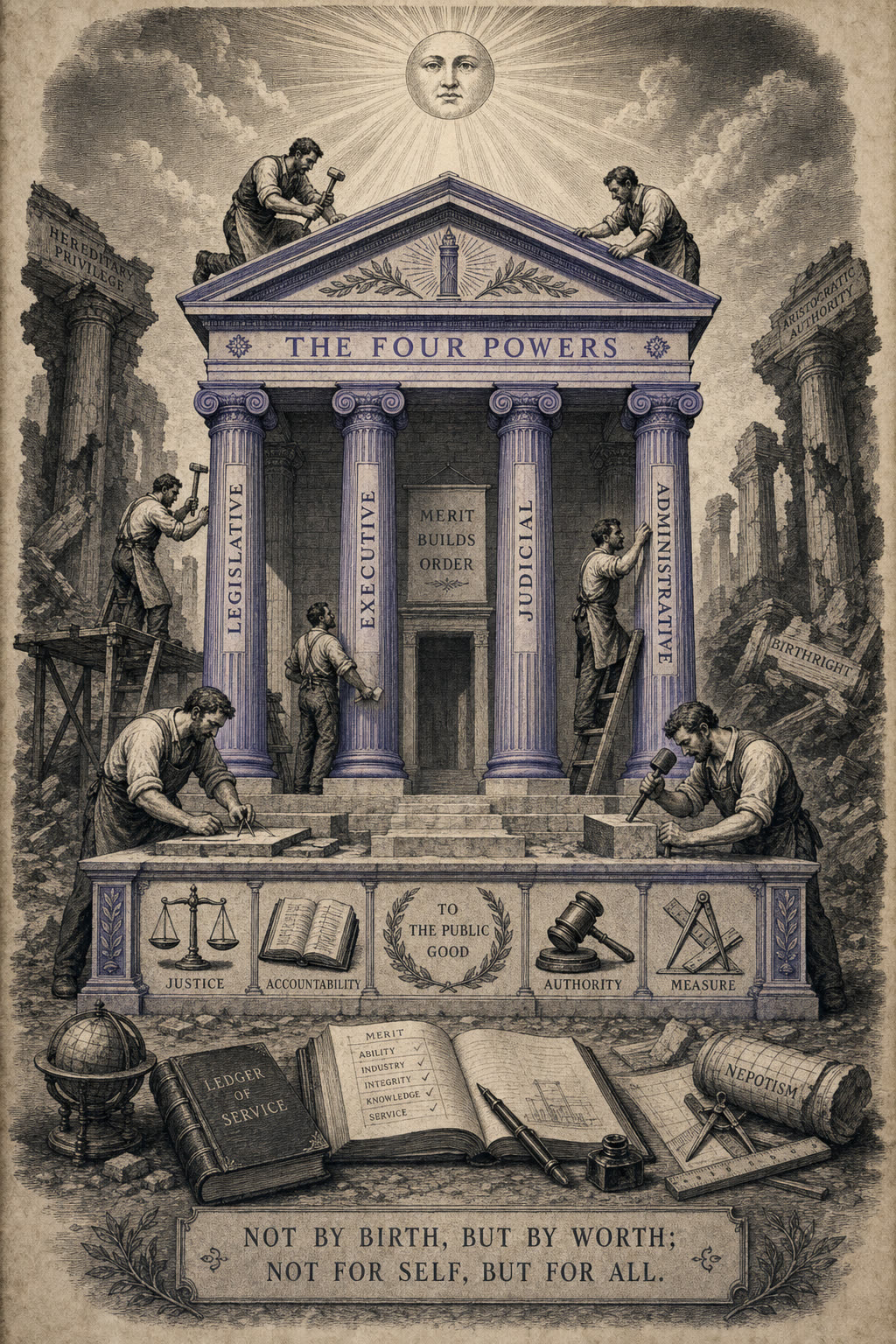
Four powers — an extension of the trias politica
The classical doctrine of three powers is supplemented by a fourth: the performance-reviewing power. A fourfold separation of powers as the constitutional foundation.
Legislative power
Establishes general rules, controls the budget and safeguards compatibility with constitutional norms.
Executive power
Implements laws and budgets within the limits set by statute; renders periodic account.
Judicial power
Fully independent; resolves disputes and reviews decisions against statute and the Constitution.
Performance-reviewing power
Independent statistical services measure and report on the functioning of all core fields.
Remuneration linked to performance
There is no general statutory cap on remuneration for public officeholders, provided there is a demonstrable relationship between the weight of the role, the scale of the domain administered and the results achieved on key indicators. All remuneration data are published annually.
Performance link mandatory
No fixed remuneration without performance accountability.
Automatic restriction
In cases of structural underperformance, the remuneration ceiling is automatically and proportionally reduced.
Deferred pay capped
Political officeholders: max. 80% (year 1), 40% (year 2), 20% (year 3) — nothing thereafter.
Implementation and evaluation
The introduction of Nova Democratia proceeds in phases via three mutually reinforcing tracks.
Constitutional revision
Amending foundational rules through a reinforced majority and a public referendum.
Institutional reform
Restructuring bodies and procedures along the seven core articles.
Gradual transition
Step-by-step introduction — first core fields such as education, then governance, then the constitution.
The system is constitutionally evaluated after five years on effectiveness, predictability, equal opportunity and the rule of law. Adjustments require a reinforced majority and a public referendum.
In closing
What is set out here does not fit within the existing Constitution — not because it conflicts with it, but because it replaces its logic. Nova Democratia is not a repair. It is a parallel constitutional design that begins with education and ends with a country that governs itself predictably once more.
Those who see a better route are invited to sketch it. Those who see nothing but the present decline do not belong at the table.
May 2026 · Version 1.0 · Open for discussion · Mallorca / Switzerland