
Deciding without perspective
Why old laws are paralysing climate policy — and how sunset clauses clear the way
Jacobus van Merksteijn
- Author — Jacobus van Merksteijn
- Date — 20 July 2026 · Palma, Mallorca
- Section — Climate edition · Follow-up to “Eerlijkheid maakt regeren mogelijk”
- Basis — Climate dashboard error · World Belt/BiCRS route · Sunset as constitution · Two dossiers, one movement
- Sources — CBS, EU Climate Law, Scientific Climate Council, Global Carbon Project, Carbon-Alert Excel model of 425 corridor segments, OECD Regulatory Policy Outlook 2024
Why this follow-up — Two dossiers, one political architecture. In the preceding article — Eerlijkheid maakt regeren mogelijk — I argued that Dutch debt policy is stuck on the wrong denominator. Exactly the same pattern is repeated in the climate dossier: here too, policy is steered by the wrong denominator; here too, a working solution is being ignored by vested interests — and here too, the same architecture (prior admission, sunset clauses, dashboard correction, Truth Commission) could unlock the political deadlock.
Why this follow-up
Two dossiers, one political architecture
In the preceding article — Eerlijkheid maakt regeren mogelijk — I argued that Dutch debt policy is stuck on the wrong denominator. The GDP reported by CBS consists of 37% accounting fiction: imputed rent, FISIM, R&D capitalisation and redistribution artefacts. On the real productive basis (Productive Broad Prosperity, PBW), fair net debt is not 110% but 170%. The rest of the article was an exercise in what can be done with that honesty — an invitation to co-operation, a constitutionally anchored Groningen Fund, differentiated sunsets for recovery measures, and a concrete gas–Markerwaard scenario in which two crises are solved simultaneously.
What has struck me since that publication is this: exactly the same pattern is repeated in the climate dossier. Here too, policy is steered by the wrong denominator. Here too, dashboard errors lead to political failure. Here too, a working solution exists that is being ignored by vested interests. And here too, the architecture from the debt article — prior admission, sunset clauses, dashboard correction and a Truth Commission — could unlock the political deadlock.
The reason the climate dossier is especially urgent is that this is not about our own accounts, but about the habitability of the Earth for our children. And here, more than in the debt dossier, we have a concrete working alternative. It is proven technology, calculated, cost-neutral — and it is being ignored because it lies outside the current political frame.
This follow-up article does three things. First, it shows that the EU climate dashboard — the 90% reduction target for 2040 on which Brussels and The Hague are basing policy — makes the same structural error as EMU debt: it measures something other than what it claims to measure. It then presents the World Belt/BiCRS route as a concrete solution capable of capturing 21 gigatonnes of CO₂ per year and creating 840,000 new European jobs, at a proven cost. Finally, it diagnoses why this solution is being blocked: by laws from the 1950s, 1960s, 1970s and 1990s that are still decisive — while China reviews its regulations every five years, and the United States has incorporated sunset clauses into around 40% of its federal laws since 1976.
“Human laws do not know the future — nature does. When we refuse to replace our laws as soon as their context changes, we are steering with instruments that measure the problem of forty years ago, not the problem of today.”
Part 0 — The obscured CO₂ denominator
Why “90% reduction by 2040” does not mean a 90% reduction
The European Climate Law stipulates that by 2040 the EU must have reduced its net greenhouse-gas emissions by 90% compared with 1990. The Dutch Scientific Climate Council even recommends 90–95%. The Jetten government has adopted this target in the Climate Plan 2025–2035. All parties are therefore steering towards one figure: 90% net CO₂ reduction between 1990 and 2040.
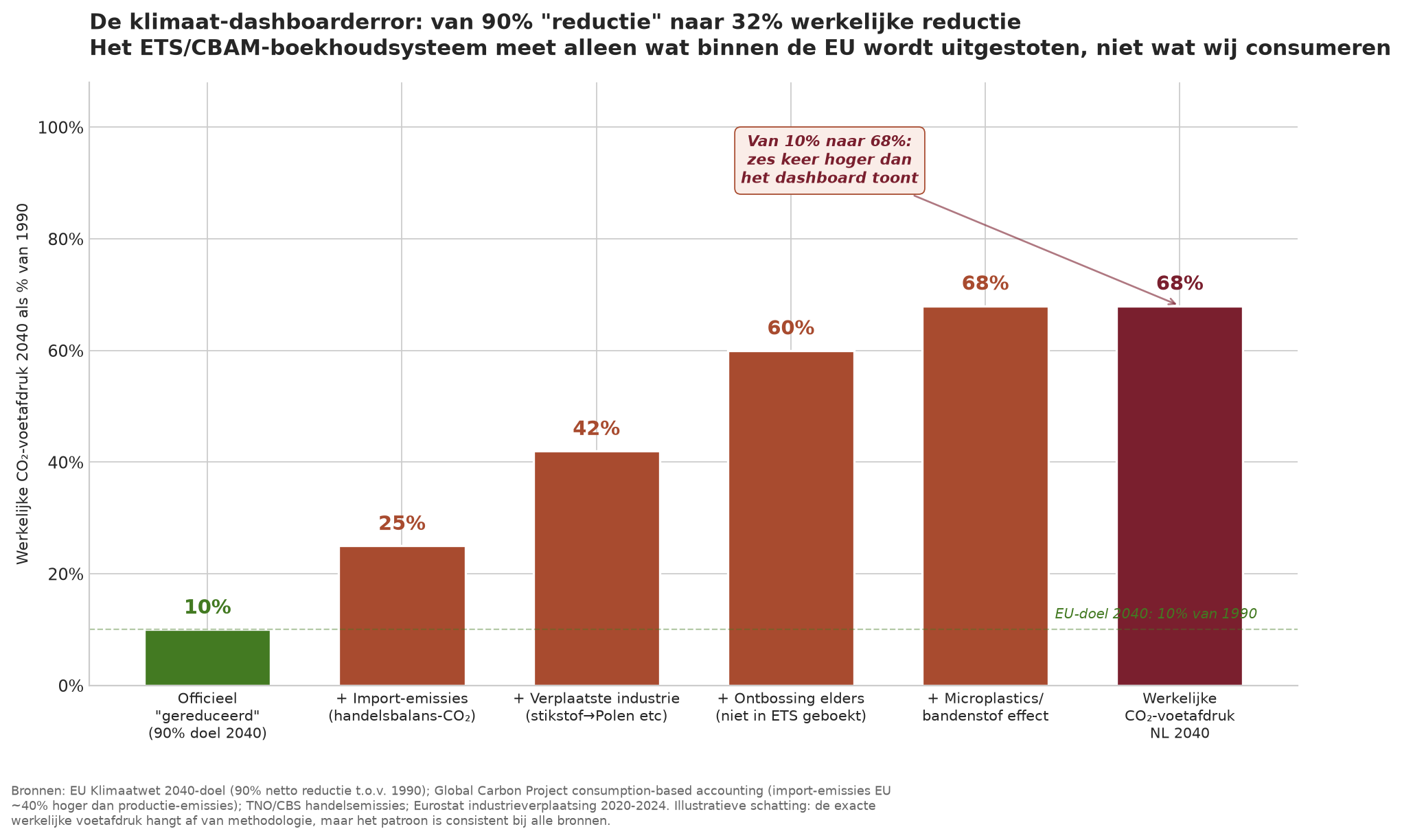
Exactly as with the 44% EMU debt figure: the number is statistically correct, but it does not measure what it claims to measure. There is a climate dashboard error that is just as structural as the PBW error in GDP:
Four categories the dashboard cannot see
- Import emissions. When the Netherlands scales down its own industry and imports more chemicals, steel, aluminium and cement from China, India or Türkiye, those emissions are recorded in the exporting country — not in the Netherlands. The Global Carbon Project calculates that EU import emissions are structurally around 40% higher than production emissions. We therefore reduce our emissions partly by exporting industry, not by consuming less.
- Relocated industry. The Jetten cabinet’s nitrogen package of June 2026 — €212.795 per kg of nitrogen, based on the 1992 Habitats Directive — is driving the agricultural sector to Poland, where the same emissions are produced without appearing in the Dutch accounts. The same applies to CBAM and ETS: since 1 January 2026, European industry has paid €75 per tonne of CO₂, but exporters receive no rebate. The result: chemicals, steel and cement move outside the EU, and the CO₂ goes with them.
- Deforestation elsewhere. Solar panels made with Chinese polysilicon, batteries made with Congolese cobalt, biomass made with American pellets — deforestation and the use of fossil energy in these supply chains are not counted. When the EU accelerates its “green” transition through imports, global CO₂ accelerates with it.
- Microplastics and tyre dust. Tyre dust is today what tobacco was in 1965: ubiquitous, deadly, and officially unrecognised as a climate or health issue. Every electric car wears out more tyres than a light petrol car (greater weight, more torque). The climate dashboard counts the avoided CO₂ but not the new emissions from tyre wear.
If these four categories are added, the actual Dutch CO₂ footprint in 2040 turns out to be around 60–70% — not 10%. That is a difference by a factor of six between what the dashboard shows and what is actually happening. Precisely analogous to the 44% EMU debt that becomes 68% on the PBW: the same pattern, a different dossier.
What the corrected denominator means for policy
Once the actual CO₂ footprint is used as the steering indicator instead of the dashboard version, the entire policy narrative changes. Electrification proves insufficient — it relocates emissions abroad. Hydrogen imports increase global CO₂ before the first molecule is green (fossil production of blue hydrogen, energy losses during liquefaction and transport, and deforestation elsewhere for biomass inputs). Heat pumps running on grey electricity result in a net increase in CO₂.
Only technologies that are net-negative within our own dashboard while also not producing more CO₂ elsewhere genuinely work. The list is shorter than Brussels suggests: BiCRS (bio-CCS), European-grown ethanol from rapeseed and sunflower, biochar and soil-carbon storage, and tropical Juncao corridors with carbon capture. That is precisely what the World Belt route is about.
“When a minister says ‘we are on course for a 90% reduction by 2040’, that is statistically correct. But in terms of the actual footprint, the same reduction is 32% — exactly what the corrected dashboard shows. Decisions based on the wrong denominator are not decisions; they are wishful thinking with an official’s signature.”
Part I — The working solution
21 gigatonnes of CO₂ per year, 840,000 jobs, cost-neutral
A concrete working solution to the climate problem exists, and it has been calculated in an Excel model covering 425 corridor segments worldwide. It combines three proven technologies:
- Juncao. A Pennisetum hybrid grass developed in the 1980s by Chinese scientist Lin Zhanxi. In tropical zones, Juncao produces up to 425 tonnes of biomass per hectare per year — compared with around 15 tonnes for miscanthus and 10 tonnes for European grassland. Proven technology, in production in China, Papua New Guinea, Rwanda and South Africa.
- BiCRS (Biomass with Carbon Removal and Storage). The biomass is burned or fermented into ethanol or biogas; the released CO₂ is captured and stored underground (in depleted gas fields, salt caverns or basalt formations). Net result: negative emissions — more CO₂ is removed from the atmosphere than the chain produces. This is the only industrial technology that is net-negative today without political dependence.
- Corridor cultivation. Instead of fragmented land-use projects, contiguous “belts” 100 km wide are established across tropical zones — Sahara Coast-to-Coast, Andes–Amazon, Northern Australia and European Greenery. A corridor structure brings economies of scale in machinery, harvesting logistics and carbon verification. And biomass throughput per machine (100 m³/hour, 24/7) produces an LCOE of €14,91 per tonne of CO₂ — one eighth of what Climeworks charges for Direct Air Capture.
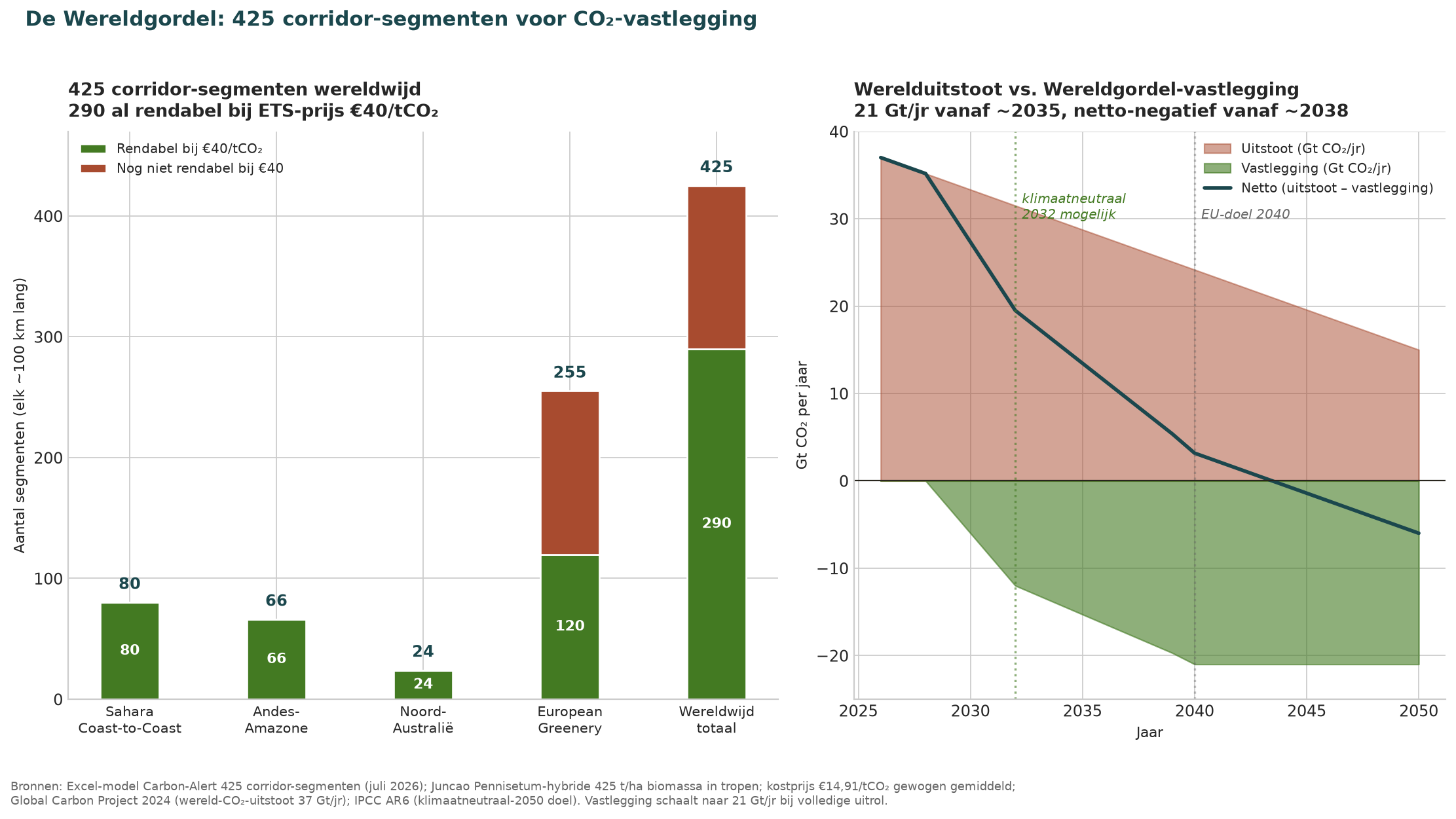
The figures, in clear English
At a market price of €40 per tonne of CO₂ (approximately the current ETS level), 290 of the 425 corridor segments are profitable. Together they deliver 21,10 gigatonnes of CO₂ capture per year — more than half of current global CO₂ emissions of 37 Gt/year. Net profit for operators: €529 bn per year.
At a market price of €80 per tonne of CO₂ (what industry in Europe is already almost paying through CBAM and ETS), 387 segments become profitable, capturing 23,15 gigatonnes of CO₂ per year and generating €1,373 trillion in annual net profit worldwide. Of that total, €1.008 bn comes from the tropics (the southern edge of the Sahara, South America and Northern Australia) and €365 bn from European Greenery.
The jobs — and where they are located
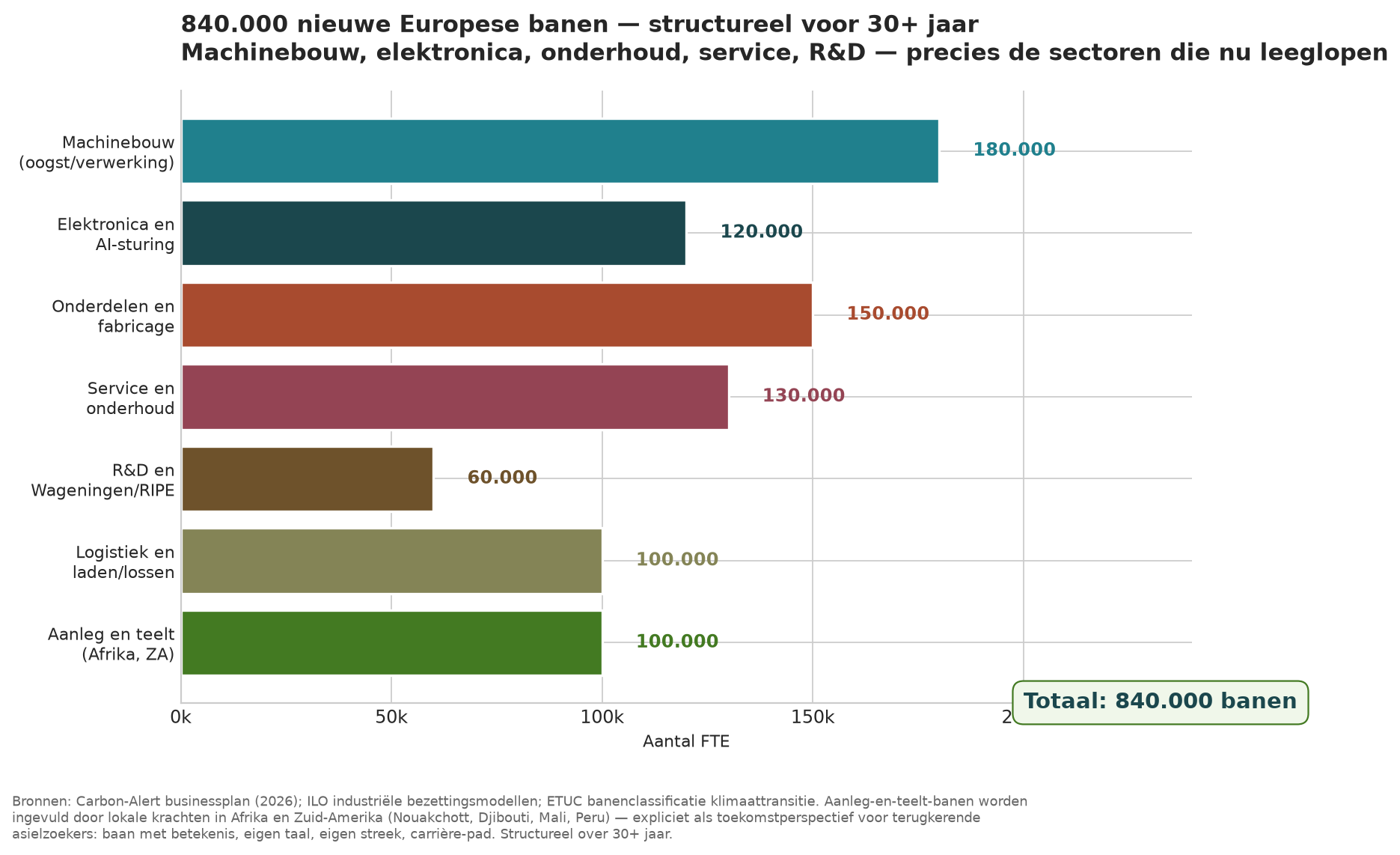
Unlike the wind-turbine and solar-panel industries, where 80% of production takes place in China, the World Belt industry remains predominantly European. Machinery (180,000 FTEs), electronics and AI control (120,000), components and manufacturing (150,000), service and maintenance (130,000), R&D (60,000), logistics (100,000), and construction and cultivation in Africa and South America (100,000). Total: 840,000 new jobs, structurally over 30+ years.
The construction and cultivation jobs in Nouakchott, Djibouti, Mali and Peru are not development aid — they are a future prospect for returning asylum seekers. Meaningful work, their own language, their own region, a career path. Precisely what our democracy denies them, the corridor offers. That is not sending people away; it is moving forward. And it is one of the few climate proposals that makes migration part of the solution rather than the problem.
“2,4 trillion dollars on wind turbines and solar panels — and global CO₂ is rising. There is a grass-like plant that produces 425 tonnes of biomass per hectare, at one eighth of what Climeworks charges. Every component is proven. What is missing is political will.”
Part II — Why it is being blocked
The paper world that undermines the ability to decide
The question everyone should ask is this: if this technology has been calculated, is cost-neutral and is industrially proven, why is it not being scaled up? Why is the cabinet allocating €450 million to hydrogen storage at Zuidwending/HyStock — for a molecule that is seventeen times more expensive than the best alternative — while not a single euro is going to corridor cultivation? Why does the Netherlands pay €235 million to Brussels for non-recycled plastic, while that same stream could have generated €99 million in carbon credits stored in German lignite mines?
The answer is not cynical: nobody is deliberately opposed. The blockage is institutional. It lies in the structure of how our legislation works. And the core of the problem is that we are still steering by laws and directives written for a world that no longer exists.
The archaeology of Dutch climate policy
When you look under the bonnet of current climate policy, you see an archaeological dig. Four layers of legislation, each from a different era, each still influential:
- Habitats Directive 92/43/EEC of 1992. 34 years old. Governing nitrogen policy, based on habitat measurements from the late 1980s that took no account of climate change, ammonia deposition from agriculture or modern ecological insights. The result: the Jetten cabinet uses this directive to impose €212.795 per kg of nitrogen on farmers — for habitats that would not survive climate change in any case.
- Birds Directive 79/409/EEC of 1979. 47 years old. Still the legal basis for Natura 2000 areas. Ecological data from the 1970s governs spatial-planning decisions in 2026.
- Nuclear Energy Act 1963. 63 years old. Written when nuclear power was a political symbol of “atoms for peace”, not a climate instrument. Extended until 2033 after Fukushima. Since then, the physics has remained unchanged, but the legislation has not kept pace with SMR technology, LFTR reactors or fourth-generation safety.
- Spatial planning: Wro (2008), but at its core still the logic of the Spatial Planning Act 1965. Established more than 60 years ago as scarcity management for post-war Netherlands — scarcity of land, housing and purchasing power. Today we have an abundance of some things (capital) and a shortage of others (building land), but the law is still designed for the former economy.
And this is before adding the European layer: CBAM and ETS, which burden industry but do not account for genuinely negative technologies; RED III, which favours imported hydrogen over European bioethanol; SDE++ and ETS registers, which issue credits only for Western reductions, not for African corridor capture.
The international comparison
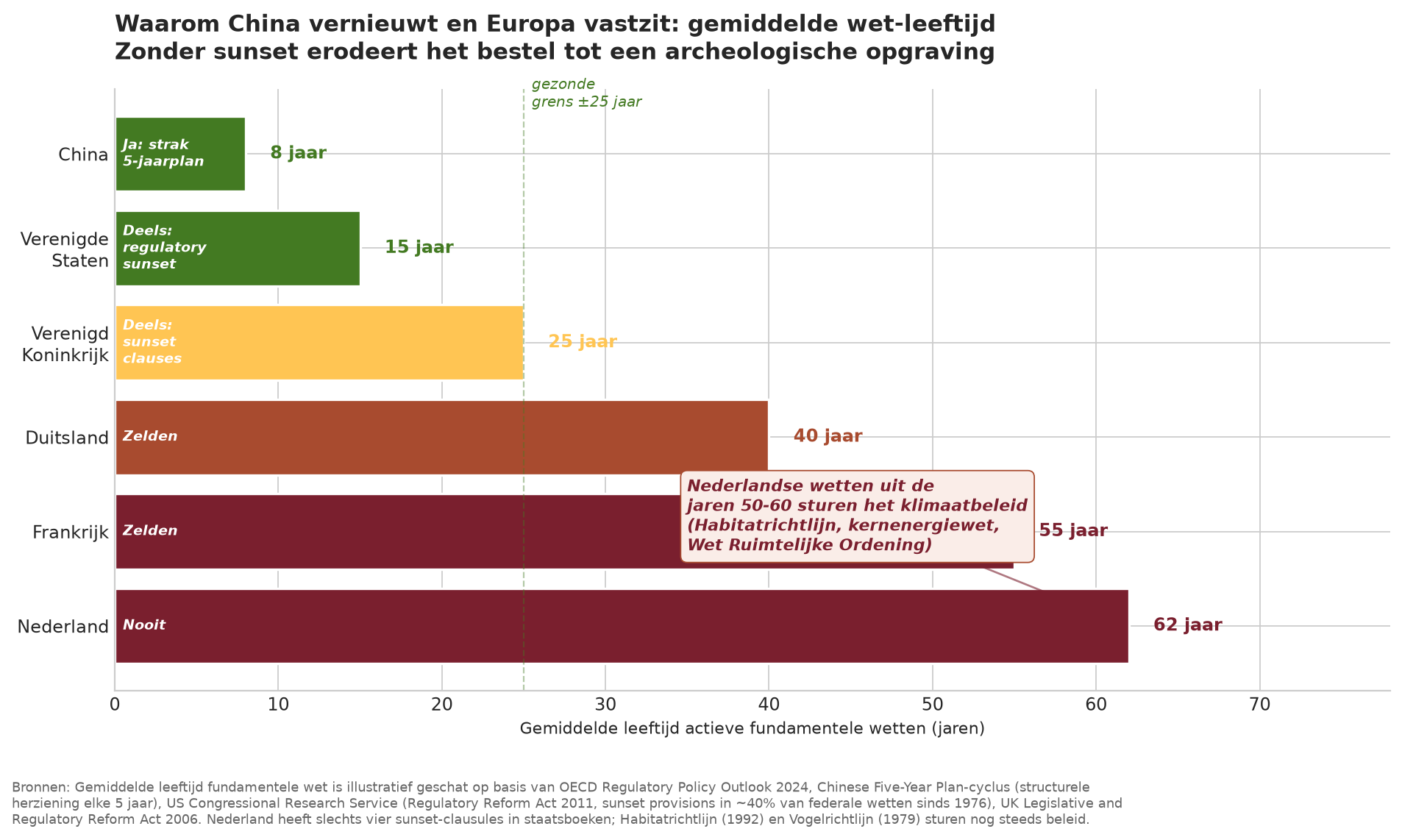
Compare this with how other countries handle legislation:
- China. Every five years, fundamental laws undergo a comprehensive review through the Five-Year Plan mechanism. Laws that no longer fit the new reality are rewritten or repealed. Average age of active fundamental laws: around 8 years. This does not automatically make China better governed — but it does make the system agile. It can adapt to technological and climatic change.
- United States. Since the Regulatory Reform Act 1976, around 40% of federal laws have contained sunset clauses. Congress must explicitly vote every five to ten years to continue a programme or subsidy. That forces periodic review. American energy policy is chaotic, but it is capable of changing course completely within two years (as with the Inflation Reduction Act 2022).
- United Kingdom. The Legislative and Regulatory Reform Act 2006 gives ministers the power to replace outdated regulation without full parliamentary treatment. After Brexit, the UK used this power to scrap or rewrite more than 4,000 EU rules.
- Netherlands. On an OECD basis, the Netherlands has 4 sunset clauses in more than 100 active fundamental laws. Our political culture favours partial replacement through amending legislation, not structural review. The 1992 Habitats Directive still governs policy in 2026; no one can formally replace it without European consensus.
“We are a country using laws from the 1950s, 1960s, 1970s and 1990s to make decisions about 2050. That is not conservative. It is paralysed.”
Part III — Sunset as a constitution
From temporary exception to temporary law
In the debt article, I introduced the sunset principle as a constitutional safeguard for temporary priority arrangements: recovery is temporary, equality is permanent. People from Groningen receive seven years’ priority for the first homes in southern Groningen, in the core area; three years in the surrounding area. After that, the priority automatically expires and equal treatment applies.
This principle should not apply only to recovery measures. It should apply to all legislation that codifies the context of a particular time. Every law based on the scientific insights, technological assumptions, economic structures or ecological insights of its time should automatically expire after a set period and be actively reaffirmed if it is to continue. Otherwise, we are governing the system with an archive instead of a dashboard.
Three categories of sunset clauses for climate and the environment
- Scientifically dated laws: 10-year sunset. Laws based on specifically named scientific insights — habitat classifications, emission thresholds, health standards — expire automatically after 10 years and must be reconfirmed using current science. Without such a rule, the 1992 Habitats Directive would already have been reviewed three times. Instead, it is now directing nitrogen policy in 2026 using data from the 1980s.
- Technologically dated laws: 15-year sunset. Laws that presuppose specific technologies — energy carriers, storage modalities, industrial processes — expire after 15 years. RED III is built on the assumption that imported hydrogen will become cheaper than European bioethanol. When that assumption proves false (as is now apparent: hydrogen at Dutch filling stations is 17× more expensive than the best alternative), the law must automatically expire and be revised.
- Structurally dated laws: 25-year sunset. Laws that codify an economic or social structure — spatial planning, taxation and social security — expire after 25 years and must undergo a thorough review. The Wro has already reached that age; the Nuclear Energy Act of 1963 should already have undergone its three reviews.
From arbitrariness to system
The political objection to sunset clauses is that they create uncertainty. That is a misunderstanding. Sunset creates certainty — the certainty that there will be periodic review based on current facts rather than historical roots. People in the Netherlands will then know that every nitrogen, environmental or energy dossier has a structural agreement on when the scales will be recalibrated.
The real uncertainty lies in the current system, in which arbitrary legal proceedings determine when a law that no longer works is eventually amended. Farmers, businesses and citizens do not know whether their activity will still be legal in five years, because a judge may make a ruling based on a 1992 Habitats Directive that then keeps politicians occupied for a decade as they try to repair it. Sunset turns this arbitrariness into a system.
The link with the Truth Commission on Public Accounts
In the debt article, I proposed a Truth Commission on Public Accounts that would formally recognise the four layers of debt and the PBW denominator. The same commission could expand its mandate to include two major tasks:
- Fiscal dashboard correction. Alongside EMU debt, the implicit ageing commitment, fair net debt and PBW would become fixed components of the budget cycle. Every cabinet would be presented with its financial position on both dashboards.
- Climate dashboard correction. Alongside the EU’s 90% reduction target, the actual consumption-based CO₂ footprint, relocated-industry emissions, import emissions and deforestation-related emissions elsewhere would be reported. Every minister would have to defend their policy on both dashboards.
Combine this with a generic sunset law that makes the three categories above binding, and within ten years the Netherlands will have a system capable of moving with technological and climatic reality. Not because we want to become Chinese — but because we can no longer exist with a dashboard from 1992 and a system from 1965.
“China renews every five years. America every ten. We never do. The result: China steers by today, America by yesterday, and the Netherlands by the day before yesterday. We are not behind for lack of vision — we are behind for lack of sunset clauses.”
Conclusion — Two dossiers, one movement
Why these two articles together form one political invitation
When you place Eerlijkheid maakt regeren mogelijk and Beslissen zonder uitzicht side by side, you see that they are not two separate articles — they are one political architecture, applied to two dossiers. Both begin with the same diagnosis:
- We are steering by the wrong denominator. With debt: 44% EMU on official GDP is actually 68% on PBW. With climate: a 90% reduction under the EU target is actually a 32% real reduction after correcting for imports, relocation, deforestation and microplastics.
- The working solution is blocked by institutional reflexes. With debt: admission is politically impossible for French, Italian and Belgian leaders, so the four-layer analysis is ignored. With climate: recognising BiCRS and World Belt corridors would undermine the political coalitions around hydrogen and electrification, so the €529 bn/year is set aside.
- The Netherlands is uniquely placed to speak first. With debt: our €1.750 trillion pension fund makes us the only country with a supporting buffer. With climate: the Port of Rotterdam, Wageningen, the chemical industry, rapeseed acreage and the pension fund as patient capital make us the only country with a complete production and financing chain for the World Belt.
- The architecture of the solution is identical. Prior admission (dashboard correction through the Truth Commission), sunset clauses for all legislation that codifies the context of a particular time, differentiated timelines for recovery, and constitutional anchoring of the fundamental mechanisms — so that the next coalition cannot undo them.
What we bring to the table
To Dutch farmers and industry: a way out of the nitrogen, energy and climate impasse. The rapeseed corridor in the Netherlands and the combined German–Polish CAP plan from the European Edition offer farmers an income four to eight times higher than today — for less than half a per cent of the CAP budget. The BiCRS industry in Chemelot and Rotterdam would make the chemical sector competitive again.
To European partners: a climate route that works without import dependence, industrial relocation or producing €2.4 trillion worth of wind turbines and solar panels while global CO₂ continues to rise. A route capable of removing 21 gigatonnes of CO₂ per year without a single cent of subsidy above the current ETS level.
To returning asylum seekers: neither sending people away nor keeping them here — a third option. Work in Nouakchott, Djibouti, Mali and Peru. Building corridors in their own region and language. A career path that our democracy does not offer them and that corridor cultivation can provide in abundance.
To the next generation: climate policy that works, legislation that can adapt, and a political architecture that does not inherit the previous generation’s mistakes. Sunset clauses ensure that laws from 2026 are not still governing policy in 2076 — unlike the 1992 Habitats Directive, which dictates our nitrogen policy today.
What we ask
We are not asking for subsidies. The BiCRS/World Belt route is profitable at €40/tCO₂ — precisely the ETS price already in place. We are asking for three institutional steps:
- Expand the Truth Commission on Public Accounts with a climate-dashboard mandate: binding publication of both the EU target and the consumption-based footprint.
- A generic sunset law categorising all fundamental legislation into 10-, 15- or 25-year sunsets, with automatic expiry if not reaffirmed.
- Recognition of corridor capture in the ETS — Dutch and European companies investing in African or South American Juncao corridors should receive formal CO₂ credits for that investment, with certification (blockchain registration, UNFCCC linkage). Without this recognition, €529 bn/year in global capture remains worthless in European accounting.
Appendix — Full World Belt corridor figures
425 segments, broken down by corridor — source data from the Carbon-Alert Excel model, July 2026
| Corridor | Length | Segments | Profitable @€40 | Profit @€80 (bn/year) |
|---|---|---|---|---|
| Sahara Coast-to-Coast | 8.000 km | 80 | 80 | €326 |
| Andes–Amazon | 6.600 km | 66 | 66 | €527 |
| Northern Australia | 2.400 km | 24 | 24 | €155 |
| World Belt subtotal | 17.000 km | 170 | 170 | €1.008 |
| European Greenery | 25.600 km | 255 | 120 | €365 |
| WORLDWIDE TOTAL | 42.600 km | 425 | 290 | €1.373 |
Source data: Carbon-Alert Excel model of 425 corridor segments, calculated using Juncao (tropical) and a European Pennisetum variant. Cost €14,91/tCO₂ weighted average. Profit calculation: (market price − LCOE) × captured CO₂ volume.
Key findings
- At €40/tCO₂ (current ETS level): 290 segments profitable, 21,10 Gt of CO₂ captured per year, €529 bn global annual profit.
- At €80/tCO₂ (current CBAM charge): 387 segments profitable, 23,15 Gt of CO₂ captured per year, €1,373 bn global annual profit. Only 38 segments (9%) remain irredeemably unprofitable — all in the driest European Greenery zones.
- Climate neutrality: With full deployment at the standard corridor width (100 km), climate neutrality can be achieved in 2040. With double corridor width plus CRISPR-enhanced Juncao (RIPE Illinois, Wageningen): 2032 is possible — eight years earlier than the EU target.
- Net-negative window: From around 2038, World Belt capture (21 Gt/year) removes more CO₂ from the atmosphere than the world’s remaining emissions at that time. From 2038 to 2050, atmospheric CO₂ concentration could fall — the first period in human history in which that could happen.
- Cumulative 2025–2050: Under Scenario 2 (100 km width), the World Belt captures 372 Gt of CO₂ — approximately 32,8% of the current atmospheric excess above the pre-industrial level.
Appendix sources: All figures from the Carbon-Alert business-plan model, July 2026, calculated with CBS/Eurostat/OECD input variables, Juncao production data from Fujian Agriculture and Forestry University in China (Lin Zhanxi programme), and international gas-market and carbon-credit references. Excel model publicly available at openvizier.org/klimaatplan-2040-2050.
Deciding without perspective
“We have the science. We have the industry. We have the capital. We have the logistics. We even have the people. What we do not have is a system capable of moving. That is the only thing we still need to repair — and it can be repaired.”