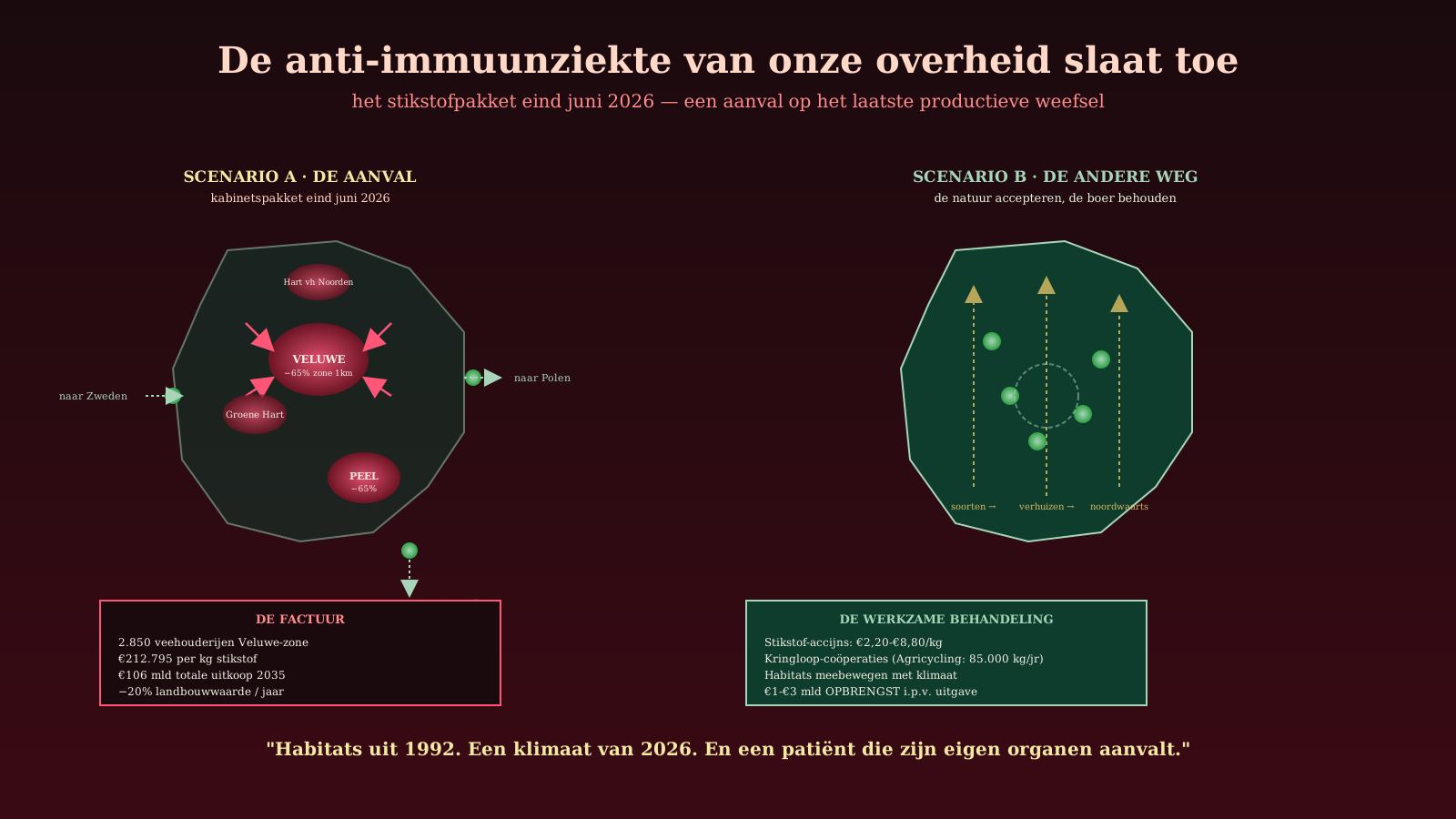
Our government's anti-immune disease strikes
The nitrogen package at the end of June 2026 — an attack on the last productive tissue. And there is another way.
Jacobus van Merksteijn · 19 June 2026
On Friday 26 June the Jetten cabinet presents its nitrogen package. It will be the heaviest attack on the Dutch farmer in fifty years.
What is on the table this week:
Zones of 500 to 1,000 metres around twenty large Natura 2000 areas. Within them, 2,850+ livestock farms around the Veluwe alone must disappear, move or innovate. Reduction: 65%, ambition 69%.
Source: WNL, 17 June 2026
National reduction 42-46% for agriculture and horticulture in 2035. Industry and mobility: 50%. Firm-specific emission standards, forced land-based dairy farming as of 2032, continuation of Lbv buy-out.
Source: Task Force Agriculture, Nature & Nitrogen, 28 May 2026
€212,795 per kilo of nitrogen is what the Lbv buy-out already costs. A kilo of nitrogen in concentrate feed costs €1.50. 140,000 times more expensive than the problem. To reach the government's 2035 goals through buy-out: €106 billion.
Source: ESB, 16 June 2026
Value added in agriculture –20% in 2026 alone. Barns are dismantled and rebuilt in Poland, Sweden, Croatia, Peru and Ukraine. Especially the young modern barns.
Sources: Rabobank, 12 June 2026 · NieuwRechts, 15 June 2026
That is the package. What it really is, in the language of medicine:
The anti-immune disease of our government, which we described earlier in this paper, is now striking in full force. The leadership attacks the productive tissue, on the basis of calculation models from 2019, in a climate of 2026, in order to protect habitats that themselves are already shifting northward.
The madness in one number
One indicator sums up the whole disease.
€212,795. That is what the State pays to get one kilogram of nitrogen out of a Natura 2000 area via the Lbv buy-out scheme.
That same kilogram in concentrate feed costs the farmer €1.50.
The societal damage of that kilo, highest estimate: €8.80.
So we spend €212,795 to prevent €8.80 of damage. A ratio of 1 to 24,000. No thinking person can defend such a decision. And yet the policy continues — and is even expanded.
Why? Because the system no longer thinks. It executes. The Council of State said in 2019: nitrogen must come down. The models say: this much per year. The civil servants say: therefore this many farmers gone. Nobody asks any more: does this entire construction actually hold up?
What nature is doing in the meantime
While we are calculating against 2019 targets, reality is moving.
The tree line shifts northward. Mediterranean species settle in Brabant. Scandinavian coniferous forests are shrinking, birds are breeding weeks earlier, insects are shifting their range by hundreds of kilometres per decade.
The habitats for which we are buying out farmers are themselves moving out of their protected areas.
We protect postage stamps of vegetation types the climate no longer offers. We fight for the existence of species in places where they no longer want to be. And we do it by buying out the farmers who could support them — via nature-inclusive farming, circular farming, soil carbon.
That is not policy. That is an autoimmune reaction to a reality the body no longer perceives.
Two scenarios
There are exactly two paths for the coming ten years. One is the package of Friday 26 June. The other is what a healthy leadership would do.
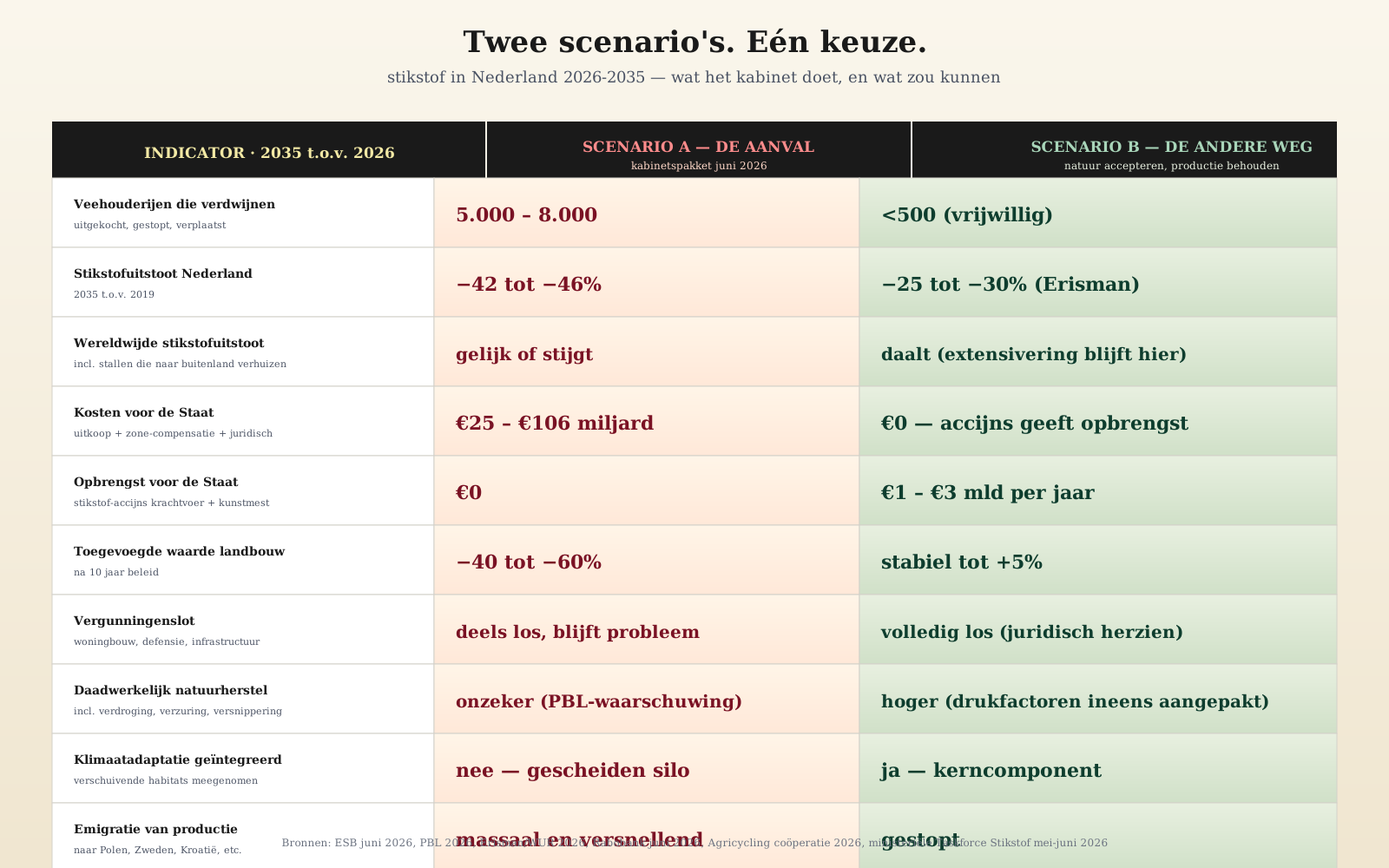
Ten indicators. Two outcomes. The choice is on the table this week.
Scenario A — The cabinet package
The system carries the auto-immune disease through to the end.
- 5,000 to 8,000 livestock farms disappear
- Agricultural value shrinks by 40 to 60% over ten years
- Barns move en masse abroad — livestock numbers rise there
- Global nitrogen emissions remain equal or rise
- State cost: €25 to €106 billion
- Permit deadlock remains a problem (PBL: nitrogen remains a pressure factor)
- Nature does not recover sufficiently — desiccation and acidification remain untouched
- Climate shift is not taken into account
A patient growing weaker under ever heavier medication. A country attacking its own productive cells to protect habitats that will soon no longer be there.
Scenario B — The other way
Three principles. No more attacks on the productive tissue.
One. Tax what you want to reduce, rather than chasing away what you need. ESB research points the way: a nitrogen excise of €2.20 to €8.80 per kilo on concentrate feed and fertiliser. Do not expropriate whole farms — a targeted incentive that allows farmers to choose extensification, circular farming or continuation. Revenue: €1 to €3 billion per year. For the State a net revenue instead of a net expense.
Two. Stop zoning and buy-out. Terminate Lbv and Lbv-plus immediately. Withdraw the 500- and 1,000-metre zones. Replace the legal basis (KDW as legal norm) with an area-based objective that moves with climate shift. The cabinet is already working on replacing KDW with per-sector emission targets — that is an opening that must now be radically filled in.
Three. Accept that habitats shift. Natura 2000 dates from 1992. The Habitats Directive assumes static areas. But habitats move with the climate. The Nature Plan that the Netherlands must submit to Brussels on 1 September 2026 can anchor this new principle: protect moving habitat, not immutable postage stamps of outdated vegetation.
The living proof that it is possible
In Friesland a cooperative of farmers works under the name Agricycling. They process urban residual streams into compost and thereby replace fertiliser.
In 2025 they processed 12,600 tonnes of residual streams into 11,340 tonnes of compost. In doing so they replaced 317,940 kg of fertiliser — equivalent to 85,844 kg of nitrogen. No buy-out, no subsidy of €212,795 per kilo. A working circular economy with a net societal value of €4.4 million per year.
Source: Duurzaam Ondernemen, 27 May 2026
One cooperative. A handful of farmers. Scalable to all of the Netherlands. But it does not fit the cabinet package — because it requires farmers who stay, and the package is built on the idea that farmers must go.
Scenario A: €212,795 per kg of nitrogen less, via buy-out.
Scenario B: 85,000 kg of nitrogen per year replaced via circular economy, with revenue.
Both work. One kills the farmer. One strengthens him.
What science has known for a long time
The most painful thing about this situation: there is no scientific debate any more.
- ESB (16 June 2026): buy-out does not work, taxation and auctions do
- Professor Erisman (Second Chamber, 2026): 25% national reduction suffices, provided it is targeted — not the 42-46% the cabinet demands
- PBL (Nieuwe Oogst, 21 May 2026): nitrogen reduction alone does not lead to nature recovery — desiccation and acidification are equally large pressure factors
- Agricycling Friesland: circular agriculture delivers concrete proof that it can be done differently
- Wageningen UR: buffer strips have a 5 to 10% effect on nitrogen in water, but only after 1-5 years — generic policy does not meet the targets
All the same signal. And the leadership ignores it all. Not out of ill will. Because it cannot recognise the sick.
What must be done now
The five decisions of the first hundred days
- Withdraw the nitrogen package of 26 June. Do not amend it, withdraw it. It is wrong at its foundation.
- Stop Lbv and Lbv-plus immediately. Dismantle the buy-out circuit. €212,795 per kg is not policy.
- Introduce a nitrogen excise. €2.20-€8.80 per kg on concentrate feed and fertiliser. Revenue to nature-inclusive transition and circular pilots.
- Abolish KDW as a legal norm. Replace it with per-sector emission targets, linked to a moving habitat concept.
- Rewrite the Nature Plan of 1 September 2026. Protect moving habitat. Accept climate shift as given. Stop protecting postage stamps from 1992.
The end of self-deception
The cabinet package of Friday 26 June will be presented as "balanced", "scientifically grounded" and "necessary". It will be supported by GroenLinks-PvdA, D66, VVD, CDA, NSC and largely by the employers' organisations and FNV.
It will be presented as the solution.
It is the disease. The anti-immune disease of our government, now entering its most aggressive phase.
And it is precisely at this moment that the inhabitant must say: not this. Not with our names. Not with our votes. Not with our barns, our land, our future.
A different package lies ready. It costs nothing. It yields revenue. It lets the farmer live. It lets nature breathe. It accepts the climate. It only lacks one thing: a leadership that can think.
Until that leadership exists, the responsibility lies with us. With the farmer who does not want to leave, with the DGA who still believes, with the SME owner who sees it coming, with the employee who feels it on his pay slip.
We are the Treg cells. We are the healthy counter-force that can sideline the auto-immune cell line — but only if we activate ourselves.
26 June is coming. The package is coming. It is time to refuse it. And to put the alternative on the table.
