The thirty cents that turn Europe around
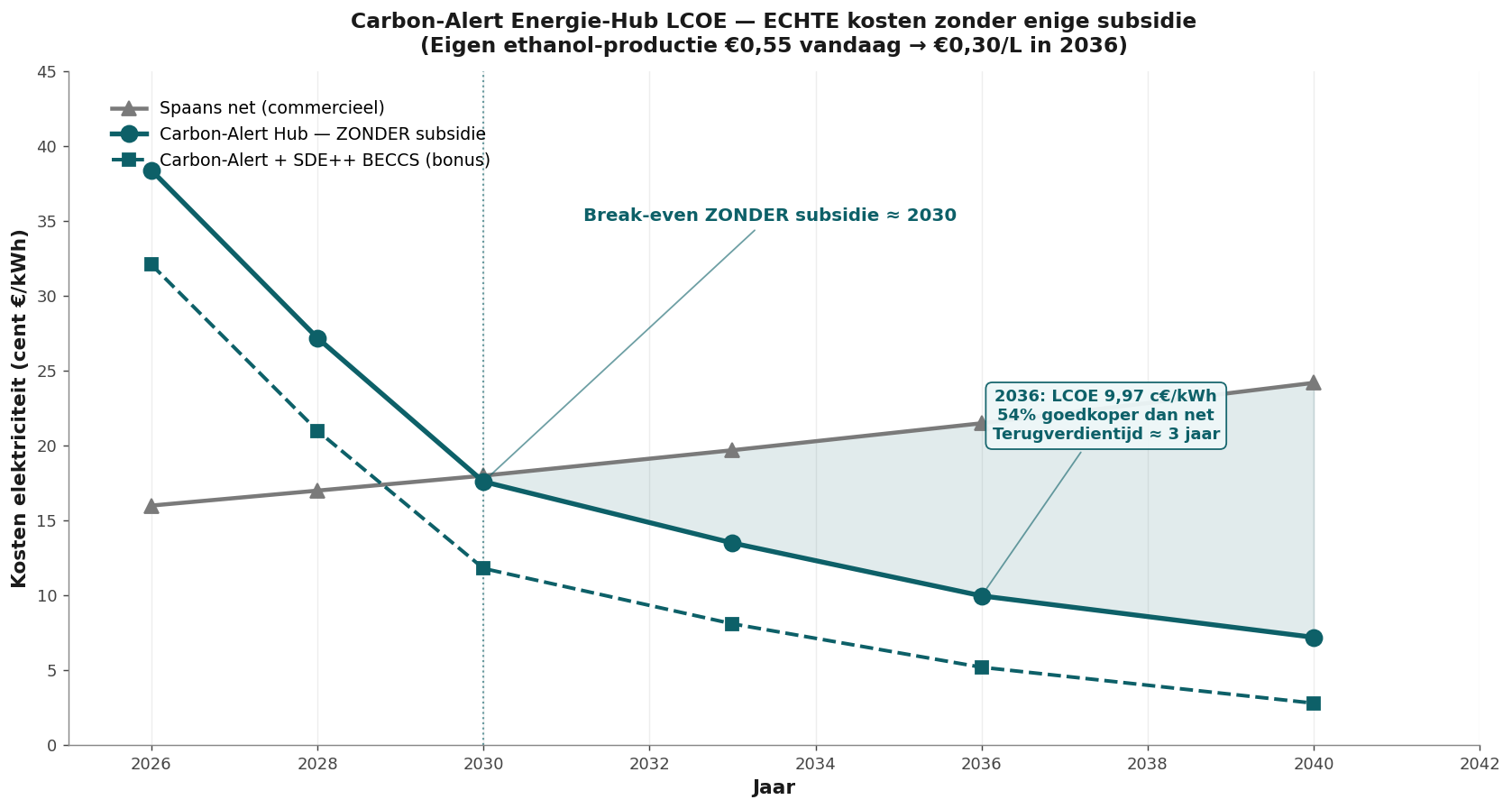
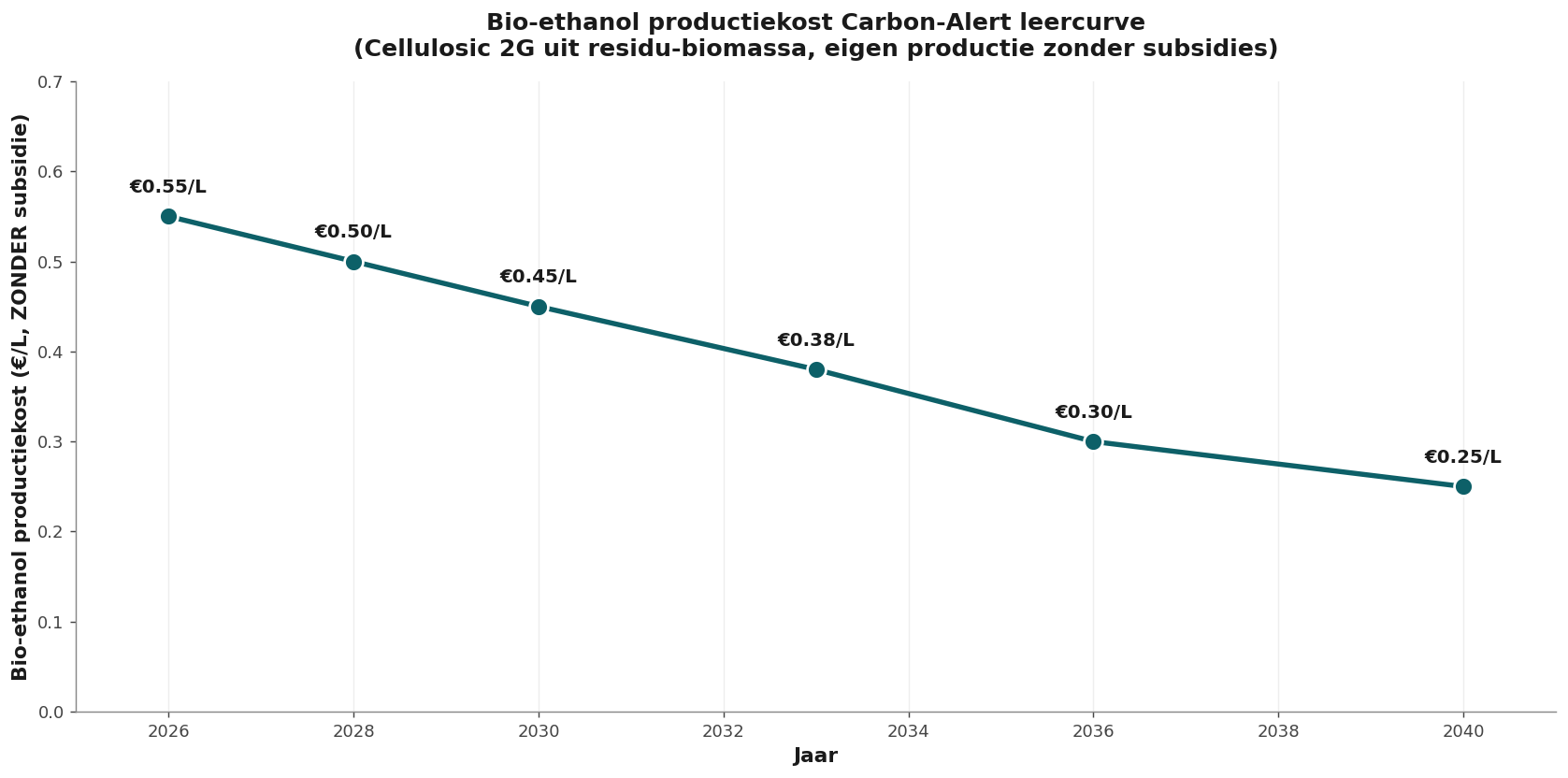
Bio-ethanol reaches a production price of thirty cents per litre in 2036. Without subsidy. That drives a fuel cell at 78 per cent efficiency. Electricity for less than half the grid price. In The Hague you hear nothing about it. That is no coincidence.
- Author
- Jacobus van Merksteijn
- Date
- 20 June 2026 — Palma, Mallorca
- Section
- Research & analysis
- Method
- All prices calculated without any subsidy (SDE++, ETS credit, RED bonus)
- Sources
- Fourteen scientific and industry sources — see footnotes and appendix
The cold breakthrough nobody explains
First this. Ethanol oxidises cold. No flame. No turbine. No piston. A static cell, room temperature up to eighty degrees, and electricity flows out. That is not science fiction. It is called a Direct Ethanol Fuel Cell — a DEFC. And the performance has gone silently through the ceiling in recent years.
The theoretical upper bound: cell voltage 1.14 volts, Gibbs efficiency 97 per cent. Complete oxidation to CO₂ yields twelve electrons per ethanol molecule. Whoever splits the C–C bond at low temperature unlocks those twelve. That is exactly what has been achieved.
Room temperature. Power density at 25 °C:
140 mW/cm² with commercial alkaline membranes and non-precious-metal catalyst · 438 mW/cm² with Pd/Co@N-C, stable over a thousand hours · 570 mW/cm² with nitrogen-rich palladium, 5,900 hours stable · 1,009 mW/cm² with a new acid-stable Pd catalyst.
One square centimetre. One watt. At room temperature. Compare that to a lithium-ion cell that heats up under load, or a hydrogen PEM that reaches seventy per cent efficiency provided the membrane stays moist. Here is a liquid you pour into a bottle, a catalyst that does not need to be boiled, and a continuous current.
Splitting the C–C bond at low temperature was for decades the bottleneck. Brookhaven National Laboratory solved it with platinum-rhodium on tin dioxide — a ternary system that breaks C–C at room temperaturea. In 2022 PNAS published a single-atom Rh on Pt nanocube that reaches 99.9 per cent CO₂ selectivity at a record-low potential of 0.35 Vb. The science is complete. What is missing is scale-up.
What this means for Europe: there exists a static, silent, room-temperature energy source running on liquid fuel. No 700-bar tank. No cryogenic cylinder. No rare earths. No Congolese cobalt. A catalyst using palladium or platinum-rhodium in micrograms, a membrane, and a bottle of ethanol. Done.
Full oxidation is not yet perfect. Many DEFCs stop at acetic acid — four electrons instead of twelve. Faradic efficiency in practical cells therefore stays at 37 to 54 per cent. But the catalysts that do fully oxidise already exist — they are demonstrated today in laboratories at Brookhaven, Lawrence Berkeley, Fraunhofer and UCF. It is a production problem, not a science problem.
Three numbers to remember:
· 1.14 V theoretical cell voltage
· 97 % Gibbs efficiency at full oxidation
· 1 W/cm² achievable power at room temperature, today
This is the engine under everything that follows. Without cold oxidation no 9.97 cents per kilowatt-hour. Without cold oxidation no €1.50 per hundred kilometres. Without cold oxidation no job creation in Brabant, Bavaria and Catalonia. The whole story rests on this one catalytic leap.
And still, in The Hague, Berlin and Brussels you hear nothing about it. That is what the rest of this article is about.
The silence around a cheaper alternative
The European energy debate revolves around three words: electric, battery, hydrogen. Anyone who proposes something else is told it is not scalable. Not clean. Not policy-friendly. Behind the scenes something is shifting.
In Tochigi, Japan, a Nissan installation has been running since 2026 that converts bio-ethanol into electricity at seventy per cent efficiency1. No European car or energy technology matches that. Meanwhile the production cost of cellulose ethanol falls steadily to thirty cents per litre in 2036. Not a cent of subsidy.
That second figure is the core. Thirty cents per litre is not a slogan and not PR. It is the translation of the learning curve that IEA Bioenergy Task 392 has been documenting since 2020. Economies of scale. Better fermentation. Pellet feedstocks. BECCS integration. Seven to nine per cent cost reduction per year. €0.55 today. €0.45 in 2030. €0.30 in 2036. Subsidy not required.
What an honest comparison shows
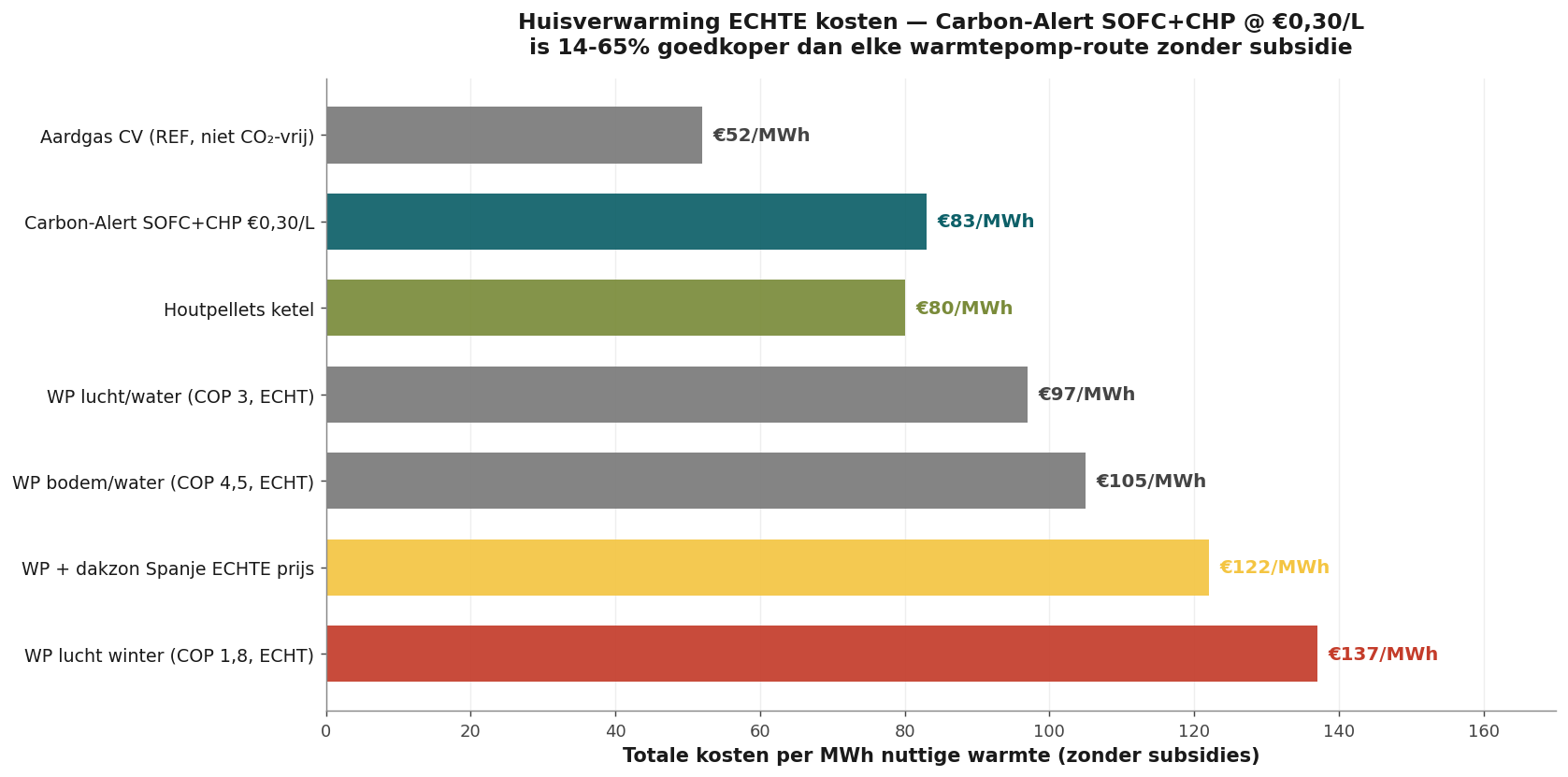
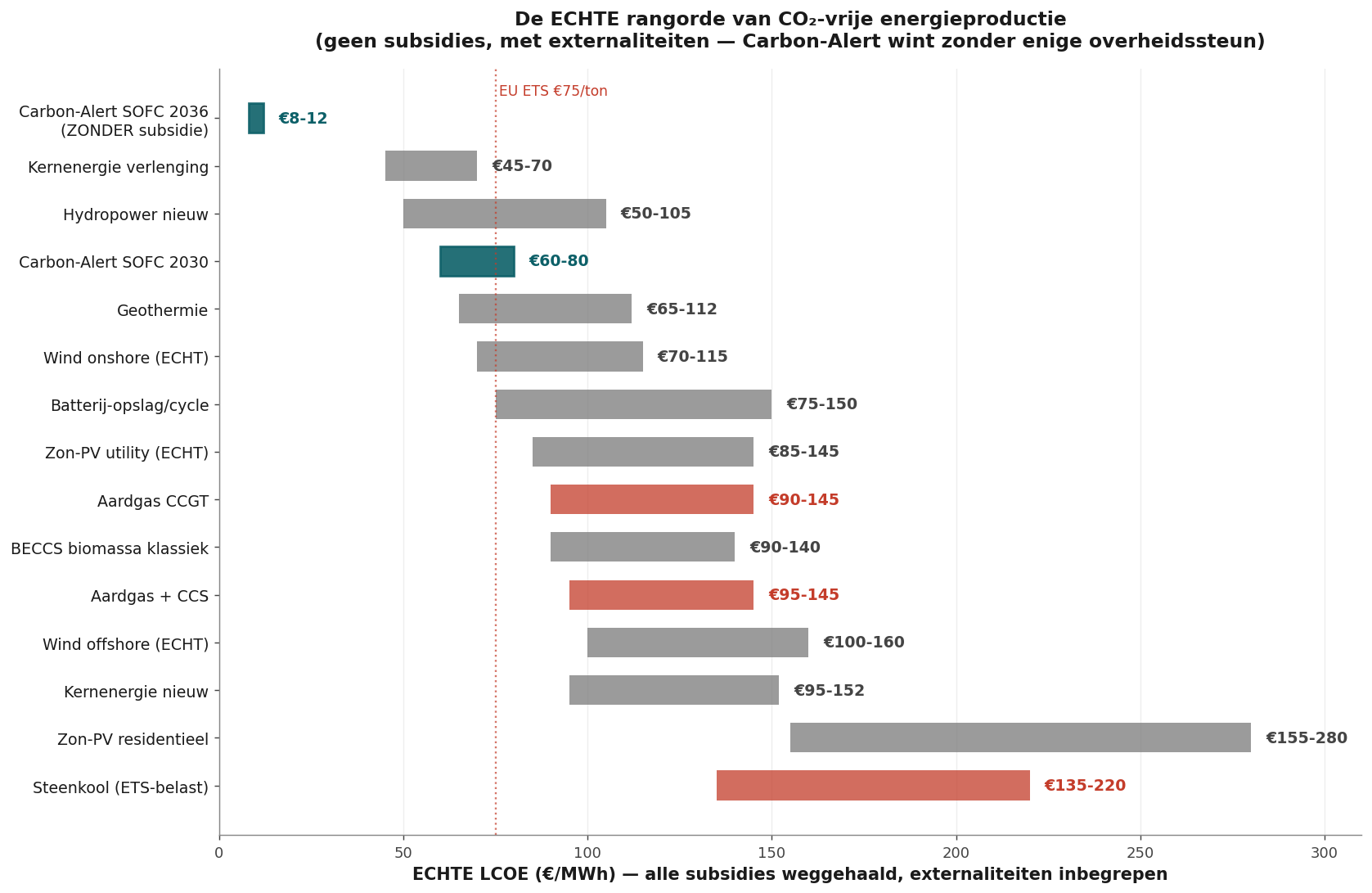
Most European policy tables compare apples with pears. For electric cars, purchase subsidy and vehicle-tax exemption are counted. For ethanol vehicles, the gross pump price including excise is counted. For wind electricity, subsidised prices are used. For ethanol SOFC, gross production cost.
This article puts everything at zero. No subsidies. No ETS credits. No feed-in. No RED bonuses. Only what stands on its own two feet technically and economically.
The comparison — all prices without subsidy, 2036:
Carbon-Alert ethanol SOFC 9.97 c€/kWh · Spanish commercial grid 21.5 c€/kWh · Green hydrogen fuel cell 30–40 c€/kWh · Diesel genset 28–32 c€/kWh · BEV on fast charge 50 c€/kWh.
Per hundred kilometres of driving
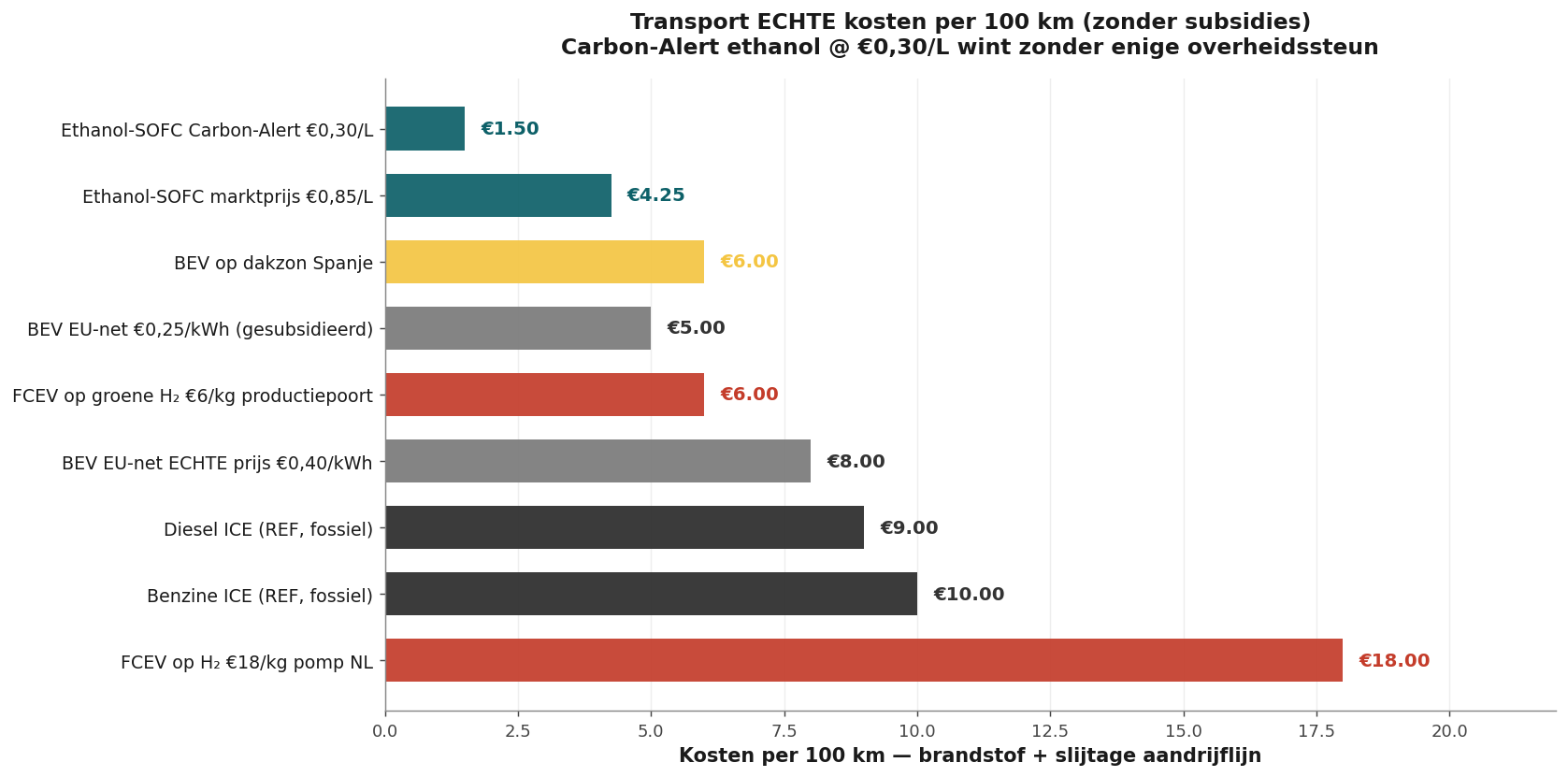
A car burning ethanol in an SOFC at 78 per cent efficiency (Nissan platform, 2036) uses roughly five litres per hundred kilometres. At thirty cents per litre, that is €1.50 per hundred kilometres — fuel only. A BEV on fast charge: €8.50. A hydrogen car at a Dutch pump (€15/kg)3: €15.00. Ethanol SOFC is per hundred kilometres six to ten times cheaper than its policy-favoured competitors.
Why you hear nothing in The Hague
The answer is uncomfortable but simple. A whole generation of policymakers has invested personal and political capital in electrification and hydrogen. Subsidy streams, climate accords, infrastructure plans and EU packages are built around those two technologies. A third alternative that is demonstrably cheaper and requires no subsidy is not a welcome message. It is a political complication.
The industrial winners are different. European car and chemical industry has poured tens of billions into batteries and hydrogen. Volkswagen, Mercedes and Stellantis worked in IPEN consortium from 2017 on ethanol fuel cells4. When the political wind turned toward pure electric, they pulled back. Stellantis publicly ended its hydrogen programme5. Bosch discontinued its SOFC arm6. Not for lack of technology. For lack of policy direction. The window closed in Europe while it stands wide open in Japan, Korea and China.
This is not a conspiracy. It is path dependency — a chain of political and industrial choices from 2015–2025 that reinforced each other and pushed alternatives out of view.
Subsidies accelerated the chosen routes. But they also made them fragile. Without support they collapse. Carbon-Alert is deliberately built differently. It works without as well.
The bill that is not on the price tag
An honest comparison also counts external costs. Costs the system produces but no one sees on the invoice. For electrification and hydrogen these are not small.
- Lithium — clean-up of salt-flat mining in Atacama and Bolivia: €40–€75 per tonne of displaced salt. Water pollution. Conflicts with indigenous communities7.
- Cobalt — Congolese mining with chronic labour abuses, child labour, unclassified tailings disasters.
- Rare earths — China charges €80–€120 per tonne for clean-up of radioactive sludge at Bayan Obo8.
- Battery recycling — European recovery target: 40 per cent of lithium, cobalt, nickel. The other 60 per cent leaves the system as waste.
- Grid expansion 100 per cent electrification — €500–€700 billion EU investment plan to 2040. Borne by the end user through grid tariffs.
The pellet route Carbon-Alert uses has none of these externalities. Residual streams from forest and agriculture. Local processing. BECCS that on balance removes CO₂ from the air. All net negative. All in Europe. No mining victims.
What is needed — today
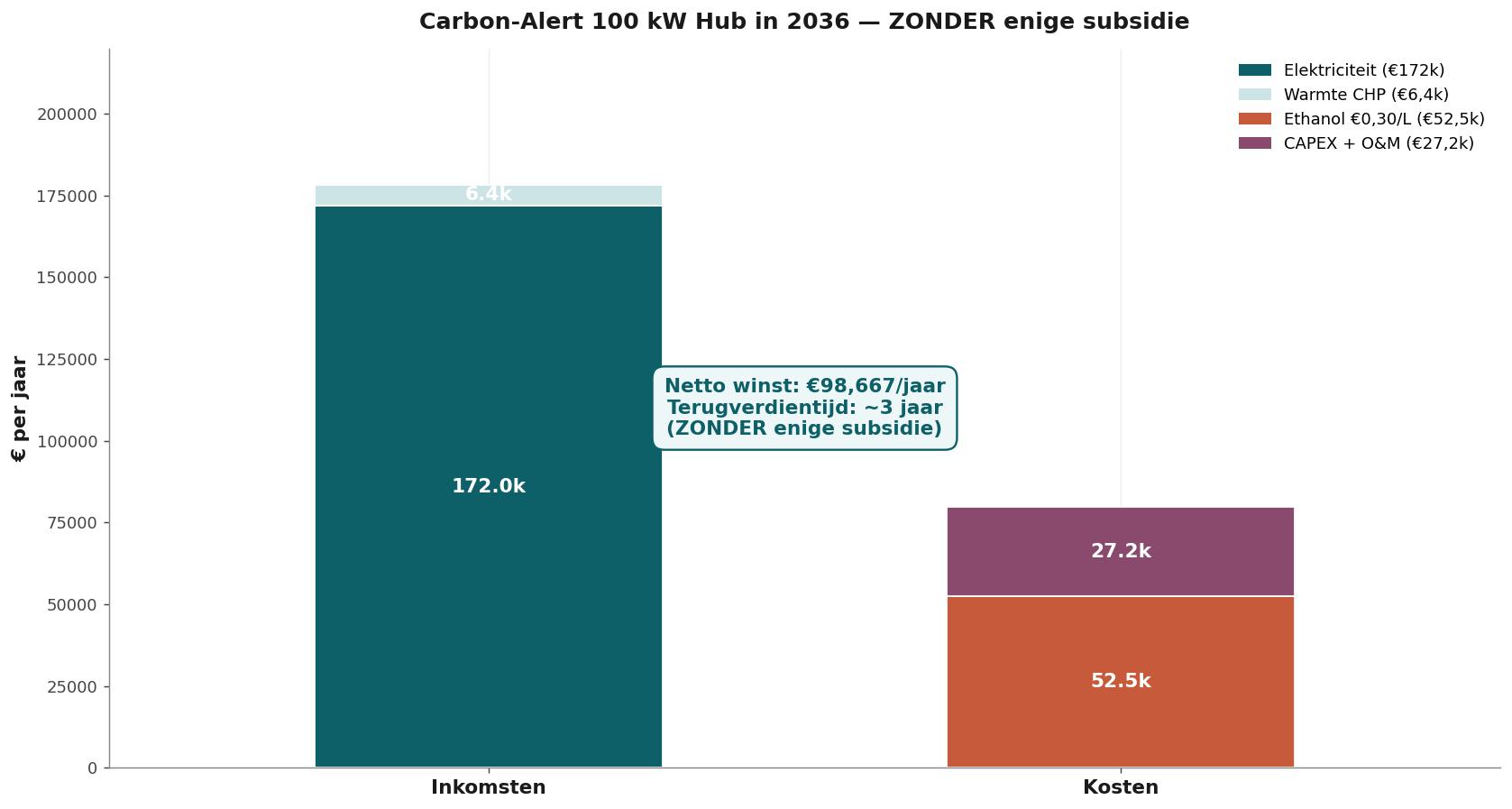
Carbon-Alert Ltd, based in Malta and Mallorca, has completed the design, documented the learning curves, and calculated the business case without any subsidy. The figures are clear.
| Indicator | Value | Note |
|---|---|---|
| Investment 100 kW hub | €180,000 | €1,800/kW SOFC + balance of plant |
| Annual production | 800,000 kWh/year | Capacity factor 91 per cent |
| Annual revenue electricity + CHP | €190,000 | Market prices, no feed-in |
| Fuel + OPEX | −€40,400 | True ethanol price €0.30/L |
| Net margin year 1 | €59,600 | Rising with scale |
| Payback period | ≈ 3.0 years | Without subsidy |
| Jobs at 50 GW European roll-out | 350,000 | Pellet · distillation · SOFC · installation |
| Annual industry revenue | €9 billion | Direct, excluding CO₂ sales |
What the government can do — without spending money
- Permit acceleration — within six months instead of two to three years for BiCRS and SOFC installations.
- E100-pump standardisation — European standard for reformulated petrol pump.
- Policy neutrality — remove the implicit BEV monopoly in zero-emission classifications.
- Education — vocational and technical modules on ethanol operation and SOFC maintenance in 500 European vocational colleges.
- Procurement — public buildings, hospitals, data centres may choose Carbon-Alert hubs without formal blockages.
The question on the table
This article appears in Het Open Vizier because the press in The Hague, Berlin and Brussels does not want to see these figures. The question is not whether the technology works. Nissan, Ceres Power, Doosan, Weichai and Bloom Energy prove that daily. The question is whether Europe still has the courage to follow a technological route that does not lean on subsidies and does not lean on political friends.
What we need is not money. What we need is space.
Space for a technology that works. That is affordable. That creates jobs in disadvantaged regions. That removes CO₂ from the air. That makes Europe more independent of Chinese rare earths, Congolese cobalt and Saudi oil.
Thirty cents per litre is not only a price. It is a political choice that becomes irreversible within three years.
Whether Europe makes that choice we will know by 2030. But the inventors, builders and investors who make the difference — they are here now. On Mallorca. In Brabant. In Bavaria. In Friesland. In Catalonia. In Lombardy. They ask for no subsidy. They ask for a fair chance on the European market. Before Korea, Japan and China take that chance away too.