★ What is emerging · Malta, June 2026
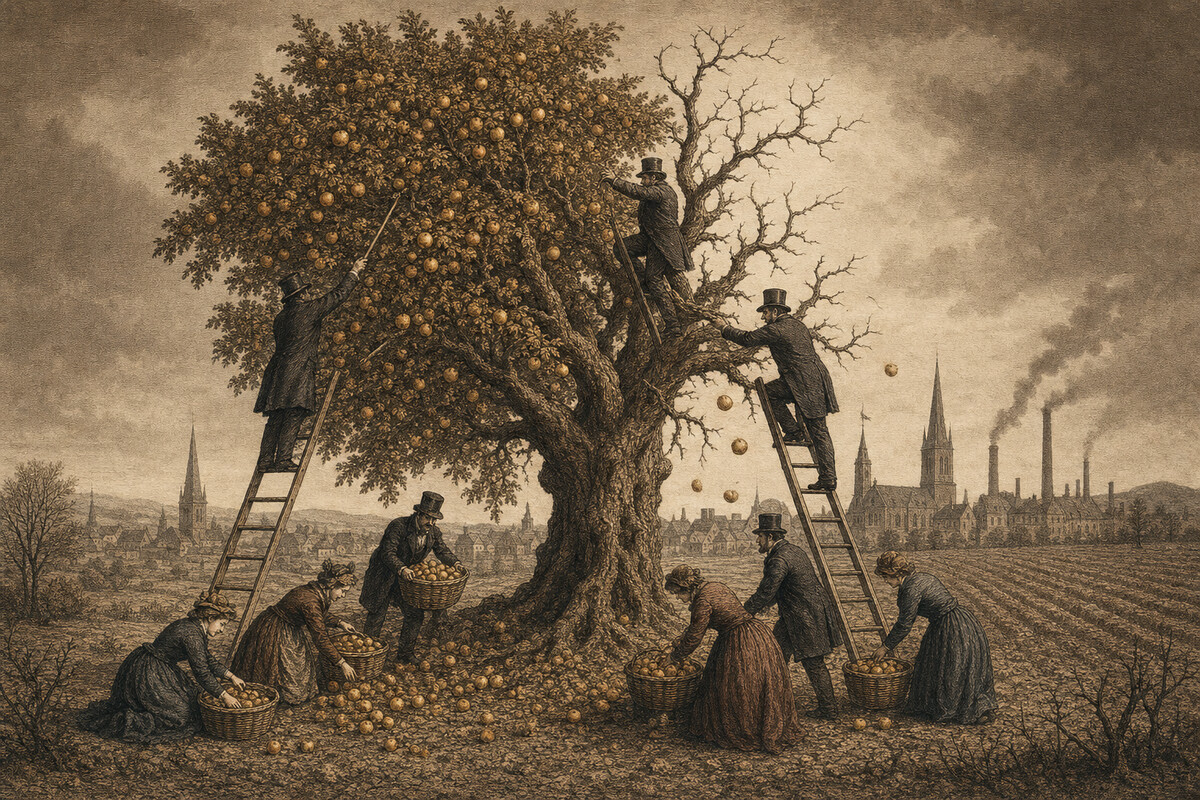
A mirror for the European voter in the second quarter of 2026. Five pieces, one diagnosis, no escape door.
The five-part series in five paragraphs
For those who have no time to read all five parts — here the core of each part in one breath.
0 · First plunder, then judge
A wage is what someone earns with what he makes. A profit is what remains after everyone has been paid. We have decided that that surplus must be skimmed off to finance the bottom and the middle. First we pluck those who feed us. Then we restrict them so they can no longer keep up with China, America and India. Then we pass judgement on them when their factories close. The circle closes itself — and we, the majority, are the executors.
I · Diagnosis — we pluck those who feed us
Five per cent of the population carries fifty per cent of the wealth. In Germany DGB demands a wealth levy of ten per cent. France and Norway have introduced exit taxes. On 12 February 2026 the Second Chamber passed a wealth tax for the super-rich with 124 votes to 26. Brussels is working on a European minimum exit tax. At the same time 16,500 millionaires have left the United Kingdom. The same pattern follows in Italy, Portugal, Spain. We are plucking the productive minority faster than it can leave.
II · Mechanics — the walls we have built
Box 3, wealth tax, exit taxes, gift schemes, succession rules. Each reasonable on its own; together a trap from which a family business, an inventor, an entrepreneur can less and less easily escape. Italy made an opening with the 24-bis flat tax (200,000 euros per year, for life) and attracted 5,500 wealthy people in two years. Lugano and Ticino do the same. The walls we built to keep the productive people inside turn out to be gates for those who want out — and prison walls for those who stay.
III · Outcome — South Africa as mirror
Between 2000 and 2020, 100,000 highly educated people left South Africa. The rand lost 75 per cent of its purchasing power. Eskom recorded 247 days of load shedding in one year. Urban water became unreliable. And the looters — those who had demanded the policy of transfer — were left behind with a country that could no longer carry them. The same mechanics are now working in Europe. When the productive leave, it is not the productive who suffer. It is those who stay behind.
IV · The political landscape — no way out within the system
A European left flank that plucks with moral certainty. A centre-right that bends along without knowing how to do otherwise. A populist right that points without building. A Brussels institution that produces documents but no products. Employers' organisations that protest technically but lose morally. The productive class no longer has political representation in Europe. Statistically, politically, culturally, morally alone. The way out lies outside Europe. For those who stay, there is no way out any more.
↓ Read the full five-part series below
Read the parts
Central piece
First plunder, then judge
The circle of injustice in which Europe destroys itself
Read this part →Part I
Diagnosis
We pluck those who feed us
Read this part →Part II
Mechanics
The walls we have built to lock up our builders
Read this part →Part III
Outcome
Why the plunderers will suffer more heavily than the plundered
Read this part →Part IV
The political landscape
Who wants what, and why Brussels does not know how to proceed
Read this part →
Jacobus van Merksteijn
Editor-in-chief of Het Open Vizier. Entrepreneur, developer of industrial and governance innovations (Carbon-Alert Ltd, TerraClean Ltd, GuardSkin Ltd). Writes about economic, ecological and political system questions from experience with the Brussels and The Hague decision-making machinery.