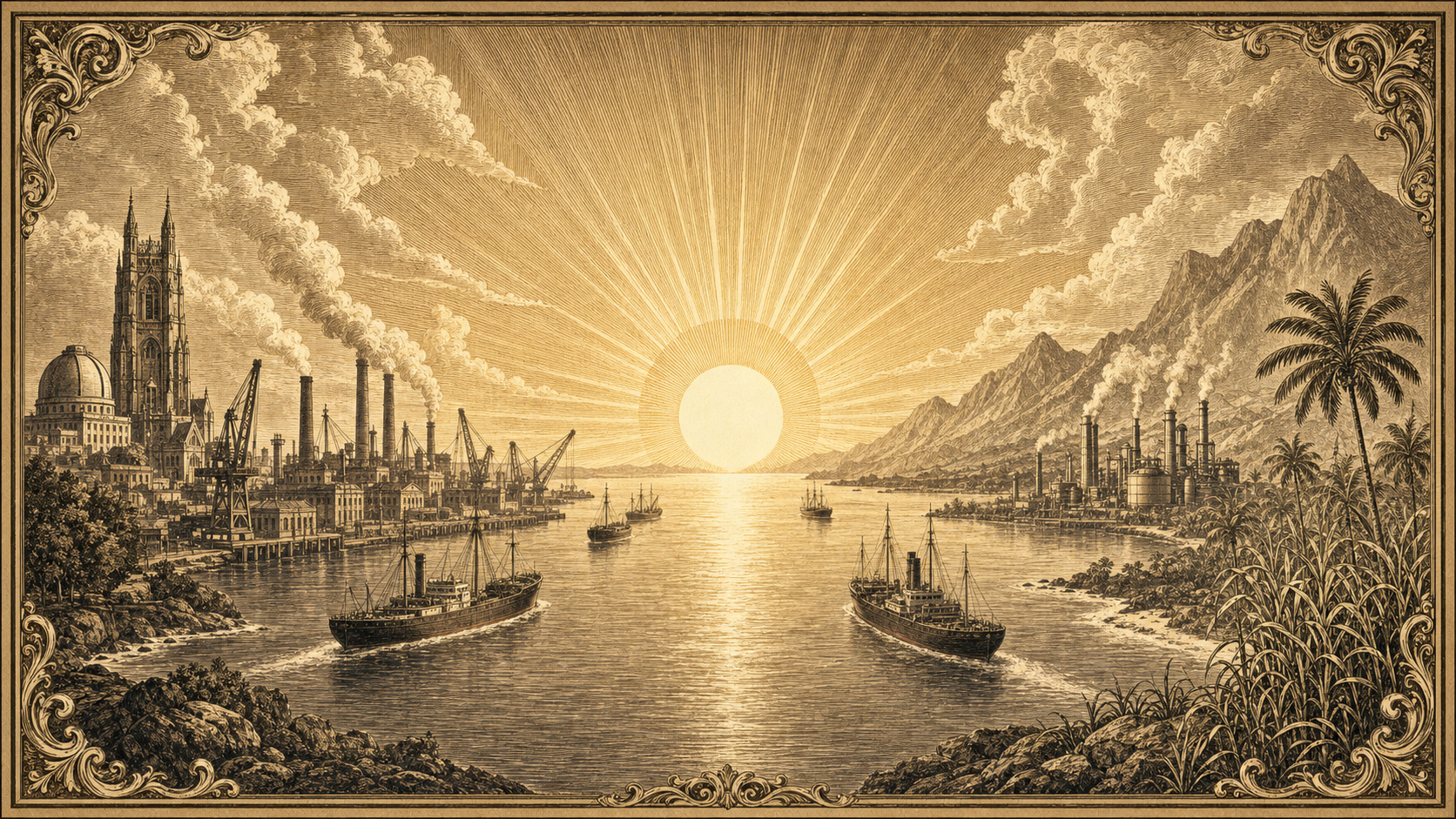
The sun is over the equator
and we stand with our blinkers on
A Socratic confrontation with the Dutch and European energy route. Five blinkers removed. One route that works. And Europe back on the leadership throne — not through domination, but through partnership.
I · The question that is not being asked
Europe’s energy transition is stalling. Not because of a lack of money. Not because of a lack of technology. Because of a lack of questions.
We ask: how do we reach 2050? We do not ask: where is the greatest amount of sunlight, and how do we harvest it there? We ask: how many wind turbines can fit in the North Sea? We do not ask: how much solar energy do we lose before the wind reaches us? We ask: how do we distribute the shortfall? We do not ask: how do we make use of the surplus?
The sun stands above the Equator. There, two to three times as much solar energy falls per square metre each year as here. There, Giant Juncao grows to one hundred tonnes of dry matter per hectare per year — eight times what a Scandinavian forest produces, four times what Iowa maize produces. And yet we are building wind turbines in the North Sea, where the sun rarely penetrates six metres of fog.
That is not a technical misunderstanding. It is a choice arising from five blinkers. We are going to remove them.
II · The five blinkers
Blinker one — the Edison paradigm
We think energy is electricity. Electricity is a form of energy, not a synonym. We cannot store the sun as electricity. We can store it as a molecule. One litre of ethanol contains 21 megajoules. One litre of Tesla battery contains 1 megajoule. Twenty times denser. And a tanker carrying oil from Rotterdam to Singapore loses less than 1 per cent. A cable transmitting electricity over 9,000 kilometres loses 30 to 50 per cent. The sun at the Equator is a molecule problem, not a cable problem.
Blinker two — chimney trauma
In 2018, a biomass storm erupted in Diemen. Vattenfall began burning wood from Estonian forests in a power station. Citizens were angry, and rightly so. Burning a forest to generate electricity is foolish. But that made every biomass route in the Netherlands suspect. That is a fallacy. Burning an Estonian forest is something entirely different from growing elephant grass on marginal land at the Equator, converting it into ethanol locally, and transporting it by tanker to Rotterdam, where it is converted into electricity in a fuel cell without a flame. Those who condemn the chimney must not condemn all biology along with it.
Blinker three — short-sighted self-interest
We think dependence on the Equator is worse than dependence on Russia or the Middle East. Until 2022, 35 per cent of our oil came from Russia. Ninety per cent of our rare earth metals comes from China. Our uranium comes from Niger and Kazakhstan. We depend on suppliers who can use their monopolies against us. The Equator is not a monopoly. Brazil, Mozambique, Indonesia, Ghana, Suriname — ten countries, no cartel, no geopolitical blackmail. And a biogenic molecule that regrows every season is not a scarce raw material. Anyone afraid of dependence on the Equator must confront our existing dependencies.
Blinker four — wind as a new source
Wind is not a new energy source. Wind is solar energy of which 98 to 99 per cent has already been lost before we attempt to capture it. The sun warms the air. Differences in temperature create differences in pressure. Differences in pressure move air. One hundred units of sunlight become one to two units of wind. Anyone building wind turbines is harvesting a second-order effect of solar energy. Anyone harvesting that same sun directly at the Equator through photosynthesis obtains fifty to one hundred times more. This is not an ethical choice. It is a first-order versus second-order choice.
Blinker five — “it will not be my problem”
This is the most dangerous blinker, because it is honest. Those currently sitting in parliament are, on average, between 45 and 60 years old. Their horizon of responsibility extends to approximately 2040. Anyone who is fifteen today will still be alive in 2070 and will have to inhabit the world we are building now. A father sitting on the patio and saying “it will not be my problem” has betrayed his own child. That is the honest description of much of European politics today.
III · The route that works
Reject the blinkers and the route becomes clear. It is not a revolution. It is not technology that still needs to be invented. All the components exist and operate at laboratory or pilot scale. What is missing is the decision.
Step one — harvest where the sun is
On marginal land at the Equator — land that cannot produce food because of erosion or poor irrigation — we grow Giant Juncao and related high-yield crops. The figures speak for themselves.
| Crop | Location | Tonnes DM / ha / yr | CO₂ capture |
|---|---|---|---|
| Beech (production forest) | Netherlands | 4 | ~7 tonnes/ha/yr |
| Maize (food) | Iowa, USA | 12 | ~22 tonnes/ha/yr |
| Elephant grass (Miscanthus) | Poland | 20 | ~37 tonnes/ha/yr |
| Sugar cane | Brazil | 35 | ~64 tonnes/ha/yr |
| Giant Juncao | Mozambique | 95 – 100 + 25 roots | ~37 tonnes permanent |
Juncao’s root mass is not the greatest energy gain, but it is decisive in climate terms. Twenty-five tonnes of roots down to a depth of two metres means that a significant proportion of the bound carbon remains permanently in the soil. The highlands of Mozambique planted with Juncao do what Flemish and Estonian forests do not — actively remove carbon from the atmosphere and store it permanently.
Step two — produce an intermediate liquid
Transporting raw biomass by sea is foolish. It is mostly water and fibre. The correct intermediate step is decentralised densification at the Equator itself. Two technologies are ready.
Fast pyrolysis — biomass is converted at 500°C in the absence of oxygen into biosyncrude. Approximately five to seven times the energy density of raw biomass, with a 35 per cent mass yield.
Fermentation into ethanol — biomass is converted enzymatically and biologically into ethanol. 21 MJ per litre, liquid and transportable in conventional tankers.
Both liquids are transported by VLCC tanker to a European port. The CO₂ emissions from the transport itself are less than 5 per cent of the chemical energy being transported.
Step three — Europe as refinery and scientific heart
Upon arrival in Rotterdam, Delfzijl, Antwerp, Hamburg or Marseille, the biosyncrude or ethanol is converted into the end products Europe is seeking: sustainable aviation fuel via Fischer-Tropsch and Alcohol-to-Jet, a diesel substitute for shipping, chemical building blocks for the petrochemical industry without Russian or Saudi oil, and direct conversion into electricity through fuel cells operating at room temperature.
This is not science fiction. The KIT Bioliq facility in Karlsruhe has been operating since 2014. INERATEC in Frankfurt has been producing commercial PtL-SAF since 2024. CARE-O-SENE achieved a catalyst milestone in October 2024, with an 80 per cent kerosene yield from syngas. ASTM certification for ethanol-derived SAF was granted as early as 2018.
Step four — close the loop
Where we made the chimney mistake in 2018 was in thinking that burning biomass was the final step. Carbon-Alert and related research programmes are now developing the subsequent step: the direct chemical conversion of bioliquid into electricity through fuel cells operating at room temperature, using polyoxometalate as a catalyst and without platinum. Theoretically, 97 per cent of the chemical energy becomes work — above the Carnot limit of any combustion engine.
The cycle: sunlight at the Equator is converted by Juncao into biomass (3 to 5 per cent), the biomass is converted into ethanol (50 per cent), the ethanol is converted into electricity (60 to 80 per cent), and the electricity powers every industry from Rotterdam to Rome. Net efficiency from sun to useful work: around 1.3 per cent — almost twice as good as solar energy converted via Brayton turbines running on natural gas. And the entire chain is biogenic.
IV · Europe leading again, in partnership
In the nineteenth and twentieth centuries, Europe was the engine of the Industrial Revolution. Watt’s steam engine from Scotland. Diesel’s engine from Bavaria. Bell’s telephone from Scotland. Pasteur and Lavoisier from France. Marconi from Italy. We built the world in which every other nation could pursue its industrialisation.
In the twenty-first century, we have lost that position. Semiconductors have moved to Taiwan and South Korea. Automotive electrification has moved to China. Smartphone software has moved to California. We became a museum with good education and beautiful cities, but no new technologies of our own.
The Equatorial biomass route gives Europe back its industrial core. Not through domination — the Equatorial countries are not colonies. Rather, through partnership in which Europe applies its comparative advantages: advanced chemistry, maritime expertise, scientific education, stringent regulation and machine-building.
For the Equatorial countries, this is finally an industrial partnership rather than the exploitation of raw materials. The countries do not merely supply raw material; they supply biomass that has already been densified locally into biosyncrude — a semi-finished product worth ten to thirty times more than the raw biomass. Employment, export revenue, technology transfer. Both sides benefit.
V · What we must do immediately
One — an EU–Equator Energy Agreement. Negotiate a multi-year framework agreement with ten Equatorial countries (Brazil, Indonesia, Mozambique, Tanzania, Ghana, Colombia, Ecuador, Peru, Malaysia, Suriname) for biomass trade under clear sustainability and certification requirements. This is not development aid. It is a trade agreement between equal partners.
Two — a Rotterdam Bioliq Hub. Build an industrial cluster for biosyncrude refining alongside the petrochemical industry on the Maasvlakte. Five to ten billion euros in investment, fifty to one hundred billion euros in annual turnover at full capacity. No subsidy needed — only the right political permit.
Three — patent protection for European breakthroughs. Glasgow (Cronin), Groningen (Feringa), Karlsruhe (Bioliq), Wageningen — European research groups are working on level-3 and level-4 technologies. A fast track for climate-critical patents, with applications processed within 12 months, would restore Europe’s IP position vis-à-vis China and the United States.
Four — education and youth participation. Those who will build the future energy transition are fifteen or twenty years old today. A European Youth Energy Council with a formal advisory role to the Commission and the Council would ensure that decisions about 2050 are made with input from the people who will actually be at the helm in 2050.
The sun is over the equator. It is time we looked that way.
Europe can once again become the place where industry and science come together to build something the world has never seen. Not through copper on the seabed, not through wind turbines that stand idle for half the year, not through biomass from Flemish forests, not through nuclear power stations that no young person wants to work in anymore. But by taking the equator seriously, taking the sun seriously, and finally recognising biomass as an energy intermediary — the solar route that it is.
— Het Open Vizier · June 2026
Read on
Activists build continents
The technological route is half the story. Those who build it are the other half. Drive is looking for ground. What chafes here can build elsewhere. An open invitation to organisations that want to turn their vision into reality.