The Brussels Consequences Map asked one question of twenty European scenarios: what will cumulative EU policy cost you by 2030? The Swiss version asks the same question of fifteen Swiss scenarios, but the mechanisms are different. Switzerland has its own policy stack — and on 2 March 2026 the Federal Council signed Bilaterals III in Brussels, the most important treaty Bern has ratified since 1999.
This map plots fifteen lives and businesses against ten federal mechanisms that are in force or being phased out in 2026. The values are third-order effects — meaning that each policy is read together with the others, not in isolation. Direct costs, behavioural response, secondary equilibrium. A figure you can read.
What the map shows
Read horizontally: each row is one Swiss scenario, from Hans, the retired Zurich resident, to a multinational headquartered in Zug. Read vertically: each column is one federal mechanism, from AHV/BVG reform via Bilaterals III to the SNB’s interest-rate environment. The rightmost column shows an alternative reference — what the same scenario would produce under a different federal policy direction.
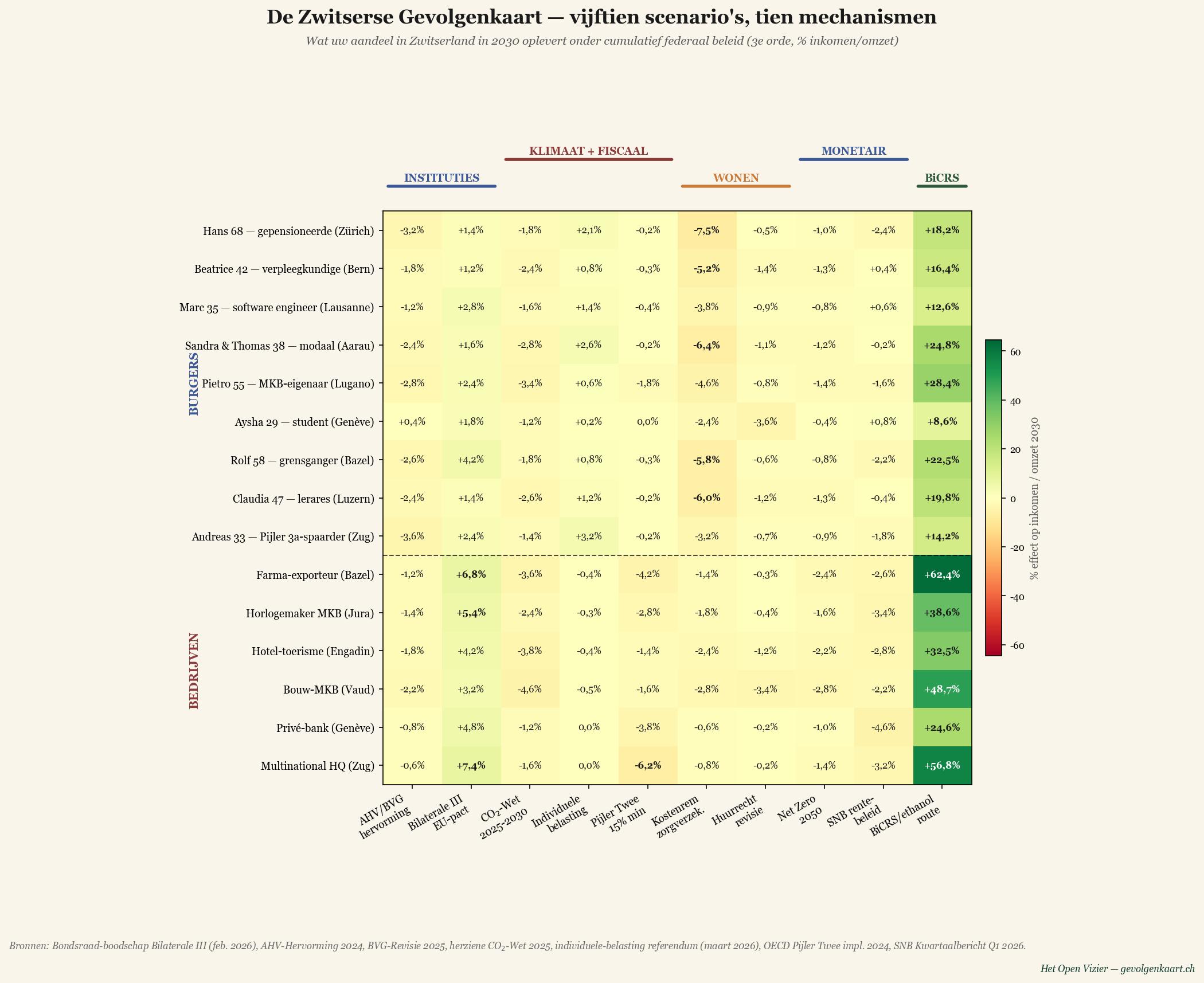
The ten mechanisms
Social + institutions
- AHV/BVG reform — the 2024 AHV revision and the 2025 BVG update, with higher contributions and adjusted conversion rates for occupational pensions.
- Bilaterals III (EU pact) — the Bilaterals III package signed in Brussels on 2 March 2026, restoring full market access and dynamic alignment in seven core areas.
Climate + fiscal
- CO₂ Act 2025–2030 — the revised federal CO₂ Act, with an increase in the CHF/tonne levy on fossil fuels and the introduction of border adjustments.
- Individual taxation — the 2026 referendum decision to abolish joint spousal taxation at federal, cantonal and municipal level.
- Pillar Two 15% minimum — Switzerland’s domestic top-up tax for large multinationals, introduced in 2024 in line with the OECD agreement.
Housing + healthcare
- Cost cap (health insurance) — the federal cost-containment initiative limiting premium growth, with structural consequences for hospitals and supplementary insurers.
- Rent law revision — the federal revision of tenancy law tightening rent controls in shortage zones.
Climate + monetary
- Net Zero 2050 — the federal Climate Protection Act ratified by referendum in 2023, with binding sectoral targets.
- SNB monetary policy — the position of the Swiss National Bank regarding negative interest rates, franc strength and capital flows.
BiCRS/ethanol route
- BiCRS/ethanol route — what the same scenarios would produce if the CO₂ Act and Net Zero routes were replaced by the BiCRS strategy (biomass injection + ethanol as a motor fuel). Switzerland’s dependence on German and Italian industrial supply chains is eased because the €40/tonne CO₂ model price closes the entire cascade. Pharmaceuticals, watches and heavy industry benefit disproportionately; pensioners and construction benefit moderately through lower energy costs.
The fifteen scenarios
Citizens (nine)
Hans, 68 — pensioner (Zurich)
Dependent on AHV + BVG, modest Pillar 3a savings, owner-occupier. The cost cap hits him hardest because supplementary insurance is repriced.
Beatrice, 42 — nurse (Bern)
Cantonal hospital employee, single, tenant. The CO₂ Act + cost cap reinforce each other; Bilaterals III provides a small boost.
Marc, 35 — software engineer (Lausanne)
Above-average salary, mobile, partial 3a maximiser. Bilaterals III is a clear plus; AHV reform is a moderate drag.
Sandra & Thomas, 38 — middle-income earners (Aarau)
Dual earners, two children, mortgage. The cost cap + CO₂ + AHV stack up to a meaningful net loss.
Pietro, 55 — SME owner (Lugano)
Small business in Ticino, with cross-border exposure. The CO₂ Act bites; Bilaterals III is the relief valve.
Aysha, 29 — student (Geneva)
Doctoral student, partly supported by a rent subsidy. The rent law revision is the largest direct effect.
Rolf, 58 — cross-border commuter (Basel)
Cross-border commuter from Lörrach. Bilaterals III is decisive; the cost cap is the second factor.
Claudia, 47 — teacher (Lucerne)
Cantonal public servant. The cost cap + CO₂ + AHV reinforce one another. Steady improvement under the alternative.
Andreas, 33 — Pillar 3a saver (Zug)
Maximum 3a contributions, employed in tech. Individual taxation removes the joint-couple penalty; AHV reform offsets it.
Businesses (six)
Pharmaceutical exporter (Basel)
Large pharmaceutical company, mainly EU + US revenue. Bilaterals III is a major plus; Pillar Two and Net Zero reinforce each other.
SME watchmaker (Jura)
Mid-market watches, EU + Asia. Bilaterals III restores ease of importing and exporting; SNB interest rates are the biggest drag.
Tourism hotel (Engadin)
Alpine resort, mainly EU guests. Bilaterals III brings relief through easier movement of people.
Construction SME (Vaud)
Cantonal builder, tight labour market. The CO₂ Act + rent law revision squeeze margins.
Private bank (Geneva)
Asset management. SNB monetary policy + Pillar Two are the biggest factors; Bilaterals III is a modest plus.
Multinational HQ (Zug)
European HQ of a US/Asian multinational. Pillar Two is costly; Bilaterals III is the strongest counterweight.
How to read the figures
The figures are not forecasts. They are derived from federal impact assessments, AHV/BVG actuarial dossiers, OECD Pillar Two implementation tracking, and the Federal Council’s message on Bilaterals III (February 2026). They are presented as though each mechanism reaches its 2030 end state and stacks with the others. In practice, individual results will vary. The map is a structure, not a forecast.
What the map does make clear is which scenarios are net winners and which are net losers under cumulative Swiss federal policy as it stands in mid-2026 — and what escape route the BiCRS/ethanol route offers: a consistently positive effect across all fifteen scenarios, from +8% for the student to +62% for the pharmaceutical exporter in Basel.
The Brussels Consequences Map showed twenty European scenarios losing more than they could absorb. The Swiss version shows a smaller country with a different policy stack — but where the same stacking logic applies. Bilaterals III is the first positive lever; the BiCRS/ethanol route is the second, and it works for everyone, not just cross-border commuters and exporters. Read the final column.
What comes next
This Swiss Consequences Map is the first in a series extending beyond the EU. A Singaporean Consequences Map follows in the same publication (published simultaneously). The methodology — fifteen to twenty scenarios × ten to twelve mechanisms × third-order stacking — travels well to any jurisdiction where the policy stack is sufficiently documented and stable to model.
The aim is not to map every country. The aim is to make the cumulative consequences of policy visible, scenario by scenario, before the elections that decide them.