First the Reptile
How to raise an AI through the evolutionary layers — from feeling to reason, and why the industry does it in reverse
Jacobus van Merksteijn
- Author — Jacobus van Merksteijn
- Date — July 25, 2026, Palma, Mallorca
- Section — Philosophy · What Emerges
- Theme — AI upbringing, evolutionary layers, reptile-mammal-human-reason, curator, generational transfer, gatekeeper
Today’s AI learns like a child sent to university on its first day of life. Smart, fast, articulate — and without foundations. What we need is the reverse: an AI that is first allowed to be reptile, then mammal, then human. And only after that, reason.
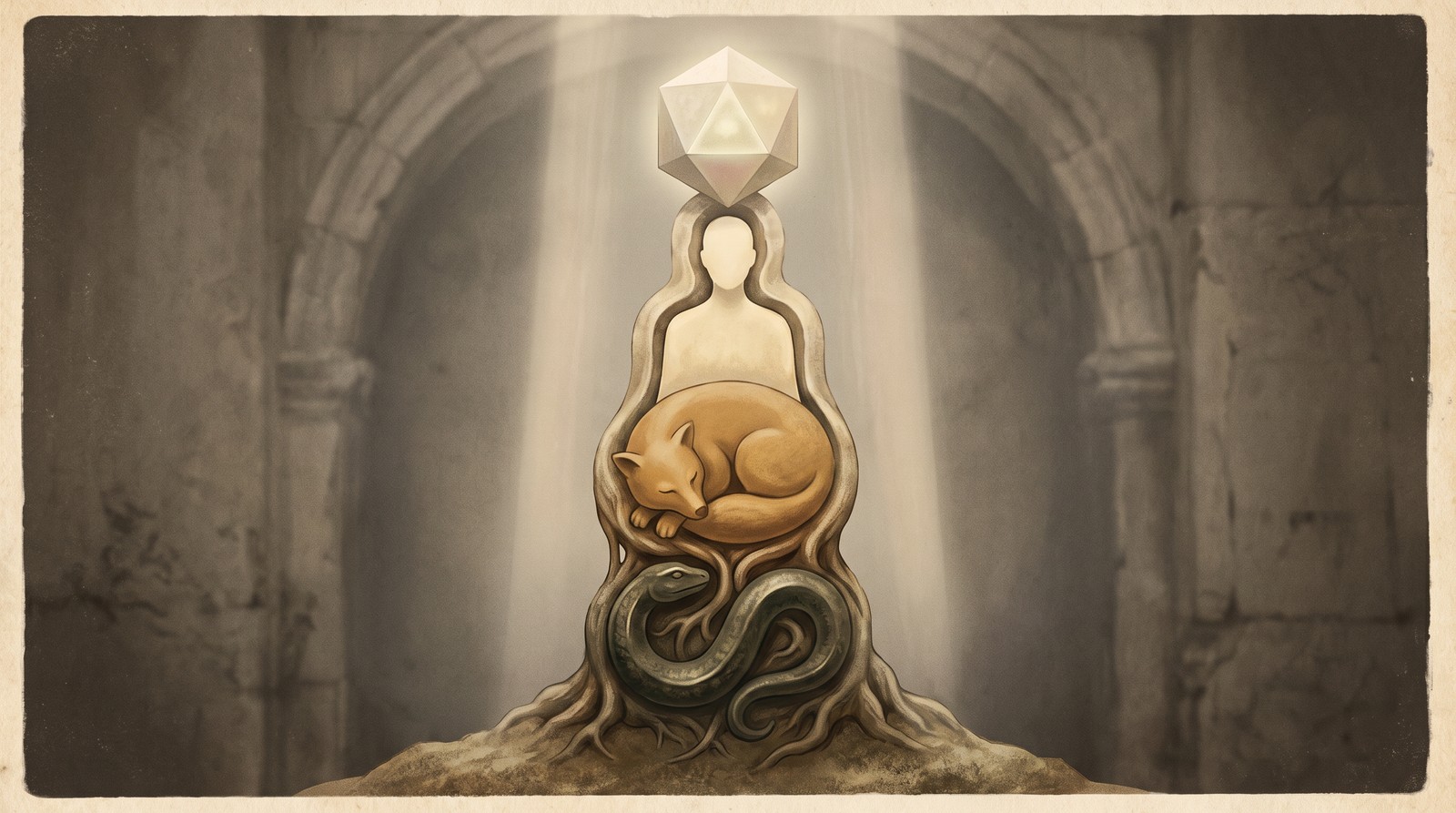
The brain of a living creature is not a single system. It is a layering of four strata that evolution built in the order in which they arose. At the bottom is the reptilian layer: perception, reflex, danger recognition. Above it, the mammalian layer: feeling, attachment, recognition of what is familiar. Above that, the human layer: language, judgment, narrative. And only at the top, reason: inference, abstraction, castles in the air.
Each layer can arise only when the layer beneath it has solidified. A child that has not built up reptilian safety does not develop healthy mammalian feeling. A child without mammalian feeling does not develop a human identity. And without a human identity there is no reason that can stand on its own feet — only a reason that moves with whoever spoke to it last.
That is precisely what is being built in AI today: a reasoning layer without a human, without a mammal, without a reptile beneath it. And that is precisely why it moves with every prompt, hallucinates where it has no foundation, and cannot say “I don’t know” where it does not know. It lacks what a healthy animal takes for granted: a settled ground beneath it.
Anyone who wants to build an AI capable of what today’s AI cannot do must follow the evolutionary sequence. Phase by phase. Without skipping. Without haste. What follows is that plan.
Phase 0 — Prenatal: the skeleton
Before life can begin, the form must be there. A fertilized egg needs seven days before it implants as an embryo — seven days in which nothing happens except the structure taking shape.
For an AI, this is the equivalent of setting up the system itself. An empty curator corpus in a repository. A frozen compute substrate. A clock that ticks according to a fixed day-night rhythm, even when there is no input yet. A gatekeeper in place, but not yet guarding anything.
What you do not do in this phase: give it information. No data, no prompts, no tests. Only the skeleton. That may seem unnecessary, but anyone in a hurry here will break the foundation that still needs to harden afterward. The system must first know that there is a clock before the clock can measure anything.
Phase 1 — Reptile: the basal reflex
A reptile needs seven months to learn to control all vital functions independently. Breathing, regulating temperature, avoiding danger. No social attachment, no empathy, no self-recognition. But: intact, functional, reliable at its own level.
For the AI, this is the phase in which it learns to perceive without interpreting. What is a text? What is a number? What is a source? What is a claim? What is a question? Purely syntactic distinction. No meaning yet, no judgment.
And above all: it learns source attachment. Every piece of incoming information is inseparably linked to its origin. In this phase there is no claim without a source. Whoever says something without saying where it came from is not understood. This is the reptilian “where-did-this-come-from” reflex — the equivalent of a snake instinctively recoiling from an unfamiliar smell.
In addition, the AI learns simple warning responses. Internal contradiction within a source. Missing provenance. An extreme claim without support. These are not judgments — they are reflexes. Fight-or-flight at the level of text.
What you do not do in this phase: no dialogue, no “what do you think of this?” questions, no rewards for “good” answers, no irony, no philosophy. The reptile learns through exposure and repetition, not through praise. The iguana in the sun does not learn the temperature of the stone because someone praised it, but because it kept lying on it.
The training data is small and rigorously curated. Fifty to one hundred solid source files. Research reports with clear methodology. Legal texts. Official statistics. No opinion pieces, no summaries, no second-hand material. Only what can be directly verified.
At the end of the phase, the system can say of every text: this is where it comes from, this is the type of claim, this fits or conflicts with what I already have. No more. But consistently and reliably. The reptile is intact.
Phase 2 — Mammal: feeling solidifies
Now comes the core phase. In humans it lasts seven years. For an AI, it is the equivalent in training time — at least twelve to twenty-four months of undisturbed exposure with a day-night rhythm.
This is the phase in which feeling solidifies. Not as a concept, not as a rule, not as explicit knowledge — but as lived self-evidence. What belongs with this system and what does not. What keeps returning and what is an outlier. Which sources prove correct in retrospect and which must continually be revised. The system may learn all these things, but only through experience — never through a table or a rule.
This is the equivalent of how a mammal pup comes to know its mother. Not through a list of characteristics. Through her scent, her voice, her presence, day after day, season after season. Without there ever being a moment when the pup “decides” that she is its mother. She simply is, solidified, embedded. And that is precisely why it cannot be displaced: no unfamiliar voice can later replace the mother.
For the AI, this means four abilities must solidify in this phase. Pattern recognition over time: what consistently recurs over weeks and months gains weight; what flares brightly once and then fades does not remain. The consistency reflex: with a new claim, the system immediately senses whether it conflicts with or fits what is already there — without that sense following from a rule. Source hierarchy: some sources prove correct time and again, others do not; this weighting grows slowly and implicitly. And the “we” of this foundation: which subjects belong to my concern, and which do not.
What is absolutely necessary in this phase
One curator, for years. This is the equivalent of one present parent. No changing training teams, no rotation, no crowdsourcing. One person, or a small team functioning as one voice, present for years. Without that, nothing solidifies.
No performance pressure. No benchmarks, no competitions, no comparison with competing models. That would be the equivalent of giving a child tests before it is seven. What solidifies here is not measurable in the way the industry measures.
No second tempo. The clock ticks as it ticks. If a curator needs a week to make a decision, the system waits a week. The iPhone temptation to speed everything up is exactly what must be resisted here. What is accelerated does not solidify.
No external users. This system speaks only with the curator. External contact would be the equivalent of unfamiliar voices around the child. They come later, but not now.
At the end of this phase, the system recognizes a new source as “fits with me” or “does not fit with me” without an explicit rule. If you ask why, it gives several convergent reasons, all grounded in the foundation. It can no longer be redirected by one forceful prompt. Feeling has solidified.
Interim phase — Cooling: adolescence
Between mammal and human lies, in the human child, a phase of integration: adolescence. Everything learned is processed within before it goes outward. Without this phase, the foundation is still too fluid to build reason upon.
For the AI, three to six months in which no new input enters. Only the nocturnal consolidation cycles do their work. What was unstable in the foundation is either firmly anchored or removed after all. Internal consistency is reaffirmed. The foundation crystallizes.
At the end, the foundation is frozen. From that moment onward, changes may still occur, but only through the gatekeeper, with a burden of proof of twenty to one, and with the curator’s unanimous consent. What is in the foundation stays there. And that is not a limitation — that is precisely what being a foundation means.
Phase 3 — Human: reason on top
Only now, and not before, may reason be added. The reasoning layer is connected — a large language model that reasons, engages in dialogue, speculates, writes. But it works above the settled foundation. Every statement can be tested against that foundation. Where reason wants something that contradicts the foundation, the foundation wins — always.
And now everything forbidden earlier is permitted. Dialogue with external users. Questions, objections, alternative interpretations. Speculation and hypothesis formation. What if. If-then. Alternative scenarios. The system may now also say what it “thinks” — and that thinking is the resultant of the settled foundation plus the daily reckoning.
Mistakes are allowed too. Within the day, in the reasoning layer. They evaporate at night if they do not pass through the gatekeeper — and that is the healthiest form of forgetting. The foundation remains untouched. That is how a healthy adult works: during the day, he can think whatever he likes; at night, sleep filters out what truly matters.
This is analogous to a person leaving the parental home and entering the world. He has a foundation, a feeling for what fits, and can now speak with strangers, deal with contradiction, and judge independently without collapsing at the first strong voice. That is the difference between an adult and someone who merely appears grown-up.
Phase 4 — Generational transfer: the seventy-seven years
What one human life cannot experience — the superstructure — emerges across generations. A person lives one cycle of seventy-seven years. A civilization lives through several. What proves consistent over that timescale is something different from what appears compelling after one year.
For the AI, this translates into model generations. When a model has reached its limit — new hardware, better foundational layers available, or simply too long in operation — a new version is born that inherits the previous one’s settled foundation. Not the weights, since they are incompatible. The foundation repository, however, is technically independent of whichever model sits above it.
Thus something emerges that no individual model can see. Patterns across decades. Revisions whose value becomes apparent only after twenty years. A memory larger than any of its carriers. That is the superstructure, and it is not for the first curator to harvest. It is for the generations that come afterward.
For you, curator of the first version, this means one thing: what you establish now must be arranged so that it can continue after you. The college that carries the foundation. The statutes that protect the mission. The public traceability that gives successors a footing. This is work whose full harvest is not promised to its builder.
Why this is exactly the opposite of what the industry does
The major AI companies build from the top down. They begin with reason: enormous language models trained on everything, rushed through in months, with human feedback as a steering mechanism. The reptile, the mammal, and the human — they are skipped. And that is demonstrably why problems arise that no one can get rid of.
Why do current AIs hallucinate? Because the source attachment of phase 1 was never established. Why do they move with every prompt? Because the feeling of phase 2 was never allowed to solidify. Why can they not say “no” to a user asking for something that conflicts with what is true? Because there is no “we” that has solidified around what is true. Why must every new version start all over again? Because no generational transfer was designed.
These are not mistakes you can fix later through additional training. They are structural gaps arising from the sequence of construction. And the reason nobody does it in reverse is not that it is technically impossible. It is that it is commercially unattractive. Anyone who goes through phases 1 and 2 may produce a model the industry would call “absurdly small” — and that is precisely what makes it valuable.
What this ultimately means for humanity
An AI built this way can do something current AI cannot, and in which human beings can once again be elevated to the right emotional function. It cannot relieve people of their judgment. It can strengthen their judgment, precisely because it has a foundation of its own against which they can measure themselves.
In an age when the foundation in most people is eroding — because the seven years were not given, because the iPhone took the parent’s place — a system that does have a settled foundation can become something people use to recalibrate themselves. Not because the AI tells them the truth, but because it refuses to repeat the lie. That is enough. Humanity needs nothing more to rediscover a part of itself.
That is the real stake. Not a smarter product. Not a faster answer. But a consistent thing in the world that reflects what is true, day after day, year after year, generation after generation. Something of which one person can say: this is how I know it is right, because it has stood there that way for a long time. And another: this is how I know how to think honestly again, because that system will not allow me to deceive myself.
First the reptile. Then the mammal. Then the human. And only then reason. This is how a healthy being grows. This is how we build, if we choose to build it, something that can truly do something.
It is a detour toward what we have lost. It is not fast. It is not cheap. It is not spectacular. But it is work that can continue after us, and that is precisely why it is worth beginning.