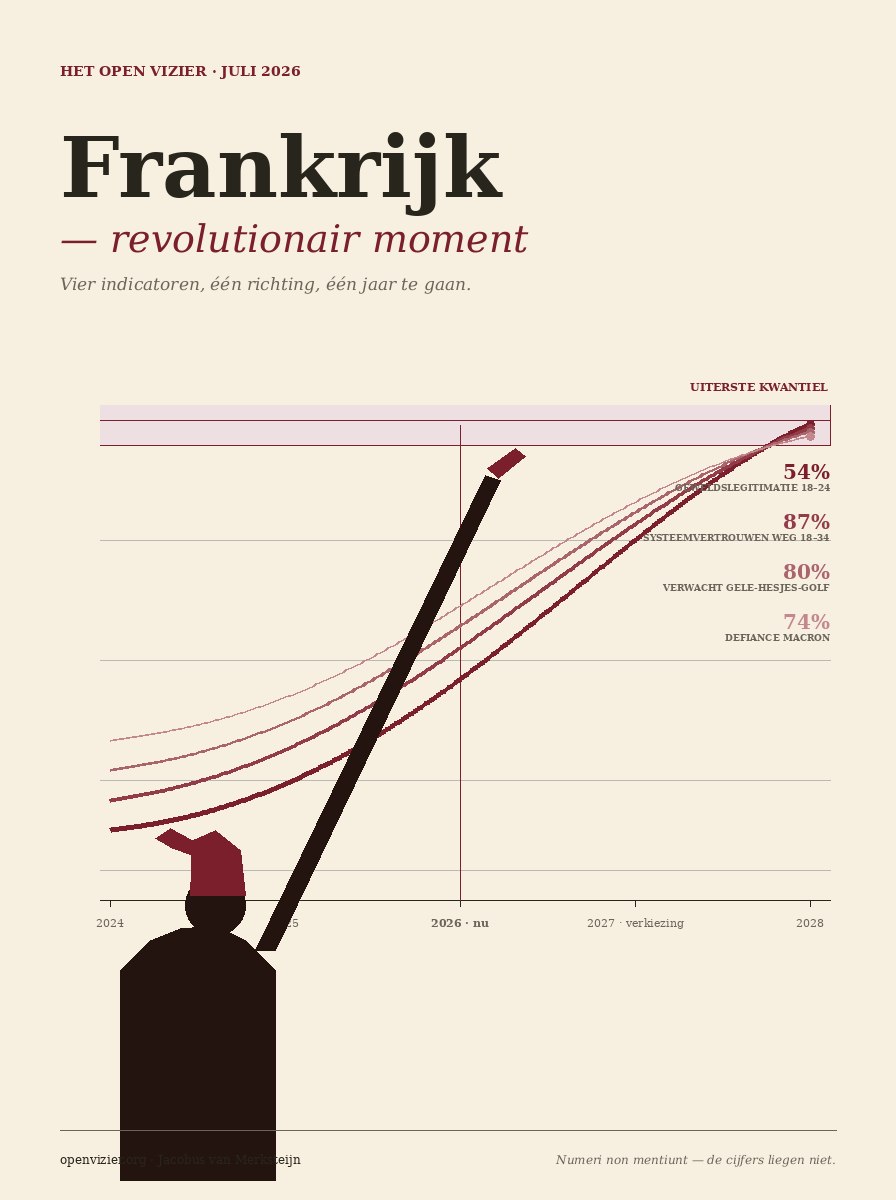
France — revolutionary moment
Four classic conditions have been fulfilled simultaneously. Plus a generation that considers violence legitimate, plus a physical aggression infrastructure that is already operational.
Jacobus van Merksteijn
- Ifop / Fondation Jean-Jaurès / MAIF (June 2026) — La passion militante
- Ifop / Club Landoy (June 2026) — pensions survey
- Odoxa / Franceinfo / Le Figaro (July 2026)
- Ipsos barometer (July 2026)
- Le Monde · Fondapol · LCP Assemblée nationale · Challenges · Arab News / AFP · Aplutsoc · Le Journal Toulousain
France is not heading towards a revolutionary moment. France is already in one — it is waiting for its trigger and its form.
1. What the polls say
Four independent French polls from June–July 2026 are simultaneously pointing towards their extreme quantile. This is no longer a “warning sign” — it is the condition itself.
- Legitimisation of violence among young people. 54% of militant 18–24-year-olds believe that “one must sometimes use violence to push ideas through”. Among militants over 65, the figure is just 12%. Ifop / Fondation Jean-Jaurès / MAIF.
- Trust in the system. 72% no longer trust the system to provide a decent pension; the figure is 87% among 18–34-year-olds. Ifop / Club Landoy.
- Expectation of a social wave. Eight in ten French people expect a new Yellow Vest-like movement if fuel prices rise further. Odoxa.
- Presidential defiance. Macron is on 74% unfavourable opinions — a historic low point shortly before the 2027 election. Ipsos barometer.
2. The mobilisation infrastructure is ready
“Bloquons tout” on 10 September 2025 was leaderless, organised digitally and without trade-union backing — yet it still forced the deployment of 80,000 police officers. For autumn 2026, this pattern is being repeated, now with trade-union support.
- Preparations for Bloquons Tout Île-de-France have been under way since July 2026, with the explicit ambition of “unsettling those in power as in September 2025”. Aplutsoc.
- 18 September 2026: inter-union mobilisation day; up to 900,000 demonstrators expected; 80,000 police officers deployed. Le Journal Toulousain.
- 1 May 2026: according to organisers, more than 1 million demonstrators in more than 200 cities.
3. Four classic conditions — all present
Historical sociologists (Skocpol, Tilly, Goldstone) identify four simultaneous conditions that define a revolutionary situation. All four are now present in France.
| Condition | France in 2026 |
|---|---|
| Fiscal state crisis | Fitch and S&P downgrades; the 2026 budget kept afloat only by the threat of censorship from the PS. |
| Paralysed political system | Three blocs since June 2024; three prime ministers in one year; Lecornu II narrowly survives the no-confidence vote of 6 July 2026 (132 in favour, 289 required). |
| Elite division | Zucman tax demanded by its own left-wing flank and rejected by both the Senate and the Assemblée; Piketty versus Macron; the De Courson commission itself criticises the tax authorities. |
| Mobilised mass with a belief in the legitimacy of violence | 54% of young people pro-violence; Bloquons tout 2.0; inter-union mobilisation on 18 September. |
The cooling of opinion on the fiscal route is not a counterforce — it is a shift in method.
4. Where the aggression is landing in policy
- Commission on speculative funds (Assemblée, unanimously on 16 June 2026): ban on majority takeovers of strategic enterprises, a blacklist of tax havens, and mandatory transparency regarding ultimate beneficial owners.
- Commission on the highest fortunes (De Courson report, 8 July 2026): eleven recommendations, explicitly stating that the tax authorities cannot grasp the true wealth of the richest fortunes.
- LFI rhetoric in summer 2026: Panot (revoking the nationality of departing millionaires), Mélenchon (“46,000 ultra-rich people who pay not a euro in tax”), Piketty (referendum on a €800 billion solidarity tax).
5. The apparent cooling is a shift
Odoxa July 2026: support for “tax the rich more heavily to close the deficit” falls from 80% (2024) to 68% (2026), most sharply among 18–34-year-olds (from 73–78% to 55–57%). Headline in Challenges/Odoxa: “hatred of the rich is losing steam in France”.
Wrong reading: hatred is declining. The correct reading: the same age group that is abandoning the fiscal route is also the group in which 54% now consider violence legitimate. The 12 percentage points lost by taxation as a solution are not translating into resignation. They are going towards other methods.
6. Likely scenarios (July 2026 – 2027)
| Scenario | Form | Trigger |
|---|---|---|
| 1 · September 2026 as the first release of pressure | Bloquons tout 2.0 + inter-union mobilisation on 18 September + budget debate + another downgrade. | 2026 budget, fuel price, rating downgrade |
| 2 · Expansion of physical aggression beyond crypto | H2 2026 – H1 2027. The first high-profile case outside crypto makes the pattern public. | First incident outside the crypto sector |
| 3 · 2027 electoral crisis | RN wins or comes very close. Elites refuse to legitimise it. Post-election escalation is possible. | 2027 result, court rulings |
| 4 · Targeted intimidation of individuals | Additional to 1 or 3. Industrialists, former ministers and prominent entrepreneurs as “symbols of wealth”. | Symbolic figure caught in a media storm |
Conclusion
The usual scientific caution — “correlation is not prediction” — is no longer appropriate once four or five independent indicators are simultaneously moving in the same direction, towards their extreme quantile.
What the sources do not establish is the timing and the precise form: a classic revolution, permanent disruption à la Yellow Vests, or violent polarisation without a seizure of power. But the fact that the basic conditions for a revolutionary moment have been fulfilled is no longer a cautious proposition, on the basis of the data from June–July 2026.