Vote-winning
How Dutch government eats its own foundation
Jacobus van Merksteijn
- Author — Jacobus van Merksteijn
- Date — 23 July 2026 · Palma, Mallorca
- Section — What is emerging · Capital-flight analysis
- Basis — DNB half-yearly figures · EU Tax Observatory · CPB · Malta squeeze
- Sources — DNB, EU Tax Observatory, ESB (Leenders 2023), Alstadsæter/Johannesen/Zucman, Henley & Partners, Tax Justice Network, MFSA, IMF Malta Article IV 2025
The figures. Since 2015 the Netherlands has lost about €225 billion in wealth to places outside the European Union. In the past five years alone €130 billion. That is 65% of the Dutch budget deficit for 2025. Every Kamerbrief on box 2 or box 3 produces a measurable spike in bank balances held outside the Netherlands. The government wins votes on announcements; the country loses its tax base.
The figures
The hard measurement series comes from De Nederlandsche Bank: foreign bank balances of Dutch households doubled in two years. From €7.3 bn in June 2022 to more than €20 bn in June 2025. In addition, the EU Tax Observatory measures that Dutch offshore wealth in tax havens rose from $73 bn in 2015 to $128 bn in 2024. Dutch real-estate investments through offshore companies grew from €3.8 bn (2013) to €21.9 bn (2023).
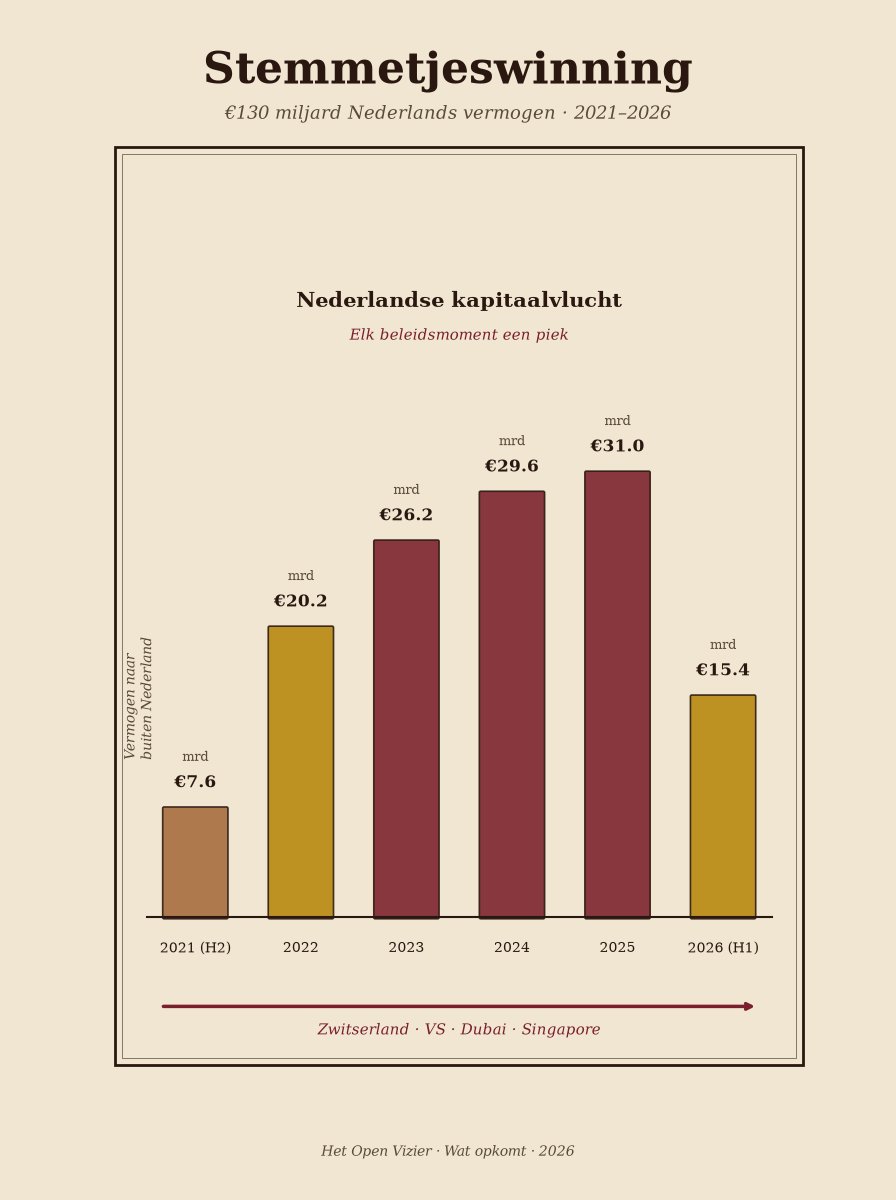
Added together and adjusted for double counting, the total wealth flow from the Netherlands to non-EU jurisdictions comes to the half-yearly series below. Figures are in billions of euros.
| Half-year | Bank abroad | Offshore | Real estate | UHNW emigration | Box 2/3 flight | Total |
|---|---|---|---|---|---|---|
| H2 2021 | €0.8 | €3.8 | €1.4 | €1.6 | 0 | €7.6 |
| H1 2022 | €1.1 | €4.0 | €1.6 | €1.9 | €0.5 | €9.1 |
| H2 2022 | €2.2 | €4.2 | €1.7 | €2.0 | €1.0 | €11.1 |
| H1 2023 | €2.5 | €4.5 | €1.8 | €2.3 | €2.0 | €13.1 |
| H2 2023 | €1.5 | €4.5 | €1.8 | €2.3 | €3.0 | €13.1 |
| H1 2024 | €1.5 | €4.7 | €1.9 | €2.7 | €3.5 | €14.3 |
| H2 2024 | €2.5 | €4.7 | €1.9 | €2.7 | €3.5 | €15.3 |
| H1 2025 | €2.6 | €5.0 | €2.1 | €3.0 | €3.0 | €15.7 |
| H2 2025 | €2.7 | €5.0 | €2.1 | €3.0 | €2.5 | €15.3 |
| H1 2026 | €2.8 | €5.2 | €2.2 | €3.2 | €2.0 | €15.4 |
| Total | €20.2 | €45.6 | €18.5 | €24.7 | €21.0 | €130.0 |
Amounts in billions of euros. Sources: DNB, EU Tax Observatory, ESB, CBS, Henley & Partners.
Every policy moment a spike
Whoever reads the table carefully sees that the acceleration is no accident. Every step accelerates measurably at the moment the Dutch government announces new pressure on wealth. The sequence is always the same: announcement, anticipation, outflow, disappointing yield, new announcement.
| Policy moment | Extra outflow per half-year |
|---|---|
| 2019 — box 2 rise announced | +€0.5 to €1 bn |
| 2022 — Box 3 court ruling on wealth-return levy | +€2 bn |
| 2023 — box 2 to 33% announced | +€3 to €4 bn |
| 2024 — EU Pillar Two + Malta IIP closure | +€2 bn |
| 2025 — box 3 reform uncertainty | +€1 to €2 bn |
| 2026 — general political instability | +€1 bn |
Each of these measures is meant to broaden the tax base or raise the yield from wealth. Each has in practice achieved the opposite. The expected extra yield from the 2023 box 2 rise was, according to the Dutch Central Planning Bureau (CPB), €2 to €3 bn a year. The measured extra outflow of capital in the same period: €8 to €10 bn a year above trend. Net: the base shrinks faster than the rate brings in.
“Every time a minister announces that wealth will be taxed more heavily, more leaves than is collected. That is in De Nederlandsche Bank's quarterly statistics.”
Why Malta was squeezed before the pressure came
The crucial detail missing from Dutch debates: Brussels cut the within-EU escape route before national taxes were driven up. Malta was, until 2023, the most obvious destination for European wealth that wanted to avoid the heaviest national tax burden without leaving the EU.
The Maltese Individual Investor Programme, the 5% effective rate via refund system, the holding-friendly fund structure: all three were dismantled under EU pressure or forced upwards between 2023 and 2025. What has happened: Dutch wealth that could have stayed within EU jurisdiction via Malta has shot on to Switzerland, the United States, the United Arab Emirates and Singapore. Beyond European reach. Not recoverable in a crisis.
The estimate: of the €225 bn of Dutch wealth that has disappeared to extra-EU since 2015, about €55 to €65 bn could have remained within the EU via an un-squeezed Malta. That is a quarter to a third of the total flight. For the EU-27 as a whole it amounts to €900 bn to €1,100 bn — five to seven Marshall Plans that could have been, and now are not.
Vote-winning
Why does the government do this? Why a series of measures that provably shrinks the base faster than it yields? Why squeeze Malta before raising your own pressure?
The answer does not lie in economic ignorance. The figures are available. DNB publishes the series. The CPB calculates the yields. Every civil servant at Finance can see that a box 2 rise drives away the base faster than the rate brings in.
The answer lies in the electoral cycle. Every announcement “we will tax the rich more heavily” delivers votes at the next polling moment. Every subsequent capital outflow only becomes visible in budget figures two to three years later — when the policy has meanwhile been replaced by another announcement, made by another minister, which wins votes again.
This is vote-winning. A political practice in which the visible announcement has value for the electoral position of the announcer, and the invisible long-term costs are borne by a country the minister has long since left. The country loses its base. The party wins an election. That is the trade.
The rich Dutch who leave are no worse than other Dutch. They are better informed, have more options, and respond more rationally to the announced incentives. Every Dutch person with €5 mn or more who leaves has done exactly what the policy — from his perspective — advises him. Staying is loss. Leaving is preservation. The government made that choice, not the leaver.
What will no longer be there
The wealth that has departed does not return. Swiss wealth management, American trusts, Emirati real-estate structures: none of these responds to Dutch tax reforms by coming back. The structures are set up with time horizons of decades and with legal barriers specifically designed to prevent return upon policy change.
When the Netherlands — or Europe — enters a fundamental restructuring within five to fifteen years, the capital needed for that restructuring will no longer be there. The Netherlands will then need external loans, from parties that will impose political conditions costing ownership. That is what happened to Greece in 2010. That is what happened partly to Italy. That is what the Netherlands is structurally preparing for with every Kamerbrief promising to tax the rich.
For context: the original Marshall Plan amounted to about €165 bn in current euros. The Netherlands alone has lost €225 bn of wealth in ten years that could have been used for its own reconstruction. That is more than the entire historical Marshall Plan, from one country alone.
The bill for votes
Administrative powerlessness is not the same as administrative stupidity. The measures shrinking the base are taken by people who know what they are doing. They do it because the electoral reward for the announcement is greater than the electoral cost of the later-visible consequences. That is an internally consistent system, only not in the country's interest.
What you see in the half-yearly figures is the price the Netherlands pays for this system. €130 bn in five years. €31 bn per year structurally. More than half a euro for every two euros of budget deficit. And the curve rises, for every next announcement leads to a new spike.
The government wins votes. The country loses its capacity. That is the bill.
Sources
- DNB — Foreign bank balances of Dutch households doubled in two years (2024)
- DNB — Flow through to tax havens structurally down (2025)
- Dutch House of Representatives — Dutch wealth in offshore financial centres (2025)
- ESB — Leenders, Untaxed wealth (2023)
- Alstadsæter, Johannesen & Zucman — Offshore Real Estate: Evidence from Dubai (2022)
- Henley & Partners — Private Wealth Migration Report 2025
- Tax Justice Network — The millionaire exodus myth (2025)
- MFSA — Regulatory Brochure Financial Services in Malta (2024)
- IMF — Malta 2025 Article IV Consultation
Vote-winning
“Every time a minister announces that wealth will be taxed more heavily, more leaves than is collected. The government wins votes. The country loses its capacity. That is the bill.”