
"Where there is a will, there is a way"
Why a generation of young people are at home sick, and what upbringing has to do with it.
Jacobus van Merksteijn
- Author --- Jacobus van Merksteijn
- Date --- 5 August 2026, Palma, Mallorca
- Section --- Opinion · accompanying Edition 3 (Under the Ice) · response to the FD report
- Direct source --- Jildou Beiboer, Alwine de Jong, Lien van der Leij, "Anxious, exhausted and depressed: why are more and more young people at home sick?", Het Financieele Dagblad, August 2026
- Background --- Edition 3 of Het Open Vizier — Under the Ice (the primal feeling, the three layers of the brain, the triple brain)
Het Financieele Dagblad published a report this week about young workers who end up in the WIA disability benefit scheme with anxiety, exhaustion and depression. The figures are stark: the inflow of under-thirties into disability benefits is growing, psychological complaints are by far the biggest driver, and only one in seven return to the workplace, either partially or fully, within five years. The societal costs of psychological complaints amount to €51bn a year. For 2026, the WIA shortfall comes to €285m, rising to more than €1bn within five years.
The article describes symptoms. It describes them well, but it remains within the frame that produces the symptoms themselves. Prevention, better HR, less stigma, more flexibility from managers. All true. All on the wrong side of the problem.
This piece is about the other side. About the place where the problem is made: upbringing, and the foundation beneath it.
The three brain layers, briefly
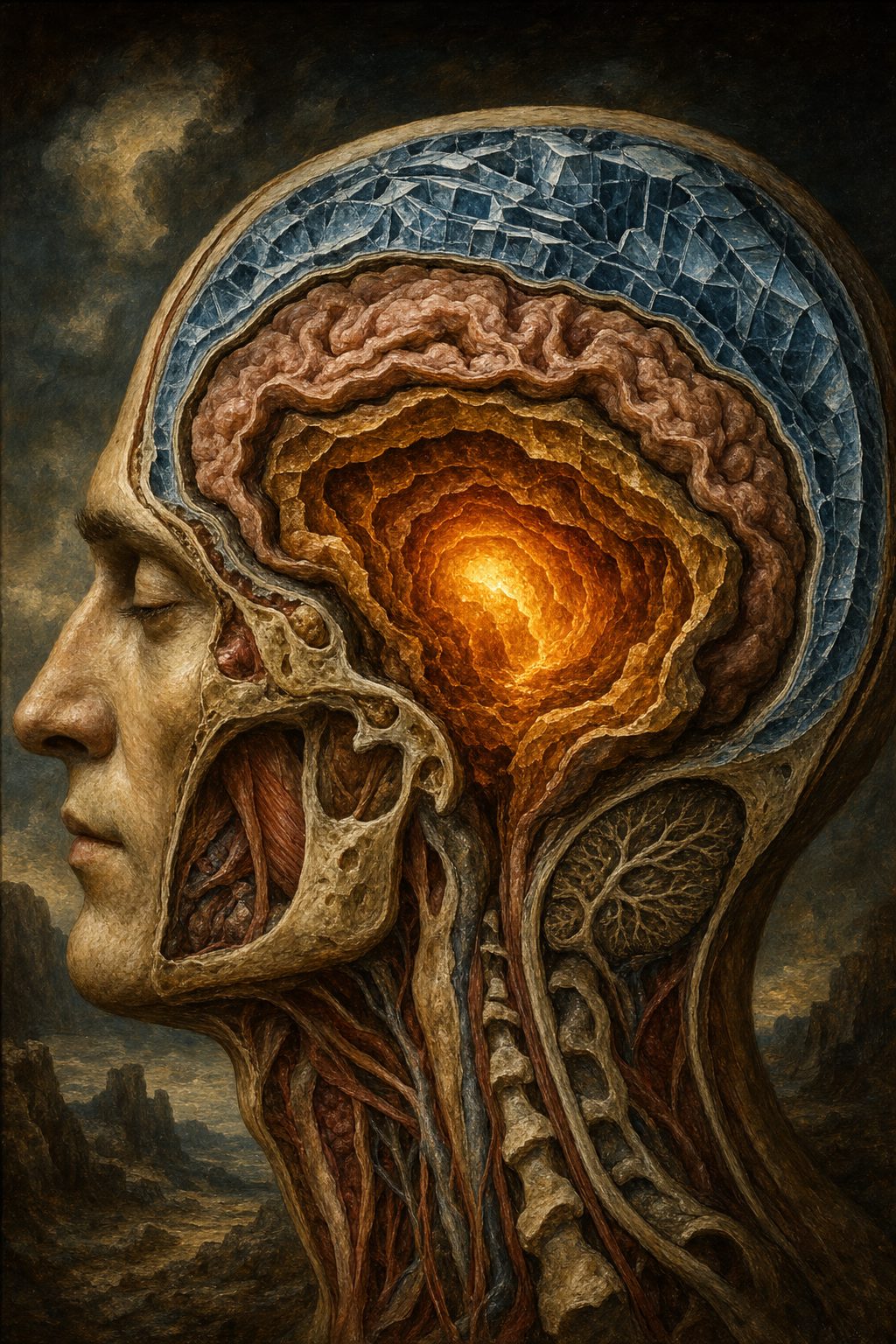
A human being has three layers stacked on top of one another, communicating with each other. The bottom layer is primal feeling: hunger, fear, safety, belonging, “this is not right”. The middle layer is emotion: sadness, anger, shame, pride, social mirroring. The top layer is reason: plans, goals, reasoning, language.
Those three layers must be in dialogue with one another. The bottom layer provides the signal, the middle layer gives it colour, and the top layer turns it into a decision. If one of those layers is skipped, the body takes over. Tinnitus. Palpitations. Panic. Two years at home on the sofa.
Nina, the central figure in the FD article, describes precisely that:
“Physically, I was completely exhausted; I had tinnitus, palpitations, I was in complete panic and extremely emotional.”
That is not an illness. That is a bottom layer finally having its say, after being skipped for two years.
What we do to children
A child enters the world with a functioning bottom layer and nothing else. Hunger, cold, fear, comfort. “Mummy, I’m hungry” is the first sentence in which all three layers work together: the body feels, the feeling is given a name, and the mind makes a request. If an adequate response follows — food, warmth, an arm around you — the child learns that its bottom layer is allowed to speak and that speaking helps.
In two generations, we have broken that learning process. Not because we do not love our children, but because we can no longer see it. We do not see it because seeing it would mean arranging our own lives differently. And we cannot do that, because the mortgage has to be paid, the job kept, the diary filled.
Concretely, what we do
- We place children in childcare too early and for too long where signals from the bottom layer cannot be answered individually. One carer for six babies cannot adequately mirror each individual hunger, each individual fear, each individual need for comfort. The child learns: my signal does not help, so I will stop signalling.
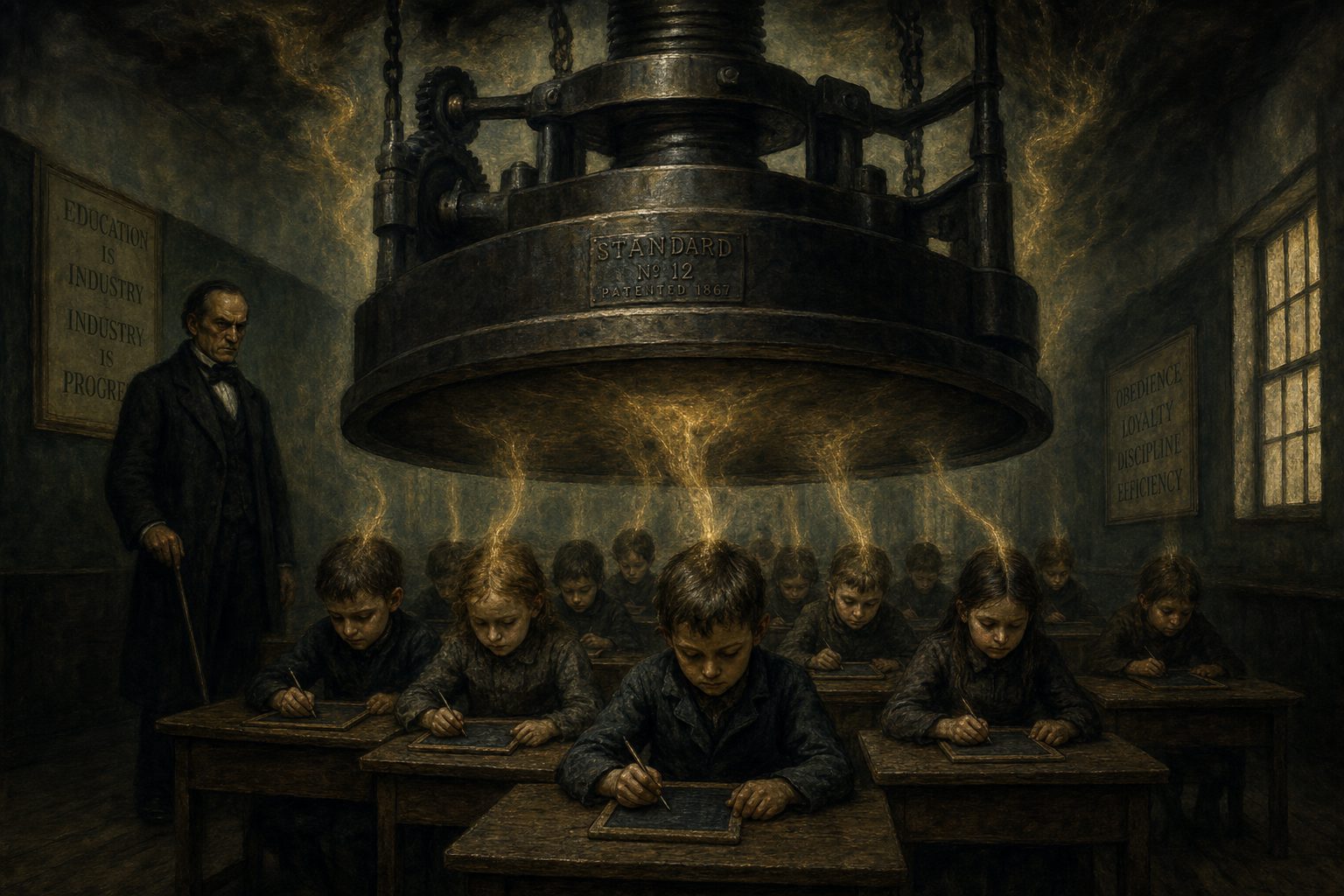
- We answer the bottom layer with the top one. A child cries: “what is wrong?”, “use your words”, “why are you sad?”. A three-year-old has no words for the bottom layer. It needs an arm around it, not a question. The question trains it to skip the middle layer.
- We reward the top layer exclusively. Marks, targets, performance, “well done”. The bottom and middle layers receive no language, no space, no recognition. By the age of eighteen, there is a young adult who can reason perfectly about their feelings, but can no longer feel them.
- We allow social media to hijack the middle layer. Instagram is a middle-layer machine: constant social comparison without the bottom layer (a real body, real safety) and without the top layer (context, time, judgement). Nina put it literally: “All my friends had cars too, the first was pregnant, everyone was making good career progress.” That is the middle layer operating at full power while the bottom layer has no address.
Education in the age of AI

Our education system was already a top-layer machine before AI arrived. Marks, tests, targets, outcomes. Now that AI makes the top layer cheap — every pupil can have an essay, a calculation or an analysis produced — the top-layer monoculture of education has suddenly become empty. There is nothing left that distinguishes a human being from a language model.
What remains is what AI does not have: a functioning bottom layer, and a middle layer in dialogue with it. A human being who can feel that something is not right before being able to reason it through. A human being who knows when they are tired, afraid, or do not belong somewhere. A human being who can say “no” because their body says so, not because their mind has constructed an argument.
That is what education must now teach, and it does not yet know how. It tries to combat AI through detection, bans and assignments designed to be AI-proof. That is treating the symptoms. The real task is a reversal: teach a child to reclaim its bottom layer. Teach it rest, boredom, physical presence, real conversations, real nature, real craftsmanship. Things AI cannot do, because AI has no body.
Primal feeling in professional practice
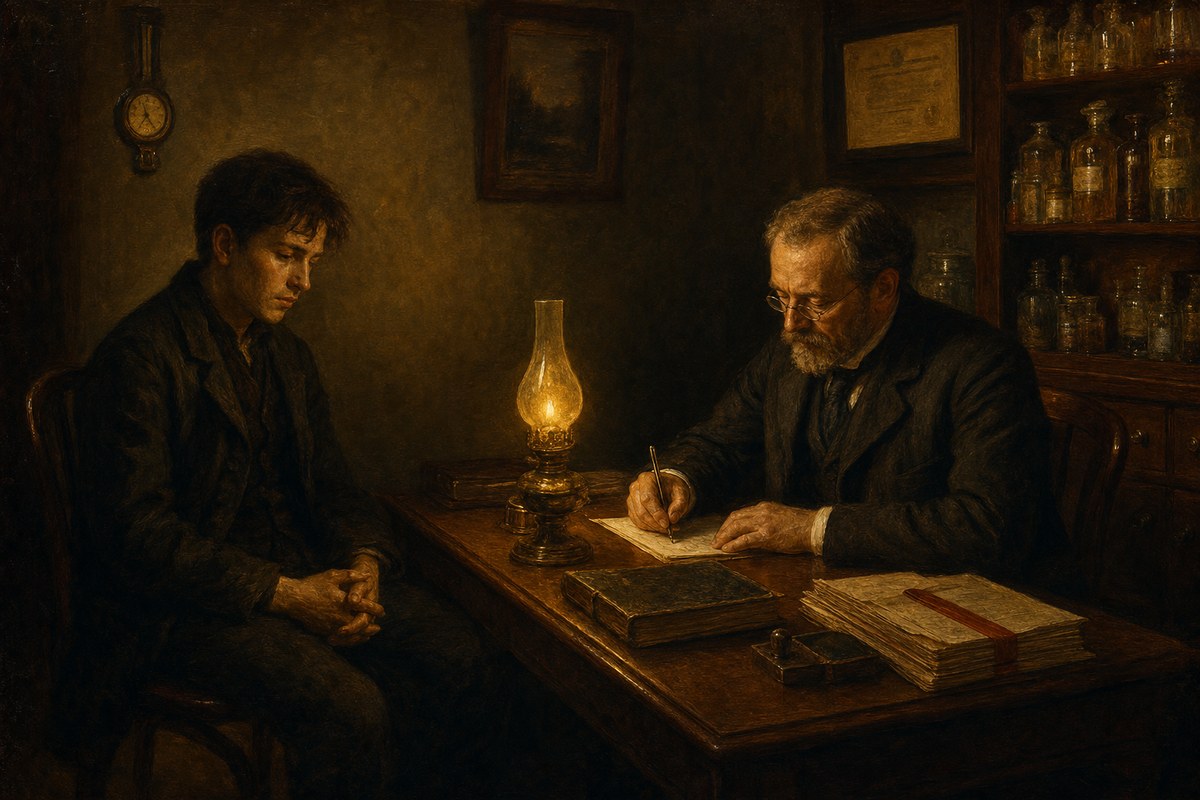
What you then see in the workplace is the bill. A young person on a temporary contract who is told that “the boss’s door is always open” but is biologically unable to walk through it, because their bottom layer is signalling correctly: contract not renewed = no money = no home.
Seventy-two per cent of employees see absence coming in advance. Eleven per cent of managers pick up on it. That gap is not a communication deficit. It is a power asymmetry that economically forbids the bottom layer from speaking.
And when that bottom layer ultimately takes over anyway — palpitations, panic, two years at home — the system’s response is: “go to the doctor”. Medicalisation. Diagnosis. Benefits. The problem is placed with the individual, in the form of a disorder, and treated with individual therapy and medication. Upbringing, education, the contract, Instagram comparison, the childcare structure, remain untouched.
Make-up economics
That is not a conspiracy. It is a system clearing up its own failures of production through its own consumer circuit. In economic jargon: it is make-up economics. WIA costs, healthcare costs, occupational health service revenues and insurance premiums all appear neatly in GDP.
GDP grows. The productive core — young, healthy, working people — shrinks. The shopping basket grows while the production machine breaks down.
Why we do not see it
We do not see it because seeing requires a different lens. A lens that says: you should keep your child at home when they are small, or place them in small groups with permanent carers. A lens that says: you should work less, consume less, perform less, scroll less. A lens that says: the perfect picture is the illness, not the norm. A lens that says: a temporary contract is not a form of employment but a biological gag.
That lens cannot be reconciled with our daily lives. We have the mortgage, the job, the diary, the school, the childcare. We cannot simply stop. So we carry on. And because carrying on is incompatible with seeing, we stop seeing. Not out of cruelty. Out of necessity.
Then we combat the symptoms that arise from not seeing. More prevention in the workplace. Better HR training. Anti-stigma campaigns. More psychologists. Better apps. Shorter waiting lists. All useful. All on the wrong side.
What you hear in the background
Every euro spent on prevention, occupational health services, medication and therapy is taken from an economy that cannot afford to spend that euro a second time. And every young person who spends two years at home is a young person who no longer produces that euro.
Two forces colliding: the GDP figure rises through repair, while real productive capacity falls through damage. Sooner or later, the two meet. Usually in a shock.
Where the error lies, and where the way forward is

The fault lies neither with the parents, nor with the teachers, nor with the managers, nor with the young people themselves. The fault lies in the fact that we have built a society in which the lowest layer of a person no longer has a legitimate address. Not at home, not at school, not at work, not on social media, not in the consulting room.
The way forward begins where the fault begins: with the very first sentence. "Mummy, I’m hungry" must receive an answer that addresses all three layers. Food (lower). An arm (middle). A word (upper). In that order. Every day. For years.
That requires a society to enable parents to hear and answer that sentence. This means:
- Time, calm, closeness — no performance pressure during the first seven years.
- Childcare on a human scale, not an economic one.
- Education that trains the lower layer before filling the upper layer.
- Forms of employment in which a young person may allow their lower layer to speak without losing their livelihood security.
That is a different perspective. It is expensive in the short term and cheap in the long term. It is politically uncomfortable and biologically necessary. It is precisely what we do not do, because we do not want to see it.
Where there is a will, there is a way. That will is not yet there. It is this generation’s task to create it — not by working harder on symptom management, but by daring to look at what we are doing to our children at the moment they first say: "Mummy, I’m hungry". And then doing what is necessary to be able to give that answer.
Food. An arm. A word. In that order.
Further reading — Edition 3
- The primal feeling — what the first layer is and how we feel it
- The three brain layers — primal feeling, mammalian brain, human brain
- What we do to children — the systematic squeezing
- Mummy, I’m hungry — the constant presence and the cost of absence
- Education in the age of AI — why everything we learn now will soon no longer matter
- The primal feeling in professional practice — the bill on the shop floor
Source
Jildou Beiboer, Alwine de Jong, Lien van der Leij, "Anxious, exhausted and depressed: why are more and more young people off sick?", Het Financieele Dagblad, August 2026.