What I leave behind
On VMB-ESG, the legacy of Nova Democratia, and the doubt I do not explain away
Jacobus van Merksteijn · Materials scientist and inventor
Background
A few years ago, I wrote Nova Democratia. It was an attempt to formulate something I was missing at every level of government in Europe: a system that is democratic without being paralysed, that listens without getting bogged down in listening, that makes decisions without coercion. I believed in it. I still believe in its intention.
But, to be honest, I have begun to doubt its execution. As I developed Nova Democratia further, it became a gigantic project of meetings and structures. Councils, layers, consultation moments, feedback loops. It tried to solve paralysis by adding more consultation, which is precisely what causes paralysis. I only recognised this when I had written it down and looked back at it. The medicine was the same prescription as the disease, merely dressed up differently.
Since then, I have been working on something I have come to call VMB-ESG. It is not a variation on Nova Democratia. In a sense, it is its opposite. Where Nova Democratia began from the premise that more democracy = more consultation, VMB-ESG starts from the premise that more democracy = faster ownership with visible accountability afterwards.
This piece is my attempt to explain what I am creating, why I think it differs from what currently exists, and why I doubt whether we will make it — while continuing nonetheless. It is not a manifesto. It is not a call to sign anything. It is an attempt to set out an idea as clearly as possible, so that someone else, somewhere, someday, can take it up and actually implement it.
What I did differently
The difference between Nova Democratia and VMB-ESG lies in one observation I had already known from my parents’ family business, but only understood later.
About 98% of what my father and mother decided, they decided independently. My father in his domain, my mother in hers. No meeting. No consultation. No signature from the other. A decision made alone, immediate and final.
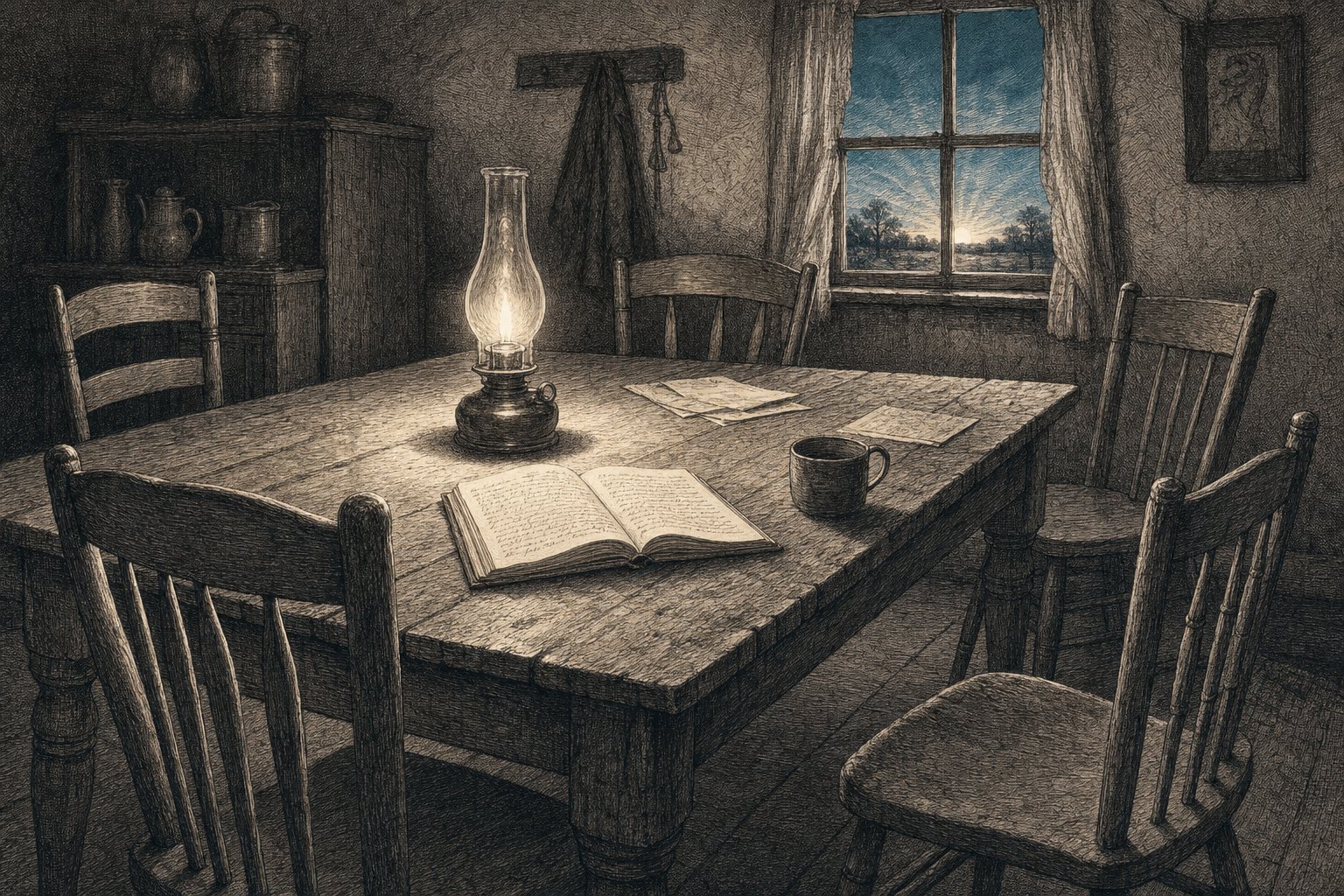
The difficult 2% went to the kitchen table. Everyone sat there — we children, sometimes staff, sometimes a neighbour we trusted. Everyone could contribute. Everyone could suggest changes. But in the end my father decided, after listening.
What I did not see then, but do now, is this: it was a highly developed governance model, not old-fashioned family business. Without calling it that, my parents had discovered what modern systems of government fail to combine: extreme speed for the ordinary, shared attention for the exceptional, and clear ultimate responsibility for both.
When I saw that, a large part of my earlier work fell apart. Much of what Nova Democratia contained was an attempt to conceive what my parents simply did. But because I had not seen it as one coherent system, I had spread it across councils, committees and layers. It could be simpler. Much simpler.
The form of VMB-ESG
I will summarise it more briefly than it deserves, because at the end of this piece I refer to the full documentation. But the core must be set out here, otherwise I would be talking about an empty term.
VMB-ESG consists of three components that operate at different scales:
The Table Model — for small groups, companies, institutions and municipalities. N people together form N domains. Each domain holder decides alone within their domain. In case of doubt or overlap, they convene the table — where the majority decides. Everything decided is entered on the Track: a public, immutable decision archive. Periodically, at the Open Hearth, the group discusses its own decisions retrospectively. Not in order to reverse them — a decision made alone is final — but to learn collectively. Anyone who is systematically wrong receives markings. After enough markings, they lose their authority to decide alone. No meetings, no sanctions, no committees. The system corrects itself.
VMB-EGS — for large-scale settings, where people no longer know one another personally. Ten layers, with three revolutionary additions: a Sortition Engine that selects anonymous controllers from the population, a Three-Voice Gate in which implementation takes place only when the rule, a human being and a randomly selected panel simultaneously give their approval, and a Public Track that makes external auditors and internal oversight departments unnecessary.
The Growth Rule — which governs both systems. Each block is given a directional assignment: two to four measurable objectives for the period. Alongside this comes an envelope as a means, and an economic framework as a boundary. A block grows — receiving more resources, more authority and more freedom — when it achieves its measurable quality objectives in a sustainable manner. Both conditions must be met simultaneously. Anyone who achieves quality through exhaustion receives less, not more. Anyone who works sustainably without delivering quality likewise receives no increase. Only those who combine both will grow.
And finally: one number for oversight. For each decision, the higher-level block provides two figures — one for problem recognition, one for the quality of the solution. The population provides a third set of figures through an assessment list. Together, the three figures form the diagnostic picture. No audits, no reports, no admissibility tests. Figures.
That is all.
Where this is fundamentally different
Three things distinguish this from almost everything currently proposed as democratic renewal:
It is an anti-meeting system. Most contemporary proposals add consultation. Citizens’ assemblies, deliberative committees, citizens’ panels, councils of wise people. All well-intentioned, all meeting-based. VMB-ESG drastically reduces meetings. Not by banning them, but by placing 98% of decisions in the hands of people who are authorised to act directly.
It separates oversight from correction. In almost all modern systems, oversight automatically leads to correction, sanctions or revision — which is why people become defensive and secretive. In our system, a decision made alone is final, so the domain holder does not need to defend themselves. But it is shared, because learning is not a threat. Openness costs nothing, and the gains from learning are enormous.
It rewards sustainable delivery rather than the consumption of resources. Most conventional budgetary systems teach people to spend their budget, otherwise they will receive less the following year. VMB-ESG turns this around: anyone who achieves their directional assignment with fewer resources receives more freedom, not less. That is not a detail; it is a complete cultural change.
Why I think Europe needs this
My fear for Europe is concrete, not abstract. We have entered a world in which three powers are pressing in on us — China with its speed, the United States with its capital, India with its demographics. None of these three has fundamentally hostile intentions towards us. But none of them has fundamentally benevolent intentions either. They have their own interests, and those interests will at some point intersect with ours.
By then, Europe must be able to stand on its own. At present, it cannot. Our decision-making is too slow. Our strategic execution is disconnected from our strategic plans. Our industrial base has withered. Our tolerance for risk has eroded. Our energy sovereignty has been surrendered. Our demographics are falling below replacement level.
Not all of this can be solved by a system of government. Demographics are what they are. Capital markets will not recover through a new decision-making model. But a substantial part of Europe’s paralysis stems from the way we make decisions. What can be done in China within weeks takes years in Europe. What is privately financed in the United States within months passes through a decade of committees here. Our slow decision-making is not cosmic bad luck. It is an organisational choice we have made, often with good intentions, but with dramatic consequences.
VMB-ESG is an attempt to repair that specific disadvantage. Not every disadvantage. This one.
The problem that reinforces itself
This brings me to something I rarely hear being named, but which has occupied my thoughts for years.
In a politics concerned exclusively with distribution, a dynamic emerges in which each generation makes the productive layer thinner in order to feed a broader consuming layer. Not because anyone wants it that way. Because, in the short term, it is politically the most stable course. Those with more to distribute win votes. Those who limit distribution in order to protect production lose votes. So distribution continues until what was available to distribute can no longer be produced.
The endpoint of this dynamic is that everyone is poor — not because the rich were too powerful, but because society’s productive substance has been depleted in order to maintain the illusion of fair distribution. We are already partly there, in many European welfare states. Politics is still about distribution, but there is less and less to distribute, so the struggle becomes more intense and the result more meagre.
What VMB-ESG could do — not as a miracle cure, but as an organisational precondition — is return politics to production. Not as a right-wing ideology, not as austerity, but as the straightforward answer to the question: how do we make more together than we consume, so that distribution remains possible at all?
The directional assignment forces each block to make explicit what it wants to build. The Growth Rule measures whether this is done sustainably. The population’s assessment gives ordinary people a voice, not only over distribution, but over the direction in which we build.
This is not an anti-democratic story. It is anti-passive-democratic. It is an attempt to involve the population in what is produced, not only in what is handed out.
Why I doubt whether we will make it
I am not going to pretend that I believe Europe will implement this within ten years. That is not realism; it is naïvety. My doubt is concrete and has four layers.
The gravity of what already exists. All our current systems have an interest in keeping things as they are. Not out of bad faith. Their reason for existing lies in the existing system. Someone whose career has been built on writing EU directives gains no advantage from a system that makes directives redundant. A municipal executive who derives their power from controlling budgets loses power when those budgets are distributed as envelopes to domain holders. This is a fundamental problem, and I do not underestimate it.
The voice of anger. Populist parties at both ends of the spectrum channel genuine frustration about genuine problems, but offer no workable alternatives. They win elections through opposition, not construction. What VMB-ESG requires is precisely construction — patient, disciplined, generative work — and that is not what current politics rewards.
The fragmentation of attention. People nowadays can no longer focus their attention on one thing for longer than a news cycle. A system such as VMB-ESG requires commitment over decades. No political movement in Europe currently has that kind of sustained attention.
The negative selection of leaders. Who can still rise to the highest levels of government today? Often not the most decisive, entrepreneurial, truth-speaking person, but the most media-friendly, conflict-averse, party-loyal one. The system selects for qualities that are the opposite of what we need for implementation.
Together, these four factors mean that I do not believe in the rapid, broad introduction of VMB-ESG in Europe. The negative currents are currently far too strong. Anyone who claims otherwise is selling hope. I do not want to sell hope.
What I do believe is achievable
But doubt must not replace commitment. Here is what I see as realistic:
Path one — One country or region as proof. Not the whole EU. One country, or even one Dutch province, that actually implements the Table Model and the Growth Rule. Proof that something works is a hundred times more convincing than a theoretical argument. Singapore, Estonia and, to a lesser extent, Ireland were built on the choice to try something fundamentally different from their larger neighbours. That is achievable within ten years, provided there is one level of government willing to take the risk.
Path two — One company or organisation as proof. Not the government. A large family business, a cooperative, or a major civil-society organisation that actually implements the Table Model and demonstrates that it works on a non-trivial scale, with 1,000 to 10,000 people. This is much easier than a municipality, because private ownership can undertake structural reform in a way that public ownership cannot.
Path three — Leaving the idea properly documented. The third, and perhaps deepest, path. Ensuring that the system is described so clearly, coherently and operationally that someone else can take it up in ten, twenty or thirty years when the time is ripe. Crisis forces change. When Europe enters a deeper crisis — financial, geopolitical, demographic — people will look for a workable alternative to what no longer works. A well-documented system that is ready and waiting can then be implemented within years, instead of everything having to be devised afresh.
This third path is, frankly, my own role. I am not the implementer. I am not the politician who will introduce this. I am not the leader who will transform their company. I am the thinker and documentalist ensuring that the idea is complete, clear and operationally ready for whoever needs it, whenever that may be.
What I am leaving behind, and for whom
My age compels me to be honest. I will almost certainly not live to see the implementation of VMB-ESG. Perhaps I will see an initial experiment somewhere, in a family business that has the courage to try it. Perhaps I will not even see that. What I can do is ensure that the idea remains.
That is why I am writing this piece, and why over the past few weeks I have drawn up three extensive documents together with my AI assistant that describe the entire system:
• A document on VMB-EGS — the large, formal superstructure with sortition and a three-vote gate, suitable for governments, large institutions and supply chains that cannot be built on personal trust.
• A document on the Table Model (VMB-DGM) — the human, operational implementation for small groups, with domain holders, two tracks, Track, Open Hearth and a marking system.
• A document comparing both models, including hybrid application and when each model is appropriate.
These documents are not intended to impress political committees. They are intended to be useful to anyone who may one day want to implement the system. Concrete, with figures, scenarios and measurable parameters.
I leave them to:
The entrepreneur who wants something fundamentally different in their own company or organisation from the matrix structures and stacks of KPIs being copied everywhere. The Table Model can transform a company without the outside world having to understand it immediately.
The alderman or mayor who is prepared to experiment in their municipality. One neighbourhood pilot. One domain. One year. As proof that it works, a hundred times more convincing than any discussion.
The younger thinker who in twenty years will face the same problems as I do now, but with a Europe in an even worse state. What I write down now, they will not have to devise then. They can begin where I end.
The civil servant in Brussels or The Hague who works within the existing system, but can see that the existing system is not holding. Here is a workable alternative, ready for the moment there is the courage to take it up.
What I ask of the reader
Do not sign. Do not like. Do not share merely for the sake of sharing.
Instead: read, think it through, criticise it if it is not sound, and — if you are in a position to try something — try. One domain. One department. One neighbourhood. One decision-making moment. Start small. Test it. Say what worked and what did not. That is worth more than a thousand pamphlets.
And if you are not in such a position, but do consider the idea important: keep it. Pass it on. To someone younger, someone with more power, someone who will reuse it in ten years' time. An idea that is ready when crisis compels action is worth more than an idea that still has to be conceived during the crisis.
The conclusion
A few years ago I believed that I had properly solved Nova Democratia. Now I see that it was too complex. What I am writing now may also prove too complex in a few years' time, or incomplete in another respect. That is how thinking works. What remains is that someone tries, and that someone writes it down, so that the next person does not have to start from zero.
I do not know whether Europe will retain its independence. I do not know whether we can withstand the negative currents. I do not know whether a workable alternative will arrive in time for the crisis that forces us to change.
What I do know is this: without people who try, it certainly will not happen. It costs me little to continue, and it would cost a great deal if I stopped now.
So I will continue. With these documents, with these pieces on Het Open Vizier, with this thinking that touches on physics, public administration, education and economics at the same time. Not because I believe I will succeed. Because I know that without me — and without the people who read and pass this on — it certainly will not succeed.
What I leave behind is not an army. It is a direction. For those who wish to take up that direction, the system is ready.
Jacobus van Merksteijn
Malta, June 2026
Attachments — the complete documentation
Beneath this article lie three extensive documents that work through the reasoning technically and institutionally. For those who wish to build the system themselves, or check whether it holds up.
The Legacy — Part I
VMB-EGS — layered governance architecture for large-scale application. The system capable of supporting a country, a union or a continent.
The Legacy — Part II · The Table Model
VMB-DGM — governance at human scale. How 98 per cent of decisions can be made alone, and 2 per cent at the kitchen table.
The Legacy — Complete · VMB-EGS and the Table Model
The summary document comparing both scales and building them on top of one another. For those who want to gain a quick overview of the whole.