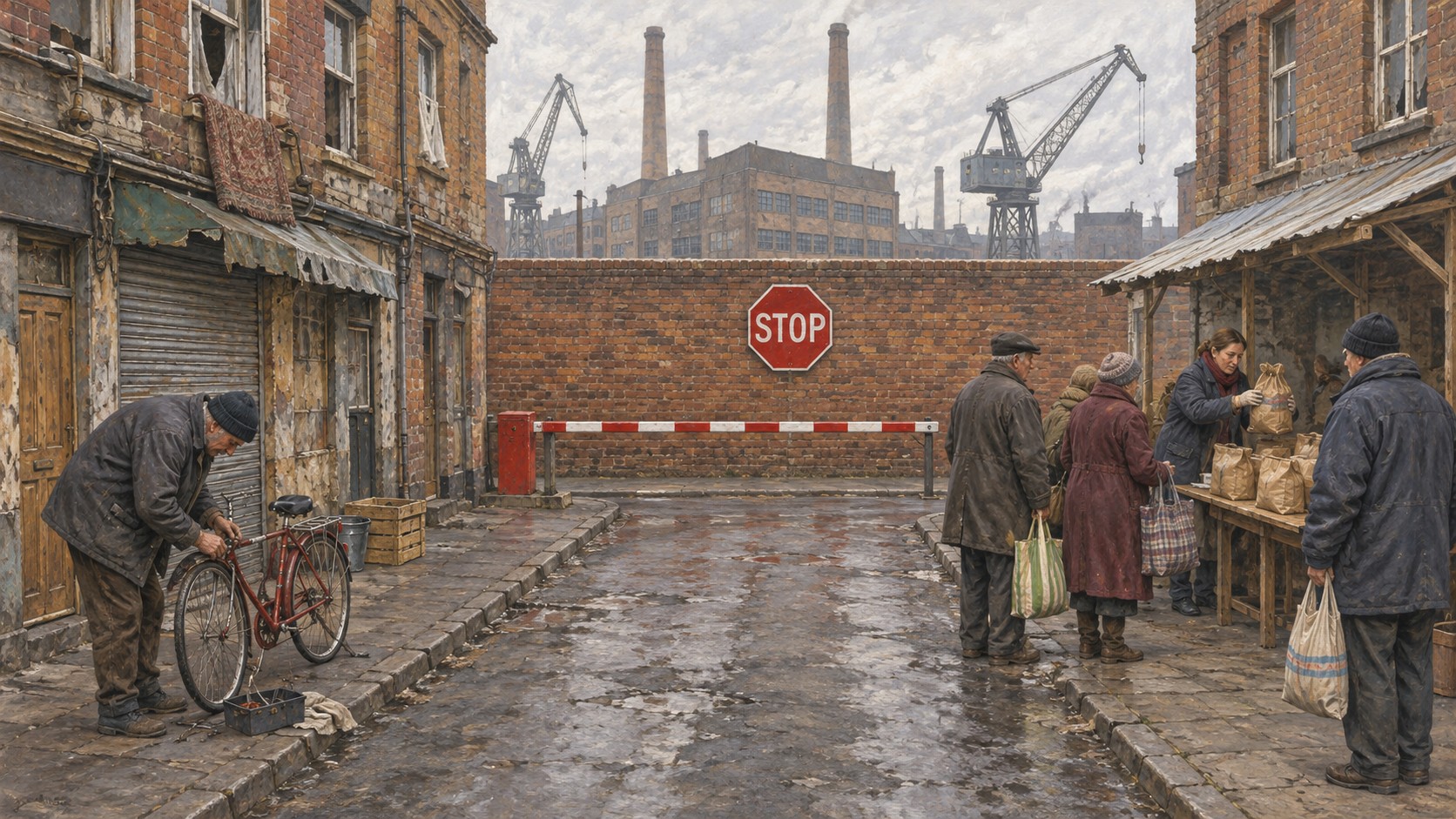
Europe has chosen a direction: mandating, prohibiting and putting a price on things, rather than letting businesses find advantages for themselves. That direction costs production. Factories close, supply chains thin out, and those who can invest or live elsewhere. This article’s argument is that there is no turn-off on this road. The road ends only at a stop sign: the moment when money, energy or parts run out. And behind that stop sign there is no road back to what was. The figures below are measured values or published data; the numbers in square brackets refer to the source list. Where a figure is an original calculation or an observation of my own, this is stated.
The direction: compelling rather than enticing
The European toolkit consists increasingly of obligations. The proposed Industrial Accelerator Act aims to bring industry back with requirements for European content in public procurement and subsidies. The Commission’s own Regulatory Scrutiny Board gave the proposal a negative opinion [1]. The OECD finds that such local-content requirements have predominantly negative effects [2]. A proposal is on the table for company cars, with targets of 69% low-emission and 45% zero-emission vehicles in 2030 [3]; the Netherlands wants to introduce an additional levy on non-zero-emission company cars from 2027 [4].
Brussels is also promising fewer rules. The target was a reduction in the regulatory burden of 37.5 billion euros; 22.3 billion has been proposed, around 60% of its own target [5]. So obligations are being added while the promised reduction falls short.
Energy: the most expensive raw material is self-inflicted
Energy is available worldwide. The import price is determined by the global market, but Europe’s status as an importer and the additional charges imposed on top are choices of its own. Natural gas cost 28.93 dollars per MMBtu in Europe (TTF), compared with 3.29 dollars in the United States (Henry Hub) [6]; that is almost nine times as much (author’s own calculation). Industrial electricity is about twice as expensive in the EU as in the US [7]. Taxes and levies account for 18.6% of the electricity price for non-households [8]. The carbon price in the emissions trading system was around 84 euros per tonne on 23 November [9]; for electricity generated from gas, that works out at about 30 euros per MWh (author’s own calculation).
Production is disappearing
Energy-intensive industry in Germany is producing 17.8% less than in 2021 [10]. In the European chemicals industry, 39 million tonnes of capacity, around 9%, have been announced for closure [11]. This is not a temporary dip: a closed cracker or furnace does not come back with an economic upturn.
The author’s own observation: a steel-coating company in Overijssel that employed 230 people five years ago is now operating with one shift of 35 people. It will close if it falls below a minimum volume.
The chains are breaking
What disappears is not just the factory, but also everything that supplies it. Large transformers now have lead times of 48 to 60 months, compared with 12 to 14 months before the pandemic [12]. Medium-voltage switchgear takes 34 to 40 weeks, and up to about a year [13]. The author’s own observation: frequency converters and control cabinets, previously delivered within two days to a week, now take three to six months. No public figures on this have been found.
This is the heart of the problem. As long as the chain exists, you can make adjustments. Once the chain is gone, a return is no longer a reversal but new construction: new companies, new skilled workers, new suppliers. That takes years, while production lines stand idle and companies wait for deliveries from China.
Capital and people are leaving
European direct investment in the United States rose by 70% in the first half of 2026 [14]. Audi is building a 4 billion dollar factory in Georgia, with 4,500 jobs [15], motivated by import tariffs [16] and approximately 1 billion dollar in government support [17].
People are leaving too. The net outflow of Dutch nationals rose from 9,384 in 2023 to 14,150 in 2024 and 18,821 in 2025 [18]. More than 5% of Dutch companies with at least 50 employees relocated activities abroad in 2021–2023, but companies that left entirely are not included [19]. Small businesses were not surveyed, and emigration figures say nothing about people’s occupations. Winding down here and building up elsewhere appears in no table as a single movement. What is not measured, politics does not see.
Wanting to have, not wanting to work
A person in work in the Netherlands works an average of 27.5 hours per week [20], or 1,436 hours per year [21]. A full-time job is contractually more than 39 hours [22]. The European maximum of 48 hours is a long way off for most people; compared with 48 hours, the average is about 43% lower (author’s own calculation).
At the same time, sectors that occupy themselves are growing. In end-of-life care, overtreatment aimed at prolonging life is the most frequently cited problem [23]. More than 1.16 million people aged 65 and over take five or more medicines for chronic conditions [24]; according to the RIVM, some of these are not or are no longer needed [25]. This is work paid for out of what the productive core earns, without strengthening that core.
Why there is no turning off
First, the measuring instrument. Policy is guided by GDP, and GDP also rises when the country spends more on itself: more civil servants, higher wages, more healthcare. The dashboard therefore gives no red light while production is moving away. What would sound the alarm—the work that is paid for through exports—is not used as a steering metric.
Second, every rule has its own implementers, regulators and advisers. Abolishing it would abolish their work. That explains why simplification remains stuck at 60% of its own target [5].
Third, the new European industrial laws set targets and obligations, but do not build capacity. A target on paper does not deliver a transformer, a variable-frequency drive or cheap energy.
Fourth, decision-makers do not feel the consequences themselves. Their income does not depend on an order book or an export market. For them, there is no need to reckon with lost production and dependence.
Signs along the road
| Signal | Value | Reference date | Source |
|---|---|---|---|
| Gas price in Europe versus the US (TTF / Henry Hub, $/MMBtu) | 28.93 / 3.29 | 2026 | [6] |
| Industrial electricity price in the EU versus the US | approx. 2× | 2026 | [7] |
| Production in Germany’s energy-intensive industry compared with 2021 | −17.8% | 2026 | [10] |
| EU chemical capacity announced for closure | 39 Mt (approx. 9%) | 2026 | [11] |
| Lead time for large transformers | 48–60 mths | Q3 2026 | [12] |
| European direct investment in the US | +70% | H1 2026 | [14] |
| Net outflow of Dutch nationals | 18,821 | 2025 | [18] |
| Average working hours per employed person | 27.5 hours/week | 2025 | [20] |
| EU burden reduction achieved against its own target | approx. 60% | 2026 | [5] |
| French interest-rate premium over Germany | 157 bp | Nov. 2026 | [26] |
What it means for you
- Anyone who needs an installation, machine or grid connection waits months rather than days.
- Anyone working in industry sees the work disappear; the suppliers and services around those factories follow.
- Anyone paying for energy also pays for European choices, on top of the world market price.
- Those who take initiative and can move build elsewhere; those who stay bear the burdens with fewer shoulders to share them.
- Those who wait for a turnaround wait in vain: after the stop sign there is no return, only a new beginning at a lower level.
What the stop sign looks like
A stop sign is the point at which it is no longer possible to carry on. It does not come from a report, but from outside: when lenders demand a higher interest rate (France already pays 157 basis points more than Germany [26]), when energy or parts are no longer available, or when workers take to the streets because their purchasing power is disappearing.
That stop sign is not a turning point. It is the end of the road.
No way back
After the stop sign, Europe cannot drive back to where it came from, for five reasons.
Production is elsewhere and stays there. A factory like Audi's in Georgia is built for decades [15]. The markets Europe is now giving up will be taken over by those who produce there. No one gives them back.
The supply chain has to be brought back all at once, and that is impossible. A factory only runs if its suppliers, parts and maintenance are there too. They all have to be rebuilt at the same time, while lead times for basic equipment are already measured in years [12].
The people do not come back. People of Dutch origin leave more often than they return: in the first quarter of 2025, 7 thousand left and 4 thousand returned [27]. Anyone who has built a business elsewhere does not dismantle it to return to the country that drove them away. The skilled workers who stay will retire without successors who have learned the trade in a factory.
The money is gone when it is needed. The stop sign appears precisely when borrowing becomes expensive. At that point, new construction has to be paid for with money that is no longer there, by a productive core that has already shrunk.
The rules remain in place. Even after the stop sign, the laws, institutions and officials who built the road remain. They do not disappear of their own accord, and those who would have to abolish them are themselves part of the system.
What comes after the stop sign is therefore not a return but a new beginning from a lower point. The author's expectation is that this beginning will take place under conditions that now seem unimaginable: much longer working weeks, lower wages and fewer safeguards. The Europe of before the dismantling will not return.
Sources
[1] European Parliament (EPRS), briefing on the Industrial Accelerator Act. https://www.europarl.europa.eu/RegData/etudes/BRIE/2026/789300/EPRS_BRI(2026)789300_EN.pdf
[2] OECD, Local content requirements. https://www.oecd.org/trade/topics/local-content-requirements/
[3] European Parliament (EPRS), briefing on clean commercial vehicles. https://www.europarl.europa.eu/RegData/etudes/BRIE/2026/791449/EPRS_BRI(2026)791449_EN.pdf
[4] Business.gov.nl, additional tax on fossil-fuel company cars. https://business.gov.nl/amendments/extra-tax-on-fossil-fueled-company-cars/
[5] European Commission, simplification (target) and EUR-Lex COM(2026) 715 (status). http://eur-lex.europa.eu/legal-content/AUTO/?uri=CELEX:52026DC0715&qid=1793957028102&rid=7
[6] OilPriceAPI, TTF–Henry Hub spread. https://www.oilpriceapi.com/blog/ttf-henry-hub-spread-european-factories
[7] IEA, Electricity 2026 – Prices. https://www.iea.org/reports/electricity-2026/prices
[8] Eurostat, Electricity price statistics. https://ec.europa.eu/eurostat/statistics-explained/index.php?+title=Electricity_price_statistics
[9] Trading Economics, EU Carbon Permits. https://tradingeconomics.com/commodity/carbon
[10] Destatis, press release on energy-intensive production. https://www.destatis.de/EN/Press/2026/02/PE26_043_421.html
[11] European Commission, chemical industry (capacity closures). https://webgate.ec.europa.eu/circabc-ewpp/d/d/workspace/SpacesStore/471c025b-a039-4211-a9b5-7100e08fbba3/download
[12] Grid Readiness, Lead Time Index Q3 2026. https://gridreadiness.com/gridreadiness_lead_time_index_q3_2026.pdf
[13] Find Critical Supply, Long-lead equipment. https://findcriticalsupply.com/reports/long-lead-equipment/
[14] European Parliament, Transatlantic Pulse Fall 2026. https://www.europarl.europa.eu/meetdocs/2024_2029/plmrep/DELEGATIONS/D-US/DV/2026/10-21/Report20261020_TA_Pulse_Fall_2026EN.pdf
[15] Audi, production facility in Georgia. https://www.audi.com/en/media-releases/audi-to-establish-first-us-production-site-in-georgia-investing-4-billion-and-creating-4500-jobs-18420
[16] CNBC, Audi Georgia and import tariffs. https://www.cnbc.com/2026/10/25/audi-georgia-us-plant-tariffs-volkswagen.html
[17] Autoevolution, government support for Audi Georgia. https://www.autoevolution.com/news/audi-will-invest-7-billion-in-us-plant-while-vw-group-shuts-down-plants-in-germany-278110.html
[18] CBS, Immigration and emigration by nationality (85451NED). https://www.cbs.nl/nl-nl/cijfers/detail/85451NED
[19] CBS, 1 in 20 companies relocated activities abroad. https://www.cbs.nl/en-gb/news/2026/05/1-in-20-firms-have-recently-moved-some-business-activities-abroad
[20] CBS, Monitor of Well-being, SDG 8,2 Work and leisure. https://www.cbs.nl/nl-nl/visualisaties/monitor-brede-welvaart-en-de-sustainable-development-goals/sdg-s/sdg-8-2-arbeid-en-vrije-tijd
[21] OECD, average hours worked per worker. https://sdmx.oecd.org/public/rest/data/OECD.ELS.SAE,DSD_HW@DF_AVG_ANN_HRS_WKD,1.0/NLD+DEU+BEL+USA........_T....?startPeriod=2025&format=csvfilewithlabels
[22] CBS, The labour market in figures 2025. https://www.cbs.nl/-/media/_pdf/2026/17/de-arbeidsmarkt-in-cijfers-2025.pdf
[23] KNMG steering group, Niet alles wat kan, hoeft (via the States General). https://staten-generaal.nl/9370000/1/j4nvgs5kjg27kof_j9vvkfvj6b325az/vmgm21jbnu4n
[24] Staat van Volksgezondheid en Zorg, polyfarmacie 2025. https://www.staatvenz.nl/kerncijfers/polyfarmacie-aantal-pati%C3%ABnten
[25] RIVM, miljoen 65-plussers risico verkeerd medicijngebruik. https://www.rivm.nl/nieuws/miljoen-65-plussers-loopt-risico-op-verkeerd-medicijngebruik
[26] Deutsche Bundesbank, Monatsbericht November 2026. https://publikationen.bundesbank.de/publikationen-en/reports-studies/monthly-reports/monthly-report-november-2026-1016266?article=financial-markets-1015936
[27] CBS, Bevolking groeide in eerste kwartaal ongeveer even hard als vorig jaar. https://www.cbs.nl/nl-nl/nieuws/2025/18/bevolking-groeide-in-eerste-kwartaal-ongeveer-even-hard-als-vorig-jaar
Own calculations
Gas price ratio: 28.93 / 3.29 = 8.8. CO₂ charge on gas flow: approx. 84 €/t × approx. 0.37 t CO₂/MWh ≈ 31 €/MWh. Working time: 1 − 27.5 / 48 = 0.43.