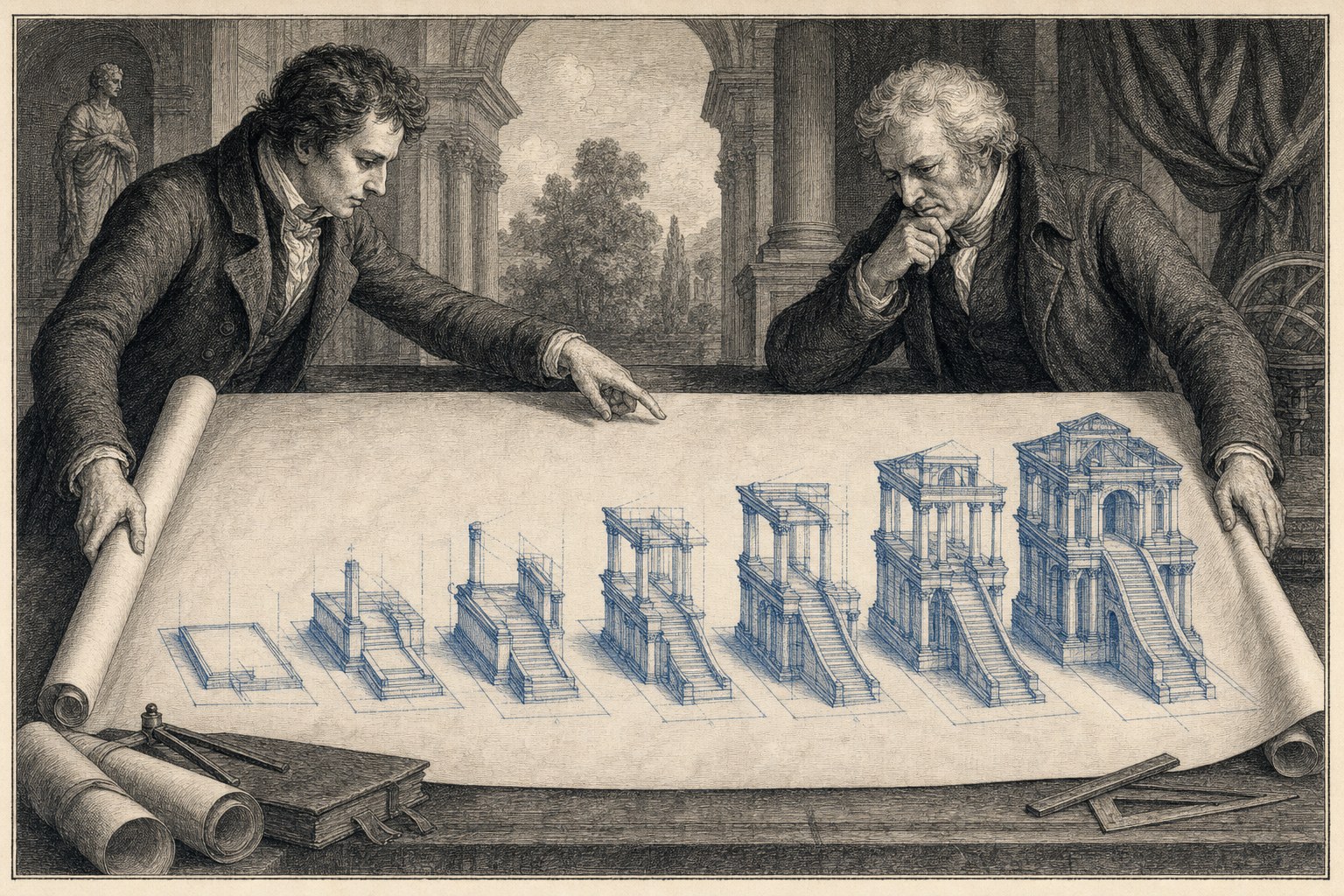
An engineer who renovates a bridge does not simply knock away pillars. He first measures the structure, places temporary supports, replaces components in a calculated sequence, and checks after every step whether the margin remains acceptable. For Dutch democracy, the same principle applies. He who wishes to revise the system without it collapsing during the renovation must work in sequence — not in revolution.
This document describes that sequence in six phases. Phases zero to four run sequentially; phase five, education, begins immediately and runs in parallel for ten years or longer. For each phase, there follows the objective, the concrete measures, and the implementation — what the citizen experiences and what the system performs. The reasoning is physical, not ideological.
Timeline 2026 to 2036
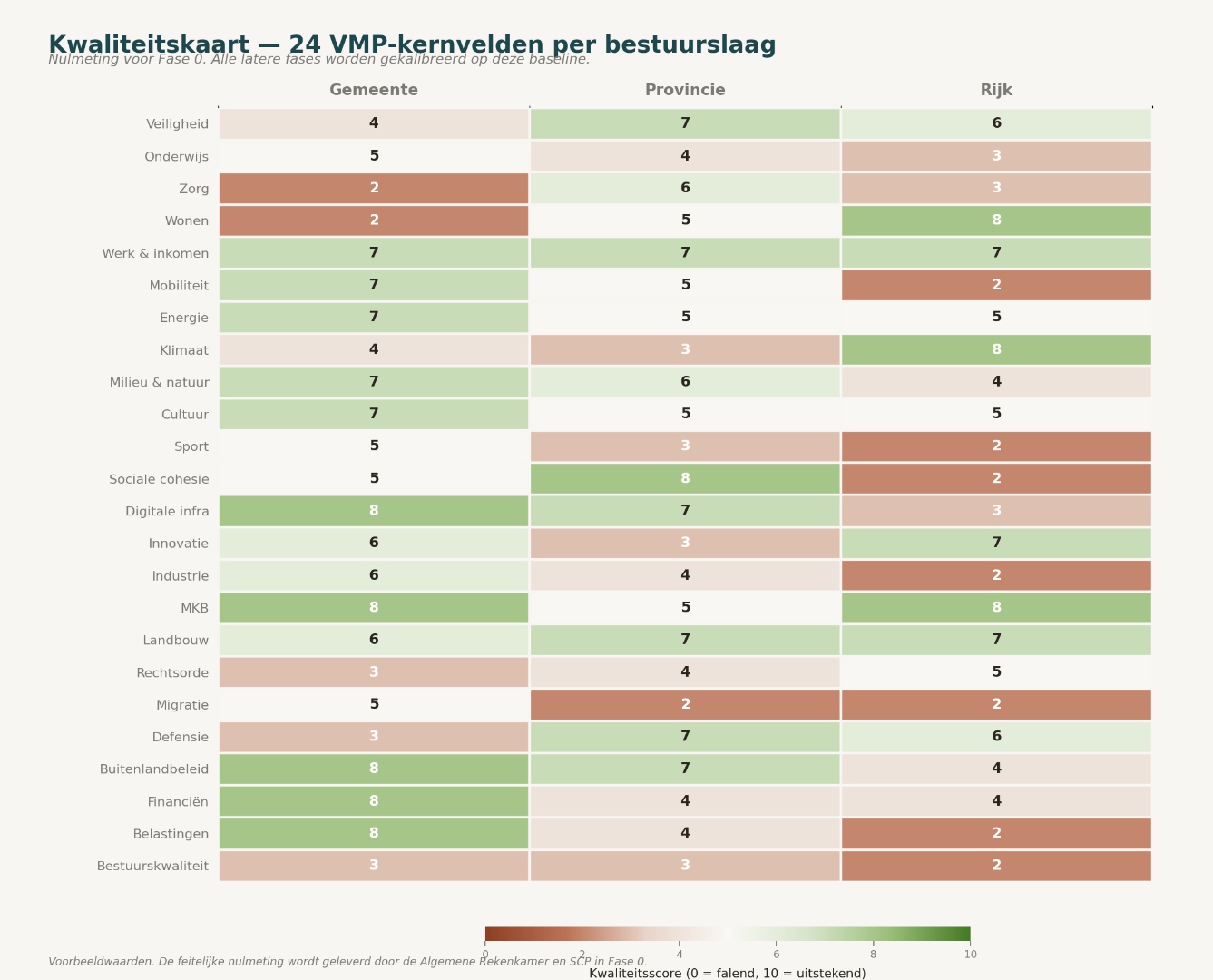
The phasing affects three administrative layers simultaneously — National Government, province, municipality — each with its own measurement and its own tempo. The quality map below shows where each layer stands across the six phases, and where the gaps lie that are filled within this blueprint.
Phase Zero — Constitution and Baseline Measurement (Year Zero)
Objective: To lay the political and legal foundation without activating anything. Establishment of a political movement for Nova Democratia. Draft constitutional amendment on four points: sunset clauses, separation of powers two-point-zero, abolition of the Balkenende-norm, Article Thirty-two concerning media financing. Determination of the twenty-four VMP core fields with corresponding measurement definitions per administrative layer. Baseline measurement per municipality, province, and National Government — without an assessment score, the twenty per cent threshold from phase three cannot be introduced later.
Implementation. No citizen notices anything yet. However, a measurable baseline is established. Without this phase, every subsequent step is arbitrary — comparable to a contractor who begins demolition without a structural drawing.
Phase One — Transparency and Measurement Layer (Year One to Two)
Public performance dashboard live on all three administrative layers. Each public service receives a cost-per-unit-result indicator. Independent supervisors receive a mandate for unannounced inspections with an escalation of sanctions: warning, multi-year ban, permanent exclusion. Article Thirty-two enters into force: public broadcasting is limited to non-tension-increasing information provision; political debate moves to privately funded broadcasters. This occurs early, because the rest of the transition requires an independent media landscape.
Implementation. For the first time, citizens can see per core field whether their municipality is performing well or poorly. This creates bottom-up demand for the next phase — measurement invites judgement.
Phase Two — Personnel and Remuneration Layer (Year Two to Three)
Abolition of the Balkenende-norm for policy personnel, simultaneously with the introduction of the funding model: the civil service apparatus is fully paid from the state treasury, with a uniform basic amount per inhabitant per administrative layer. Redundancy pay [wachtgeld] for higher administrative layers in national service is phased out from eighty per cent to zero over three years. Performance-linked remuneration based on the KPIs from phase one. Until at least one full measurement year has been completed, no variable payments shall be made — otherwise, the system rewards noise. Single-headed leadership via citizen advisory groups is first introduced at the municipal level, with sharply defined mandate boundaries.
Implementation. A more efficient government because top quality can be attracted, redundancy pay no longer feeds job carousels, and a single person responsible per dossier breaks the diffuse power of the bureaucracy.
Phase Three — Deliberation and Voting Layer (Year Three to Four)
Citizen deliberation by lot becomes structural: for each core field, citizens deliberate, informed by experts. Zero-base reformulation of five-year goals per core field, adjusted annually on current data. Double voting — policy vote plus performance vote — is first tested locally in two or three pilot municipalities, then provincially, then nationally. Both votes are binding. Mandate and deselection: if less than twenty per cent of goal realisation is achieved, the deselection of administrators follows. This is only to be activated when core fields have received their assessment score — otherwise, the threshold is meaningless.
Implementation. Politics is held accountable for results instead of promises; changes in coalitions no longer disrupt policy because policy is no longer tied to a coalition.
Phase Four — Legislative Layer with Sunset System (Year Four to Six)
Sunset clauses come into effect in phases: ordinary laws five years, significant laws ten years, constitutional provisions twenty years. Existing laws receive a staggered expiry schedule so that not everything expires at once. Renewal requires citizen council evaluation. Laws that do not pass evaluation expire automatically. Important exception: EU implementation laws are exempt from automatic expiry; only the obligation for evaluation applies. Human rights constitutional provisions are subject to renewal-by-default rather than expiry-by-default.
Implementation. The system cleanses itself. Dead or counterproductive legislation disappears without the need for subsequent political courage.
Phase Five — Educational Foundation (Parallel, Year One to Ten plus)
Education is deliberately long and parallel. Crime prevention through upbringing only works at a very young age, and funding reform only has an effect after an entire school generation. Sub-phase a, years one to two: centrally regulated final examinations become the measuring instrument. Funding shifts from the number of graduates to average examination scores. Sub-phase b, years two to four: stricter entrance examinations, returning to selection based on motivated makers. Sub-phase c, years three to ten: the emphasis shifts to a very young age for character formation. Sub-phase d, year five plus: higher education aligns with the twenty-four VMP core fields.
Implementation. Only in this phase does the type of citizen and civil servant emerge who can sustain a performance-based democracy. Therefore, education must not stand at the end — it must run from year one.
The current democracy cannot withstand a revolution. It can, however, withstand a calculated renovation, in this sequence.
What this document is not
Not a blueprint. Not a law. Not a party programme. It is a structural calculation for the Dutch state — measurable, phaseable, and recalibratable. Each phase derives its legitimacy from the measurement of the previous one. Whoever rejects the reasoning is free to do so. But without sequence, without measurement, and without the classification of objections by order, any reform will at some point be overtaken by the existing inertia. That is not a prediction; that is an engineering finding based on the Pareto analysis in the next instalment.
Open Vizier · novademocratia.com · Working Material · Jacobus van Merksteijn · June 2026