The farmer and nature both moving forward
From “fewer cows means less income” to four scenarios — including the radical cow-free buffer zone that lets Natura 2000 breathe for fifteen years. With a cost–benefit table per hectare per year.
By Jacobus van Merksteijn · Palma, Mallorca · 9 July 2026 · extended version
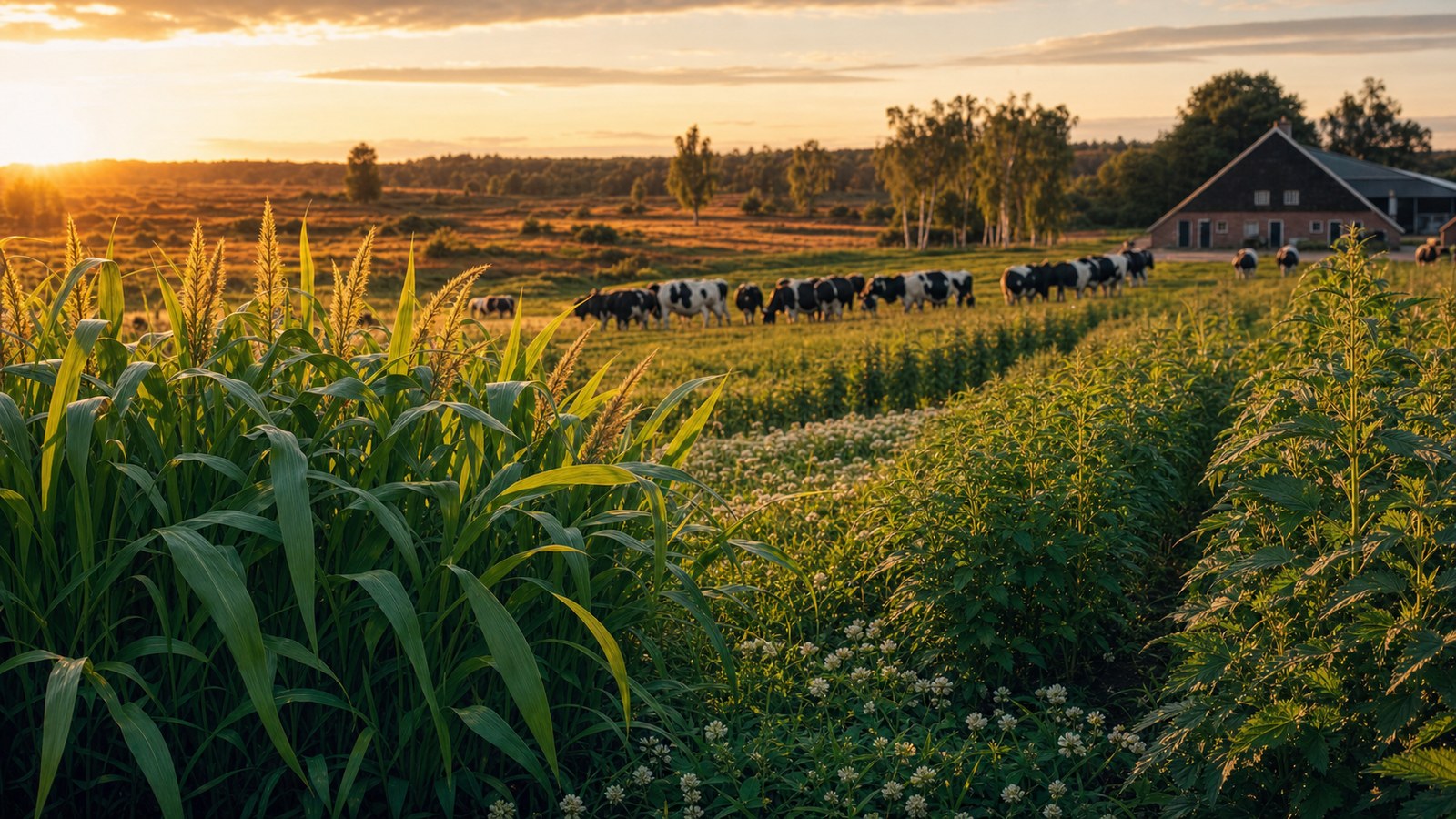
On 9 July 2026, Het Financieele Dagblad opens with an analysis that asks precisely the question at which nitrogen policy has stalled. “Fewer cows means less income,” concludes agricultural economist Roel Jongeneel of Wageningen. The livestock norm of 2.6 cows per hectare costs three-quarters of farmers nothing, but 3,500 businesses — especially in Noord-Brabant, around Eindhoven, on the sandy soils bordering Natura 2000 areas — must choose between buying more land, getting rid of cows, or signing a manure contract with the arable farmer further down the road. The government is putting € 215 million on the table to cushion the blow. And the farmers’ lobby is once again on edge. What the FD does not consider in a single paragraph: precisely those same buffer zones have two other options ready. One is a mixed intermediate form — three plants on fifteen per cent of the field, with the same cows remaining in the shed. The other is a radical choice — a fully cow-free buffer zone for fifteen years, two cuts a year, and one long-term offtake contract. This article works out both options and sets out the business plan.
Part I — The question the FD asks
Jongeneel summarises the problem bluntly: “The Netherlands is a relatively small player in the total EU market. Our share is 9%. A reduction in supply from us will not raise prices across the Union. It really is fewer cows, less income.”
That is an honest analysis and immediately a devastating one. The government has no answer to the simplest question a farmer can ask — how do you compensate for a forced loss of income in a family business that has often worked the same land for three generations? The € 215 million is a paltry sum for a farming population that has 130,000 too many cows and 50,000 hectares too little land. Spread across 3,500 businesses, it amounts to little more than € 60,000 per business to adapt over nine years. For the purchase of a single hectare of agricultural land in Noord-Brabant, where the FD gives the price as € 120,400 and in the Peel as approaching € 206,400, that is insufficient for half a hectare.
The farmer therefore has roughly three options, according to the FD: buy more land, get rid of cows, or enter into a co-operation agreement with arable farmers to dispose of manure. All three options amount to contraction or dependence. None offers growth.
We propose two other options. And they are not theoretical.
Part II — Option 3: mixed farm with three plants on fifteen per cent
What the FD map does not look at
The blue-green colour on the FD map — 3,500 farms above the 2.6 norm — overlaps almost exactly with the sandy soils and peat meadows bordering the most important Natura 2000 areas. Southern Netherlands through to the Peel. The Achterhoek. Drents-Friese Wold. Gelderse Vallei. These are precisely the fields described as “vulnerable” under the Habitats Directive, and at the same time the fields offering the most favourable microclimatic conditions for the cold-tolerant, selectively bred Northwestern European variety of Giant Juncao — emphatically not the tropical Amazon form, which does not survive the winter here, but the cold-adapted variety selected by Carbon-Alert Ltd in Malta and Mallorca over the past three years, supplemented with white clover for nitrogen fixation and nettles for protein density.
The farmer who currently has 3.1 cows per hectare around Eindhoven has two practical scenarios in this model. The first is to dispose of a quarter of the herd in order to fall below 2.6. Mathematically, that means € 250,000 to € 500,000 in lost turnover, compensated by a fraction of that amount from the government’s € 215 million fund. The second scenario — which we describe as Option 3 — is to keep the same cows and grow the three plants on fifteen to thirty per cent of the hectare, with a mobile Tier 1 unit brought onto the field to process them into hydrolysate, which is then fed back into the farmer’s own shed as a full-value protein ration. The cow receives more protein from its own land than from soya imported through Rotterdam. It emits thirty per cent less nitrogen and ten to fifteen per cent less methane. Manure disposal is halved.
Yield per hectare — in figures
For an average Brabant dairy farm of forty hectares with 125 cows, Option 3 works out as follows:
| Item per farm (40 ha, 125 cows) | Scenario A get rid of cows | Option 3 Carbon-Alert on 6 ha |
|---|---|---|
| Number of cows | 104 (−21) | 125 (unchanged) |
| Effect on milk turnover | −€ 35,000 | € 0 |
| Concentrate-feed substitution (soya → hydrolysate) | € 0 | +€ 27,000 |
| Reduction in manure disposal | € 0 | +€ 8,000 |
| Reduction in fertiliser on 34 ha (clover-N) | € 0 | +€ 9,000 |
| Depreciation of mobile unit (shared by 5 farms) | € 0 | −€ 12,000 |
| Government compensation from € 215m fund | +€ 6,700/year | € 0 |
| Net structural effect on farm income | −€ 28,000/year | +€ 32,000/year |
| Ammonia deposition in adjacent Natura 2000 area | −17% | −30% |
| Methane emissions per litre of milk | unchanged | −10 to −15% |
| Biodiversity on the field | unchanged | significantly positive |
Between scenario A and Option 3 there is a difference of € 60,000 per year per farm, in favour of Option 3. Multiplied by the 3,500 businesses mentioned by the FD: € 210 million per year structurally — the entire government compensation package, every year again, paid by the farmer himself.
Part III — Option 4: the cow-free buffer zone, fifteen years
Option 3 is the compromise variant. It keeps the cow in the shed and the plant on the buffer-zone field. For many farmers, that is the right choice. But there is a more radical option that is possible on precisely the same buffer-zone fields, and that delivers a number of effects Option 3 cannot achieve. We call it Option 4: the cow-free buffer zone, for fifteen years, two cuts a year, and one long-term offtake contract.
Why fifteen years, and not three or fifty
Buffer zones have existed on Dutch maps for years. What they have never had is a time limit. The farmer currently in the buffer zone is told by the government that less will be permitted “for the time being” — and, rightly, interprets that as “for ever”. That is why every buffer-zone discussion turns into an existential quarrel within thirty seconds. It is never a temporary measure. It is always expropriation.
Fifteen years is different. Fifteen years is one generational transition on a farm. Fifteen years is precisely the period in which Giant Juncao’s root mass — one to one and a half metres deep — structurally restores the soil, in which acidified sandy soils regain their buffering capacity through continuous clover nitrogen fixation, and in which soil life on an exhausted dairy field returns to a level that Dutch soil still had in 1960. And fifteen years is precisely long enough to bring ammonia deposition in the adjacent Natura 2000 area from “critically exceeded” to “below the KDW standard”, after which the area — for the first time since the 1992 Habitats Directive — can maintain itself again.
After those fifteen years, the farmer has a choice. They can extend the arrangement, return to a mixed circular system with a greatly reduced number of cows on what will then effectively be “new land”, or continue with permanent Carbon-Alert cultivation.
What happens in May and September
The cow-free buffer zone grows a polyculture of three plants that reinforce one another in time and space. In March, the clover is the first to awaken: dense ground cover that binds between ten and twenty kilograms of atmospheric nitrogen per hectare per year. In May — before the first clover flowering — comes the first cut: twelve to fifteen tonnes of dry matter per hectare. Between June and August the crop recovers, and the clover flowers in two waves; peaks of more than twenty thousand bee visits per day per hectare have been measured at Wageningen. The nettles host the caterpillars of at least forty native day- and night-flying butterfly species. In September — after the second clover flowering — comes the second cut: eighteen to twenty-five tonnes of dry matter. In total: thirty to forty tonnes of dry matter per hectare per year. Between October and February the field is harvested but not empty: skylarks, meadow pipits, fieldfares and redwings find cover and fallen seed. Two cuts. Fifteen years. No fertilisation, pesticides or ploughing.
Where the biomass goes
The thirty to forty tonnes of dry matter per hectare per year leave the field through three possible offtake channels:
| Offtake channel | Gross per hectare per year | Buyer |
|---|---|---|
| High-quality animal feed (16–20% crude protein, lucerne level) | € 4,500 to € 6,000 | ForFarmers, De Heus, Agrifirm — long-term contract |
| Cellulosic ethanol (220–340 L per tonne of dry matter) | € 5,000 to € 7,200 | 2nd-generation plant in Rotterdam/Amsterdam |
| Methanol / blended biofuels (450 kg/tonne d.m.) | € 3,000 to € 5,000 | Regional Fischer–Tropsch cluster |
After deducting machinery costs (mowing, chopping and transport for two cuts: € 600 to € 900 per hectare) and management costs (€ 200 per hectare), the farmer retains net € 2,500 to € 5,900 per hectare per year from biomass income. And on top of that comes the value of the CO₂ credit.
The CO₂ balance of fifteen years of a cow-free buffer zone
For one hectare of cow-free buffer zone, over fifteen years, compared with the same hectare as conventional dairy land with 2.6 cows:
| Emissions removed per hectare per year | tonnes CO₂-eq |
|---|---|
| Methane from 2.6 cows (286 kg CH₄ × GWP-100 28) | 8.0 |
| Nitrous oxide from manure and fertiliser (3.5 kg N₂O × GWP-100 265) | 0.93 |
| Fertiliser production via Haber–Bosch (180 kg N × 4.0 kg CO₂/kg) | 0.72 |
| Imported feed (South American soya, 2.6 × 700 kg × 0.8 kg CO₂) | 1.5 |
| Avoided emissions | 11.2 |
| Juncao root mass (1.5 m deep, permanent, 60% retained) | 4.0 to 5.9 |
| Soil organic matter (SOM build-up through no ploughing) | 1.1 to 1.8 |
| Ethanol replacing petrol (if offtake channel 2) | 5 to 8 |
| Additional sequestration + fossil fuel replaced | 10 to 16 |
| Total CO₂ balance per hectare per year | 21 to 27 |
Over fifteen years cumulatively: 315 to 405 tonnes of CO₂ equivalent per hectare. Across one hundred thousand hectares of Dutch cow-free buffer zone: 31 to 41 million tonnes of CO₂ equivalent over fifteen years — roughly a quarter of the Netherlands’ annual emissions. At an EUA price of € 85 per tonne: € 2.6 to € 3.5 billion in tradable CO₂ credits over fifteen years, or € 1,800 to € 2,300 per hectare per year in additional gross income for the farmer, provided the BiCRS component is verified through the EU ETS.
That brings total net returns to € 4,300 to € 8,200 per hectare per year — virtually equal to or higher than the € 7,000 to € 7,500 margin generated by the same hectare as full dairy land. Without labour. Without feed concentrates. Without manure disposal. Without a nitrogen fine. And with fifteen years of contractual certainty.
What nature looks like after fifteen years
Years one to three: the degassing. The topsoil sheds decades of excess nutrients; the crops remove phosphate, nitrogen and potassium through the cuts.
Years three to seven: the soil reversal. Soil pH stabilises, mycorrhizal fungi return, and earthworm populations increase from twenty to thirty individuals per square metre to two hundred to three hundred — values rarely seen in Dutch soil since the 1960s.
Years seven to twelve: the fauna explosion. Day-butterfly richness reaches twenty-five to forty species per hectare, compared with three to six on intensive dairy land. Skylarks, grey partridges, yellow wagtails and meadow pipits return.
Years twelve to fifteen: corridor formation. The cow-free buffer zones around all Natura 2000 areas begin to connect with one another. For the first time since land consolidation, the Netherlands gains a network of ecological corridors that has not been designed on a drawing board but has grown in practice.
And the adjacent Natura 2000 area receives fifteen years without ammonia deposition. The KDW standard is structurally undershot in virtually every area within seven to ten years. The legal basis for “critically exceeded” disappears. Permit procedures elsewhere in the Netherlands can get moving again.
Part IV — What “the farmer and nature both moving forward” means in practice
Over the past decade, the debate in the Netherlands has systematically been polarised into a choice between two groups: the farmer who wants to keep their business, and nature conservation, which wants to uphold the habitat standard. Every coalition agreement, every Rabobank analysis and every protest action on the Malieveld is about who wins and who loses.
What Options 3 and 4 together show is that this division is a political construct, not a biological one. There are architectures in which both sides win. Option 3 achieves this by keeping the cow and adding the plant. Option 4 does so by allowing the plant to reclaim the field for fifteen years while keeping the cow elsewhere in the circular system. Both are valid, and the choice between them belongs to the farmer — not the government.
The taxpayer wins in both scenarios. Under Option 3, the € 215 million need not go towards buyouts but towards investment in mobile units. Under Option 4, the full national cow-free buffer-zone programme covering one hundred thousand hectares over fifteen years costs approximately € 1.17 billion in establishment, transition payments, mobile processing clusters and monitoring — 5.9 per cent of the € 20 billion the government wants to spend on buffer-zone buyouts.
Business plan — costs and returns per scenario
Calculated below the line, per hectare per year, in constant 2026 euros. All amounts are net for the farmer after deduction of machinery and management costs, excluding labour.
Per hectare per year — four scenarios
| Option 1 current dairy | Scenario A cows removed | Option 3 mixed 15% CA cultivation | Option 4 cow-free 15 years | |
|---|---|---|---|---|
| Milk revenue | € 9,900 | € 7,400 | € 9,900 | € 0 |
| Concentrate feed | −€ 1,800 | −€ 1,350 | −€ 900 | € 0 |
| Manure disposal | −€ 700 | −€ 560 | −€ 350 | € 0 |
| Fertiliser | −€ 300 | −€ 240 | € 0 | € 0 |
| Biomass sales (thirty to forty tonnes d.m.) | € 0 | € 0 | +€ 4,500 | +€ 4,500 to +€ 7,200 |
| Machinery costs (mowing + transport) | € 0 | € 0 | −€ 400 | −€ 900 |
| Management / contract | € 0 | € 0 | −€ 200 | −€ 200 |
| CO₂ credit (BiCRS via EU ETS) | € 0 | € 0 | +€ 400 | +€ 1,800 to +€ 2,300 |
| Government compensation (spread over 9 years) | € 0 | +€ 170 | € 0 | +€ 500 (years 1–3) |
| Net per hectare per year | € 7,100 | € 5,420 | € 13,350 | € 5,700 to € 8,400 |
| Labour hours per hectare per year | 180 | 150 | 185 | 18 |
| Contract certainty | year to year | year to year | 5 to 10 years | 15 years fixed |
At farm level — 40 hectares / 125 cows
| Scenario A | Option 3 6 ha CA cultivation | Option 4 10 ha cow-free | |
|---|---|---|---|
| Net structural effect on annual farm income | −€ 28,000 | +€ 32,000 | +€ 14,000 to +€ 22,000 |
| Ammonia deposition in adjacent Natura 2000 | −17% | −30% | −100% on 10 ha, KDW restored within 7–10 years |
| Farm methane emissions | −17% | −12% | −25% |
| Cumulative CO₂ sequestration over 15 years | 0 | approximately 240 tonnes | 3,150 to 4,050 tonnes |
| Biodiversity | unchanged | positive on 6 ha | corridor on 10 ha |
At national scale — 100,000 hectares of buffer zone, 15-year horizon
| Taxpayer investment item | Option 4 total |
|---|---|
| Seed and establishment (one-off, € 1,200/ha) | € 120m |
| Transition payment years 1–3 (€ 2,000/ha × 3 years) | € 600m |
| Cluster of mobile Tier 1 processing units (200 × € 1.5m) | € 300m |
| Monitoring, verification and CO₂ credit administration (15 years) | € 150m |
| Total taxpayer cost | € 1.17bn |
| For comparison: € 20bn planned for buffer-zone buyouts = 17× more expensive for a worse result | |
What the taxpayer receives in return
- 31 to 41 million tonnes of CO₂ equivalent removed from the atmosphere over 15 years (market value at € 85/tonne: € 2.6 to € 3.5bn)
- Dutch protein independence for one-third to one-half of soya imports (€ 400 to € 600m import substitution per year)
- 4 to 6 billion litres of cellulosic ethanol or methanol per year nationally — a strategic biofuel base
- Restoration of the KDW standard in all adjacent Natura 2000 areas within 7 to 10 years → permit procedures elsewhere can get moving again
- Farmers retained on their own land with long-term contractual certainty instead of buyouts
- Biodiversity restoration without parallel in Dutch post-war history
Payback period for the taxpayer: 4 to 6 years based on CO₂ credit revenues alone. All other benefits come on top.
Part V — The question politics must now ask
The Jetten government has four major agricultural and nature dossiers open simultaneously in July 2026: the livestock norm of 2.6 cows per hectare, buffer zones extending five hundred or one thousand metres around Natura 2000, the € 20bn buyout budget, and the ongoing Lbv programme, which according to ESB costs € 212,795 per kilogram of nitrogen removed from Natura 2000. Four dossiers, four problem statements, four budget lines. None resolves the next — they merely pile up against the farmer.
What we describe in this article is one architecture that resolves all four dossiers at the same time. Not with more subsidy. Not with more buyouts. Not with more relocation. But with three plants, two cuts a year, one long-term offtake contract and fifteen years of patience.
The decisive choice is not the € 215 million being put before the Dutch parliament on Friday. The decisive choice is whether the government is prepared — for one per cent of that same € 215 million — to fund a genuine pilot on fifteen Dutch dairy farms in the worst-affected buffer zones. Fifteen farms, six to ten hectares per farm, a shared mobile Tier 1 unit, and a measurement programme at Dairy Campus and Louis Bolk. Total budget: two to three million euros. Payback period for the farmer: three to four years. Political risk for the minister: negligible. Political risk of doing nothing: the next Malieveld.
The farmer does not have three options, as the FD assumes. They have four. And the fourth — the cow-free buffer zone, for fifteen years — is the one that resolves the entire nitrogen problem, the entire methane problem, the entire soya-import problem and the entire farm-income problem in a single architecture. For 5.9 per cent of the buffer-zone budget.
The cow is waiting. The clover is waiting. The nettles are waiting. The livestock norm is approaching. The question is which of the four politics will allow to go first.
- Let politicians go to nature school first — 5 July 2026, on buffer zones and why the Habitats Directive is missing its target
- They are killing their lifeblood — on the € 212,795 per kilogram buyout
- Three problems, one answer — the Carbon-Alert NL architecture in detail
News source: Het Financieele Dagblad, 9 July 2026, “What does a livestock norm mean for the farmer? ‘Fewer cows means less income’”, by Nika Buijs and Bauke Schram.

Jacobus van Merksteijn
Malta
Publisher of Het Open Vizier. Systems thinker on climate, energy and democracy.