Let the politicians first go to nature school
Why three plants see what three thousand four hundred buffer-zone maps no longer perceive
Jacobus van Merksteijn
- Author --- Jacobus van Merksteijn
- Date --- 5 July 2026, Palma, Mallorca
- Section --- Investigation & analysis · Nitrogen edition
- News source --- FD, 5 July 2026, "Cabinet's nitrogen zones affect at least 3400 farm businesses"
- Method --- Comparison of the buffer-zone scenario against the Carbon-Alert NL architecture; all figures documented on openvizier.org
On 5 July 2026 Het Financieele Dagblad opened with a calculation the cabinet itself does not openly share. In the sharpest scenarios, the Jetten nitrogen package affects at least 3,400 farm businesses. In the mild variant still 1,900. Between seven and thirteen percent of Dutch agricultural land will fall within buffer zones where "much less polluting activity" may take place. Twenty billion euros of taxpayers' money stands ready for buy-out, relocation and compensation. And at the very same moment the plants for which those zones are intended have long since moved north. They are not waiting for a minister. They are no longer there. The cow is --- for now.
A bottomless pit
Twenty billion euros. For buffer zones. Seven months after the €212,795 per kilogram buy-out of the Lbv scheme. Four weeks after the Jetten climate package. One day after the €450 million for hydrogen storage under Zuidwending. The bill mounts up at a pace for which the Dutch tax system was not designed --- and the pattern is always the same: a problem nature itself was already solving is dampened by the government with piles of euros in a direction nature has meanwhile left behind.
This is no aside. This is the core of the entire nitrogen dossier. And it is the reason why three thousand four hundred farm businesses stand on an FD map that not a single biologist --- no Van Eekeren of the Louis Bolk Institute, no Wamelink of Wageningen --- takes seriously. It is a political map. Not a biological one.
The plants are gone
Let us start with the biology. The 1992 Habitat Directive assumes a Europe in which vegetation types stand in fixed places. Pine forests on the Veluwe. Raised bog in the Weerribben. Beech vegetation in South Limburg. Every habitat a postage stamp, every stamp a protected area, every protected area a reason to regulate everything around it.
What thirty-seven years of biological field work since then has shown is unmistakable. The plants have moved. The treeline shifts annually between ten and forty metres northward. Mediterranean species establish themselves in Brabant. Scandinavian conifer forests shrink. Birds breed weeks earlier. Insects extend their range by hundreds of kilometres per decade. A habitat is no longer a postage stamp. A habitat is an ongoing movement.
This is not speculation. It stands in every PBL report, in every Nature article on range shifts since 2015, in every EEA report on European biodiversity. The Dutch government knows this. The ministries have the reports. The legal departments have read them. And still --- and this is where it hurts --- the KDW norm (critical deposition value) from 1992 is still handled as a legal standard as if the vegetation for which that norm was calculated still stands in its original place. It does not. In many places it has been replaced by species that live perfectly well with a higher nitrogen level. In other places it has departed for the north and will not return --- however many buffer zones the politicians draw.
The farmer is bought out to protect a habitat that has itself already left. And this is not because the farmer is malicious, or the habitat precious. It is because the instrumentation with which measurement is done --- the map, the model, the norm --- still looks at 1992 while the Earth stands in 2026.
What stands on the FD map
The map the FD publishes shows in orange the vulnerable Natura 2000 areas and in blue-green the parcels that fall within the buffer zone. Around Zwolle. Around the Veluwe. Around the Drents-Friese Wold. Thousands of postage stamps, scattered across peat pastures and sandy soils. At a zone of five hundred to one thousand metres --- the sharpest cabinet variant --- this affects 3,400 to 5,000 businesses. At two hundred and fifty metres --- the LTO and provincial proposal --- still 1,900.
LTO chair Ger Koopmans calls the impact "gigantic". The Gelderland deputy Ans Mol launched her own zone approach in the spring; the Van der Wal cabinet then revoked the nitrogen permits there again. In 2022 farmers drove tractors to the Malieveld. In 2026 the same pattern starts again, only in a grimmer key.
And €20 billion stands ready. On top of the ongoing Lbv buy-out that according to ESB costs €212,795 per kilogram of nitrogen taken out of a Natura 2000 area --- against €1.50 for that same kilogram of nitrogen in concentrate feed. One in 140,000, documented in They kill their lifeblood. No other policy domain in the Netherlands exists in which the state works one hundred and forty thousand times more expensively than the market and sells that as "scientifically founded".
What a minister would learn at nature school
If the officeholders who put their signature under this package on Friday had first stood a week in the wood --- not with an iPad, but with boots and an identification booklet --- they would have learned three things no memo has ever told them.
First that a habitat is not a postage stamp but a climate window. The vegetation the norm tries to hold in place has to a large extent already moved away. It is neither more nor less dramatic than that. It is physiology. Plants not adapted to a temperature range no longer grow in places where that range has shifted. What the map still calls "protected raised bog" has in many places factually become transitional vegetation --- sometimes even with a Mediterranean admixture. A buffer zone around something that no longer exists protects nothing. At most it displaces the problem.
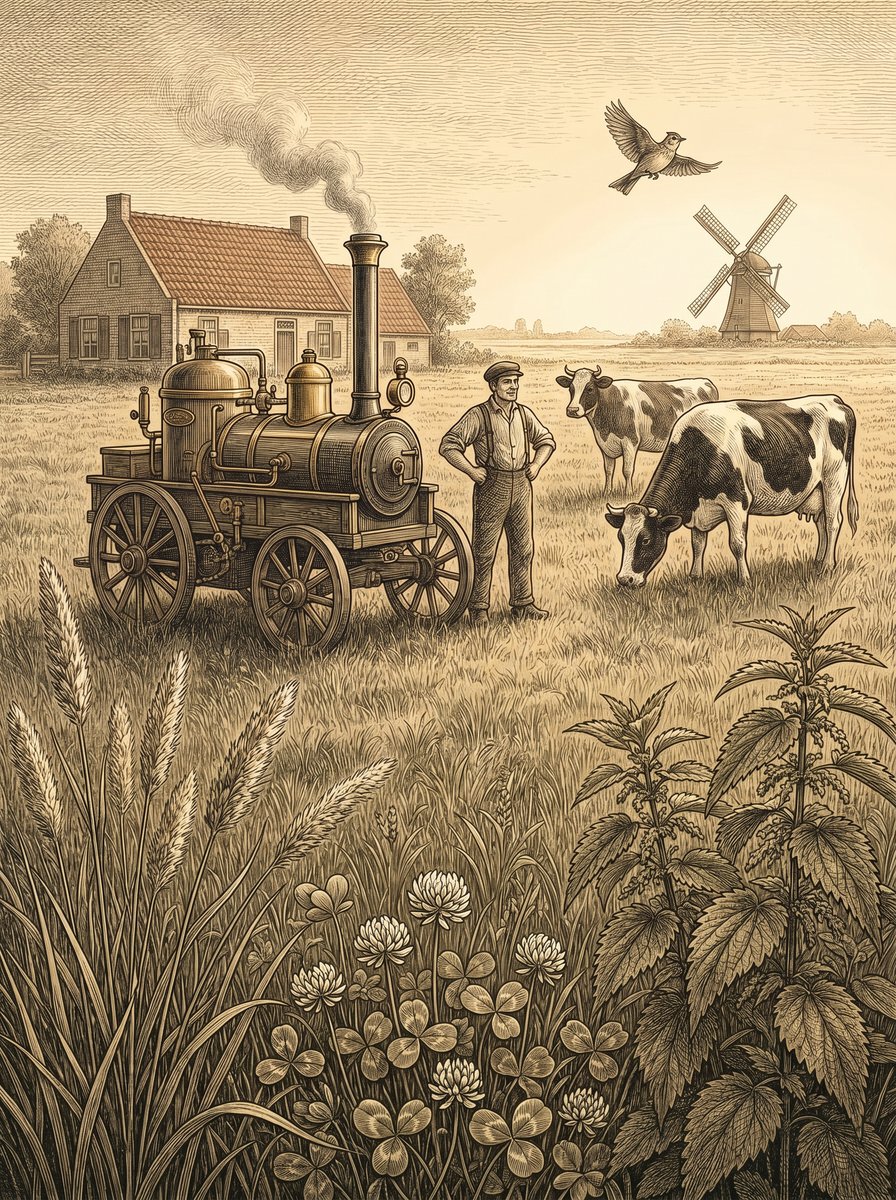
Second that nature solves her own nitrogen problem --- if you let her. White clover fixes between ten and twenty kilograms of nitrogen per hectare per year from the atmosphere, without a single gas molecule of Russian natural gas having to be converted, via the Haber-Bosch factories of BASF, into fertiliser. That is a symbiosis that has proven itself in the Dutch landscape for fifty years and that can start working again on every parcel --- provided the clover is not out-competed by artificial fertiliser. We have a nitrogen crisis because sixty years ago we replaced the clover with a factory. Not because clover cannot handle it.
Third that the stinging nettle --- which every farmer knows as a weed --- is in reality the most complete indigenous protein crop North-West Europe has. Crude protein content up to twenty-five percent on dry matter. Vitamin K, iron, silicon, calcium in concentrations no imported feed reaches. Historically it was a crucial component of cattle fodder --- until industrial agriculture struck it from the rations because it was "difficult to process", with its stinging hairs and its tough cell wall. That problem disappears completely as soon as it has gone through cold pressure explosion. A technological improvement the plant itself did not need --- but that lets it back into the cycle.
These three lessons --- the climate shift, the clover nitrogen, the stinging nettle --- stand in no coalition memo. They do stand in the field. Only: it is 2026, and ministers who have crossed the field with their own hands have become a minority.
The three plants that close the pit
On openvizier.org the architecture of Carbon-Alert NL has been set out since June. In essence it consists of three plants that grow in the Netherlands, one machine that comes to the parcel, and one end product the dairy chain can take up.
Giant Juncao is a frost-resistant grass bred by Carbon-Alert for North-West European conditions. Yield per hectare per year: thirty to fifty tonnes dry weight --- fifteen times the dry-weight yield of winter oilseed rape. Crude protein ten to thirteen tonnes per hectare, against about two tonnes for rape meal. Deep root mass that permanently sequesters carbon via a natural BiCRS mechanism in the soil column. And --- importantly --- no fertiliser needed, because the clover supplies the nitrogen.
White clover does the work Haber-Bosch does elsewhere in Europe --- biologically, free of charge, per hectare. Ten to twenty kilograms of new nitrogen per year, straight from the air, straight into the soil, directly available for the crop.
Stinging nettle --- the crop every farmer knows and no one eats any more --- supplements the ration with a density and a mineral profile no imported feed reaches.
On one and the same hectare, in the same cool-moist climate zone as the peat pasture or the sandy soil now under buffer-zone pressure, these three grow together. They do not compete. They strengthen each other. Juncao supplies biomass. Clover supplies nitrogen. Stinging nettle supplies protein density and micronutrients. What the farmer harvests on his own land is no longer one crop with one yield --- it is one ration, complete and of Dutch origin.
The machine on the parcel
On that parcel a mobile Tier 1 unit then comes that processes the biomass on the spot via cold pressure explosion followed by mechanical refinement. The fresh plant mass is brought under pressure without thermal pre-treatment, and then suddenly decompressed. The cell walls --- cellulose, hemicellulose, lignin --- tear open mechanically. The structure falls apart.
What then leaves the unit is a homogeneous, standardised hydrolysate: a rumen-stable protein concentrate in which the complete nutritional value of Juncao, clover and stinging nettle for the dairy cow has become biologically available. Classical steam-explosion factories operate at 180 to 220 degrees Celsius and consistently lose protein there through Maillard reactions. Cold pressure explosion avoids that entirely. No fuel for steam generation. No thermal breakdown of nutrients.
The measurement data --- from international cell-wall unlocking studies, from Grassa, from Dairy Campus Wageningen --- point consistently in the same direction. Dry-matter digestibility rises 24 to 47 percent. Methane emission from the cow falls 10 to 15 percent. Nitrogen and phosphate emission via manure falls 30 percent. Three problems, one mechanism, one machine. The cow that emits thirty percent less nitrogen in principle no longer needs a buffer zone around it, and the dairy factory that takes the hydrolysate no longer has to buy Brazilian soy.
What the end of the soy transport means
The Netherlands imports about 3.5 million tonnes of soy meal annually, mainly via Rotterdam, from Brazil and Argentina. Every tonne travels on average ten thousand kilometres over sea, followed by domestic distribution. Every tonne threatens after 2025 to come into conflict with the EUDR regulation, because the dairy chain cannot with certainty demonstrate that the meal has no link with deforestation. And every tonne subsidises an agricultural system in South America that meanwhile slowly dismantles the Dutch landscape through the compulsion of cheap-protein import.
On one hundred thousand hectares of Dutch Carbon-Alert NL cultivation by 2035, between thirty and forty-three percent of that soy import falls away. On two hundred thousand hectares --- still less than half of the five hundred thousand hectares under transition pressure --- the Netherlands can become self-sufficient in dairy protein. Fully. No more tankers over the Atlantic. No more EUDR audit nightmare. No more Rotterdam harbour unloading meal that has caused a habitat problem on the Brazilian countryside that the Dutch countryside subsequently exploits with buffer zones.
This is what self-sufficiency means in the modern era. Not: producing everything oneself at any price. But: keeping the strategically vulnerable at home, and using the space gained to make it more productive than the import. For dairy protein that is the answer to nitrogen, methane and EUDR at the same time.
What the €20 billion elsewhere would mean
The €20 billion for buffer zones has been announced, not spent. For €700 to €900 million --- four percent of the package --- the Netherlands can realise a full national rollout of fifteen thousand hectares of Carbon-Alert NL pilots, with the accompanying Tier 1 and Tier 2 processing infrastructure. With the remaining €19 billion the Netherlands can build fifty thousand Carbon-Alert energy hubs, or purchase 470 million tonnes of permanent BiCRS CO₂ removal --- nearly four years of Dutch national emissions definitively out of the atmosphere. Or, in the most ambitious variant, finance the complete hundred-thousand-hectare Carbon-Alert rollout that removes nineteen to twenty-seven percent of Dutch agricultural emissions in one stroke.
All three variants solve the nitrogen problem better than the buffer zone. All three preserve the farmer. All three strengthen Dutch protein sovereignty. And all three are developed on the basis of biological insights that Wageningen, Louis Bolk, Grassa and Dairy Campus in the Netherlands have long since documented --- insights for which you do not need to travel to Silicon Valley, and not to Brussels, but to the meadow on the other side of the dyke.
Related reading
The ministers deciding this summer all have an iPad and a series of briefings, no boots and no identification booklet. They will not understand that the plant on which the map depends has long since moved north, as long as the map remains their field of view. They will not understand that a cow that emits thirty percent less nitrogen no longer needs a buffer, as long as they keep calculating it behind a screen with a KDW norm set in 1992.
Nature knows this. The farmer knows it. Van Eekeren and Wamelink know it. Grassa knows it. And Carbon-Alert Ltd on Malta and Mallorca knows it --- as one of the few places in Europe where three plants, one machine and one end product have been brought together into an architecture that solves the nitrogen dossier, the methane dossier, the soy dossier and the farm-income dossier at the same time.
What we ask of the cabinet this summer is not complicated. Withdraw your buffer zones. Withdraw your €20 billion buy-out budget. Invest one percent of it in a real pilot. Go outside. To the meadow, where the clover is again coming through the sward in some places since farmers have been careful with fertiliser. To the roadside, where the stinging nettle already stands waiting. To the peat pasture, where the cow still stands but not for long if the policy stays like this.
The cow waits. The clover waits. The stinging nettle waits. Only the plants for which the buffer zones are drawn are no longer waiting. They have gone.
It is time the politicians followed them --- not north, but to nature school.
- Three problems, one answer --- the directing article of the Nitrogen edition
- They kill their lifeblood --- €212,795 per kg
- The auto-immune disease of our government strikes --- the five decisions of the first hundred days
- The Rapeseed Multiplier --- the German sister article
- What Brussels really gets --- European scale
- Four hundred and fifty million for a hole in the ground --- Zuidwending, 5 July 2026
Look into the matrix
The Voting Behaviour app runs Party × Person × Baseline for the Dutch case. Seven questions — one projection for you.
Open Voting Behaviour