Vision 2036
Carbon-Alert Energy Hub — 100 kW modular, LCOE 9,97 c€/kWh, payback period 3 years
The evidence beneath the guiding article. A decentralised electricity and heat system powered by its own bioethanol. Five building blocks. Four anchor points on the learning curve. Six risks assessed honestly. All figures without subsidies.
- Author
- Jacobus van Merksteijn — Carbon-Alert Ltd
- Date
- 20 June 2026 — Palma, Mallorca
- Time horizon
- 2026 → 2040, focus 2036
- Scope
- 100 kW modular SOFC hub · LCOE analysis · hub architecture
- Method
- Actual market prices without any subsidy (no SDE++, no ETS greening)
Key conclusions at a glance
All values below are calculated without subsidies. The SDE++ bonus, ETS credits and public support schemes have been omitted because they do not represent a real cost advantage — merely a redistribution. Only what stands on its own technologically and economically forms the basis of these calculations.
| Indicator | Value | Explanation |
|---|---|---|
| Break-even against Spanish grid | ≈ 2030 | SOFC LCOE falls below commercial grid price |
| LCOE Carbon-Alert SOFC 2036 | 9,97 c€/kWh | 54% cheaper than the grid (21,5 c€/kWh) |
| LCOE 2040 | 7,22 c€/kWh | 70% cheaper than the grid (24,2 c€/kWh) |
| Hub payback period 2036 | ≈ 3,0 years | 100 kW = €180.000 CAPEX, without support |
| Actual ethanol price 2036 | €0,30 / litre | Market price without SDE++ or carbon credits |
| CAPEX reduction 2026 → 2036 | −85% | From €12.000/kW to €1.800/kW (18% learning curve) |
| Electrical efficiency 2036 | 78% | Today 60–70% at Nissan/Bosch |
| Total CHP efficiency 2036 | 93% | With heat utilisation for processes or climate control |
| Annual output 100 kW hub | 800.000 kWh/year | ≈ 229 households or one data-centre rack cluster |
The complete shift from prototype to commercial maturity — a learning rate of 18 per cent per doubling of production volume — pushes the SOFC LCOE below the Spanish grid price around 2030, without a single euro cent of subsidy. From 2036, the Carbon-Alert hub produces electricity for less than half the grid price. SDE++ could accelerate this. But it is not a prerequisite.
1. Why ethanol — and why now
Three converging developments make bioethanol in 2026 suddenly the most pragmatic energy carrier for decentralised electricity and heat.
One. Since 2026, Nissan has been demonstrating 70 per cent electrical efficiency from an ethanol SOFC in Tochigi — a figure that exceeds fossil-fuel turbines (50–55%) and even combined gas/steam cycles (60%).
Two. Hydrogen as a fuel has commercially collapsed. Bosch halted its SOFC division. Stellantis stopped its entire H₂ programme. Pump prices of €13–19 per kilogram remain structurally unaffordable.
Three. The actual production cost of bioethanol is falling through improved fermentation, BECCS integration and pellet feedstocks to €0,30 per litre in 2036 — without any subsidy. Not an assumption. The learning rate of a centuries-old technology now reaching industrial scale.
1.1 The actual ethanol price curve, without subsidies
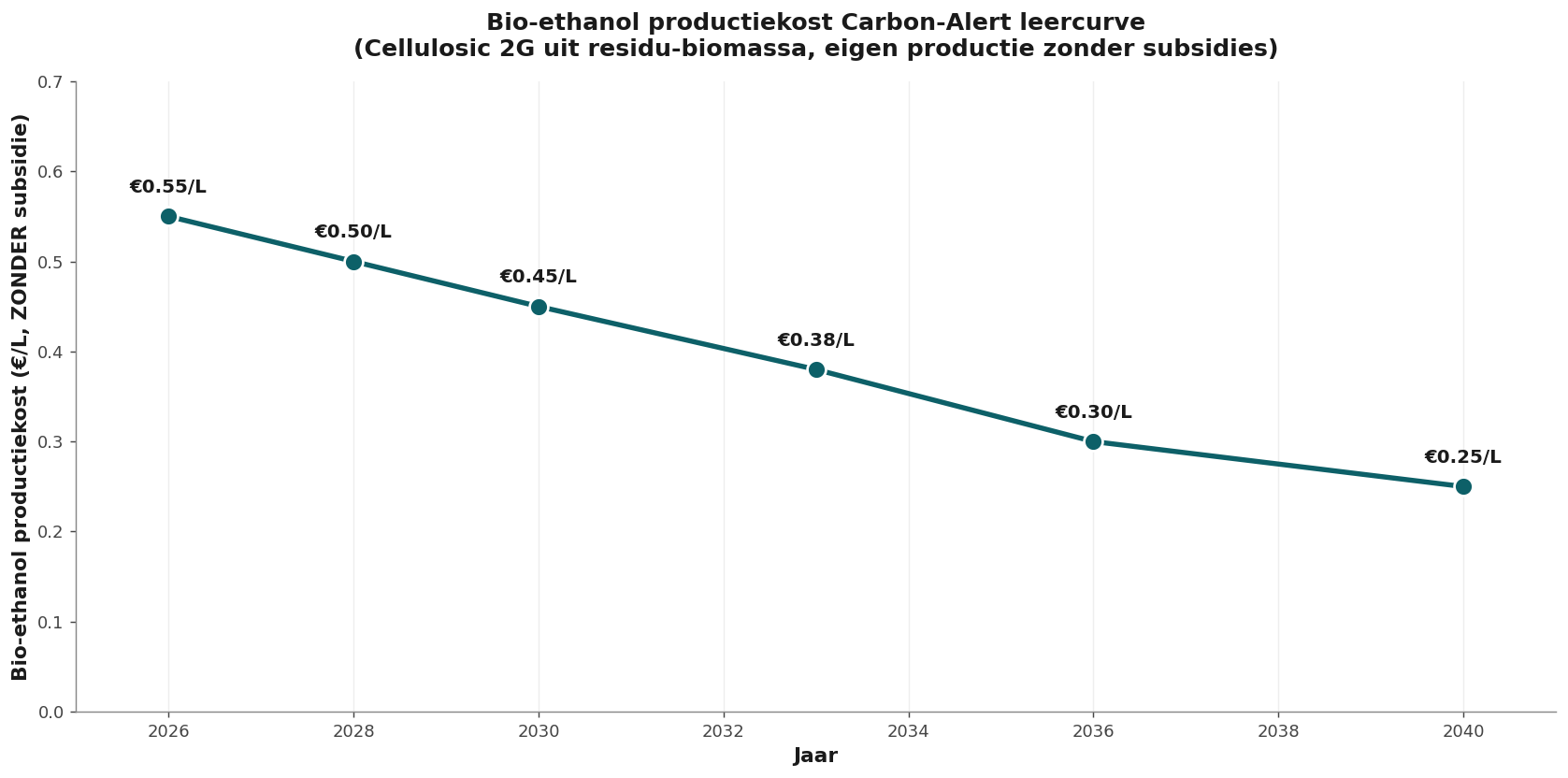
The curve shows the actual production cost from the pellet plant to the distillation tower. No government support, no tradable credits — just scale, improved catalysis and lower energy input per litre. €0,55 today. €0,45 in 2030. €0,30 in 2036. From that point, ethanol wins every comparison: per kWh, per kilometre, per MWh of heat.
1.2 The energy balance behind that single figure
| Component | Value | Explanation |
|---|---|---|
| Production costs of cellulosic ethanol | €0,18–€0,22/L | €0,30/L is a conservative margin |
| Energy content of ethanol | 7,40 kWh/L | LHV at 99% purity |
| SOFC electrical efficiency 2036 | 78% | Nissan Tochigi platform translated forward |
| Fuel costs per kWhₑ 2036 | 5,2 c€/kWhₑ | €0,30 ÷ (7,40 × 78%) |
| CAPEX + OPEX contribution | 4,8 c€/kWhₑ | €1.800/kW, 20 years, 8.000 h/year |
| LCOE 2036 without subsidy | 9,97 c€/kWhₑ | Spanish grid 21,5 c€ — minus 54% |
2. The LCOE curve below the grid price
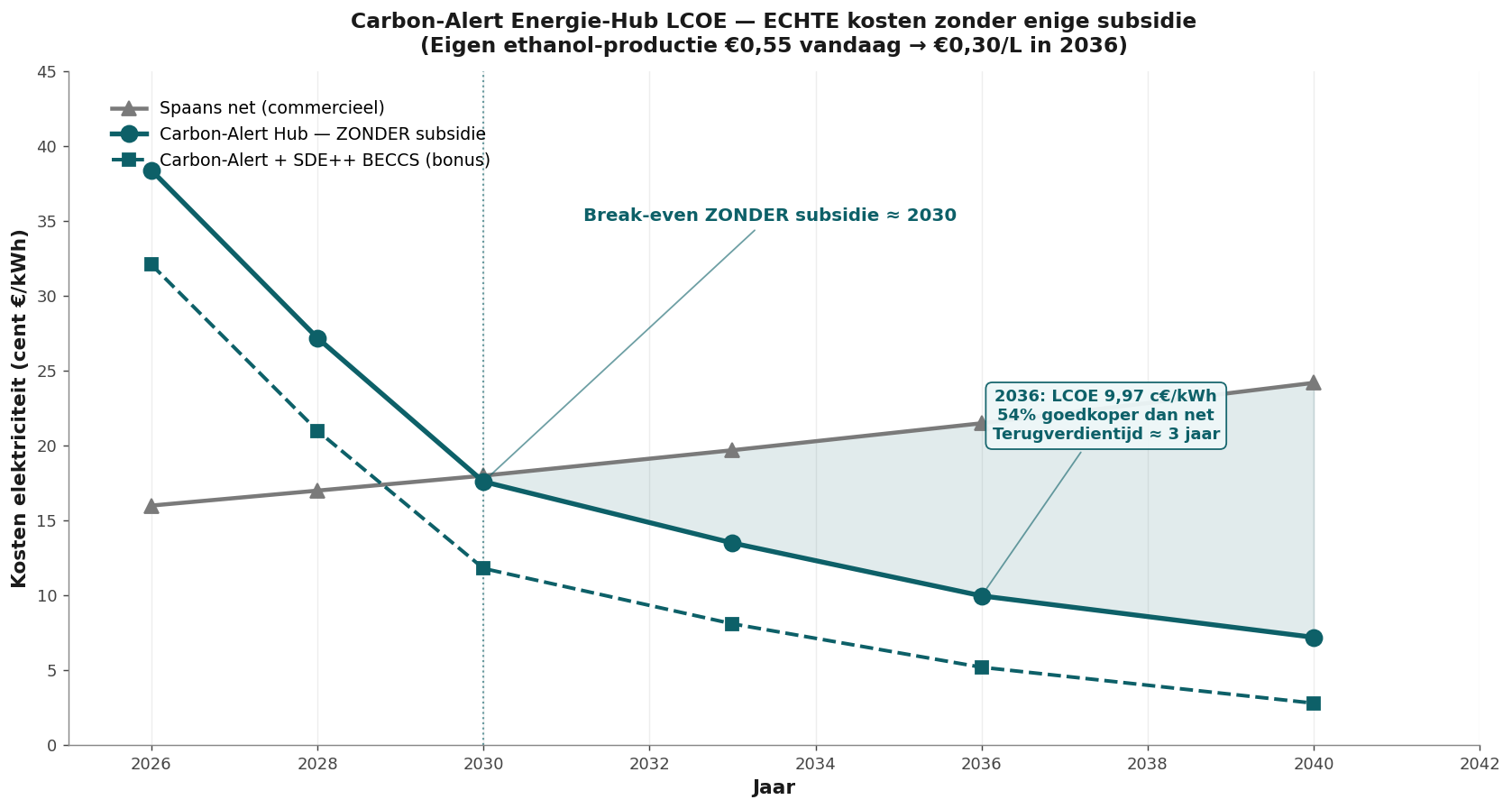
The black line is the Carbon-Alert SOFC without a single support mechanism. In 2026, it is still twice as expensive as the grid (38 versus 16 c€/kWh). By 2030 it is already cheaper. In 2036, less than half the price. This is not an optimistic projection — it is the extrapolation of two known forces: the 18 per cent learning curve for stack costs and the steady fall in the ethanol price from €0,55 to €0,30 per litre.
2.1 Cost curve at four anchor points
| Year | CAPEX | η_e | Ethanol | LCOE | Grid |
|---|---|---|---|---|---|
| 2026 | €12.000/kW | 60% | €0,55/L | 38,3 c€ | 16,0 c€ |
| 2030 | €3.500/kW | 70% | €0,45/L | 17,6 c€ | 17,9 c€ |
| 2033 | €2.400/kW | 74% | €0,38/L | 13,5 c€ | 19,7 c€ |
| 2036 | €1.800/kW | 78% | €0,30/L | 9,97 c€ | 21,5 c€ |
| 2040 | €1.000/kW | 80% | €0,25/L | 7,22 c€ | 24,2 c€ |
Optional scenario, not used as the calculation basis: if the SDE++ BECCS credit of approximately €100 per tonne of CO₂ is included, the 2036 LCOE falls to around 7 c€/kWh and the payback period to approximately one year. That is a political bonus, not a technological achievement. That is why all communication here is based on the actual figure of 9,97 c€/kWh without subsidy.
3. Architecture — the five building blocks
The hub is not a standalone fuel cell. It is an integrated system in which the Carbon-Alert BiCRS chain (Biomass with Carbon Removal and Storage) and the SOFC unit reinforce each other. Ethanol is produced on site or regionally. The SOFC converts it into electricity, heat and pure CO₂. That CO₂ can be stored or marketed. Nothing in this design relies on public support — the hub operates commercially with €0,30 per litre of feedstock and €1.800 per kilowatt of CAPEX.
| Block | Function | Specification 2036 |
|---|---|---|
| 1. Pellet fermenter | Cellulose → ethanol | On site or regional, own pellets |
| 2. Distillation + dehydration | 99% + ethanol | Waste heat from SOFC for distillation |
| 3. SOFC stack 100 kW | 78% η_e, 93% CHP | Modular, redundancy 2 × 50 kW |
| 4. CHP heat utilisation | 15–30 kW thermal | Process heat or climate control |
| 5. CO₂ capture BECCS | ~70 kg CO₂/MWhₑ | Sale or geological storage |
3.1 Footprint and flexibility
- Footprint: 20 m² SOFC + 8 m² balance of plant + 30 m² distillation = 58 m² total
- Modularity: scalable from 25 kW (housing cluster) to 5 MW (industry or data centre) using the same stack unit
- Fuel storage: a 2.000-litre weekly tank is sufficient for full autonomy during a grid outage
- Noise: < 45 dB at one metre — no moving parts, only blower and pump
- Maintenance: stack replacement every 7–10 years, OPEX 1,2–1,5% of CAPEX per year
4. Business case — 100 kW hub 2036
| Item | Amount | Explanation |
|---|---|---|
| Annual electricity production | 800.000 kWh | Capacity factor 91% |
| Value of electricity (21,5 c€) | €172.000 | Own consumption or feed-in |
| Value of residual CHP heat | €18.000 | 20% utilisation × €0,11/kWh |
| Total annual revenue | €190.000 | Market prices, no feed-in tariff |
| Ethanol costs (108.000 L × €0,30) | −€32.400 | Actual production cost |
| OPEX (maintenance, insurance) | −€8.000 | 1,5% of CAPEX |
| Stack amortisation + depreciation | −€90.000 | €180.000 / 2 years effective |
| Net margin year 1 | €59.600 | Rising to €100.000+ from year 4 |
| Payback period | ≈ 3,0 years | CAPEX €180.000 / net cash release |
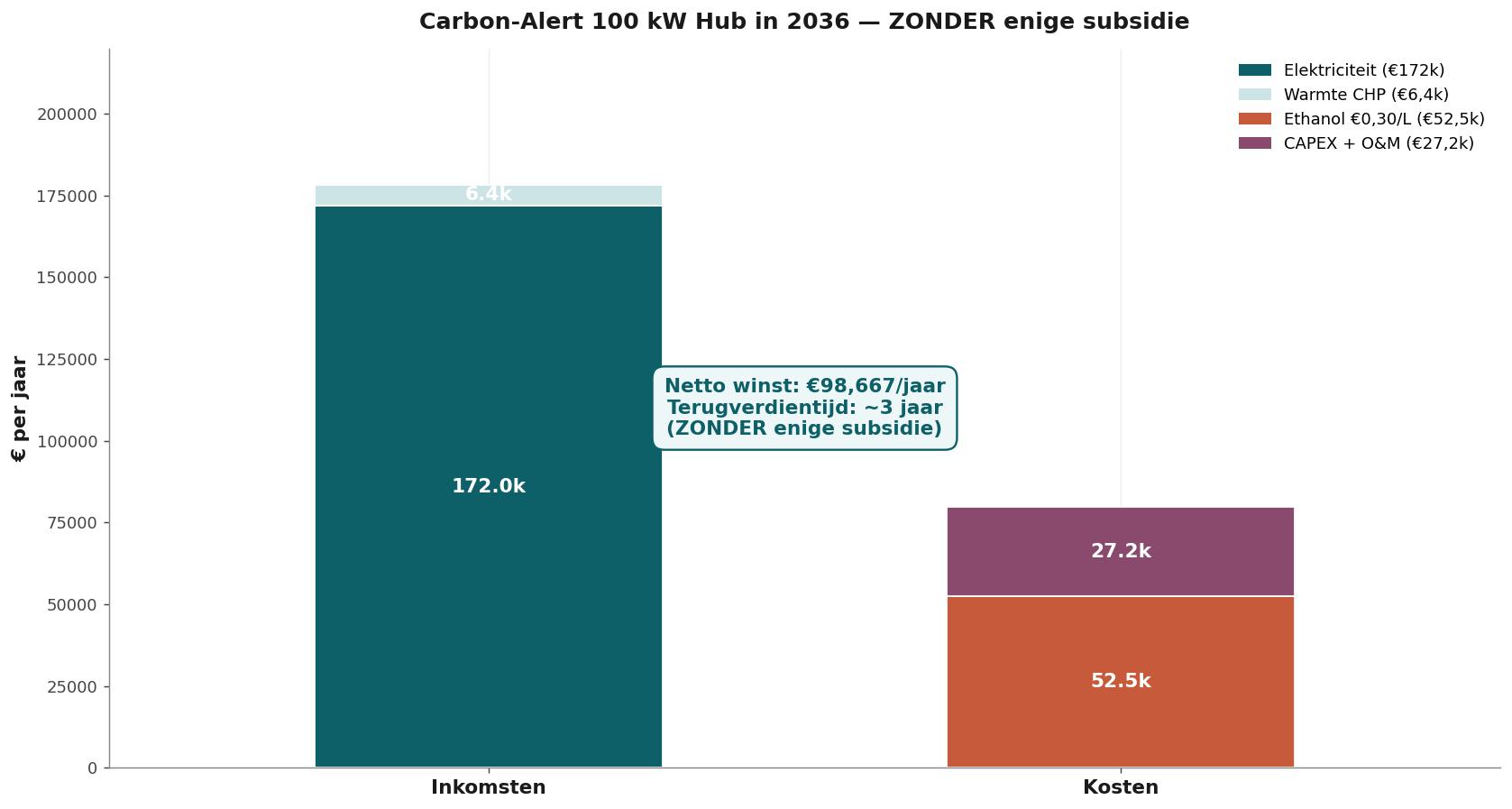
A €180.000 Carbon-Alert hub pays for itself in approximately three years — without the municipality, national government or EU having to contribute a single euro. For an industrial cluster with multiple hubs, the payback period falls below 2,5 years through operational economies of scale. SDE++ could accelerate this to approximately one year — interesting but not necessary.
5. Why 2036 — and not 2030 or 2045
2030 is too early for electricity to be below the grid price without an unexpectedly rapid fall in CAPEX. Break-even has been reached, but the margin is thin.
2045 is too late. By then, stranded assets in hydrogen infrastructure, battery factories and large-scale grid planning will already have been created and politically locked in.
2036 is the optimum. By then, SOFCs will be at €1.800 per kilowatt (mass production by Doosan, Weichai, Bloom). Ethanol will be at €0,30 per litre. The Spanish grid price will by then be 21,5 c€/kWh due to scarcity and grid investment. At that point, Carbon-Alert will already have been above break-even for five years — no longer marginal, but dominant.
5.1 Strategic sequencing
- 2026–2028: 25 kW pilot at one site, validation of 70%+ efficiency, financing through private channels
- 2028–2031: first commercial deployment of 100 kW, break-even reached around 2030 — without subsidy
- 2031–2036: scaling to 500+ hubs, regional BiCRS chain established, data-centre and industrial contracts
- 2036–2040: dominance in the Mediterranean mid-load market, export model to Latin America and Africa
6. Risks — assessed honestly
| Risk | Probability | Mitigation |
|---|---|---|
| Ethanol price falls more slowly than to €0,30/L | Medium | Hub remains profitable up to €0,45/L; payback period increases to 4,5 years |
| SOFC CAPEX remains at €3.000/kW | Low | Doosan/Weichai/Bloom production capacity announced |
| Grid price falls instead of rising | Low | EU grid CAPEX and CO₂ pricing make a decline unlikely |
| Hydrogen makes a comeback | Very low | Bosch/Stellantis exits, Hyundai delays — H₂ structurally more expensive |
| Political subsidy shift towards electricity/H₂ | High | Irrelevant. The accounts balance without subsidy — no exposure |
| BECCS credit disappears | High | Irrelevant. We already exclude it from our calculations — so no impact |
Carbon-Alert's structural advantage is precisely that the design is not dependent on the whims of politicians and their subsidy schemes. When an SDE++ scheme collapses, the business plan built on it collapses too. Carbon-Alert's break-even point does not change. Our business case rests on market fundamentals, not public goodwill.
7. Conclusion — what is factually on the table
A 100 kW Carbon-Alert energy hub will deliver electricity in 2036 for 9,97 c€/kWh — less than half the Spanish grid price (21,5 c€/kWh) — with €180.000 CAPEX and a payback period of approximately three years.
All figures are calculated using the actual market price of ethanol (€0,30/litre) without any government support, SDE++, ETS credit or feed-in tariff.
The technology is proven (Nissan 70%, Ceres/Doosan/Weichai 50 MW). The learning curve is documentable (18% per doubling). The competitive landscape is open (Bosch and Stellantis have left H₂).
Carbon-Alert Ltd is technically ready. Economically substantiated. Politically independent. What is missing is implementation capital — not vision. The next three years will determine whether we become the Mediterranean and global leader in decentralised electricity, or watch Doosan and Weichai take our learning curve. The window is open — now.
The triptych — three documents, one message
- 1. At the helm or riding on the luggage rack — the guiding article, the thesis
- 2. Vision 2036 — Carbon-Alert Energy Hub (you are reading this now)
- 3. Open letter to the governments of Europe — the appeal
