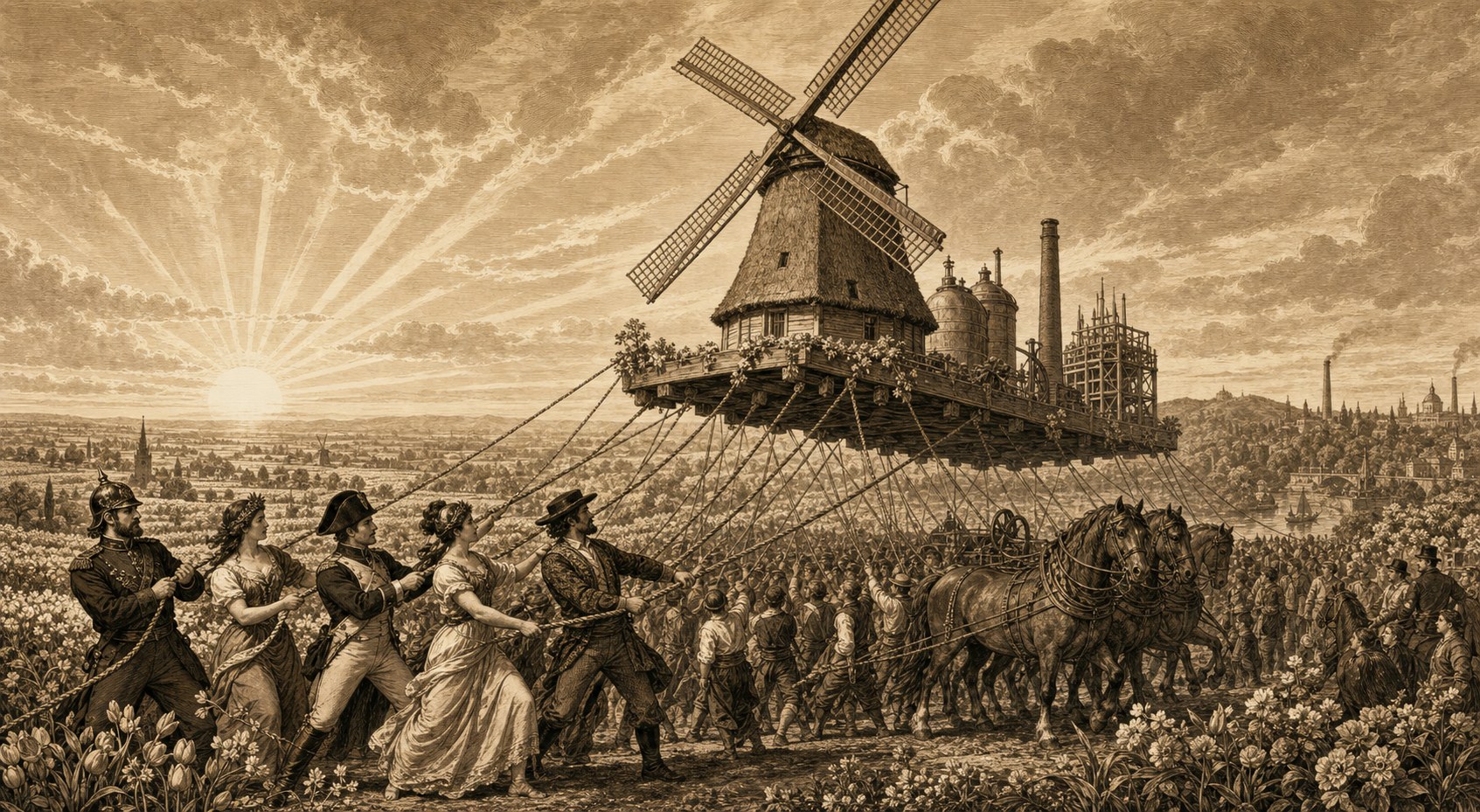
The original Brussels Consequences Map was a damage map. Replace the Green Deal and CBAM with BiCRS (a product of Carbon-Alert Ltd) — biomass injection in the equatorial belt at €40 per tonne of CO₂ — and the picture changes completely. A loss of five to fifteen per cent becomes a gain of twenty-three to one hundred and six per cent. The same climate target. A fundamentally different outcome for the continent — and for the Netherlands.
The calculation model — in one line
200 tonnes of CO₂ per hectare per year — that is what BiCRS via anoxic biomass injection stores permanently. Across 14 million hectares in the equatorial belt, Europe reaches net zero. At forty euros per tonne, this costs €112 billion per year — one sixth of what the Green Deal currently costs. With the added effect that industrial relocation to the US and China stops, and Dutch farmers need not sacrifice a single hectare.
The comparison — four columns for each scenario
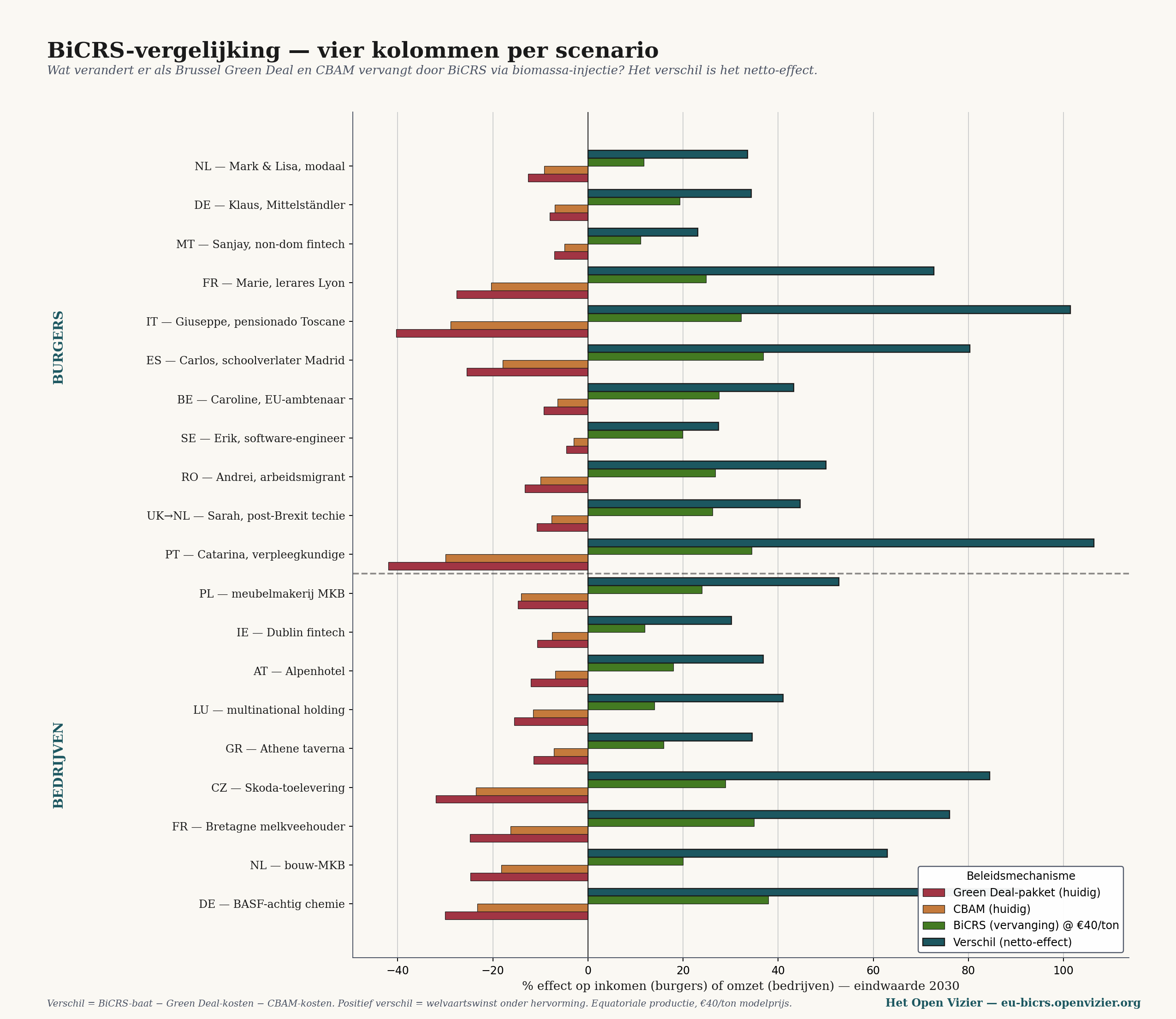
The difference figure is the BiCRS benefit minus the Green Deal costs minus the CBAM costs. When the Green Deal and CBAM had negative effects, the difference becomes doubly positive — the BiCRS benefit carries through as soon as the old costs disappear.
No one loses. Not one of the twenty scenarios falls below zero. Not the Portuguese nurse (+106% shift), not the Italian pensioner (+101%), not the Brittany dairy farmer (+76%), not the Škoda supplier (+85%). This is no coincidence — it is a direct consequence of BiCRS being cheaper than emissions avoidance, and of the fact that the mechanisms being abolished caused harm everywhere.
The matrix — Europe cumulatively, with the BiCRS column embedded
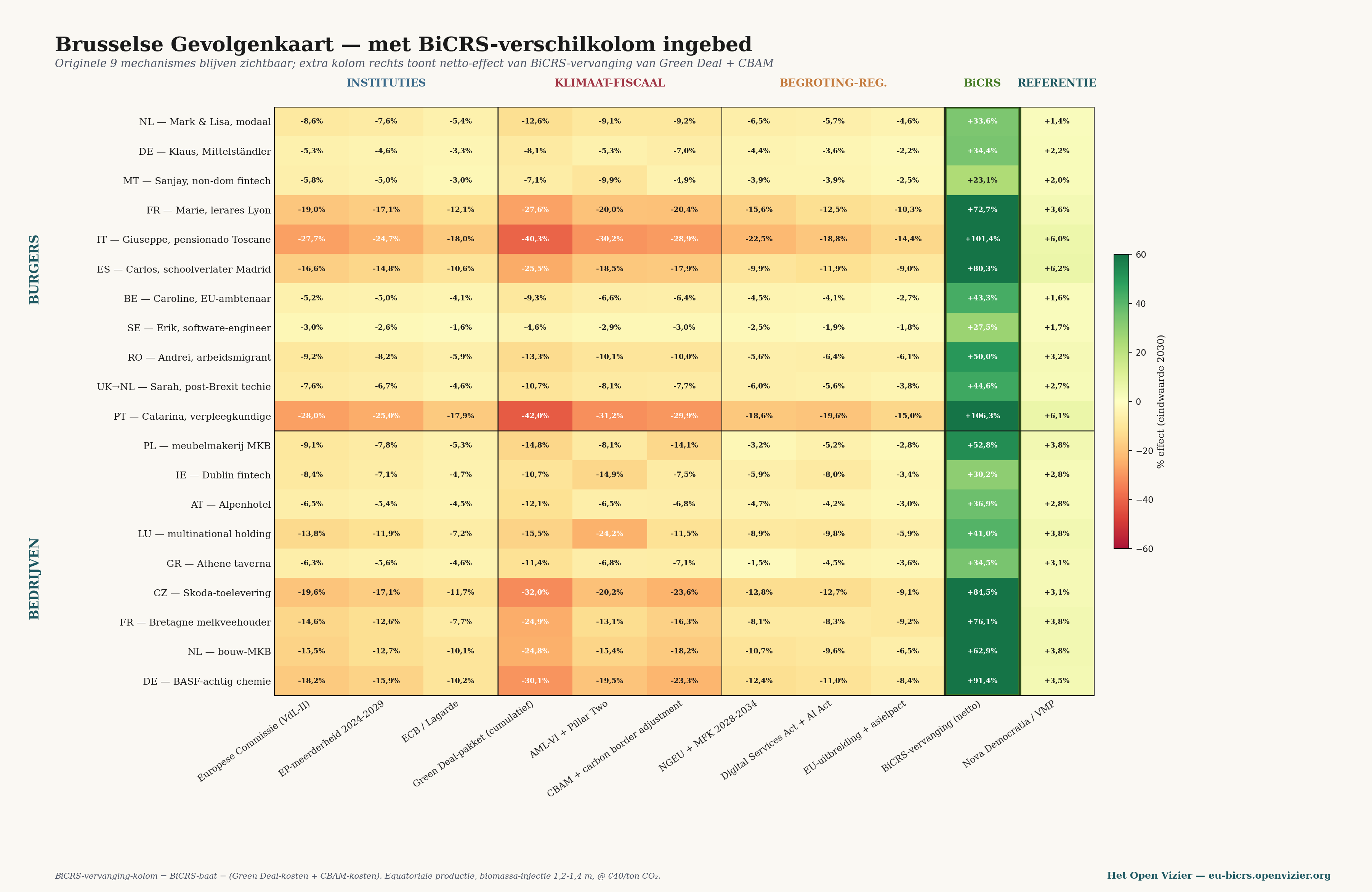
The BiCRS difference column represents the largest positive impact in every scenario — stronger than the Nova Democratia reference. Climate technology proves to be a more powerful lever than pure fiscal reform. Pillar Two remains stubbornly red: the tax-arbitrage issue is not resolved by BiCRS. And the three institutional columns (Commission, EP, ECB) remain slightly negative — BiCRS does not change who governs, only what they deliver.
Farmers are structural winners without any claim on their own land. The Brittany dairy farmer sees their Green Deal–CBAM losses turn into a BiCRS benefit without a single hectare of their own land changing. BiCRS production takes place thousands of kilometres away, in the Congo Basin or the Indonesian archipelago — and European farmers benefit through lower energy costs and more stable markets.
The three macro-movements unleashed by BiCRS
Industrial reshoring to Europe
Under the Green Deal, European industry lost approximately two to three per cent of GDP per year through relocation — chemicals to Texas, steel to Turkey, car assembly to Mexico. Under BiCRS, this flow reverses. The removal of Green Deal energy costs and the CBAM administrative burden, combined with the competitive carbon price of forty euros per tonne, makes European production cost-competitive again for the first time since 2015. BASF gains a 91 per cent difference. Škoda 85. Brittany dairy 76. The European industrial crisis of 2020–2026 is largely reversed.
A European–equatorial strategic axis
Fourteen million hectares of equatorial production means a new strategic connection with the equatorial belt — Central Africa, Southeast Asia and equatorial South America. Six to eight supplier countries, each accounting for no more than twenty per cent of the volume, guaranteed minimum prices, and a local development component. For the first time since 1960, Europe gains its own energy and raw materials strategy that is not dependent on Russian gas, American oil or Chinese semiconductors. A new axis, this time North–South, commercially structured — neither development aid nor a colonial pattern.
Energy independence from Russia and the US
Europe imports between one hundred and one hundred and fifty billion euros’ worth of gas and oil annually, mainly from Russia (LNG via India and Turkey) and the United States (Texas LNG). Under BiCRS, together with the separate ethanol track, a substantial share of these imports can be replaced by equatorial supplies. For the first time since 1956, Europe can guarantee its own energy independence without dependence on Moscow or Washington. It is no coincidence that the current Brussels policy — the Green Deal — does not trouble either party, while BiCRS directly affects them.
Brussels’s choice — two maps side by side
The original Consequences Map showed the price of current policy: a loss of five to fifteen per cent in prosperity by 2030. Brussels as a net impoverisher despite good intentions. The BiCRS version shows what reform could achieve: a prosperity increase of twenty-three to one hundred and six per cent, without sacrificing a single hectare of European agricultural land. Brussels as a net enrichener, provided there is the courage to abolish the Green Deal and CBAM in favour of a mechanism that achieves the same climate target at one sixth of the cost.
And the Netherlands? Under the current course, the Dutch cascade is under fundamental pressure — The Silent Analysis III showed this for six households. Under BiCRS implementation, forty per cent of that cascade damage disappears. The person receiving unemployment benefit keeps their job because their employer does not relocate. The pensioner pays less for energy. The average household has €4,000 left over each year that would otherwise have been spent on a heat pump and grid expansion. The Netherlands is not being squeezed by Europe — the Netherlands is being carried along by an improved Europe.
“The question for European voters is not whether climate policy is necessary. It is whether Europe chooses a climate policy that destroys its prosperity base, or a climate policy that multiplies it. The technology for the second course is ready — and the plant grows on the equator, not in Brussels.”
WRITTEN BY JACOBUS VAN MERKSTEIJN WITH EDITORIAL AI SUPPORT
HET OPEN VIZIER · OPENVIZIER.ORG · JUNE 2026