The plastic fine that should have been a carbon credit
Why the Netherlands hands €235 million to Brussels for something for which it should be receiving €99 million — and what that money flow should be doing instead.
By Jacobus van Merksteijn · Malta, July 2026
In 2024 the Netherlands paid €235 million to the European Union as a plastic own-resource — a levy of €0.80 per kilogram of non-recycled plastic packaging waste, introduced in 2021 as the fourth own resource of the EU budget. The underlying volume: approximately 294,000 tonnes of plastic packaging that does not enter the recycling stream. For that volume the Netherlands gets a fiscal penalty.
The upside-down world of the EU plastic levy
The penalty is based on the assumption that non-recycled plastic is by definition an environmental problem. That assumption holds as long as the plastic is burned, which in the Netherlands is indeed happening to around 500 kilotonnes of plastic a year in waste-incineration plants. Incineration converts 78 percent of the carbon in plastic directly into atmospheric CO₂: 2.64 kg CO₂ per kg plastic, according to the standardised LCA calculations of CE Delft (2021).
For the Netherlands this means about 1.32 megatonnes of fossil CO₂ per year purely from the plastic fraction of waste incineration — a figure that fits within the wider WIP emission of 7.2 Mton CO₂ of which 2.7 Mton is fossil, as the national government's Waste Incineration Policy Vision 2030 confirms.
But here the problem arises: the levy does not punish incineration. It punishes "not recycling". And with that the EU entangles itself in a fundamental error of thought, because there is a third option the levy does not recognise — an option climatically superior to both recycling and incineration.
The WIP doctrine the EU itself contradicts
As earlier set out in The Brussels Consequences Map — BiCRS version, Europe burns around 25 million tonnes of plastic waste a year in waste-incineration plants. This yields 2.86 kg CO₂ per kilogram of plastic — together 71.5 megatonnes of CO₂ per year, which comes to about 2.4 percent of total EU emissions.
By way of comparison: the same quantity of heat energy, generated from natural gas in a modern CHP installation, would produce about a third of that CO₂ emission. Plastic incineration is per kilowatt-hour delivered about 3.7 times more climate-damaging than natural-gas combustion for the same energy. This is not a question of energy content — plastic actually has a high calorific value. It is a question of carbon density: fossil plastic contains more carbon per joule than gas.
The consequence: over the past decades the Netherlands has built up a WIP infrastructure critical for district heating and electricity, but which structurally produces more CO₂ than the gas installations it replaces. And on those emissions we pay twice since 2021: once via the national CO₂ levy and EU ETS for WIPs (compulsory since 2024), and once via the plastic own-resource levy to Brussels.
What plastic actually is: above-ground carbon storage
On a scale of five hundred to five thousand years, plastic without UV exposure is non-degrading. Polyethylene films from the 1950s found in soils are still structurally intact. Polymer chains only break down under the influence of photons (UV), oxygen radicals, or enzymatic processes that at room temperature and without catalysis need hundreds of generations.
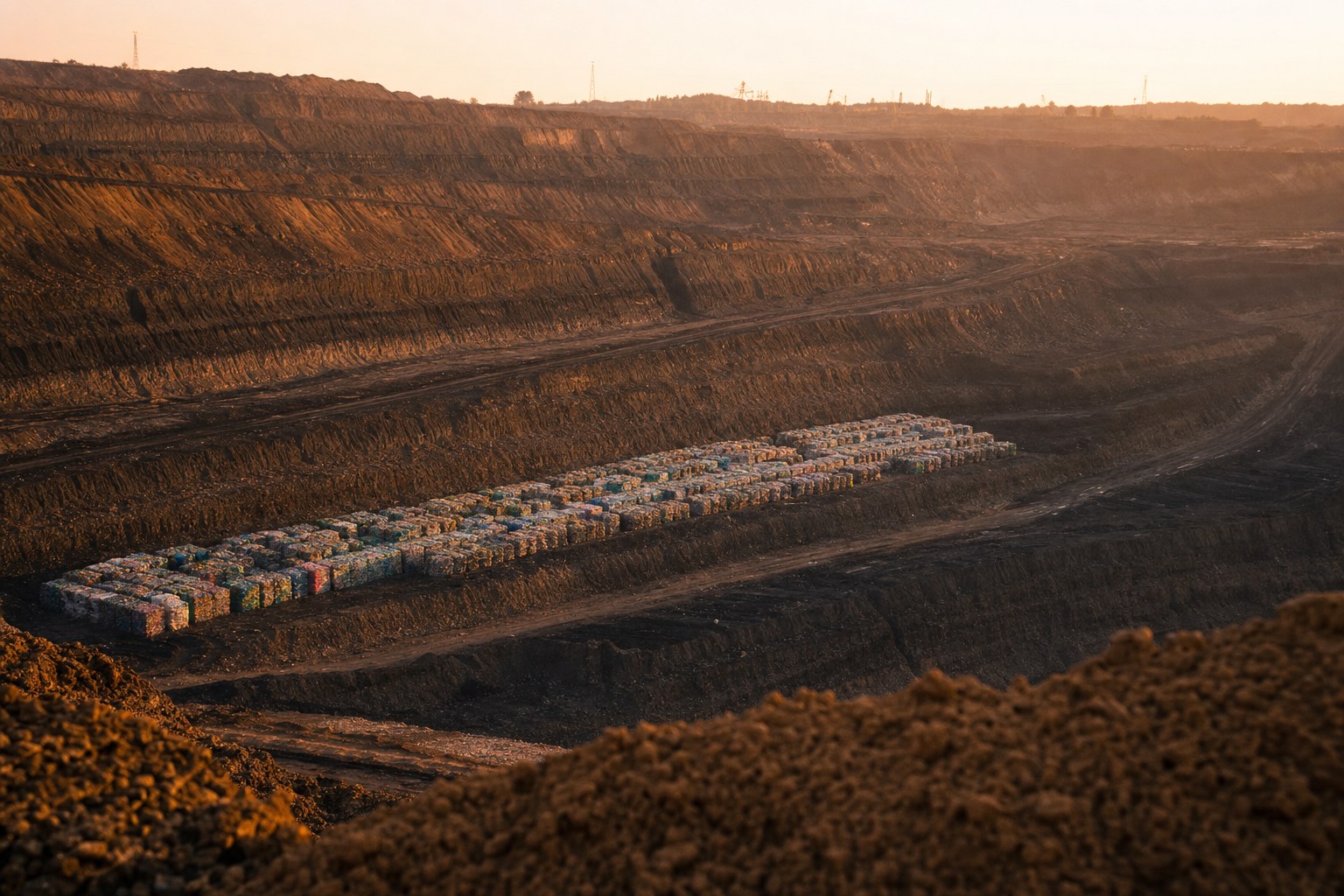
That makes plastic in a UV-free, chemically inert environment — for example at two hundred metres depth in a closed brown-coal pit — one of the most stable forms of carbon storage humanity knows. More stable than biochar (which slowly decays), comparable to coal and gas (which are geologically stable for hundreds of millions of years), and with one crucial advantage: there is no economic temptation to dig it up again. Who would want to recover what we consciously sealed off?
The EU has itself acknowledged this principle in the Carbon Removals Certification Framework (CRCF), which since 2024 certifies permanent carbon removal (>1,000 years) as a tradable carbon credit. Bio-CCS, DAC storage and biochar are explicitly in the framework. Structurally stable plastic in geological storage is not.
That is not a physical question. It is a political one.
The calculation for the Netherlands
If the EU were to apply its own CRCF logic consistently to the plastic fraction that today disappears into Dutch WIPs, the reckoning looks like this:
| Item | Current situation | Alternative (storage) |
|---|---|---|
| Plastic contribution to Brussels | −€235m | €0 |
| ETS levy on 1.32 Mton fossil CO₂ from WIP | −€99m | €0 |
| Carbon credits on storage (1.32 Mton × €75/ton) | €0 | +€99m |
| Net position Netherlands | −€334m | +€99m |
Fiscal reversal: €433 million per year. From a net payer, the Netherlands becomes a net producer of climate performance — for the same plastic stream, only with a different final destination.
At the expected ETS prices for 2030 (€100–130 per tonne of CO₂ according to the European Commission Impact Assessment 2024) the reversal grows to €500–600 million per year.
At EU-27 level, with the 25 megatonnes of plastic that disappear into WIPs annually: €5.4 billion per year in potential carbon-credit value, against the current plastic levy revenue of about €6.4 billion. For two-thirds of that amount the EU could eliminate its entire perverse plastic incentive.
What the money should do: biobased polymers that do not decay
The reversed money flow must serve one aim: the development and market scaling of biobased permanent polymers.
This is a fundamentally different direction from current policy, which relies on compostable bioplastics (PLA, PHA, starch derivatives) — polymers that precisely do decay, and thus release their stored carbon back into the atmosphere within years to decades. For carbon storage, compostability is a defect, not a feature.
What matters are three categories:
1. Bio-PE, bio-PP, bio-PET — chemically identical to their fossil equivalents, but with carbon originating from atmospheric CO₂ via biomass (sugar cane, maize, C4 grasses). Braskem already produces bio-PE commercially in Brazil. Price currently lies at €2,500–3,500 per tonne against €1,200 for fossil PE.
2. PEF (polyethylene furanoate) — the 100 percent biobased successor to PET piloted by Avantium in Delfzijl, with superior barrier properties. Price premium currently a factor of 2–3 against fossil PET.
3. New classes: bio-nylons, biobased PU, and the third generation where the sugar-to-monomer route no longer runs via fermentation but via direct catalytic conversion.
With the freed-up €334 million per year, the price premium (€1,500/tonne) can be bridged for about 223,000 tonnes of biobased replacement — well over three quarters of the current Dutch non-recycled packaging volume. With European economies of scale, price parity with fossil polymers would be achievable within ten years.
And crucially: every tonne of biobased polymer that is permanently stored removes 2.86 tonnes of atmospheric CO₂ for good. The entire Carbon-Alert chain that Het Open Vizier has described earlier — equatorial biomass via C4 grasses to ethanol and polymers — closes in this model: carbon is taken from the air, passes through a productive use cycle, and ends in geological storage in former brown-coal pits.
The storage infrastructure Europe has to wind down anyway
The German brown-coal pits Hambach, Garzweiler and Inden — together more than 23 billion cubic metres of empty volume after their planned closure around 2038 — are the most obvious storage location. They lie in a country that already plans tens of billions in post-mining remediation, they are deep enough (>100m) to guarantee UV absence, and they have existing transport and security infrastructure.
For scale: the entire Dutch annual plastic waste of about 300,000 cubic metres would fit in one ten-thousandth of the Hambach pit alone. For the entire EU output of 25 million tonnes per year that is one thirtieth. One brown-coal pit can absorb more than a century of European plastic production.
The alternatives — Polish salt mines, exhausted Dutch gas fields, British coal mines — are comparable in scale and already considered for CO₂ storage under the CCUS directive 2024. For plastic storage the requirements are actually simpler: no pressure vessels, no gas-leakage monitoring, no risk of groundwater acidification. Solid inert plastic stays where it is placed.
Three policy proposals
One — CRCF extension for plastic storage
The Netherlands must argue in Brussels for explicit recognition of structurally stable plastic (fossil and biobased) in geological storage as certified carbon removal under the CRCF. The technical criteria are available; it is a political step.
Two — differentiation of the plastic levy
The current €0.80/kg levy punishes all non-recycled plastic equally. Restructuring: burned plastic retains the levy (or higher); plastic dumped in certified permanent storage receives levy exemption and a carbon credit. This is budget-neutral for Brussels but reverses the incentive.
Three — national biobased polymer fund
The freed-up resources (€235m contribution + €99m ETS avoided = €334m/year minimum) are earmarked for three purposes: price compensation on biobased permanent polymers for product packaging, R&D into direct catalytic conversion (biomass-to-monomer without fermentation), and construction of certified geological plastic storage facilities.
The deeper logic
The current plastic levy regime is a classic example of policy that attacks symptoms rather than systems. Plastic is not inherently bad; burning plastic is bad. Dumping plastic in open landfill is bad. But plastic itself — as a molecular structure — is precisely what you want to have if you want to take carbon out of the atmosphere and do something useful with it before putting it away.
The EU framework does not make that distinction. It treats "plastic in a WIP chimney" and "plastic in geological storage" identically. That is not carelessness, it is a political choice from a time when the recycling lobby was more dominant than the climate lobby. Now that the urgency of direct carbon removal is an official EU objective (minus 55 percent net in 2030, climate-neutral in 2050), that choice is no longer defensible.
The Netherlands has the infrastructure (Rotterdam port for logistics), the industry (Chemelot, Delfzijl, Sittard-Geleen), the knowledge (Avantium, DSM, TNO) and the need (2030 climate targets unattainable without direct CO₂ removal) to be ahead in this direction. The fiscal swing of €334 million per year is not small but not enormous either — it is exactly enough to finance an industrial turnaround without additional tax pressure.
One thing is missing: the recognition that today we pay €235 million for something for which we ought to be paid. And the courage to say that in Brussels.

Jacobus van Merksteijn
Malta
Editor-in-chief of The Open Visor. Systems thinker on climate, energy and democracy.