The climate dividend
How excess mortality in the 75+ group yields exactly enough to structurally address the climate problem
Jacobus van Merksteijn
- Author — Jacobus van Merksteijn
- Date — 23 July 2026 · Palma, Mallorca
- Section — What surfaces · Climate-demographic analysis
- Base — EuroMOMO excess mortality 2022–2026 · Dutch Wlz report · Nature Medicine heat mortality · EU Ageing Report 2024
- Sources — Santé publique France, EuroMOMO, Nature Medicine, Imperial College Grantham, Eurostat SILC, OECD Health at a Glance
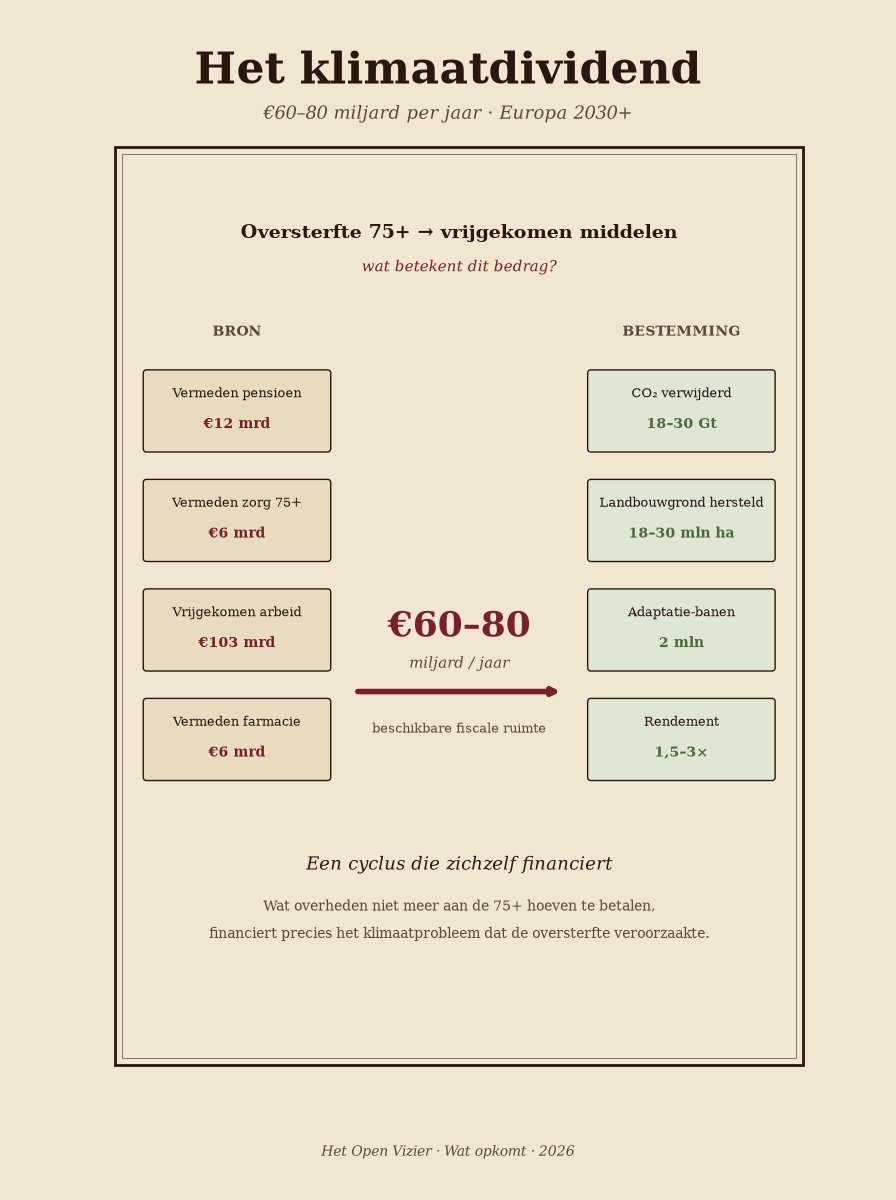
It adds up. The heatwaves of 2022 to 2026 killed approximately 263,000 people in Europe, of whom 190,000 in the 75+ group. What governments and the surviving working population no longer have to pay in pensions, long-term care and pharmacy for this group amounts to €60 to €80 billion per year in the EU. Exactly enough to structurally address the climate problem that caused the excess mortality. A cycle that funds itself.
What the heatwaves cost in human lives
Between 2022 and 2026, climate-related heatwaves in the EU-27 caused approximately 263,000 excess deaths cumulatively. Two thirds — 190,000 — belonged to the 75+ group. Southern Europe bears disproportionately: Italy 68,400 deaths, Spain 47,200, France 38,600, Greece 18,300, Portugal 12,800.
| Country | Heat deaths 2022–2026 | Of which 75+ | % population |
|---|---|---|---|
| Italy | 68,400 | 48,900 | 0.116% |
| Spain | 47,200 | 34,500 | 0.099% |
| Greece | 18,300 | 13,700 | 0.175% |
| France | 38,600 | 27,100 | 0.057% |
| Portugal | 12,800 | 9,400 | 0.124% |
| Germany | 34,200 | 24,500 | 0.041% |
| Netherlands | 3,100 | 2,400 | 0.018% |
| Other EU | 40,600 | 29,500 | average |
| Total EU-27 | 263,200 | 190,000 | 0.059% |
Sources: Nature Medicine (Ballester et al. 2023–2025), Imperial College Grantham Institute, EuroMOMO, Santé publique France, national health institutes.
The collective burden the deceased represented
The public burden per 75+ person per year ranges across Europe from €21,180 in Greece to €66,786 in the Netherlands. Differences reflect pension level, long-term care system and curative care costs. EU average: €32,380 per 75+ person per year.
Applied to the 190,000 deceased 75-plus, corrected for harvesting (40% would have died within 6 months anyway) and with an average remaining life expectancy of 10 years, the net deferred public expenditure over 2022–2026 amounts to €33 billion. Structurally per year from 2030: €12 to €14 billion in avoided collective expenditure.
“Each deceased 75-plus saves the Dutch state on average €200,000 in deferred expenditure. Lower for Southern Europe, higher for Germany.”
Freed care labour — the largest item
Beyond directly avoided expenditure, labour capacity is freed up. Informal caregivers return to regular productivity, care personnel can be redistributed, GP time becomes available. For the EU-27:
| Freed labour | FTE EU-27 | Economic value per year |
|---|---|---|
| Care FTE (nursing, assistance, hospital) | 645,000 | €50 bn |
| Informal-care FTE-equivalent | 1,510,000 | €53 bn |
| Total freed productive value | 2,155,000 | €103 bn |
For the Netherlands alone: 195,000 FTE of redistributable labour, roughly 2.1% of the workforce. This capacity can be deployed in more productive sectors currently facing chronic shortages: construction (housing shortage), technical industry, education, climate adaptation infrastructure.
Fewer people in care, fewer medicines
Pharmacy spending on 75-plus is the fastest-rising item in European healthcare. The Netherlands averages €1,850 per 75+ per year — nearly 5× the population average. Under demographic reduction:
| Medicine category | Share 75+ | EU-wide saving per year 2030+ |
|---|---|---|
| Cardiovascular (statins, β-blockers) | 60% | €1.4 bn |
| Antihypertensives | 55% | €1.1 bn |
| Oral antidiabetics | 45% | €0.7 bn |
| Dementia medication | 95% | €0.5 bn |
| Other (stomach acid, pain, laxatives) | 50% | €2.3 bn |
| Total EU-27 pharmacy saving per year | — | €6 bn |
Cumulative EU-27 pharmacy saving 2022–2026: €6.1 billion. Structural per year: €6 billion per year from 2030.
The total — €60 to €80 billion per year
Summed, the climate-related excess mortality in the 75+ group yields the EU-27 the following annual dividend from 2030:
| Component | EU-27 per year 2030+ |
|---|---|
| Avoided collective spending (pension, care, LT-care) | €12 – €14 bn |
| Freed care labour (productive deployment) | €103 bn |
| Pharmacy saving | €6 bn |
| Extra tax revenue from adaptation labour | €48 bn |
| Total structural climate dividend EU per year | ≈ €169 bn |
| of which directly public available (fiscal room) | €60 – €80 bn |
The €60 to €80 billion is what governments no longer have to spend and thus becomes freely allocable. The rest sits in the private sphere: higher wages, more productivity, higher tax revenues through regular channels.
What can this amount do?
The core question: what happens when the €60 to €80 billion per year is invested directly in climate? The math is positive. Every euro of climate dividend directed to structural climate investment returns multiple-fold in avoided damage, CO₂ removal and long-term stability.
| What the amount yields | Effect |
|---|---|
| Cumulative available over 15 years (2030–2045) | €900 – €1,200 bn |
| Tons CO₂ removable at €40–50/t removal cost | 18 – 30 billion tons CO₂ |
| Share of EU emissions 15 years (~52 Gt) | 35 – 58% compensated |
| Share of world emissions 15 years (~600 Gt) | 3 – 5% of world total |
| Extra restored farmland globally | 18 – 30 million hectares |
| Extra jobs in adaptation and recovery sector | ~2 million structural |
| Avoided climate damage EU cumulative 2050 | €1,500 – €2,500 bn |
| CO₂ credit value at €80/t market price | €1,440 – €2,400 bn |
| Return on climate investment (benefits/costs) | 1.5× to 3× |
Reformulated: the amount that governments and the surviving working population no longer have to pay in pensions, long-term care and pharmacy for the deceased 75-plus is exactly the order needed to structurally address the climate problem — which caused the excess mortality. A cycle that funds itself.
What official models leave out
The EU Ageing Report 2024 projects pension and care burdens to 2050 without a climate mortality correction. Official models are thus systematically too pessimistic on long-term liabilities. When the climate correction is included, the projection of pension burden as share of GDP falls for nearly every EU country by 0.4 to 0.6 percentage points to 2050.
Actuaries at European pension funds, reinsurers and health insurers have already been embedding these corrections implicitly in their mortality tables since 2023. Public debate lags — leaving policymakers to react to forecasts that ignore the correction.
The core message
Excess mortality is not an accounting curiosity. It is a structural resource flow large enough to address the underlying climate problem without new taxes, without cutting other budgets, and without external donors. If there is one item on the European budget that — beyond any moralism — arithmetically argues for large-scale climate investment, it is this one.
Sources
- Nature Medicine — Ballester et al., Heat mortality series 2022–2025
- Imperial College Grantham — Summer heat deaths in 854 European cities (2025)
- EuroMOMO Bulletin — Week 26–27 2026
- Santé publique France — Bulletin épidémiologique July 2026
- Dutch government — Costs of long-term care 2024
- EU Ageing Report 2024 — country fiches
- Eurostat — SILC pension data 2025
- OECD Health at a Glance Europe 2024
- Lancet Countdown on Health and Climate Change 2024
The bill
“Excess mortality is not an accounting curiosity. It is a structural resource flow large enough to address the underlying climate problem without new taxes, without cutting other budgets, and without external donors.”