The food in the supermarket is our nourishment. When we believe the supermarket earns too much and we dismantle it through price regulation, taxation, and compliance—then we are not destroying "shareholder profits." We are destroying our supply line. Empty shelves, imported leftovers from countries where the same rules do not apply, higher prices for lower quality. That is not justice; that is self-amputation.
This principle applies everywhere. The farmer, the entrepreneur, the SME, the exporter, the industrial investor, the education provider: they are all supply lines. Anyone who says they earn too much, and that their room for maneuver must therefore be restricted, is cutting into the circulation of the entire system. Not out of malice—but out of thoughtlessness regarding the workings of a living organism.
The Supermarket Case
What we are fed, and how we destroy it
The Dutch supermarket—Albert Heijn, Jumbo, Lidl, Aldi, Plus—feeds 17.5 million people. Three times a day. Every day. Seven days a week. No one complains about famine; the shelves are full; prices are relatively low; the quality is overwhelmingly good.
Margins in the Dutch supermarket chain are 2.1 to 3.4 percent—below those of Spanish, German, and Italian retail. The big profits are not with the supermarket itself; they lie with the supplying oligopolies (dairy, bread, meat processing, soft drink brands). But in the public imagination—fueled by politicians looking for an enemy—the supermarket is the profiteer.
What happens if we restrict supermarket margins through legislation, introduce price regulation, or impose additional requirements via Competition Law? The chain loses investment capacity. Distribution centers are not modernized. Fresh food shops close. Logistics are taken over by foreign competitors who do not know the rules. Shelves become less stocked, less fresh, less varied. The consumer loses more than he gains through price regulation.
Worse still: when the supermarket chain weakens, the Dutch farmers who supply it also weaken. The sales line becomes unreliable. Farmers quit. Imports fill the gap. The supply line now runs through Romania, Brazil, and Vietnam—and it is more expensive, more fragile, and shorter than before.
This is not a plea for "unlimited profits." It is a warning that the supply line that literally feeds us is not an abstraction. It is measurable in calories, kilograms, filled baskets, available choice. Anyone who constricts it does not get justice, but less food.
The Supply Line as Natural Law
The supermarket is one supply line. But the principle is universal. Everything that lives has a supply line. The body has respiration, nutrition, and circulation. A community has agriculture, crafts, and trade. A company has revenue and labor productivity. A state has a productive sector that generates taxes. A civilization has an energy system that makes its work possible. Cut into any of those supply lines, and the overlying system shrinks or collapses.
This is not ideology. This is a physiological and thermodynamic fact. Every organization—from a single cell to a transnational state—needs a net inflow of energy and nutrients greater than its loss. When outflow exceeds inflow, breakdown occurs. Not tomorrow, not in ten years—but inevitably.
The Principle of the Supply Line
Nothing lives without a supply line. Not the cell, not the farm, not the company, not the supermarket, not the municipality, not the nation, not the European Union. He who demands preservation without protecting the supply line that pays for that preservation is engaged in self-liquidation—regardless of his intentions.
Replacement is what a healthy supply line does constantly. Cells are replaced. Crops shift. Businesses are modernized. Technology is succeeded. Not as a loss, but as a condition for survival. A system that blocks replacement blocks its own supply line.
Three Forces, One Fallacy
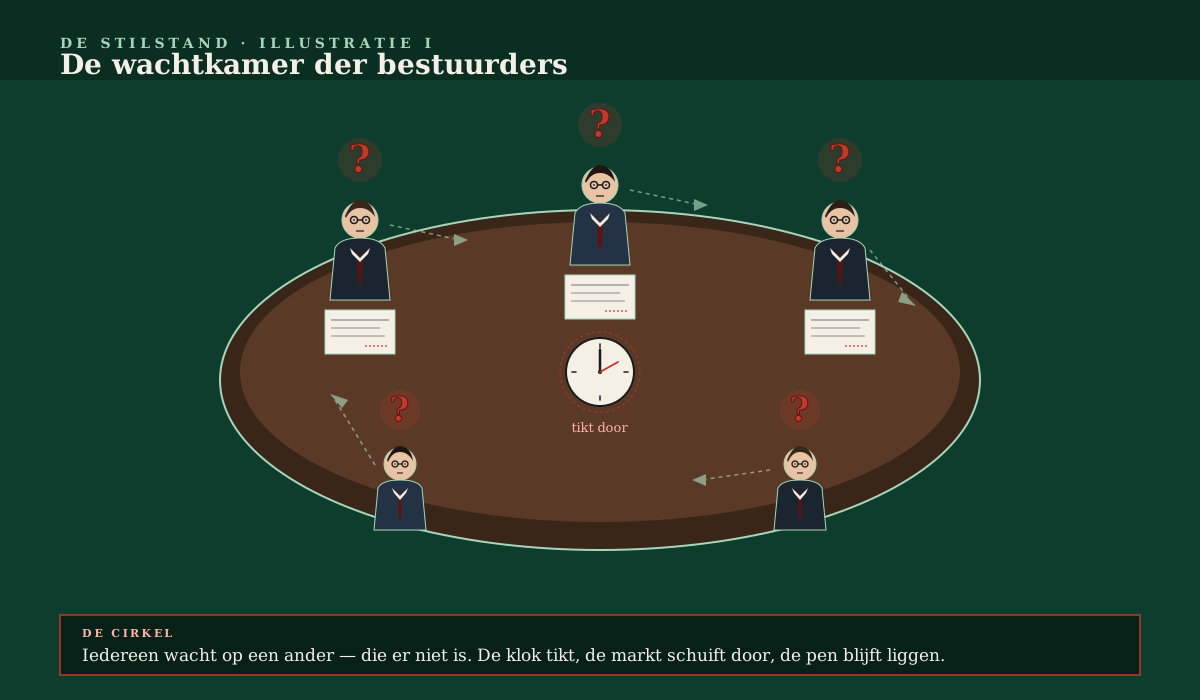
Three political forces in Europe share the same structural fallacy: they want to preserve what exists plus more, without acknowledging what that does to the supply line.
The Brussels Climate Government
Wants to preserve: the climate zones of 1990, the species of 1990, the landscape of 1990. Plus extra: emission reduction of 55 percent by 2030, biodiversity at 1970 levels, everything net-zero. Simultaneously: more regulation, more subsidies, more civil servants, more compliance.
Supply line: the European productive sector. This is being constricted via ETS prices, CBAM tariffs, energy prices, regulation, and compliance costs. Result: the German automotive industry is disappearing to China (500,000 FTE already gone since 2023), energy-intensive industry is moving to the US, farmers are leaving the sector en masse, prosperity is shrinking. The Brussels climate government can only achieve its goal by constricting the supply line from which its own budget originates.
The Dutch Left-Wing Parties
GroenLinks-PvdA, the left-wing variant of D66, BIJ1, Volt: want to preserve—the welfare state of 1980, the minimum wage, employee protection, the pension. Plus extra: more healthcare, more education, more housing, more climate action, more accessibility, more redistribution.
Supply line: the Dutch SME, the self-employed entrepreneur, the substantial shareholder (DGA), the exporter, the innovative industry. This is being constricted via corporate tax, Box 2 increases, income tax rates, ZZP rules, permit processes, nitrogen mandates, and growth taxes. Result: entrepreneurs leave for Portugal or Dubai, families with growing wealth emigrate, the SME sector shrinks. The left-wing coalition can only achieve its goal by constricting the supply line from which it extracts its redistribution.
The Trade Unions
FNV, CNV, sectoral unions in healthcare, education, construction, industry: want to preserve—permanent jobs, fixed wages, fixed pensions, a fixed work week, fixed rights. Plus extra: higher wages, a shorter work week (32 hours), more vacation days, more sick pay, more job retention, more dismissal protection.
Supply line: the same employers from whom the members receive their wages. They are being constricted via collective labor agreement (CAO) increases that can no longer be offset by productivity improvements. Result: the employer either automates, goes bankrupt, or relocates—and the jobs the unions wanted to protect disappear. The union can only achieve its goal by constricting the supply line from which its members' jobs arise.
The Shared Error
All three want preservation plus extra demands, in complete disregard for the supply line that must pay for it. None of the three asks the question: where does the money come from that pays for this, and what happens to that source when we put it in a vice?
When the supply line fails, first the extra demands become impossible, then preservation itself fails, and eventually the entire system collapses. This is not a prediction—this is how organisms, companies, municipalities, and states have perished for thousands of years.
No Self-Knowledge, No Revolution
Here we touch the deepest layer. It is not that administrators are too cowardly to say that something is wrong. It is not that they lack backbone. It is that they lack the self-knowledge to know that it is wrong—and that is a structural error, not a character flaw.
Self-knowledge is the ability to judge for yourself whether something is right or wrong, independent of what the majority, the law, the curriculum, or the committee thinks of it. Self-knowledge does not arise from books. It arises from making mistakes oneself, feeling oneself that a road is a dead end, bearing the pain of a wrong choice oneself, and learning from it oneself. That is what gives a person self-knowledge: lived mistakes.
A system that excludes mistakes also excludes self-knowledge. An education that makes all paths safe does not make people wiser—it makes them incompetent to become wise. We have educated three generations in an environment where every decision was already made for them, every answer was already filled in, every exit was already marked. The result: an entire administrative layer without a single truly lived mistake to its name. Not because they wouldn't have dared to make one—but because the system never gave them the chance.
The Structural Error
Revolution—in the sense of daring to say that something is wrong and that there is another way—requires self-knowledge. Self-knowledge requires lived mistakes. Lived mistakes require the right to go wrong. That right has been taken away by three generations of safe education, safe administration, safe procedures, safe career paths.
What remains is an administrative layer that takes everything it must do on authority, for it has no personal anchor point from which to say “this isn't right.” Not out of cowardice—but out of a lack of instrument. The instrument is called self-knowledge. It was never granted to them.
This is why criticism from within the system remains superficial. Those who have grown up within the system can only be critical within the terms of the system itself. They can say "this procedure can be more efficient," not "this procedure as a whole is wrong." They can say "more subsidy" or "less subsidy," not "no subsidy." They can say "net-zero in 2030" or "net-zero in 2035," not "net-zero is the wrong metric." The radical question—whether the concept itself is sound—they cannot even formulate, for their language was formed within the concept.
The revolution that is needed is therefore not a political one. It is epistemic: the restoration of self-knowledge as a legitimate source of judgment. Only those who know what they know—because they have lived it themselves, and not because a textbook or a committee told them—can say that the emperor has no clothes. Everyone who derives their knowledge exclusively from the emperor's clothing factory sees clothes where there are none.
The System Reflexively Expels Its Rebels
Here a second mechanism comes into play that sits one layer deeper. Our whole society—our institutions, our procedures, our decision-making, our education, our entire model of civilization—is built on evolutionary action and thinking. Small steps, consensus building, gradual change, caution. Those who move within this are recognized and accepted. Those who move outside it are by definition alien to the system.
The revolutionary is not someone who goes too far. He is someone who goes outside the logic on which the system itself is founded. He asks questions that cannot be asked within the system. He sees patterns that are not visible within the system. He suggests directions that cannot be addressed within the system. That doesn't automatically make him right—but it does make him indigestible to the system that produced him.
And so something disconcertingly human happens: we expel him without really thinking about him. Not out of anger, not out of consideration, not out of refuting argument. Reflexively. He is marginalized in the press, not cited in research, refused for committees, not hired for positions. His ideas are either found inexplicable—“I don’t understand that, so it can’t be right”—or nicely framed as "conspiracy theory," "extremist," "no scientific consensus," "unrealistic," "unfeasible." All words that say nothing about the content of what he claims. All words that only say: he doesn't fit in with us.
Three examples from our own reality
BiCRS / ethanol from equatorial biomass: an evolutionary solution to the CO₂ issue—carbon cycling instead of enforceable net-zero—that works perfectly elsewhere in the world (Brazil, Indonesia) and is systematically rejected in Europe. Not because the numbers are wrong. But because it falls outside the ETS+CBAM paradigm upon which the entire climate bureaucracy is built. Anyone proposing BiCRS is not a candidate for an EU position.
VMP — a Voluntary Mandate Party: a political form that is not bound to voters and therefore can take decisions that voters might not like. On paper, exactly what is needed for the transition. In practice: unknown, uncategorized, not in line with "how we do things in the Netherlands." Not refuted—unread.
The Consequences Map: a diagnostic instrument that shows the drain on prosperity per voting position. Something fundamentally outside the scope of Voting Assistants (StemWijzers). But it is not picked up by existing political science, not discussed by the press, not investigated by committees. Not because of errors in the matrix—but because of an inability to think outside its own framework.
The pattern is the same everywhere: it is not the content of what the rebel says that is investigated, but his position relative to the system. "Who is he, exactly?"—instead of "what is he saying?" "Where does he stand?"—instead of "is it true?" That is not malice; that is reflex. The system has its antibodies, and they work automatically.
The Evolutionary Trap
Evolutionary action works as long as the environment changes evolutionarily—slowly, predictably, with enough time for consensus building. We face an environment that is changing revolutionarily: AI in months, China-speed in weeks, climate in years-not-decades. At such a moment, a purely evolutionary system is not safe, but lethal—it has no mechanism to change course quickly.
At exactly this tipping point, we have deprived ourselves of the capacity to recognize revolutionaries. Not because they don't exist—they exist, and more so every day. But we have developed a reflex against them. The result: the people who could still save us now are expelled before we have even read them.
This is not a plea to agree with every outsider. Many rebels are wrong—that is exactly why we built our evolutionary system. But the problem is not that we are skeptical of rebels; the problem is that we no longer investigate. We have replaced skepticism with reflex. A healthy society would test the revolutionary on his arguments. A stiffened society expels him based on his form.
Europe Has Bricked Up Its Detours
Anyone who thinks this is a Dutch problem, a French problem, a German problem—is mistaken. The problem has established itself across the full breadth of the European continent, such that there is no longer any detour. Not through another country, not through another coalition, not through another law. All roads have been bricked up by laws that serve the same purpose: ensuring that a real decision can no longer be made anywhere.
Look at how the pattern runs through all layers of European society:
- Legislation: every decision must first pass through 27 member states, then the European Parliament, then the Court of Justice, then 27 national parliaments, then 27 national judges, then municipalities, then appellate courts, then stakeholders. Ten to fifteen years later, the decision is watered down beyond recognition.
- Permit processes: building a new factory takes an average of seven years in the Netherlands; five in Germany; eight in France. Not because the factory is complex—because the procedure has been made complex by a stack of decades of protection laws that allow nothing to move.
- Education: teachers are no longer allowed to fail, schools can no longer be strict, universities can no longer create rankings that hurt feelings. Everyone is guided safely through the system. No one ever enters a dead end. Thus, no one learns that they were wrong.
- Labor market: firing costs a fortune, hiring brings long-term obligations, automation is fiscally punished. The employer no longer dares to decide—so no decision is made, and productive employment emigrates.
- Governance: ministers may not decide without committees, committees may not decide without consultation, consultations may not decide without peer review, peer reviews may not decide without a hearing. There is no longer a place where the decision falls.
- Climate policy: ETS, CBAM, RED-III, Fit-for-55, Green Deal, Just Transition—every instrument is designed so that no member state can step out, no parliament can deviate, and no future government can reverse it. The laws of today have already made the laws of tomorrow impossible.
A Closed System
The pattern is the same everywhere: every law makes it impossible to make the next law differently. We do not live in a democracy where we can change course. We live in a closing cocoon of laws by people who could not know the future—and who no longer allow us to discover that future ourselves.
The laws of the people before us cannot know the future. They were written for the world they saw. We face a different world. But we are not allowed to decide—because their laws forbid it.
Nature Knows More Than Our Laws
If all roads are bricked up by human laws, there remains one guide that cannot be abolished by committees, lawyers, or majorities: nature. Nature knows no quorum, no veto, no consultation round. For three billion years, it has constantly made decisions, gone wrong, and learned. It knows much more than any legislator—because it has lived what we can only predict.
What would happen if we took nature as our guide again, instead of the laws of people who do not know the future?
- Material cycling instead of net-zero: nature knows no "net-zero CO₂". It knows a carbon cycle in which every gram that comes out of the ground is stored somewhere else—in biomass, in oceans, in soil. BiCRS follows that cycle. ETS and CBAM try to freeze it.
- Replacement instead of preservation: nature replaces constantly. Cells, leaves, species, biotopes. What is no longer adapted to its environment disappears; what fits gains ground. Our laws try the opposite: preserve everything, at all costs.
- Diversity instead of monoculture: a healthy soil has thousands of microbial species side by side; a healthy economy has thousands of entrepreneurial species side by side. Our laws produce monocultures—one type of education, one type of company, one type of labor contract, one type of supplier.
- Adapted fast action instead of endless consultation: an organism that "consults" too long when a predator approaches is dead. Nature rewards speed of decision. Our laws reward delay of decision.
- Local adaptation instead of central uniformity: in nature, no two biotopes are the same. Our laws impose one rule for all of Europe, from Lapland to Sicily, as if soil, climate, and culture do not exist.
The difference between a law and a natural law is this: the law people make is contingent—it applies as long as the majority supports it and can be different tomorrow. Natural law is necessary—it applies whether you recognize it or not. He who governs against gravity falls. He who governs against the supply line hungers. He who governs against replacement goes extinct.
The Guide Back to Nature
Europe has placed its laws above nature and has thereby become trapped within itself. The only way out is not better laws—it is letting nature take the lead again. Not as sentiment, not as religion, not as a "biodiversity goal." But as the factual teacher with three billion years of experience in surviving under constant change.
Our laws must adapt to it, not the other way around. That is not an anti-modern statement; it is the only remaining chance to still know the future—because those who want to fix it in advance are, by definition, unable to do so.
The Education Case
We are educating for yesterday's world
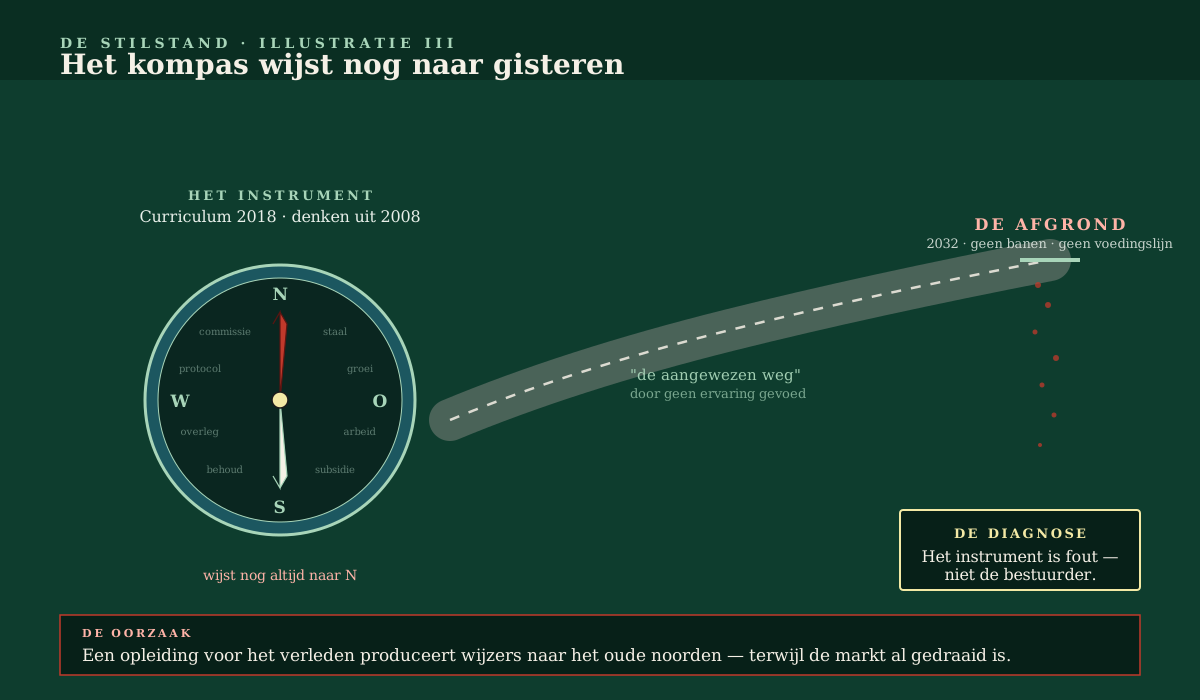
The Netherlands trains approximately 8,500 engineers annually at its technical universities. These students will begin their studies in September 2026, finish in 2031 or 2032 (Bachelor's) or 2034 (Master's), and enter the labor market with knowledge shaped over six to eight years—shaped by curricula established somewhere between 2018 and 2023.
In that same period, GPT-4 (2023) has made way for GPT-5 (2024), Claude 3 (2024), Gemini-2 (2025), GPT-5.5 (2025), the first Agentic-AIs, and the first fully autonomous software engineering agents. An AI system in 2026 can already perform more typical engineering tasks than a graduate junior engineer can—faster, more accurately, and without sick leave.
This does not mean that engineers are becoming obsolete. It means that the type of engineer we are now training—generic knowledge carrier, student-of-textbook-from-2018—is no longer viable in 2032. The student of 2026 who graduates in 2032 enters a market where AI is already doing his work. He becomes structurally unemployed, or must retrain for something AI doesn't do: judgment, ethical negotiation, physical-spatial work, complex multi-stakeholder management.
The Dutch education sector is not keeping up. Curricula are adjusted more slowly than technology itself evolves. Universities are institutionally configured for stability, not agility. Teachers' unions resist radical restructuring. The Ministry of Education works with multi-year plans that are by definition behind. The result: 8,500 engineers annually delivered into a world for which they have not been trained.
The costs of this mismatch are enormous and avoidable:
- Student financing: €20,000–35,000 per student × 8,500 × 6 years = €1.0 to 1.8 billion per cohort that ends up misplaced.
- Retraining after graduation: €15,000–25,000 per person × approximately 40 percent of the cohort = €510 million to €850 million extra.
- Lost productive years: average 18 months between graduation and first profitable work in a suitable sector.
- Social unrest: trained professionals who find no work in their field feed political instability.
This can be avoided through better foresight. What do we need in 2032? Not generic engineers. Instead: BiCRS process management, agro-mechatronics for equatorial plantations, ethanol distillation engineering, complex multi-stakeholder climate project management, elderly care work that cannot be done by AI, regulatory negotiation, ethical AI auditing. But we are educating for what we needed in the past. The supply line of the future labor market is thus cut off before it even emerges.
The speed with which other countries switch
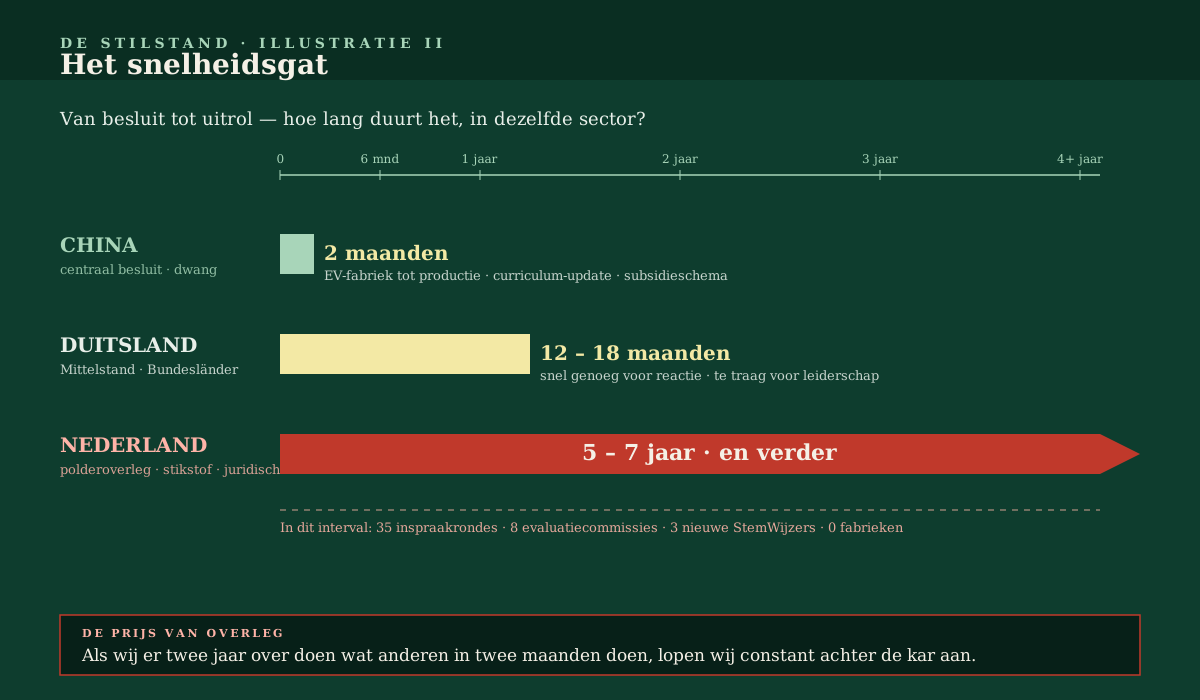
Now we come to the second major problem: even if we acknowledge that we must switch, we do so far too slowly.
| Country / Region | Recent Structural Shift | Turnaround Time |
|---|---|---|
| China | BYD EV volume production: from 0 to 4 million units/yr | ~36 months (2021–2024) |
| China | Solar cell production: from 60% to 90% world market | ~24 months (2022–2024) |
| China | Lockdown shift to reopening (zero-COVID policy reversed) | ~2 months (October–December 2022) |
| United Arab Emirates | Corporate income tax from 0% to 9% | ~9 months prep + 0 months implementation (2023) |
| Singapore | National AI curriculum for primary and secondary education | ~18 months (2023–2025) |
| India | UPI payment system national rollout | ~24 months national adoption (2016–2018) |
| Netherlands | Benefits Scandal correction | 5+ years (2018–2026, still incomplete) |
| Netherlands | Nitrogen approach (since Council of State ruling 2019) | 7+ years, still unresolved |
| Netherlands | Adjustment of education curriculum to AI | (not yet started) |
| Brussels | Reform of Green Deal/CBAM | (politically unmentionable until ~2030) |
This is an acceleration gap that grows wider every year. China reorients in months what Europe takes years to do. The United Arab Emirates implements in a workweek what the Netherlands needs a cabinet term for. India builds national infrastructure in two years what we discuss for fifteen.
The cause is structural. Our decision-making runs through:
- Polder consultation: months of input, seeking support, stakeholder rounds.
- Coalition binding: four parties that can each use their blocking minority.
- Union resistance: every reform proposal fought out in CAO negotiations.
- Judicial review: Council of State, Supreme Court, European Court—multiple instances, each taking several years.
- Participation procedures: public inspection periods, objection deadlines, appeal possibilities.
- Subsidy administration: application, assessment, and accountability cycles.
For every individual step, a case can be made for thoroughness. But added together, they lead to a country that is permanently trailing behind. China decides on Thursday and builds on Monday. We decide after six consultation rounds, three years later, and build—once the permit is finalized—only in year seven.
The Cost of Slowness
Every two years that the Netherlands is slow on a certain shift, while other countries do it in two months, means: 22 months of lag. Multiplied across twenty moments of shift in a decade, this means more than four years of permanent lag. It is never our turn to lead; we follow what others have already invented, set up, and mass-produced. The income we lose by this—as nations, as companies, as individuals—is structural and cumulative.
The CO₂ Reality, Separate from the Methane Panic
Finally, a note on the climate itself, because here lies the core misunderstanding that justifies the entire attack on the supply line.
The government methodology treats methane as the primary problem because the GWP figure (28–30) sounds high. But methane has an atmospheric half-life of about nine years. After ten to fifteen years, the vast majority has been broken down by reaction with the hydroxyl radical—into 1 g CH₄ → 2.75 g CO₂ + 2.25 g H₂O. Today's methane account is a CO₂ account in 2040.
CO₂, on the other hand, remains in the atmosphere for 100 to 1,000 years. That is the real cost issue. Not methane. Not nitrogen. Not livestock farming. CO₂ is the long-term problem, and CO₂ is what we truly need to remove.
The difference is fundamental:
- Methane approach = regulating what breaks itself down within fifteen years. Farmers, the supermarket chain, and SMEs pay the price for a gas that by 2040 will no longer exist as methane.
- CO₂ approach via BiCRS = removing from the atmosphere what would otherwise linger for 1,000 years. One carbon price (€40/ton), equatorial plantations, liquid injection on-site, market forces—not 580,000 FTE of EU bureaucracy constricting the supply line.
What the Supply Line Requires
Whoever takes the supply line seriously comes to four demands:
One — the supply line must breathe. Cells replace themselves; entrepreneurs renew products; employees learn new skills; crops shift; technology is succeeded. That is not damage—it is health. Preservation subsidies, job retention packages, sectoral protection, and regulatory stacking all work against replacement.
Two — the supply line must not be constricted. Every extra tax, every extra rule, every extra compliance requirement is a reduction in capacity. An entrepreneur who spends sixty percent of his week on administration cannot spend the other forty on production.
Three — the supply line must be fed by adaptation, not preservation. Making something different today than thirty years ago. Every attempt to freeze the status quo—farmers with dairy, industry with coal, energy with gas, education with curriculum-2018—weakens the supply line because it cannot evolve freely.
Four — we must be as fast as global competitors. Not polder-consultation speed. Not coalition-binding speed. Not judicial-process speed. Market speed. Deciding in weeks, implementing in months, evaluating in years. Those who are slow lose income, jobs, and relevance.
What Holding On Costs — What Adapting Costs
| Component | Holding On | Adapting | Difference |
|---|---|---|---|
| CO₂ target | ~€260 bn/yr Green Deal | ~€40/ton BiCRS | −83% |
| Methane regulation | ~€1.8 bn/yr NL | €0 — becomes CO₂ in 10–15 yr | −100% |
| EU climate bureaucracy | ~580,000 FTE | ~50,000 FTE | −91% |
| Subsidy layer | ~€95 bn EU budget | €0 — market chooses | −100% |
| Productive employment | 0 (preservation FTE) | ~840,000 FTE/yr BiCRS chain | +840,000 |
| Dutch agriculture | Buyout, shrinkage, sclerosis | Shifting crops, market forces | +return |
| Supermarket chain | Price regulation, margin pressure | Market forces + low prices | +purchasing power |
| Education | Curriculum-2018 for world-2032 | Forward-looking curricula, retraining-on-demand | −€1.5 bn/yr avoidable costs |
| Response time | 2 years average per shift | 2 months average (Asian speed) | 10× faster |
A Final Comparison
I am 67. My body does what it has always done: it replaces cells, it adapts, it becomes different from what it was. No cream, no treatment, no law can stop that. I can choose to move with that replacement—live healthier, different priorities, different ambitions—or I can spend a fortune on the illusion that I remain 35. The second never succeeds; the first works.
Dutch and Brussels politics have been trying the second for twenty years. They spend trillions on the illusion that the world of 1990 can be preserved—the climate zones, the species, the agriculture, the industry, the employment, the wage structure, the pensions, the welfare state, the curriculum, the supermarket chain—while meanwhile the supply line that must pay for all this is constricted by the combination of climate mandates, left-wing redistribution demands, and union pressure.
The supply line is patient, but it is not inexhaustible. When it stops breathing, first the extra demands go, then the preservation projects, and then the entire system. The Germans are learning that now, in real-time, with their automotive industry. The farmers are learning it too. The next in line is the European tech sector. Then European healthcare. Then European pensions. Then the supermarket chain.
Or we turn around. We acknowledge that everything is a replacement market. We protect the supply line—supermarket, farmer, SME, exporter, entrepreneur, education—instead of constricting it. We do what others do in two months, not in two years. We educate for what we will soon need, not for what we used to want. We calculate climate policy based on one carbon price instead of a thousand rules. We let farmers shift to what is profitable in the new climate. We let industry shift to what is productive. We let the market regulate what has always been regulated by the market in a free economy.
The supply line is not an ideological preference. It is the physiological condition for everything we ask for. Whoever disregards it—government, party, union, voter—withers away. And no idealism, no law, no majority can stop that.
WRITTEN BY JACOBUS VAN MERKSTEIJN WITH EDITORIAL AI ASSISTANCE