Plundering IV: the guided projectile
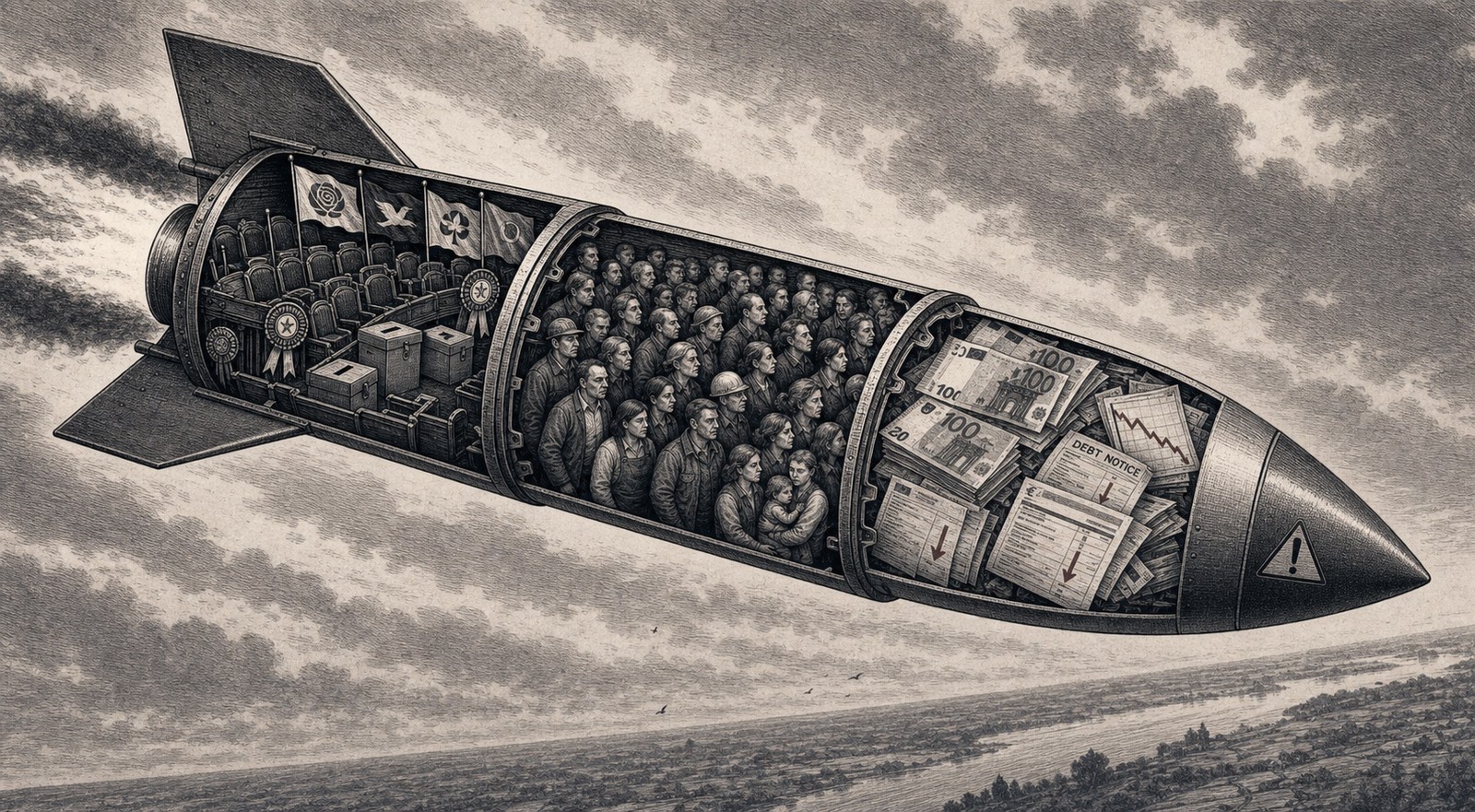
The rocket has speed. No one can stop it anymore. In a single year, a net 18,500 millionaires left Europe, taking approximately €100 billion in investable wealth with them. More next year. History knows only one endpoint for this pattern.
By Jacobus van Merksteijn · Malta · August 2026
What is happening
It is not a conspiracy. It is not a malicious plan. It is the natural outcome of forty years of democratic choices that turned out roughly the same for every generation, everywhere. Anyone who owns a factory is taxed each year on wealth that has not yet been realised. Anyone who runs a factory sees their neighbours reap the benefits through welfare payments, subsidies and public services. Anyone who works in a factory votes for the party that says the rich should pay more. Every step is logical, every choice is human. Together, they form a projectile now travelling too fast to change course.
The productive class — entrepreneurs, inventors, family businesses, patent holders — no longer has political representation in Europe. Not because anyone has silenced it. It accounts for less than five per cent of the electorate. In a democracy that by definition serves majorities, that is too little to sustain a programme. The left has declared it the enemy. Centre-right parties can no longer defend it without losing votes. The populist right would rather direct its anger at migrants and Brussels — rhetorically, that is more effective. Brussels produces documents, fifteen per cent of which are implemented. That is no accident. It is deliberate governance within a system in which the destination lies far enough away that those making the decisions do not have to pay the bill themselves.
In 2025, a net 18,500 millionaires left Europe. Sixteen and a half thousand from the United Kingdom, eight hundred from France, five hundred from Spain, four hundred from Germany, one hundred from Ireland, fifty from Sweden. They took approximately €100 billion in investable wealth with them. Next year there will be more. This is not the crisis that is coming. It is the crisis already under way.
Anyone reading these figures for the first time thinks: surely that cannot be right? And yet it is. The sources are listed at the bottom of this article — Henley, Bundesbank, Sénat français, DNB, CBS. Peer-reviewed figures from official registers. What you are reading here is no more than the addition of figures that have already been published.
The exodus — figures for 2025 and the first half of 2026
Anyone claiming that the exodus is not so bad should read this chapter. The figures come not from opinion but from the Henley Private Wealth Migration Report 2025 and 2026, the Bundesbank, the French Sénat, the Spanish Objective, the Dutch DNB and the French industry's bankruptcy statistics.
Net millionaire migration 2025 — Europe in one year
Source: Henley & Partners Private Wealth Migration Report 2025 and 2026 · New World Wealth · Bundesbank · Sénat français · DNB.
United Kingdom — the largest exodus ever recorded
🇬🇧 United Kingdom
The largest exodus Henley & Partners has ever measured for a single country. London alone lost 11,300 millionaires between November 2024 and November 2025. British equity funds lost between £11bn and £60bn — the tenth consecutive year of outflows. Wise moved to New York, Ferguson Enterprises scrapped its secondary London listing, Flutter Entertainment is leaving in August 2026, and AstraZeneca went straight to the US stock market.
Trigger: abolition of the 225-year-old non-dom regime on 6 April 2025. Destination: Dubai (+9.800 in 2025 alone), the US, Italy and — painfully ironically — Ireland (26% of departing SME owners name Ireland as their first choice).
France — negative for the first time
🇫🇷 France
The first negative reading in the survey. Between 2024 and 2026, France leapt from outside the top-40 source countries to the top 15. The industrial decline: Legrand, minus 74 net jobs; Ineos halted its Tavaux plant, with the site shrinking from 823 to 750; Stellantis Poissy is contracting from 1.925 to around 1.000 by 2030 (925 jobs lost). Renault is moving five EV models to Palencia and Valladolid — Spain is getting 6.000 jobs “secured”. According to Trendeo, French net job creation fell from +9.500 in 2024 to +310 in 2025 — almost zero.
Trigger: Zucman-tax (2% above €100m) rejected in Sénat français, replaced by a 20% levy on luxury goods and passive family holdings from €5m. Destinations: Switzerland, Italy, Portugal, Greece, UAE.
Germany — negative for the first time
🇩🇪 Germany
Germany jumped from 24th to 13th in the Henley ranking. Applications rose 16 percent between Q4 2025 and Q1 2026. Net emigration of German citizens in 2025: minus 97.000. In the automotive industry, one in seven jobs disappeared in six years. Volkswagen: Dresden from 550 to 248, with another 50.000 announced across the group (37.000 already realised), plus up to 45.000 at risk if Zwickau/Emden/Hannover/Neckarsulm close between 2031 and 2034. BASF cut 7.000 jobs worldwide; Ludwigshafen fell below 30.000 full-time positions for the first time since 1954. Recipient: Zhanjiang, China, with more than 2.000 new jobs on top of 13.000 in Greater China. Bosch: 22.000 jobs gone in mobility. MAN is moving truck production to Kraków.
Trigger: tightening of §6 AStG Wegzugsteuer as of 1 January 2025, plus hearings in the Bundestag on a wealth tax of 1% above €1m, rising to 2% above €50m. Destinations: Switzerland (+3.000), UAE (+9.800), US.
Netherlands — still positive on net, industry negative
🇳🇱 Netherlands
With a score of 72,8, the Netherlands ranks highest among the major EU economies in the Henley 2026 index. At HNWI level, the Netherlands is temporarily benefiting — from the UK’s paralysis. Below that level: 48.029 people born in the Netherlands emigrated in 2025, compared with 25.290 arrivals born there. Aegon is moving its HQ to New York (250 Schiphol jobs). Boskalis is moving its HQ to Abu Dhabi. AkzoNobel is closing Wapenveld (143) and Machelen (133) — 276 jobs combined — as well as 2.000 office jobs worldwide, with production moving to Spain, Poland and Estonia. ASML publicly warned of a partial relocation. NFIA new projects in 2025: 4.376 jobs over three years; the Amsterdam region: 39 companies with 969 jobs — versus 140 companies and 2.953 jobs in 2015. The curve is pointing downwards.
Trigger: Wet werkelijk rendement from 2028 — tax on actual returns, including unrealised gains, at 36%. In 2026, a transitional regime with a 7,78% notional return above €51.396. Taxing paper gains is explicitly cited by emigration specialists as a driver.
Italy — the big winner
🇮🇹 Italy
Europe’s largest net inflow and the world’s third-largest. Milan is now the world’s eleventh-richest city. Countries of origin: above all the UK, plus other high-tax countries in Western Europe. Milan now counts 244 family offices (up 10.4%). Salesforce announced a $1 billion AI investment on top of its existing 600 Italian jobs.
Trigger: flat tax for new wealthy residents — raised from €200,000 to €300,000 a year in the 2026 budget; existing beneficiaries are spared.
Spain — 500 leave, industry drains away
🇪🇸 Spain
New foreign inflows fell to €18,9 bn — the weakest in four years. Corporate departures doubled: in December 2025–January 2026 alone, seven companies moved their headquarters to Portugal, Andorra, Italy, Panama and Delaware.
Trigger: the Impuesto Temporal de Solidaridad de las Grandes Fortunas (1,7–3,5% above €3 mln) is now permanent, alongside the abolition of the golden visa (3 April 2025) and tighter scrutiny of the Beckham law. Ferrovial moved its holding company to the Netherlands.
Belgium — industry shuts down, capital-gains tax begins
🇧🇪 Belgium
Audi Brussels (Vorst) closed on 28 February 2025 after 75 years — more than 3.000 direct and indirect jobs gone. Recipient: San José Chiapa in Puebla, Mexico, with more than 500 new jobs on top of 5.351 existing ones. Q8 e-tron production went with it. Celanese is closing Lanaken (160 jobs). Dow is closing Tertre. Volvo Gent — the last Belgian car factory, with more than 6.300 employees — risks losing two of its three EV models to Košice, Slovakia, where the plant is expanding to around 3.300 jobs.
Trigger: new 10% capital-gains tax on financial assets from 1 January 2026, including an exit levy on latent gains upon emigration. Destination of Belgian wealth: Dubai.
Sweden — industry is being hollowed out
🇸🇪 Sweden
Foreign investors put just 60,6 bn SEK into Sweden in Q3 2025 — Swedish investors, by contrast, increased their foreign portfolio investments by 203,3 bn SEK. GKN Driveline is moving Köping to Bruneck, Italy (≈500 jobs lost). Husqvarna is closing Brastad by H1 2027 (~104 jobs). HydraSpecma moved Tranemo to Stargard, Poland. Abu Garcia closed Svängsta after 104 years.
Trigger: no classic exit tax, but the ten-year rule keeps capital gains on Swedish shares taxable for ten years.
Ireland — still a magnet, but pharma pauses
🇮🇪 Ireland
Another magnet, but Ireland appears on Henley’s outflow list for the first time. The risk has shifted, not materialised: thirty pharma CEOs warned the European Commission in April 2025 that up to €100 billion in planned European investment could be redirected to the US. Ireland’s pharma sector: around 90 companies, 50.000 jobs — the entire ecosystem at risk. In the UK, MSD cut 800 jobs at once in a planned London centre, plus 125 scientists elsewhere — a measure of how quickly this can happen. By May 2026, MSD, Pfizer, Eli Lilly and Johnson & Johnson had postponed new Irish investments. Allergan’s parent company re-domiciled in the US again in 2025.
Portugal — the other winner in jobs
🇵🇹 Portugal
AICEP processed €3.58bn in investment contracts in 2025 — good for more than 6,600 jobs, 20% of them highly skilled. In January 2026, CALB, Everbio, Lift One, Savannah Lithium, Topsoe and United PetFood signed contracts for 2,336 jobs. Aosheng Hi-Tech created around 200 jobs in Valongo. Alstom Porto: 300 jobs. Stadler Digital Labs: from 100 to 300.
Trigger: the IFICI-regime ("NHR 2.0") since December 2024, with a 20% flat rate on Portuguese salaries and a ten-year exemption on most foreign income.
Added up — Europe in one year
Adding up the published European losses for 2025: UK −16,500, France −800, Spain −500, Germany −400, Norway −150, Ireland −100, Sweden −50. Total: net −18,500 millionaires in one year. Worldwide, 142,000 millionaires relocated in 2025 — a record. For 2026, Henley forecasts 165,000 worldwide. For European countries, Henley is no longer publishing figures in 2026, but a qualitative compass. The direction is the same. The figures have simply become too embarrassing to put on paper.
And those 18,500 millionaires come with factories. In Germany alone: 341,500 fewer industrial jobs since 2019, including 124,100 fewer in 2025. In France: from +9,500 net jobs created in 2024 to +310 in 2025 — almost zero. At Volkswagen alone: 37,000 jobs gone, 50,000 announced, 45,000 at risk. At BASF: 7,000 worldwide. Audi Brussels: 3,000. Volvo Gent: two-thirds threatened, 3,300 new jobs in Košice. Stellantis Poissy: 925. GKN Köping: 500. Aegon Schiphol: 250. Legrand: 74 net. Husqvarna Brastad: 104. HydraSpecma: 50. Abu Garcia: 48. Add these up without names, and they become statistics. Add them with names and municipalities, and it becomes an exodus that fits on a single sheet of paper.
The global recipients 2025
Source: Henley & Partners Private Wealth Migration Report 2025. Within Europe, the money moves in a circle — from the UK, France, Germany, Spain, Belgium and Scandinavia to Italy, Switzerland, Portugal and Greece. Outside Europe, UAE and US are making off with it.
Why it works this way
Three patterns, the same everywhere.
The left lays claim with moral certainty. A coherent story, a reliable base, cultural hegemony. Anyone who argues against “the strong must contribute more” carries the burden of proof.
The centre-right bends with it. It cannot explain why taxing wealth is different from taxing income. The technical difference — you tax profit when it is realised, not wealth that does not yet exist — is impossible to sell to an electorate that thinks in soundbites. So they vote for what they rhetorically oppose.
The populist right points, but does not build. Migration, Brussels, “the elite” — never the plunder itself. Even a right-wing breakthrough would not stop the plunder; it would merely change the scapegoat.
And Brussels shifts into neutral. Of the €800 billion a year that Draghi prescribed in 2024, 15 percent has been realised in two years. The European Banking Federation reported on 10 June 2026 that the “competitiveness bill” now amounts to €1.4 trillion — nearly doubled while the meetings continue.
The Commission can do nothing because it can do nothing. Five structural reasons:
- No tax powers. Fiscal sovereignty lies with the member states. It can recommend, but not enforce.
- Wrong timetable. Seven-year budgets, 2030 plans, 2035 roadmaps. The 16,500 British millionaires who left last year will not return because a new MFK cycle begins in 2034.
- Hemmed in between member states. Large countries want coordination from above; small countries want their own fiscal space. The Commission cannot serve both, and so does nothing that makes a difference.
- It does not understand production. Lawyers, economists, political scientists. No engineers, no factory directors, no patent holders. Documents do not produce prosperity.
- It serves itself. Strong member states do not need Brussels. Weak ones do. A strong Europe is an existential problem for the Commission.
On 3 June 2026, the Commission presented its European Semester Spring Package. Mînzatu and Dombrovskis spoke of a “major shift”. The recommendations are worded so that a trade-union leader reads solidarity into them and an entrepreneur deregulation. Both are right. There is nothing there.
The Pilots of the Projectile
These are not guilty parties. This is worse. These are the leaders who knowingly steer toward the abyss—not because they want the abyss, but because the abyss does not interest them. What interests them is winning votes and not losing votes. The rest is nebenbei. A side issue. Far beyond their own terms in office. Something for a successor.
That is the crux. A politician who cries, "let the rich pay," is less dangerous if he simply does not understand it. He is more dangerous if he does understand it and does it anyway, because it wins votes while the alternative costs votes. He is a pilot who knows his course ends at a mountain and sticks to that course because his passengers elected him for it. The mountain comes later. The next election comes sooner.
The statements below are public, documented, and dated. Each of these figures is steering the rocket with a steady hand. Each of them knows the destination. For each of them, the destination is nebenbei—a problem for the years ahead, for future cabinets, for future generations. These are the mandates with which voters sent them to the cockpit.
Netherlands
GroenLinks–PvdA
Jesse Klaver, in Parliament on 4 June 2026: “a fair tax on high profits and large fortunes.” Electorate: civil servants, teachers, healthcare workers — people without wealth who want to tax other people’s wealth. Morally comfortable, cost-free to apply.
FNV
Tuur Elzinga, ultimatum to the cabinet, 4 June 2026: benefits kept at level, paid for by “the very richest”. This union is no longer a union for working people. It defends the social contract with other people’s money.
D66, VVD, CDA, NSC
All four voted for the new box 3-wet on 12 February 2026. From now on, the liberals will tax wealth that has not yet been realised — a fiscal first that the VVD once called impossible. For decades they supported the welfare state, and now they lack the moral grounds to oppose the bill.
PVV, BBB
Pointing at migrants, farmers, Brussels. Building nothing. They capture the anger and aim it at the wrong enemy.
VNO-NCW
Critical of box 3, arguing for a capital-gains tax instead of a wealth-accretion tax. Technically correct. Morally absent. They dare not ask whether the state is entitled to tax wealth annually at all.
Germany
SPD
Spitzensteuersatz from 42 to 49 percent. Wealth tax above €20 million. Fratzscher (DIW) calculates €42 billion in revenue, “with which labour can be made cheaper”. That compensation always disappears into general funds upon introduction. Every tax expert knows that.
CDU/CSU
Officially opposed. By the end of May 2026 already “prepared to compromise” — Reichensteuersatz from 45 to 47.5 percent. That is how principles evaporate in coalition politics.
Bündnis 90/Die Grünen
Karl Haeusgen, former VDMA president, argues from within the green business network itself for higher income and inheritance taxes. Self-destruction out of guilt.
AfD
Captures the anger, directs it at migration and climate. Not at the plundering.
DGB
Stefan Körzell, 3 June 2026: tax every euro of wealth above €1m, plus 10% Vermögensabgabe above €10m, spread over 20 years. Proceeds: €350bn. The word he chooses: "profiteers". That is what the German trade union calls the entrepreneurs who run the factories where its members work and pay the contributions on which its members believe they live.
Die Familienunternehmer
Warn of the substanzvernichtende Wirkung on business assets. Technically correct — a wealth tax on illiquid means of production forces fragmentation. They are not heard. In the German media, they are "the rich"; their employees are victims of those same entrepreneurs. The same company, divided along two axes.
France
La France Insoumise
Mélenchon: bring back ISF, tax windfall profits, sharply raise inheritance tax, raise SMIC to €1,700, retirement at 60. Europe’s purest form of plundering, sold as justice.
Parti Socialiste
Zucman standard: 2% wealth tax above €100m. Faure frames it as a "socially acceptable alternative" to €44bn in spending cuts. The third option — promising less — is not discussed.
Rassemblement National
Marine Le Pen defends the training account of the ordinary Frenchman. She leaves the attack on holding companies and Pacte Dutreil conveniently untouched. Tactical: defending the rich is electorally unsellable.
Renaissance en Les Républicains
Sébastien Lecornu, at the end of May 2026, has three tax measures reviewed preventively by the Conseil constitutionnel. Not opposed in principle. Concerned about legal durability. Bending with the wind in civilised form.
Medef
Talks about the "investment climate" and "competitiveness". Nobody listens. In the French debate, the entrepreneur is suspect.
Brussels
Ursula von der Leyen, Roxana Mînzatu, Valdis Dombrovskis
On 3 June 2026, present a package that everyone reads differently because it contains nothing. They know it contains nothing. They implement mandates issued by their parliamentary groups because a real package would be electorally unmanageable. They are not plunderers. They are the curators of a system that facilitates plundering, and they know that the productive economy can no longer be protected within their mandate. They choose to keep holding meetings.
The historical end point
History knows one pattern resembling this exodus: France before 1789. There too, the rich withdrew — some literally beyond France (in Dutch, English and German exile), others behind the walls of their estates. There too, taxation of the propertied class kept pace with its withdrawal. There too, the poor were left with the bill and without the factory in which they worked. And when that process had advanced far enough, the guillotine arrived — not because anyone had wanted to use it, but because the pattern produces its own end. Those who withdraw during the plundering are not found on the scaffold. Only those who leave too late.
1789 — the pattern that produces its own end
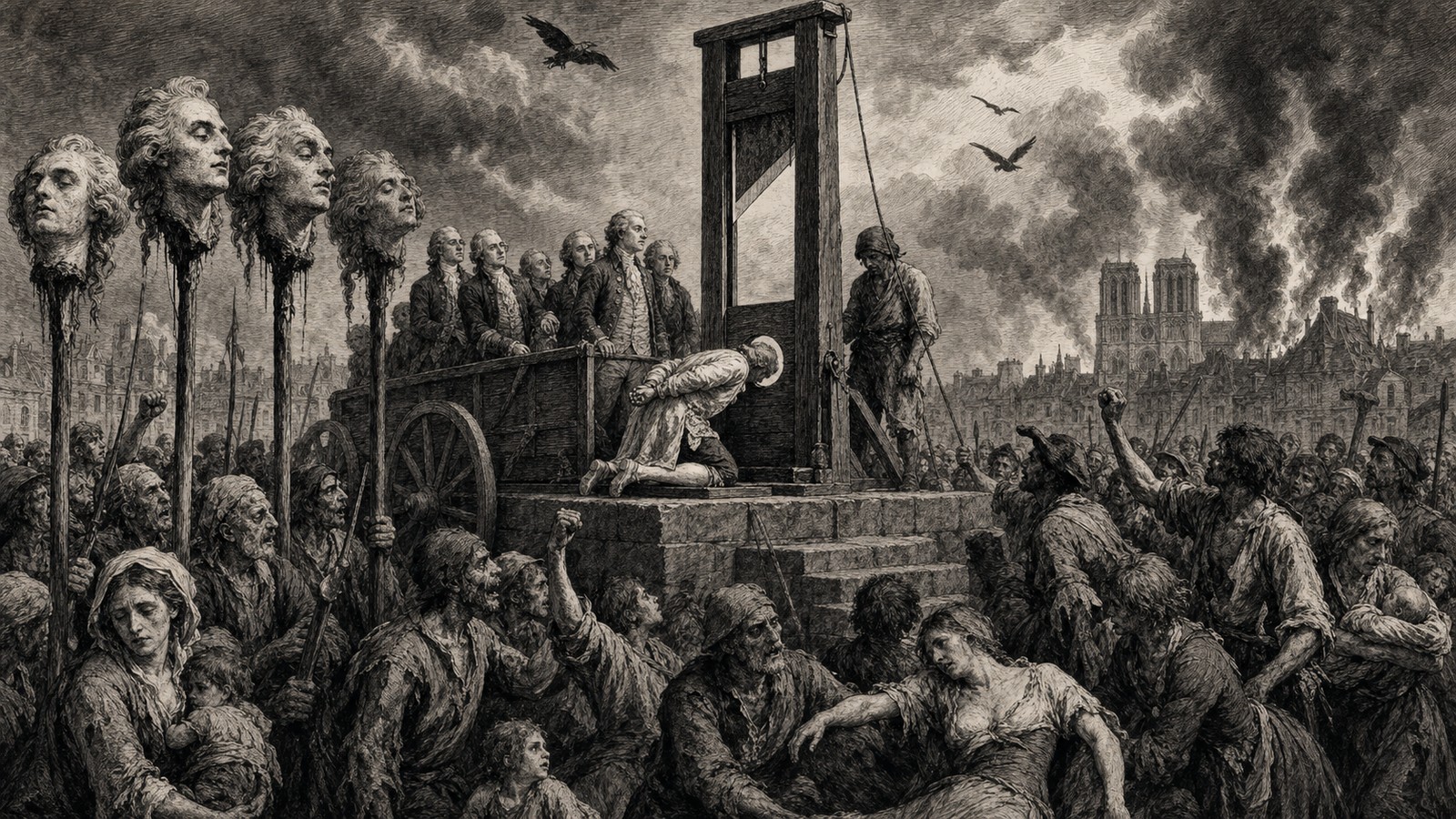
The guillotine on the Place de la Révolution. The rich who left too late ended up on the scaffold; those who went earlier could save their wealth. The poor gathered around the scaffold — still poor, still hungry, thinned out by the plundering they themselves had demanded. The pattern of 2026 follows the same steps in the same order — only accelerated by digital capital flows that did not yet exist in 1789.
The working European is sitting on a chair he is pulling out from under himself — not out of stupidity, but out of the logic of his own interests as defined by his party. Every vote for "let the rich pay" is a vote bringing the factory where he works closer to Košice, Bruneck, Delaware or Dubai. Every time a trade union calls an entrepreneur a profiteer, a pension contribution disappears faster than the union can negotiate. The union does not know that. It is doing its job.
They are waiting for the train to Singapore, Dubai, Texas, Lugano, Ticino. Eighteen thousand of them have already left in the past year. Next year there will be more. In 1789, the same movement took three decades. In 2026, it takes three years, because capital now travels faster than a carriage on the road to Koblenz.
Conclusion
There is no indictment in this article. There is an observation. The pilots of this projectile are neither criminals nor fools. They are intelligent, highly educated people who know the figures in this article—many of them know them better than its readers. And they stay the course.
That is not criminal. It is not even incomprehensible. For a politician, there is only one rationality: winning votes and not losing them. Everything else—economic sustainability, factories moving away, capital flows changing direction, historical parallels looming—is nebenbei. A side issue. Outside the “reelection” column. In a democracy that serves majorities, and in which the productive class accounts for less than five percent, this rationality is inevitable. The problem is not that the pilots do not know what they are doing. The problem is that what they are doing is precisely the rational thing—for them. For the rocket, it is fatal.
We built this ourselves. We vote. We support. We look away. For the productive, the way out lies beyond Europe. For us, who chose this ourselves, there is no way out anymore. The rocket keeps flying, and at some point it lands. Where and when, history will teach us. How: that is up to us, in the final years in which it is still up to us.
Sources on capital flight 2025–2026
- Henley & Partners — Private Wealth Migration Report 2025 and 2026
- Bundesbank — Monthly Report March 2026
- CBS table 85484NED — Dutch emigration 2025
- DNB — Direct investment statistics 2024–2025
- Government of the Netherlands — Business Climate Monitor 2025
- Sénat français — question SEQ251207170 (2025)
- Bloomberg — French factory closures, 30% Asia tariffs (March 2026)
- LSEG Lipper — UK fund flows review 2025
- Reuters — UK market exodus tracker (June 2026)
- Reuters — Aegon move to US (December 2025)
- The Objective — Wave of companies relocating (January 2026)
- Statistics Sweden — Balance of Payments Q3 2025
- CSO Ireland — International Accounts Q4 2025
- Banco de Portugal — FDI statistics 2025
Jacobus van Merksteijn
Malta
Editor-in-chief of Het Open Vizier. Entrepreneur, developer of industrial and governance innovations (Carbon-Alert Ltd, TerraClean Ltd, GuardSkin Ltd). Writes about economic, ecological and political systemic issues, drawing on experience with the Brussels and The Hague decision-making machinery.