First Pluck, Then Judge
This is not an article about taxes. This is an article about a wrongly constructed society, in which the people who create wealth pay the price for the people who consume it — and then get blamed for it too.
It concerns something simple that we have forgotten. Whoever makes something deserves to live from it. Whoever does not make something should not live from what another makes. And certainly, the second group must not judge the first, as if they know how it should be done.
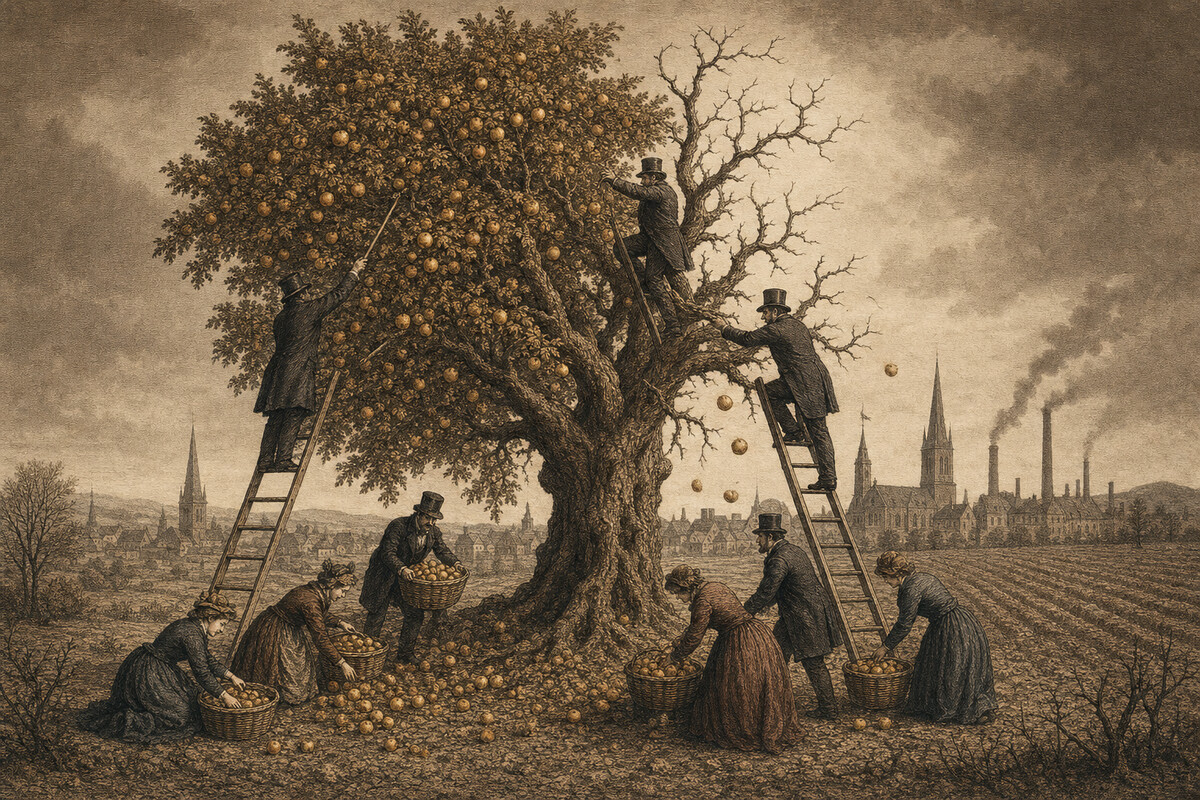
That is what is happening in Europe. We have placed the financing of our benefits, our pensions, our healthcare, our public desires — everything we want at the bottom and in the middle — on the shoulders of those who give us the opportunity to earn money. The entrepreneur. The inventor. The factory. The family that has built for generations. We pluck them.
Subsequently, we restrict them. They are left with less than their company needs to keep up with China, with America, with India. Their factories age. Their research slows down. Their production lags behind.
And then — when the consequences become visible, when German cars lose their lead, when Dutch chemicals miss the boat, when French industry shrinks — then we point to those same entrepreneurs and say: they haven't done well.
First pluck. Then restrict. Then judge.
That is the circle in which Europe is currently destroying itself. And we, the majority, are the executors.
What a wage really is
Start with the simplest. A wage is not a gift. A wage is what someone earns with what they make in an hour, in a week, in a year.
A plumber who works eight hours produces eight hours of value. For that, he receives a wage proportional to that value. If he wants more, he must work more hours, deliver better work, become more skilled, start his own business. That is not injustice. That is how it should be.
What has happened in Europe is something else. We have decided that the plumber, in addition to his wage, is also entitled to healthcare at the highest level, to a pension providing thirty years of coverage, to six weeks of vacation, to two years of unemployment protection, to childcare subsidies, to rent allowance, to healthcare allowance, to student loans for his children, to benefits whenever he wants. Added all together, that costs much more than his labor is worth.
The difference must come from somewhere. We have decided it comes from somewhere: from the people who do produce a surplus. The entrepreneur. The inventor. The third-generation family business. Their surplus — the profit that remains after they have paid everyone — is skimmed off and distributed to those who did not make it themselves.
We call this solidarity. We also call it redistribution. We call it justice. But the honest name is different. We live beyond our means at someone else's expense. That is all it is.
What a profit really is
Now for the other side. What is a profit?
A profit is what remains after an entrepreneur has paid his employees, paid for his raw materials, depreciated his machines, paid his taxes, carried his risk. It is the last thing he receives, not the first.
That profit has a purpose. Not luxury. Not a yacht or villa. The real purpose is this: to renew his factory before the Chinese manufacturer overtakes him. To finance his research before the American competitor passes him by. To train his staff before they are worth more elsewhere than with him. To arrange his legacy so the third generation can continue the factory.
That is not a privilege. That is a duty. An entrepreneur who does not use his profit to stay relevant perishes. And when he perishes, his five hundred employees go with him. His supplier goes with him. His customer goes looking for an Asian replacement. A piece of Europe is lost.
What we have done is skim off that profit for consumption at the bottom. We have sacrificed the source of future prosperity — investment in production, modernization, research — for immediate spending on things that build nothing. A benefit builds nothing. A pension builds nothing. A subsidy to a sector that would not exist without that subsidy builds nothing. It is consumed and it is gone.
That money should have been used to modernize European factories, to keep European researchers at the forefront, to make European industry resilient against what comes from outside. We have spent it.
The circle begins
This is how the circle works.
Step one — we pluck. Higher corporate tax. Higher wealth tax. Box 3 "actual return". Exit taxes that haunt you to the grave. Brussels coordination so there is no way out anywhere. We have voted for all of this, repeatedly by majority, in every country.
Step two — he can no longer do what he should be able to do. The German Mittelständler who wanted to convert his factory to electric no longer has the money for it — he has paid it to the tax authorities. The Dutch chemist who wanted to invest in new processes cannot afford it — his profit has been skimmed for the general funds. The Italian family firm that wanted to prepare the fourth generation instead goes to a Chinese buyer because the transfer tax makes succession impossible. His production lags behind the world, not because he can do less, but because he is allowed to keep less.
Step three — we judge. And then, when the German car industry loses its lead, when Dutch chemicals shrink, when the Italian fashion industry sells to Asian conglomerates, then the European newspapers lead with the same story: "Our industry missed the transition." "Our entrepreneurs didn't invest enough." "The German Mittelstand has dozed off." "Europe missed the boat." As if it were the entrepreneurs who failed — and not the majority that took the money from them with which they could have succeeded.
The cruelest lie is this: we reproach them for what we made it impossible for them to do. We cut off their legs and reproach them for no longer being able to walk.
Who carries out this circle
Here we come to the uncomfortable point. Who is in this circle?
The easy excuse is to point to the politicians. Or to Brussels. Or to Zucman and his academic followers who designed the European wealth tax. But that is a deception.
Politicians are elected by voters. The voters do not live in Brussels. They live in Maastricht, Groningen, Den Bosch. In Hamburg, Bremen, Stuttgart. In Lyon, Marseille, Lille. They chose the parties that introduced these laws. They re-elected the governments that implemented these laws. They chose, in every election, the side that says: let the rich pay more, let the factory contribute more, let the family business do its part.
That is us. You who are reading this. I who am writing this. Our neighbors. Our parents who vote for the PvdA because they want to see their pension defended. Our aunts who vote for Bündnis 90 because "the rich can contribute more". Our uncles who vote for La France Insoumise because "the system is unfair". Us. Not them. Us.
And when our enterprising nephew sells his factory to an Indian buyer because he cannot afford the transfer tax, we say he was "not enterprising enough". When our sister-in-law's German neighbor closes his machine factory because he can no longer finance his modernization, we say that "the German model is outdated". We do not see the circle, because we are in it and we do not want to see it.
What an entrepreneur really does
Perhaps this is the part we have forgotten most. What does an entrepreneur actually do?
He gets up earlier in the morning than his employees. He lies awake at night over the orders that didn't come in. He pays his staff before he pays himself — in bad years, he pays his staff while he doesn't pay himself. He carries the risk that the market shifts, that raw materials become more expensive, that a major customer walks away. He is the one held accountable when someone gets hurt at his machine. He is the one sitting in the bank when a loan is canceled. He is the one testifying in court when something goes wrong. He is the one pledging his house to guarantee next month's payroll.
And he is the one who — when it works, when the factory is running, when the invention is patented, when exports take off, when he finally builds something for his children — hears from his neighbors that he is "profiting from the system". That his profit is "unfairly high". That his wealth "should go more to the community". That his legacy "should be distributed".
This is no melodrama. This is what every entrepreneur in Europe is experiencing right now. It is the reason the baker's son would rather become a civil servant. That the electrician's daughter would rather become a consultant. That the manufacturer's grandson would rather become an activist. Our entire culture teaches our youth that entrepreneurship is indecent, that making a profit is something shameful, that building is suspicious. Then we can hardly complain in ten years that nobody builds anymore.
The South African mirror image
We do not need to speculate where this path leads. We can read it in the figures for South Africa, June 2026.
Unemployment: 32.7 percent. Broadly measured, including people who have given up looking for work: 43.7 percent. Almost one in two economically active South Africans has no job. Youth unemployment is 60.9 percent — six out of ten young people who want to work cannot find work.
Electricity production has already fallen for six consecutive quarters in 2026. A country with gold in the ground can no longer keep its own lights on. Industrial production has shrunk for the sixth consecutive quarter in heavy industry. Technical talents are leaving by the thousands — AI specialists, cyber specialists, doctors, engineers. Estimates suggest the South African tech sector has a talent exodus that threatens national security.
How did it come to this? Through exactly the same pattern we are following in Europe. South Africa decided in the nineties that its productive class — farmers, engineers, manufacturers — had to pay for the recovery from historical inequality. The moral justification sounded convincing. The practical execution was plunder. Tax on agriculture. Quotas on employees. Expropriation of land. A political climate in which the farmer and the manufacturer were declared enemies of the nation.
The result after thirty years: a country where bread is more expensive, the power goes out, the youth leaves, and the people who stayed behind march through the streets blaming "them for doing this to us". But they do not point to the plunder. They point to the migrant from Zimbabwe, to the Mozambican market vendor, to the neighbor. To whoever still has something.
This is what awaits us. Not tomorrow. But in 2040, in 2045. A Europe where the wealth we inherited has been slowly hollowed out. Where our factories are closed because they could no longer modernize. Where our pensions are cut because the productive base has evaporated. Where our young people leave for Texas and Singapore. Where our elderly march with the same slogans as the South Africans today: "let those who have left return with what they took with them".
They will not return. And what they took with them — their knowledge, their risk tolerance, their capacity to build something — does not come back.
What this means for you
You reading this might think: this is about millionaires. This isn't about me.
It is about you. Because you are the one who will suffer later, not the millionaire.
The millionaire leaving France right now buys a house in Italy or Switzerland and continues to live comfortably there. His capital is spread over three jurisdictions. His intellectual property is in a Singaporean holding company. His children study in America. He has adapted to our plunder. His life goes on.
Not you. You who have linked your life to a Dutch or German or French pension. To a welfare state that promised you that you would be cared for. To a state pension (AOW) that would mean the same in 2040 as it does now. You are the one who gets the bill when the productive base has evaporated and the treasury is empty.
In our majority, we chose the security of the state over the security of our own work. The entrepreneur did the opposite. He committed himself to the market, which can be harsh, but which he understands. We committed ourselves to promises, which sound soft, but which at some point cannot be kept. The entrepreneur survives what is coming. We do not.
And when that moment comes — not even that far off, presumably between 2030 and 2040 — we will not say: "we chose this ourselves". We will say: "they did this to us". We will march through the same streets as the South Africans today, with the same slogans, looking for the same scapegoats. The departed entrepreneur. The foreign worker. The young German who moved to Dubai. Everyone except ourselves.
Four principles from a healthy society
This is not an article with solutions. Whoever wants solutions reads another piece. This is a diagnosis. But one principle must still be stated here, because without principle, a diagnosis is meaningless.
Whoever wants to have more must work more. No more complicated than that. Whoever lives at the bottom or in the middle of a society, and desires more prosperity than their labor produces, has one honest path: work harder, work longer, work better, become more skilled, or go into business themselves. No other path is just.
Whoever makes a profit must be allowed to reinvest it. The profit of a productive enterprise is not a surplus that can go to general funds. It is the seed for the next generation of investment. Modernization. Research. Expansion. Defense against external competition. Whoever skims that seed eats today what should have grown tomorrow.
Whoever cannot work receives modest assistance. For those who truly cannot — through illness, old age after a life of effort, disability — reasonable care exists. But modest. Sufficient for a dignified existence, not for comfort. Financed from the community as a whole, not from unilateral plundering of those who still can.
Whoever squeezes the entrepreneur themselves must not judge him afterward. This is perhaps the most important. Whoever voted for the laws that deprive the entrepreneur of his means must not subsequently say with a raised finger that the entrepreneur "did not invest enough". Whoever decided that the manufacturer must hand over his profit must not then complain that the factory is outdated. That is the cruelest form of injustice possible in a democracy: the accusation reversed, the victim as the culprit.
Closing
This is a wrongly constructed society. We have placed the financing of what we want on those who give us the room to want anything. We have treated the people who work for us as an inexhaustible source. And we have then judged them for the exhaustion that we caused.
This cannot go on indefinitely. It ends as it ends in South Africa: in an impoverished, aging, polarized country where the people who stayed behind march in search of scapegoats. Where bread becomes more expensive, the power goes out, the youth leaves, and the elderly blame each other.
When that moment arrives in Europe — and it is coming, for the mathematics allow no other outcome — we will remember that we had every chance to do things differently. We chose differently every time.
And when our factories stand empty, we will not say that we made them empty. We will say that our entrepreneurs were unable to save them.
That is what we do. First pluck. Then restrict. Then judge. And then, when it's all over, complain that someone else is guilty.
Read in the four parts that follow how this circle works. What figures support it. What mechanisms execute it. What outcome awaits us. What political forces carry it. But remember with every line you read: this is not a what-others-do story. This is a mirror. We are doing this. No one else.
PART I OF FOUR

Jacobus van Merksteijn
Malta
Publisher of Het Open Vizier. Systems thinker on climate, energy and democracy.