III
The Aftermath
Why the plunderers will suffer more than the plundered
By Jacobus van Merksteijn · Malta, June 2026
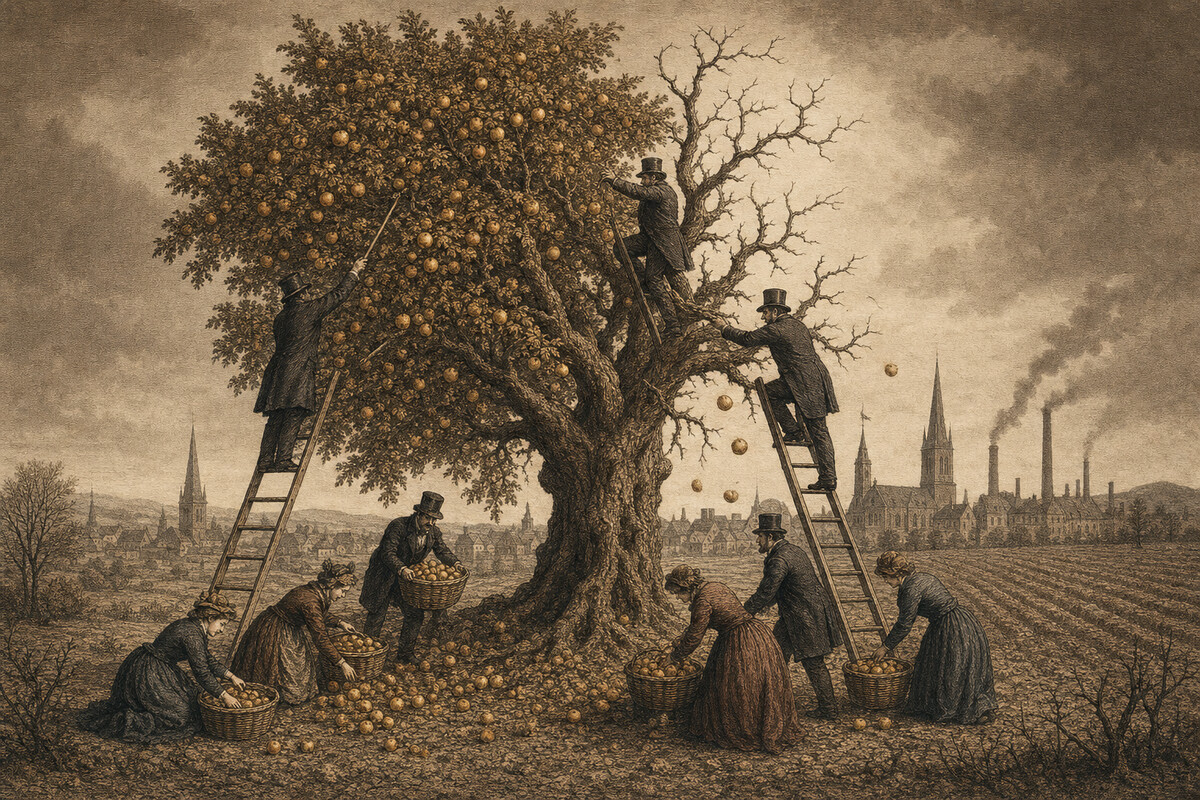
Plundering does not end with insight. It ends with exhaustion. And when it ends, the plunderers suffer more than the plundered.
Those who hope for a sensible political decision that turns our direction around before the damage is final do not know their history. Reform always comes after the crash. Never before. And by then, what could have been reformed has long since disappeared.
The four phases, and where we stand
The Russian-American historian Peter Turchin has described the laws of plundering cycles, from the Roman Empire to the France of 1789. Four phases.
Phase 1 — Expansion. Europe, 1950 to 1980. We built. The productive class was numerous. Capital flowed. Wages rose. Everyone won. Our parents and grandparents experienced this — and they were proud of it.
Phase 2 — Stagnation. Europe, 1980 to 2008. Growth flattened out. The productive class shrank relatively. The claimant classes — bureaucracy, retirees, benefit recipients — grew. We didn't notice, because we borrowed to mask the difference. Our debts grew, but that was "temporary".
Phase 3 — Crisis. Europe, 2008 to now. The bill became visible. We tried to bridge the deficit by taxing the productive class more heavily. They began to react by leaving, dodging, or staying silent. State revenues began to falter. Our political polarization increased. This is where we are now.
Phase 4 — Shock. Coming. When, no one knows exactly. Five years, maybe ten, maybe fifteen. An external or internal event — war, financial crisis, pandemic, currency collapse, pension crash — will break the system. Only then does reform begin, and only then do we see what we have done.
We are in phase 3, in the second half of it. Denial still works. The fiscal tightening continues. The exodus is accelerating. State revenues are faltering. Polarization is acute. What is missing is the shock. It is coming.
Why we will not reform before the shock
Three reasons, and they are structurally inescapable.
One — we vote rationally for our own poverty. We who live on a pension, benefits, or a civil servant's salary have no reason to vote for lower taxes on capital. It is not our money being plucked. It is that of someone else, in another city, in another life.
Do the math. In the Netherlands, 5.2 million people work in the market sector. The electorate is 13 million. Who has the majority? Not the market. Not the entrepreneurs. The others. And those others have no direct benefit from entrepreneurship they don't do themselves. A democracy without a productive majority cannot democratically decide to become productive again. The mathematics is ruthless.
Two — our politicians think in shorter terms than systems. A cabinet lasts four years. An election campaign half a year. A fiscal reform that only bears fruit in ten years is electoral suicide.
It is rational to pluck today and pass the bill to successors. That is exactly what we ask of them. We punish every politician who says we have to give something up. We reward every politician who promises that others will give something up. No wonder we get what we get.
Three — our institutions defend themselves. A bureaucracy that would shrink under reform never shrinks voluntarily. A tax authority that would simplify never simplifies. A European Union that derives its right to exist from coordination always coordinates more, never less.
The system optimizes itself for self-preservation, not for its mission. And we feed it with our vote, our tax, our indifference.
What has already happened in South Africa
We do not need to speculate about the outcome. We can read it in the June 2026 reports from Statistics South Africa.
Unemployment is 32.7 percent. Broadly measured, 43.7 percent. Almost one in two economically active South Africans has no work or has given up looking for work. Youth unemployment is 60.9 percent. Seven out of ten young people who want to work cannot find a job.
Electricity production has fallen for six consecutive quarters. A country with gold under the ground can no longer keep its own lights on. Industrial production shrank in the first quarter of 2026 for the sixth consecutive time in heavy industry. What was once an industrial nation is an industrial nation no more.
Talent is leaving by the thousands at a time. AI specialists to Australia. Doctors to England. Engineers to Canada. The South African tech sector is facing an exodus so severe it threatens national security. What remains fights over the scarcity.
And the people who have stayed behind are looking for a scapegoat. They find him in the migrant. The foreign worker who works for lower wages. The Zimbabwean refugee who still finds a job. The Mozambican market vendor who still sells what needs to be sold. In June 2026, tens of thousands of South Africans march through the streets demanding that "the migrants must go". Not the rich migrants — there are hardly any left. The poor migrants.
Public anger is not directed at the system that has impoverished them. It is directed at the weakest others in that same system. That is what plunder-losers always do: they find someone even weaker to blame.
This is what awaits us. Not tomorrow, but within fifteen years. The pension payment that doesn't come. The civil servant's salary in devalued euros. The healthcare wait that becomes years instead of months. The power outage that is no longer an outage but normal. And the public anger that is not directed at the policy that caused this — because we chose that policy ourselves — but at the migrant, the old neighbor, the wealthy uncle, the foreign student.
That is how a civilization dies. Not suddenly. Not spectacularly. Statistically, decade after decade, with a growing resentment toward whoever still has something. Until there is nothing left to harbor resentment for.
Three peoples who drove out their productive class
We are not doing something new. We are repeating what others have done before us.
The Roman Empire in the third century. The Roman state increased taxes on large landowners until they abandoned their estates and placed their property in the hands of local rulers. The emperors responded with even higher levies, exit bans, and the famous colonate legislation that tied farmers to their land. The empire was not reformed; it was carved up.
The Roman senators did not die rich in Rome. They died poor, in a continent that let the barbarians in because it could no longer defend itself. The plunderers served themselves up to their own endgame.
Spain after 1580. At the height of its power, the Spanish state plundered its own producing bourgeoisie to fund the wars in the Netherlands and court expenses. The entrepreneurs fled to Antwerp, then Amsterdam, then London. Within a hundred years, Spain went from a world power to a peripheral economy.
The Spanish nobility who had profited ended up in tattered palaces. Living on credits from the Dutch they had wanted to subjugate. The plunderers became the beggars.
France before 1789. The French Crown tried for decades to tax the productive class extra without touching the privileges of the nobility and clergy. When the system collapsed in the Estates-General of 1789, revolution came. The nobility who had refused to reform lost their heads in two years. The clergy who had profited were expropriated. The people who had insisted on redistribution ended up ten years later under Napoleon, mobilized for wars they had not chosen.
The pattern is the same everywhere: the plundering escalates until the system breaks. And when it breaks, it is not the plundered who suffer — they are long gone — but the plunderers. For they have tied their fate to a state that can no longer deliver what it promised.
What the shock in Europe will be
Which event will break our system cannot be said precisely today. But the candidates are few.
Pension crash. The Dutch and Italian funds are already audibly creaking. The German generational bill doesn't add up. At some point — presumably within ten years — a large fund will have to cut its payouts by twenty or thirty percent. Not for the poorest participants. For everyone. The anger that calls up in people who have contributed their entire lives will not lead to reform. It will lead to a search for scapegoats.
Currency crisis. A euro sustained by shrinking productivity and growing national debt is not sustainable. At some point — presumably within five to ten years — the European Central Bank will have to choose between inflation and deflation. Both options impoverish the ordinary citizen. Hyperinflation evaporates their savings in months. Deflation evaporates their job in years. Neither option is repairable without the productive class we have driven away.
Defense crisis. A real war — Ukraine, the Middle East, or a new conflict — that forces defense spending to levels where the current fiscal architecture completely breaks. At some point, we will discover that we can no longer build what we need to defend ourselves. No ammunition, no tanks, no drones, no ships. Not because we don't want to, but because the industrial base has evaporated.
Social crisis. A moment when a large group discovers that the state can no longer deliver what it has promised. Not a catastrophe — a statistical summation. The healthcare wait that is no longer a wait but never comes. The benefit that no longer covers the basics. The school that no longer has a teacher. The police who no longer send an officer. When people discover the state has become fictional while they are still obligated to finance it, a legitimacy crisis arises that no election can repair.
One of these shocks is coming. Perhaps several at once. And only then — not before — will what is now impossible become politically possible. Lower taxes on production. Shrinking the state. Protection instead of plundering of those who still build. But by then, what could have been reformed will be long gone.
Who truly suffers — the cruelest lesson
Here comes the lesson we do not yet want to hear, but which history has confirmed hundreds of times.
When the shock comes, it will not be the entrepreneurs, inventors, and patent holders who suffer most. They will be long gone by then, or they will have arranged their structure so that the plundering does not reach them. Their wealth is spread across three jurisdictions. Their intellectual property is in an Asian holding company. Their children are studying in Texas or Singapore. We have driven them away, and they have adapted.
It is we who will suffer. We who have trusted most heavily in the state.
The retiree in Leiden whose state pension is no longer paid out at the promised level. The civil servant in Bremen whose salary is paid in worthless euros. The benefit recipient in Marseille whose allowance is cut because the treasury is empty. The university staff member in Bologna whose chair is abolished. The healthcare worker in Madrid whose wage is frozen to dampen the system's collapse.
We have tied our lives to the promises of a state that can no longer deliver. The entrepreneur has tied his life to the market, which can be hard, but which he understands. We have chosen the security that has turned out not to be security at all. We are getting what we chose.
And we will be furious. Not at ourselves — that is psychologically too heavy. We will be furious at the entrepreneurs who left. At the foreigners who still have jobs. At the young German who moved to Dubai. At the Dutch inventor who set up his factory in Singapore. At everyone except ourselves.
We will march through the streets with the same slogans as the South Africans in June 2026. "They must go." "They did this to us." "Let them return with what they took." But they will not return. Because what they took is their knowledge, their risk-readiness, their capacity to build something. No law can enforce that. No state can demand that. We lost that when we treated them as enemies instead of allies. And what is lost does not come back.
Closing
We chose this. Not once, not by mistake, but at every single election. We chose the politicians who designed the walls. We praised the academics who justified them. We rewarded the journalists who normalized them. We cast the votes that legitimized them. We paid the taxes that financed them. And we gave away the future we wanted to keep for our children.
This is not a war between rich and poor. This is a popular decision, with popular implementers and popular consequences. A poor, non-productive Europe, aged and resentful, wondering why it is no longer what it was fifty years ago. A continent where our grandchildren will no longer be able to build what their great-grandparents built, because in two generations we drove out the knowledge, the capital, and the people who made it possible.
We will live like the people in South Africa. Not poorer in an absolute sense — our prosperity was high enough for the fall to last a long time. But relatively, compared to those who are still building, we will systematically fall behind. Our children will migrate to America, Asia, the Middle East. Our cities will age. Our factories will empty. Our streets will become more unsafe as the welfare state can no longer sustain its promises.
And we will scream for more plundering. That is the pattern. A people that has plundered continues to plunder until there is nothing left. It cannot be otherwise, for any other choice would acknowledge that the earlier plundering was a mistake. And that is psychologically impossible.
We are voting for the camps. Not out loud, not all at once, but at every election. And when we are in them, too old to work, too weak to build, too angry to do anything else but complain, we will not remember that we had every chance to do it differently.
We will remember that we were the victim.
That is the aftermath.
PART IV OF FOUR

Jacobus van Merksteijn
Malta
Publisher of Het Open Vizier. Systems thinker on climate, energy and democracy.