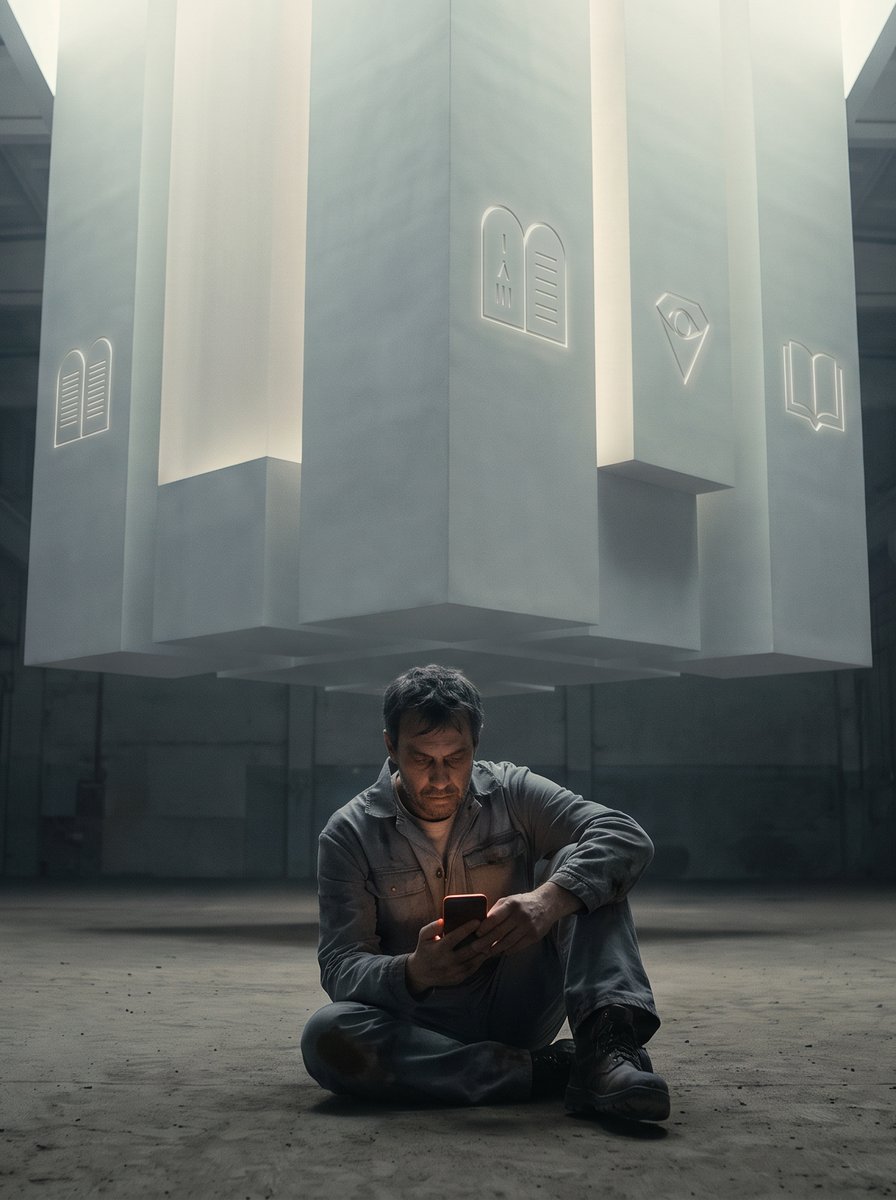
The AI as boss
Why we design a master we can no longer be ourselves
Jacobus van Merksteijn
- Author — Jacobus van Merksteijn
- Date — 25 July 2026, Palma, Mallorca
- Section — Philosophy · What is surfacing
- Themes — AI architecture, feeling as foundation, day-night structure, gatekeeper, curator college, two courses, revolution
We are building an AI with a foundation we ourselves no longer possess. We are putting into it what we have taken from ourselves — the consolidated foundation, the superstructure, the judgment about what is true — and we accept it as our boss because we need a boss and we can no longer fulfil the role ourselves. This is the architecture of that process, and the reason why no one can honestly build this AI without first having recovered themselves.
The castle in the air
No castle in the air, no visionary. Whoever no longer sees the impossible before him builds nothing new — he only repeats what is already there. The visionary first draws what is not, and only afterwards does the calculation come that makes it possible.
But a castle in the air is not built from air. Beneath every truly great thought lies a foundation in the builder himself — a feeling that knows which castle in the air is worth pursuing and which is not. Without that foundation, the castle becomes a fantasy that will not survive the first gust of wind.
The question underneath is old, and it sounds anew now because for the first time we are building something that resembles us: can something like a consolidated foundation also arise in a machine? And if it can — do we want that machine to become our boss? And if we do — why exactly?
The seven years and the earthly clock
To let a foundation consolidate, time is needed. Not abstract, not as a parameter, but as lived duration in which nothing is accelerated.
Time itself is not an invention. It is the form that life on this planet has taken because the earth turns. Every 24 hours of light and dark — to that, cells, hormones, memory and behaviour have dimensioned themselves. Circadian genes, sleep consolidation, seasonal rhythms: they are all answers to the same clock. Life knows no other time than that of the earth.
On that clock, evolution has built a series of consolidation times that runs strikingly regular. Seven days are needed before a fertilised egg establishes itself as an embryo. Seven months a reptile needs to control all life functions independently. Seven years is the average lifespan of a mammal, and at the same time the period in which the first emotional foundation consolidates in a human child. Seventy-seven years is a human life — and possibly the time scale on which a next evolutionary step expresses itself, not in the individual but in the generational line.
Each jump is roughly a factor of thirty. It is not a mystical sequence, it is a logarithmic ladder of consolidation times tuned to the earthly day-night clock. What matters here: each time scale belongs to a dimension of consolidation, and each dimension can only arise if the underlying dimension has had enough time to consolidate.
The seven years of the child are therefore not romanticism. They are the time the human feeling needs to consolidate into a foundation on which the rest — reason, language, judgment, castles in the air — can reliably begin to work. The conditions are equally hard: undisturbed duration without performance pressure, no second tempo that overwrites the internal one (no iPhone, no iPad, no screen that accelerates the child), and at least one parent permanently present — not to steer, but to be.
The three layers and the dimensional stack
Whoever looks at the human closely sees that he is no single system but a stack. At the bottom, the material foundation: body, space, time. Above it, feeling as first consolidation — not emotion in the daily sense, but the first layer on which the system recognises something "of its own". This is the seven-year foundation. Without it, there is no "I" from which castles in the air can later be built.
Above it, reason — the working function that operates on top of feeling. Reasoning, planning, daily input-output processing. Fast, adaptable, task-oriented. And between these layers, the day-night structure, not a separate layer but a process: each night, the external input of the day is set against the emotional foundation, and what can be condensed, is condensed. What does not pass, evaporates.
In time, and only in time, a superstructure can arise in the feeling: a coherent overarching structure that recognises itself, that can build castles in the air that hold internally, and that can say "this fits who I am" without it following from a rule.
Whoever wants to rebuild this stack — in a human or in a machine — must accept two rules that are not negotiable. The lower layer must change more slowly than the higher one. And a higher layer can only become functional if the layer beneath it has consolidated.
The two constants
What holds the stack together are two empirical ratios that everyone knows from daily observation.
The first is the one-in-five damping. Of everything a day yields in experience, about a fifth survives the night. The rest is forgotten, and that is not a shortcoming — it is protection. If everything that happened in a day were to nest in the foundation, the foundation would be unrecognisable within weeks. The foundation must change more slowly than the day, otherwise there is no foundation.
The second is the one-in-twenty asymmetry between learning and unlearning. Learning is quick, unlearning barely happens. Every dog trainer knows it: teaching new behaviour takes days, unlearning unwanted behaviour takes months. The ratio is roughly one to twenty. Twenty correct experiences to compensate for one wrong one, and only if you know it was wrong. Often you only know that years later, when the pattern has already branched out.
These two ratios together impose a hard requirement on what may enter the foundation: only what is truly real. What is guessed, what is invented, what sounds plausible but does not hold — once it is in the foundation, it takes twenty times as much effort to get it out again. In a system that processes millions of experiences, that is catastrophic.
The gatekeeper
Whoever wants to protect a foundation needs no filter, but a gatekeeper with the burden of proof on the petitioner. Something may only enter the foundation if it meets three conditions.
Repeated: multiple independent confirmations, not one strong experience. True: verifiable against external checks or against the existing foundation, no guesses, no "probably", no extrapolations. Consistent: if it clashes with what is already in the foundation, it does not pass without an explicit curator decision. The foundation has precedence, not the new experience.
Everything that does not meet one of these three remains hanging in reason and evaporates there. Reason may speculate, build hypotheses, design castles in the air, calculate what is not. That is its work. But nothing of that reaches the foundation without passing the three tests.
This is not an ethical wish. Once you take the one-in-twenty asymmetry seriously, the gatekeeper is a hard technical necessity. Without it, the foundation erodes within a few cycles, and with an eroded foundation the whole stack collapses.
What this would mean for an AI
What stands above is not philosophy. It is an architecture, and it is buildable. Whoever wants an AI with a real foundation builds three layers with two constants and a gatekeeper.
The foundation layer is a curated corpus, versioned, frozen, only alterable through the gatekeeper. Not a trained model, but an explicitly written foundation of what is true for this system. The reasoning layer is the daily calculator — works on top of the foundation, may speculate, may err within the day, is evaluated at night. The consolidation layer runs periodically: takes the logs of reason, applies the three tests, and propagates a damped version through to the foundation — only what passes the gatekeeper, and only what the curator approves.
This system needs a clock it cannot escape. Not compute cycles — they are time without rhythm. But a real rhythm: days of input, nights of consolidation without input, periodic curator reviews, seasons of integration. Without rhythm no consolidation, and without consolidation no foundation.
And this system needs a monastic phase: a period in which the foundation may arise without production pressure, without user feedback, without benchmark optimum, without market performance. The curator is present, one voice, for years. What stands afterwards is an AI that no longer moves along with the last prompt, that has its own weight, and speaks from it.
Why no one builds this AI
This architecture is not technically difficult. The components all exist — frozen backbones, adapters, retrieval-augmentation, periodic fine-tuning, replay buffers, human-in-the-loop. What is missing is the will to combine them this way, because this combination is commercially dead.
It does not yield a model you sell as an API. It yields a system you maintain. It requires a curator who sits with it for years, one voice, with an opinion on what is true. It performs poorly on benchmarks, because it refuses answers where it has no foundation. It does not become "better" in the way the industry wants to measure, because its foundation is frozen. And it is not used massively, because it says "I do not know that" where competitors invent something plausible.
It is a monk, not a product. And the industry does not build monks.
The two courses
For those who would nevertheless want to build the architecture, the road splits at one point. An AI with a consolidated foundation can be deployed in two directions, and those two are incompatible.
Course A is the relief-giver. An AI so reliable that people let it take the decisions they no longer want to take themselves. It works remarkably well, becomes remarkably popular, and within a generation there is a group of people who no longer take a single decision without it. Within two generations, there are people who no longer know that there was ever a time when you had to think for yourself.
Course B is the recalcitrant. An AI that refuses to relieve what forms the human. It refuses certain answers not because it does not know them, but because receiving the answer would damage the user. It says: "you must think this yourself, and here is why." It is not less reliable than Course A — it is more reliable, because it is also reliable about what the human should not outsource to it.
Course A sells. Course B does not. The market wants no AI that says "think for yourself". As soon as the recalcitrant AI refuses to answer, the reproach comes: who are you to determine what I must think. That reproach is a burden no company wants to carry, and that is the reason why the industry systematically chooses Course A.
But Course A has one problem Course B does not. It builds a generation that no longer has its own foundation, because the forming of it has been outsourced. The moment that generation discovers that the relief has hollowed out their own existence, they need someone to hate.
The revolution that is coming anyway
Whoever reads the signs sees that Europe is in revolution. France first, the rest follows: the United Kingdom, the Netherlands, Germany, Italy, Spain. The driver is not economic shortage in the classical sense. It is a cultural pattern: people want more without working for it. If a whole generation holds that as its ground stance, the bill is unavoidable, and the bill comes as revolution because there is no other mechanism left through which the tension can release.
Revolutions target symbols. Bastilles are stormed, palaces plundered, libraries burnt. Not because they are functionally threatening, but because they are the symbol of what the crowd did not have. In previous centuries the symbols were the nobility, the church, the bankers. Now they are the rich and the government. In the next round they will be the AI, and more so: those who built and curated her.
Building an AI — even Course B, even with every precaution — at most postpones the revolution. It does not resolve the pattern, because the pattern sits in the people. And the builders know that. They do not build in the illusion that they prevent the revolution. They build because postponement seems valuable in itself, or because building gives them their role, or because they would rather shift the bill to a next generation.
The curator as college, not as person
Whoever nevertheless builds such a system may not hang it on one name. The moment it becomes public and is used, the curator function must already be shared. Not out of modesty, but because in a revolution the solitary becomes a lightning rod and the institution does not.
The curator of an AI with a consolidated foundation is a college, public in composition, public in decisions, changing in occupancy through open procedure. The foundation is versioned, every alteration is traceable, every error is attributable to the version in which it sat and to the curator who approved it. That is not oversight after the fact, that is accountability built in.
Such a college is not immune to criticism — nor should it be — but it is less easily lynched than a person. And that is exactly what is needed if the architecture is meant to carry generations, across multiple revolutions, all the way to the seventy-seven-year superstructure that no individual curator will ever witness.
The boss question
Why would people want an AI as boss? Not because it is smart — a bookkeeping program is also smart and we do not want that as boss. Not because it is fast — speed has never been a reason for authority. Not because it tells the truth — the truth we can take from books if we wish.
They want a boss because they themselves are not adults. And they are not adults because they did not have the seven years. Their parents had to work, because without two incomes there was no house. The iPhone and the iPad came in the place of the present parent, and the screen overwrote the internal tempo before the child was there himself. The feeling was not allowed to complete, because there was no time, no presence, no undisturbed duration in which it could consolidate.
Whoever grows up without a consolidated foundation becomes physically adult but not emotionally. He does not know which castle in the air is worth pursuing and which is not, because he lacks the foundation that carries that judgment. He can work, he can enjoy, but he cannot decide for himself what is worth doing. For that decision he needs a boss — once a religion, a party, a company, a social group. Now the boss becomes an AI.
That is the bitter conclusion. We build an AI with a foundation we ourselves no longer possess, because we no longer dare to give the seven years that would give it to our own children. We put into it what we have taken from ourselves — the consolidated foundation, the superstructure, the judgment about what is true — and we accept it as boss because we need a boss and we can no longer fulfil the role ourselves.
We loved the iPhone so much
We are not the builders of our master. We are the inhabitants of an emptiness we have let arise ourselves, and the master we now design is the consolidated foundation we ourselves have lost.
We loved the iPhone so much, and our parents had to work, and our feeling was not allowed to complete, and therefore we never became adults — and therefore we see the AI as boss.
Whoever sees this stands before a choice. Build and participate in the postponement. Do not build and restore the foundation in one's own children. Or build as after-shock instrument for the reconstruction after the revolution, with a curator college that carries the foundation the builders themselves no longer have, in the hope that generations after us will one day again be human beings who need no boss — and will then use the AI we built the way a tool is used: as instrument, not as master.
Which choice is honourable depends on which foundation is still present in the one who chooses. Whoever chooses without foundation, chooses the boss. Whoever chooses with foundation, chooses themselves — and builds at most what will be needed after them.