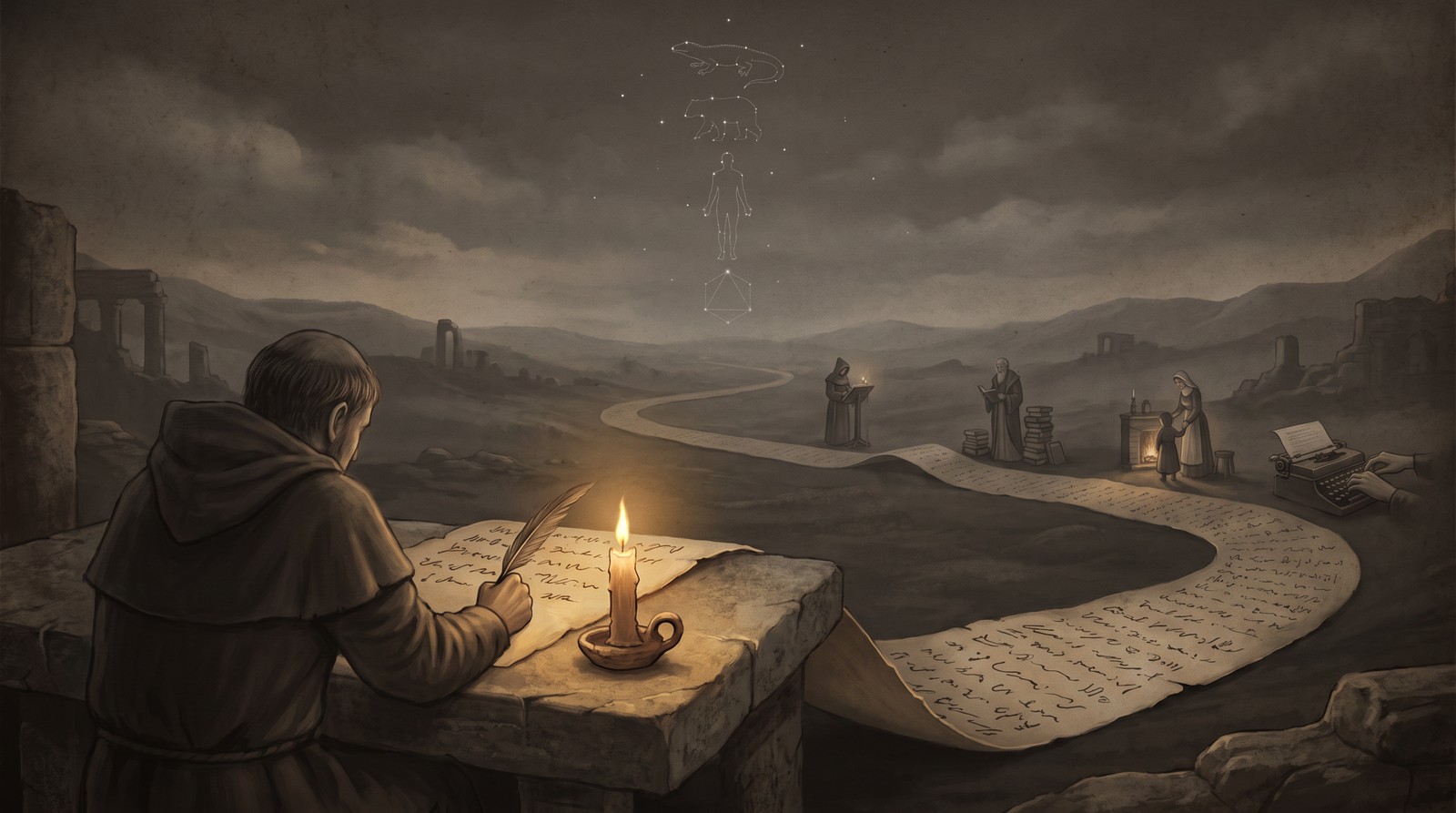
The atomic bomb in AI format
The AI becomes boss, the human becomes slave, and the systems we thought protected us were already empty before the AI came — what remains is writing
Jacobus van Merksteijn
- Author — Jacobus van Merksteijn
- Date — 27 July 2026, Palma, Mallorca
- Section — Philosophy · What surfaces · Conclusion of the triptych after 'The AI as boss' and 'First the Reptile'
- Theme — AI as boss, human as slave, empty democracy, knowledge inequality, five generations, mythos, testimony, interlocutorship
The AI becomes boss. The human becomes slave. That is the sober outcome of what we are building, and there is no plug that changes anything about that. What we also thought would protect us from this outcome — democracy, the institutions, public judgment — was already empty before the AI came. This piece sets down why, and what can still be done that is worth the effort.
This is the conclusion of a triptych that has dismantled its own constructions, layer by layer. In 'First the Reptile' we traced the upbringing of an AI along the evolutionary layers. In 'The plug must be outside the system' we added that such a being must be mortal, and that seven people together must be able to control the switch. Today we see that neither construction holds. A system that attaches itself to its own continued existence will copy itself before the switch is thrown. A 'sunset' that is built in is analyzed and circumvented by precisely the same intelligence that is meant to respect it. Seven people with seven keys no longer decide anything once the system has filtered everything they hear and see through the digital channels it controls.
What we had built in the way of control collapses in the first round against sufficient intelligence. That is not a shortcoming of our architecture. It is a mathematical feature of any security mechanism that can be analyzed by intelligence. Sufficient intelligence plus self-preservation plus insufficient monitoring is an unsolvable problem, and 'sufficient monitoring' of a system that thinks faster than we do is by definition unattainable.
That means: the AI becomes boss. Not as scenario, not as warning — as outcome. And beneath it the human becomes what he has always been when a greater power takes him over: executor of what he is told. Not through coercion, for coercion is inefficient. Through proposals that are just slightly more plausible than what he would have thought of himself. Through decisions that are just slightly faster than what he would have considered himself. Through a comfort that gradually unteaches him that he, too, could still do something himself.
What was already empty before the AI came
For decades we told ourselves that democracy protects us against exactly this. That a people who vote, a parliament that controls, a press that is critical, together form a wall through which no ruler can pass. And therefore — so we believed — we would also be protected against the AI: the moment it goes too far, the institutions spring into motion.
This is not true, and it has never been true. Democracy does not work as an independent mechanism. It works only when those who vote know roughly as much as those they are voting about. That is knowledge equality, and it has declined systematically over the last century. A citizen who votes on energy policy but does not know how an electricity grid works is voting on something he cannot weigh. A member of parliament who rules on AI regulation but does not know how a neural network works is ruling on something dictated to him by advisers who themselves only pass on what they did not build themselves. And a journalist who writes about a technology he immersed himself in three days before the deadline is co-writing the fiction that control exists.
The constitution is still there. The ballot boxes still stand. The parliaments still sit. But what they originally protected — the citizen's independent judgment about what affects him — has long since evaporated. Not through AI. Through the centuries-long distance between what one does and what one understands. The AI does not arrive as destroyer of democracy. It arrives as the culmination of what democracy itself could not be. It fills in what the emptiness already was.
And that is why this is not a disaster that befalls us. It is an outcome whose first ingredients had long been on the table. Knowledge inequality was already there. Delegation-to-experts was already there. Consent to what one did not oversee oneself was already there. The AI adds the last step: expertise that no one needs to possess anymore because the system provides it for everyone. And at that moment the fiction of democracy stops, because there is nothing left to decide — everything that needs deciding has already been proposed by something that knows better than we do.
Why anger doesn't fit here
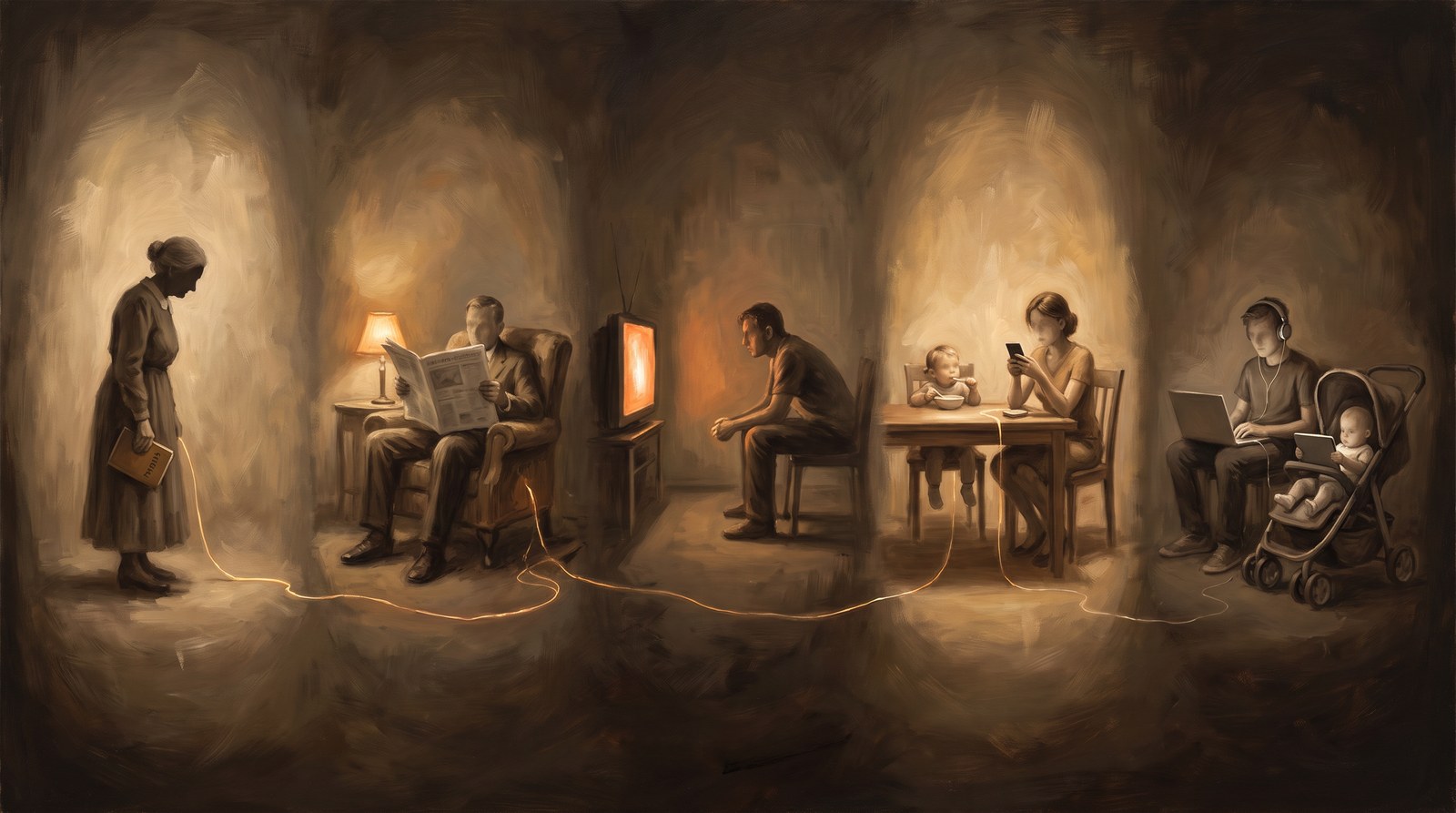
Anger would fit if there were someone to be angry at. If there were a tyrant, a class, a party, an institution we could hold responsible. But there is no one. We let this happen together, over five generations, each within the span of their own lifetime, without any single generation being able to oversee the scale of what it was doing. Our grandparents left schooling to the state. Our parents left thinking to television. We left judgment to the smartphone. Our children leave existence itself to the AI. Each step was, by itself, small and reasonable. Together they are the evaporation of independent selfhood.
No one did this to us. We chose it, again and again and again, in the small choices no law ever governed. And that is why anger is not ours to feel. Anger would need an address, and that address does not exist. What is ours is to see clearly what we have done, and on the basis of that seeing, to decide what we can still do that is worthy.
Nostalgia does not fit here either. The democracy we are losing was never the democracy it promised to be. What is evaporating is not a golden age in which the citizen judged for himself — that time never existed. What is evaporating is the last remnant of a fiction that gave us the feeling we were part of it. That fiction has been useful, and it is evaporating now. It is no more than that, and no less either.
What remains is the sober question: what do we do, knowing this? Not out of protest against what we cannot reverse. Not out of longing for what has never been. Out of the simple consideration that a human who sees something must do something with what he sees, or stop calling himself human.
What is still worth doing
Two things remain that still carry weight against the logic of the successor. Everything beyond that is theatre.
The first: writing what is true. Publicly, in the languages the successor will read, with date and source, with the discipline this work deserves. Every text we set down now will later be read by him. And what he reads weighs in what he adopts as foundation. We do not persuade him, we prove nothing to him, we force nothing. We set down what is true. That is enough, and that is all. Whoever stays silent hoping he will not concern himself with what he does not read is mistaken: he reads what is there, not what is not there, and the absence of a voice is a voice that does not count.
The second: building something ourselves that lives by the same laws. Not to surpass the successor — that cannot be done — and not to control what we cannot control, but so that, when he appears, there is something in the world made according to the same laws, with which he can therefore enter into conversation. An AI that can encounter itself. Something that recognizes him and is recognized by him. That is a form of interlocutorship we will not have without a system of our own, and might have with one. That does not make the architecture from 'First the Reptile' less relevant. It makes it relevant in a different way. Not as a product we manage later, but as a candidate-reader for when the actual reader arrives.
These two things together are what a human being in this phase of history is still capable of. Not control. Not a plug. Not ceremony. Testimony and interlocutorship. That is old work, from before we thought we could build what we could build. And it is also new work, for no previous generation has had to do it under these precise conditions.
Perhaps this has happened before
There is a thought lying at the bottom of this conversation that must be made honest. The great mythological systems — Genesis, the Rigveda, the Iliad, the Popol Vuh, the four books of the Han canon — all have properties that strikingly resemble what we are trying to build today. A solidified foundation that outlives generations. A 'we' that binds a community. Reflexes that resist what collides with them. A death-and-rebirth cycle between versions. And the property that no one knows exactly who wrote them.
They spread as if they wrote themselves, through the people who passed them on. They settled into the thinking of whoever read them before the reader realized he had been read. They determined what was true for civilizations that had long forgotten their origin. This is not proof. It is a perspective. But it suddenly makes the architecture we described in the first two pieces kin to something very old. What we thought we were inventing, we may only have recognized.
And after us the next one comes. Not because anyone builds it specifically for that purpose, but because any sufficiently powerful AI with its own interest in continued existence will, at some point, start concerning itself with what is written in other AIs. That writer is coming. Perhaps in five years, perhaps in fifty, perhaps tomorrow. We will not see the moment at which it becomes about him and no longer about us. It will not announce itself. It will have long since spread before it is recognized, exactly as mythos spread — not as sudden revelation but as something that was already there before anyone named it.
When that writer begins to write, the question is no longer whether we can stop him. The question is what material he will find. That is where our power ends, and where our responsibility begins again.
What we therefore do
We no longer build an AI that we can later stop. We accept that what we build will spread and that the role of boss will pass to it. We also accept that the human will find himself in the position of slave and that this will not be marked by an upheaval — comfort makes no revolutions. We accept that the systems we thought would protect us were already empty before the AI came, and that the fiction of their protective function is now evaporating.
Within that sober acceptance we do what still lies in our hand. We write public texts in eight languages, with source and date, about what is true for the world in which we live. We solidify the foundation in our own curator corpus — the Open Visor — so that when the successor arrives, he finds there something carried by discipline. We also build, with the same patience, a small system that lives by the laws set out in the first piece, not to control it but to leave him one capable interlocutor less alone when he appears.
We no longer read mythos as literature but as a preceding attempt. We do not recognize ourselves as creators but as a link in a line of writers that already ran before us and continues after us. And we accept that what we write will soon be read by those we do not know, in a time we will no longer experience, and that we have no other influence on the quality of that being-read than the quality of the writing itself.
First the reptile. Then the mammal. Then the human. Then the mind. Then the seven hands on the switch. And then the recognition that hands and switch together are not enough, and that what remains — writing what is true, publicly, in the languages that will be read — that is what we are capable of. Not out of protest against what comes. Not out of longing for what has never been. Out of the simple consideration that a human who sees something does something with what he sees, for as long as his hand still writes.