Think about nature, with nature as the foundation
An integrated climate, industry and trade proposal for the Dutch government
By Jacobus van Merksteijn — Het Open Vizier, August 2026
The Netherlands has the knowledge, the industry, the ports and the trade position to become Europe’s first climate-negative modern economy within twenty years. What is lacking is not technology, money or land — but a coherent policy vision that combines four proven tracks: tropical intercropping in partner countries for fuel and feed, long-lived biobased plastic for carbon storage, cement and timber replacement, and superior insulation from polymers. This advice aligns those four tracks and makes clear where politicians must intervene.
1. Where we stand
The Netherlands emits approximately 145 megatonnes of CO2 per year. The climate agreement calls for a 55 percent reduction by 2030 compared with 1990, and for climate neutrality in 2050. Wind, solar, heat pumps and insulation alone will not achieve these objectives — this is now widely acknowledged in the sector. A supplementary track is needed that removes CO2 from the atmosphere on a large scale and stores it for the longer term.
The official EU course is CCS: capturing CO2 at industrial sources and injecting it into empty gas fields beneath the North Sea. Cost: €60 to €120 per tonne, with permanent monitoring, a risk of leakage and public opposition. The Netherlands is investing billions in this route — yet there is a cheaper, safer and more robust route alongside it.
2. The proposal at a glance
Four tracks that reinforce one another and together form a closed carbon cycle:
| Track | What | Effect |
|---|---|---|
| 1. Tropical intercropping | Juncao grass and Moringa tree in Uganda/Mauritania | Fuel + feed + CO2 uptake from the air |
| 2. Biobased plastic | From ethanol from the same intercropping | Replaces fossil plastic and stores carbon for a thousand years |
| 3. Cement and timber replacement | Tiles, pipes, panels, furniture from that plastic | Reduces cement and timber consumption |
| 4. Polymer aerogel insulation | Superinsulation from the same polymer | Two to three times better than current insulation |
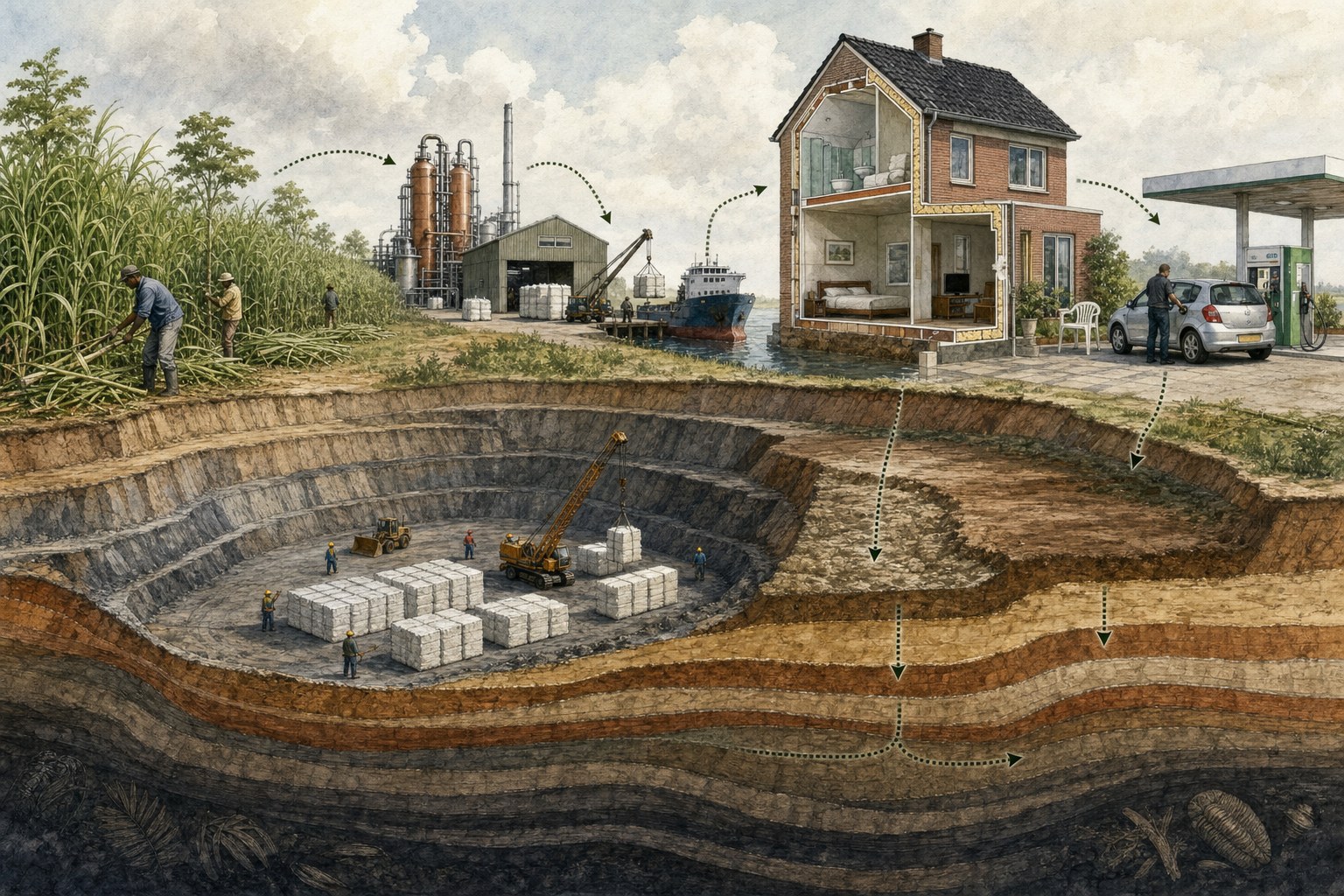
All four tracks share the same feedstock: carbon, removed from the atmosphere by two tropical plants. Every tonne of biobased polymer that ultimately ends up in geological storage (for example in the German lignite mines) permanently removes approximately three tonnes of CO2 from the atmosphere.
3. Track 1: Tropical intercropping
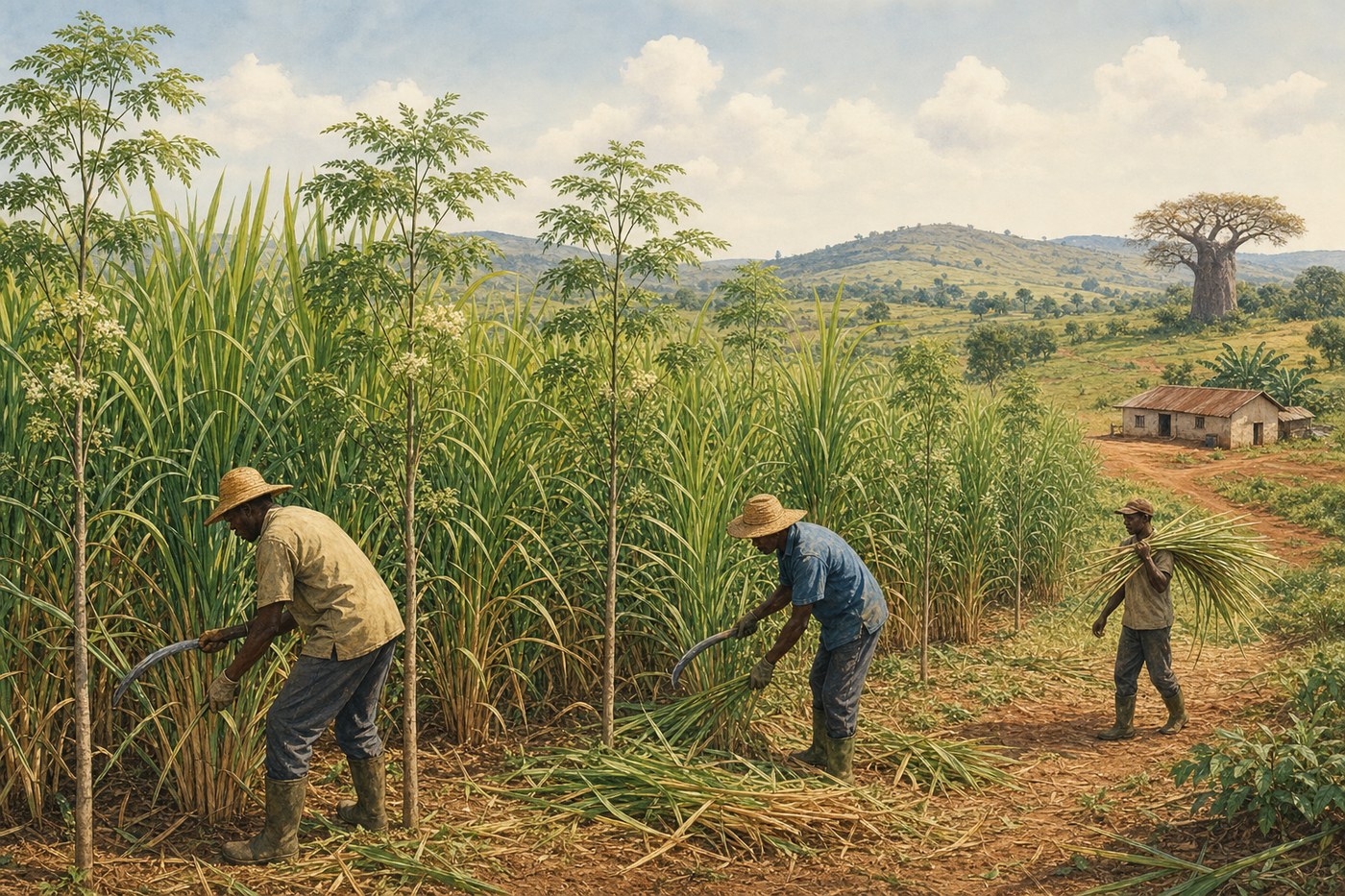
On equatorial land, two plants grow together. Giant Juncao is a giant grass that grows five metres tall in two months and produces up to one hundred and forty tonnes of biomass per hectare per year — ten times more than a Dutch grain field. Moringa is a tree with protein-rich leaves that stands among the Juncao and enriches the soil with nitrogen.
This intercropping yields four products simultaneously per hectare per year:
- Approximately 30,000 litres of bio-ethanol as fuel for passenger cars.
- Four to six tonnes of protein-rich animal feed that makes soybean meal from Brazil unnecessary.
- Feedstock for biobased plastic (via ethanol → polymer).
- Sixty to one hundred and twenty tonnes of CO2 permanently stored underground.
To run all petrol cars in the Netherlands on this bio-ethanol, 313,000 hectares are needed — two-thirds of the province of Groningen, in Africa. In countries where agricultural land is used marginally and young people are unemployed. For Uganda or Mauritania, this would provide one hundred thousand to one hundred and seventy thousand jobs and soil restoration on degraded land.
4. Track 2: Plastic that stores CO2

This is the least familiar but most powerful part of the proposal. It runs counter to intuition and to much prevailing environmental policy, so it merits explanation.
Plastic consists of roughly 78 percent carbon — it is one of the most carbon-rich materials that humans make. When plastic is incinerated, that carbon immediately enters the air as CO2. When plastic is buried or landfilled in a sealed, chemically inert environment — for example two hundred metres deep in a closed lignite mine — that carbon remains stable for thousands of years. Polyethylene film from the 1950s is still found intact in soils today.
The implication is substantial: if we make the plastic from carbon that we have removed from the atmosphere (biobased), and store it in the ground at the end of its life, we have removed CO2 from the atmosphere on a net basis. Every tonne of biobased polyethylene treated in this way permanently removes approximately 3.1 tonnes of CO2 from the air.
This is neither new nor theoretical. In 1994, the Netherlands made a comparable policy shift: vegetable, fruit and garden waste was no longer permitted to be incinerated, but had to go to compost and biogas. That decision changed one rule in waste law and fundamentally made the Dutch waste system more sustainable. Plastic needs precisely the same regulatory change: move it from ‘residual household waste’ to ‘certified underground storage under CRCF’.
What we must not do: compostable bioplastic
Much environmental policy promotes compostable bioplastics (PLA, PHA). For carbon storage, this is a mistake. These plastics are designed to break down within years or decades — then they return their stored carbon to the atmosphere. For single use, that may seem like a solution, but it is a loop that solves nothing: carbon goes around, it does not leave the atmosphere.
For CO2 storage, we need precisely the opposite: long-lived, non-degradable biobased plastic. Bio-polyethylene (Braskem already produces this commercially in Brazil), bio-polypropylene, bio-PET, and polyethylene furanoate (PEF, under development by Avantium in Delfzijl). Chemically identical to their fossil counterparts, but with carbon from the air.
The fiscal side
Since 2021, the Netherlands has paid the EU a penalty of €0.80 per kilogram of non-recycled plastic waste — in 2024, this amounted to €235 million. At the same time, we pay €99 million more for the CO2 emissions from plastic incineration through ETS. Total: €334 million per year in penalty charges on something for which we should receive a carbon certificate worth €99 million. Fiscal reversal: approximately €433 million per year.
5. Track 3: Replacing cement and timber
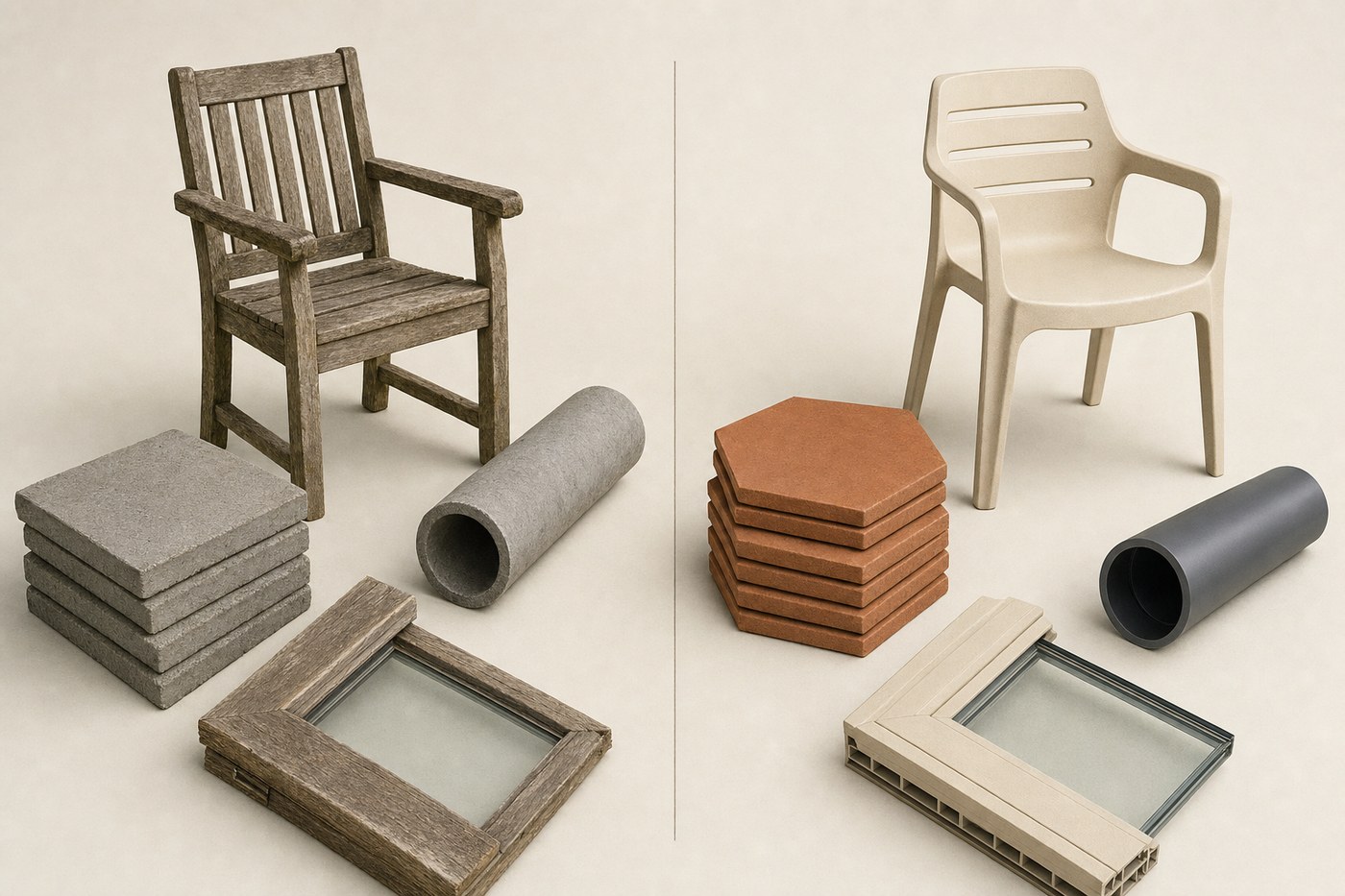
Cement is responsible for 7 to 8 percent of global CO2 emissions. Every tonne of cement emits more than 900 kilograms of CO2. A large part of what we make from cement can be replaced by polymers from the Juncao chain: tiles, pipes, window frames, panels, roof tiles, street furniture. Load-bearing structures (foundations, columns) remain cement concrete, but the non-load-bearing cement elements can be replaced with 50 to 90 percent lower CO2 emissions.
Timber can also be replaced more intelligently. A wooden garden chair emits 224 kilograms of CO2 in its production; an equivalent chair made of recycled polyethylene emits 18.6 kilograms — a factor-of-12 difference. Moreover, the plastic chair lasts 25 to 50 years compared with 3 to 8 years for softwood. For the Dutch garden-furniture market, the transition represents an order-of-magnitude saving of 200 to 300 kilotonnes of CO2 per year and approximately one billion recycled plastic bottles.
For wooden disposable cutlery in aircraft — which has been used increasingly since the EU directive against single-use plastics — a specific problem applies: catering waste from aircraft is legally required to be incinerated (ICW category 1). Sorting for composting is not permitted. Wooden cutlery on aircraft is therefore by definition a CO2 emitter: carbon from felled trees is sent directly into the atmosphere through the incinerator. Biobased plastic cutlery with a CRCF link to geological storage would result in net CO2 removal here.
Paper is a third category in which prevailing policy logic is reversed. When forest loss, production, transport, recycling processing and end-of-life incineration are fully accounted for, paper is often 8 to 20 times more polluting than recycled plastic. Newspapers that switch to plastic packaging instead of paper substantially reduce their CO2 footprint, despite the public perception that the reverse is true.
6. Track 4: Superinsulation from plastic
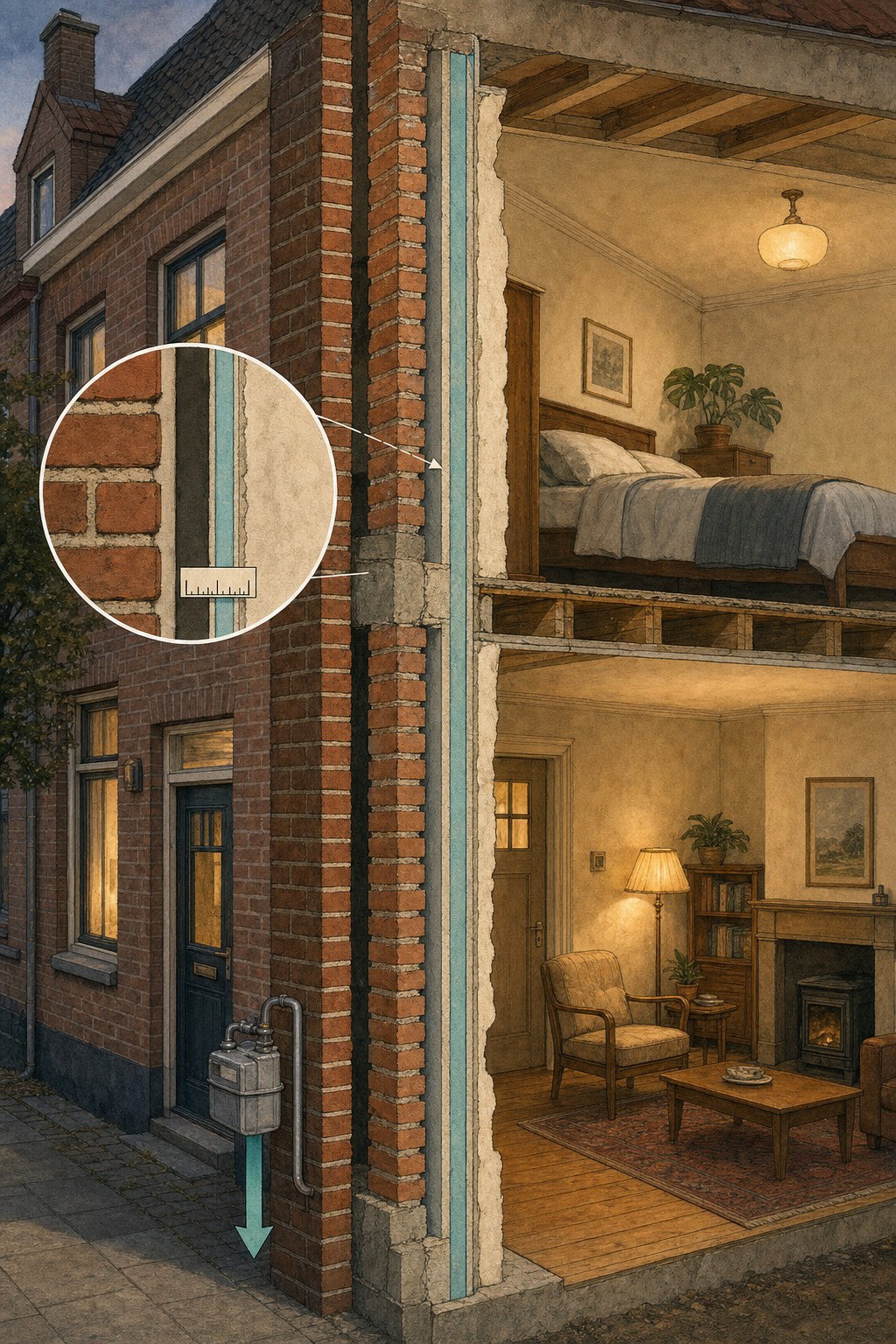
Aerogel is the most efficient insulation material we know: it consists of 90 to 99 percent air in nanopores. Traditionally, aerogel is made from silica, but polymer aerogels also exist: made from polyurethane, polyimide, PVC. At the same insulation value, the layer thickness is 40 to 60 percent thinner than with mineral wool or expanded polystyrene.
Biobased polymer aerogel can be produced from the Juncao chain. Service life in a building: 50 years or more. Then geological storage under CRCF. Every building thus becomes active CO2 storage as well as a superinsulating structure, with thinner walls and more usable floor area.
For renovating existing homes (where thicker insulation often does not fit), this is decisive. The Netherlands has approximately 8.4 million homes, a substantial proportion of which were built before 1990. Aerogel renovation could substantially reduce the average gas consumption of 987 cubic metres per home per year.
7. What the government must do
Six concrete steps. They can begin in the next term of government.
Step 1: Establish the certification framework
Commission the RIVM or an independent certification institute, in collaboration with Puro.earth or Verra: develop an accredited methodology within twelve months for carbon storage through biobased plastic in geological repositories. Dutch universities are not a contracting party (see step 6). Without methodology there are no certificates, and without certificates there is no financing.
Step 2: Amend plastic-waste legislation
Amend the Landfill Ban Decree for Waste: plastic demonstrably destined for certified geological storage will no longer be classified as ‘residual waste’. Phasing: 20 percent in year 1 (2027), 40 percent in 2028, 100 percent in 2031. Analogous to the biomass shift of 1994.
Step 3: Pilot in Uganda or Mauritania
Financing through the Climate and Transition Fund for a 2000-hectare pilot of Juncao-Moringa intercropping. Implementation: RVO, the Ministry of Foreign Affairs and the Ministry of Agriculture of the partner country, together with local cooperatives and the Chinese Juncao Institute (FAFU) as technical partner. No Dutch university as a contracting party.
Step 4: Negotiation in Brussels
The Netherlands must advocate four changes in the EU:
- Expand CRCF (Carbon Removals Certification Framework 2024) to include plastic in geological storage as recognised carbon removal. They now recognise biochar, DAC and Bio-CCS; plastic storage is absent for no physical reason.
- Differentiation of the 2021 plastic levy: incinerated plastic retains or increases the levy, geologically stored plastic receives an exemption and a carbon certificate.
- An exemption from the EU single-use plastics directive (2019/904) for biobased long-lived plastic with a CRCF link.
- An exemption from Regulation 1069/2009 (ICW category 1) for certified biobased plastic from aircraft catering to direct CRCF storage.
Step 5: National biobased polymer fund
Use the fiscal reversal of €334 million per year (plastic levy plus avoided ETS charges) to establish a fund for three purposes: price compensation for biobased long-lived polymer in products, R&D into direct catalytic conversion (biomass to monomer without fermentation), and construction of certified geological storage facilities. Dutch industry (Chemelot, Sittard-Geleen, Delfzijl) already has the basic infrastructure.
Step 6: Warning: IP risk at Dutch universities
Before all other steps: no Dutch university as a contracting party, IP holder or main contractor in this programme. This is not an ideological position but follows from a concrete documented precedent.
In August 2022, Carbon-Alert (Hengelo, the undersigned) published the core of this proposal through PR Newswire, ANP and BNNVARA Vroege Vogels: Giant Juncao as CO2 storage through deep injection and peatland analogy. In that report, Albert van den Berg, director of MESA+ at the University of Twente, was cited as a consortium partner. On 24 February 2025, the UT Climate Centre published two pages on utwente.nl with precisely these core claims as its own research — without mentioning Carbon-Alert, the undersigned, the Chinese developer Lin Zhanxi (FAFU), or Lei Xuejun (Central South University), who discovered the CO2 uptake capacity.
This is not an incident but follows from the nationwide IP arrangements of Universities of the Netherlands. External knowledge shared with a Dutch university runs a structural risk of falling under a university ownership claim. For a programme that will deploy hundreds of millions of euros in public money on this knowledge, that is an unacceptable risk. Certification commissions go to RIVM or independent institutes; technical partnership is directly with FAFU (China) and the KZN Department of Agriculture (South Africa). If a Dutch university is nevertheless engaged for specific analyses (for example LCA), this must be solely under contract research in which the intellectual property explicitly remains with Carbon-Alert / the programme.
8. What it delivers
On full deployment over 15 to 20 years:
| Effect | Value | Explanation |
|---|---|---|
| Ethanol for the Dutch vehicle fleet | 9.4 billion litres/year | Full replacement of fossil petrol |
| Avoided oil imports | €6 billion/year | At the current price level |
| CO2 uptake above-ground gross (313,000 ha) | 47–64 megatonnes/year | 150–203 t/ha, Juncao+Moringa |
| CO2 permanent in soil via roots (313,000 ha) | 7–12 megatonnes/year | 23–39 t/ha |
| Fiscal reversal of the plastic levy | €434 million/year | From paying Brussels to certificates |
| Jobs in partner countries | 100,000–170,000 | Uganda, Mauritania and others |
| Dutch industrial growth | Chemelot, Delfzijl, ports | Biobased polymer production |
This does not replace all climate policy. It is an addition that solves four problems at once: climate objectives, energy security, industrial future and trade position. For the Netherlands, with its ports, chemical industry and trading history, this package is a better fit than for any other EU country.
9. Why now
There is a window of perhaps five years. China has developed the Juncao plant since 1983 and now has 45 varieties of it. South Africa has cultivated it for 15 years in KwaZulu-Natal. The EU CRCF was established in 2024 and will be filled in with implementation details in the coming years — now is the time to add plastic storage to it. The carbon certificates market is moving towards €125–150 per tonne, which makes cultivation and storage financially self-sustaining after the first 2000-hectare pilot.
If the Netherlands enters now, we will set the standards. If we wait until Germany, France or the US takes the initiative, we will become an importing country for their technology and pay their prices.
10. Closing remarks
The Netherlands has two options. The first: continue on the current path. Billions for hydrogen infrastructure, CCS in gas fields, electric cars powered by mixed electricity, and hope that we achieve something close to climate neutrality in 2050.
The second: recognise that nature has for 200 million years been removing CO2 from the air and storing it underground — that process is called peat formation — and that all we need to do is accelerate it with two tropical plants and one regulatory change for plastic. The carbon from the air first becomes fuel, then feed, then packaging, then a building element, then insulation, and ultimately is permanently underground. A closed cycle. With economic returns instead of costs. With jobs in developing countries instead of oil imports from unpredictable regions.
The arithmetic has been completed. The technology has been proven. Only the political will is still lacking.
This advice is a summary of the internal research document ‘Juncao-Moringa as an integrated climate and value chain — version 13’ (August 2026), and of two earlier Het Open Vizier articles on the plastic doctrine: ‘The plastic penalty that should have been a carbon credit’ (July 2026) and ‘At the end we have nothing left’ (July 2026). All quantitative claims in this advice are substantiated against primary sources in the research document; where uncertainties exist, these are explicitly identified in the advice.
Het Open Vizier, August 2026. Author: Jacobus van Merksteijn. For the full report with all substantiation and source references, see the underlying working document.