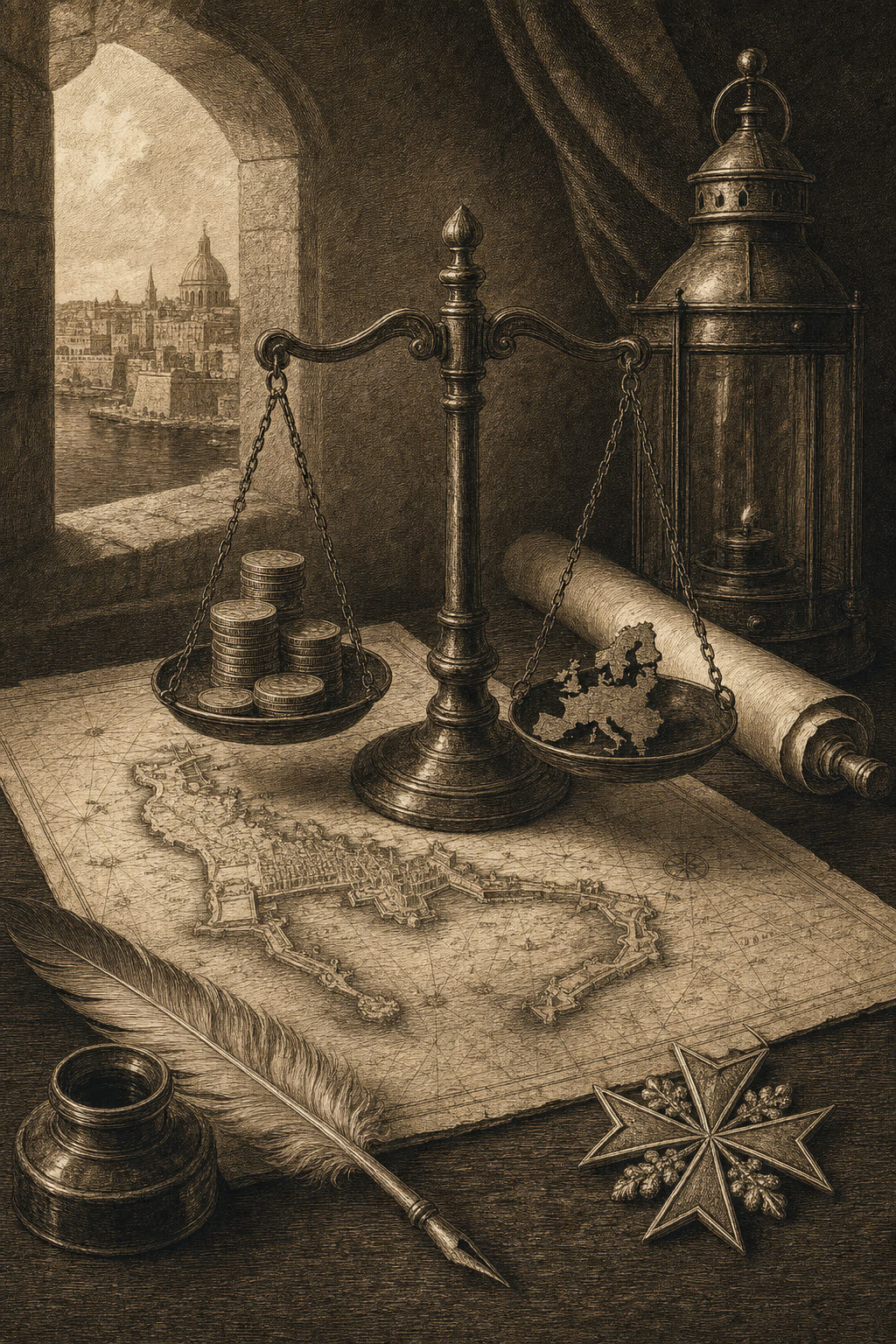
Het derde stuk in de Gevolgenkaart-reeks. Voor Malta geldt de scherpste asymmetrie: klein genoeg dat elke EU-richtlijn een nationale schok is, groot genoeg om binnen het systeem te zitten dat die richtlijnen vaststelt.
Mappa tal-Konsegwenzi
Maltese politiek + EU-druk tegen 2030
Jacobus van Merksteijn · Malta, juni 2026
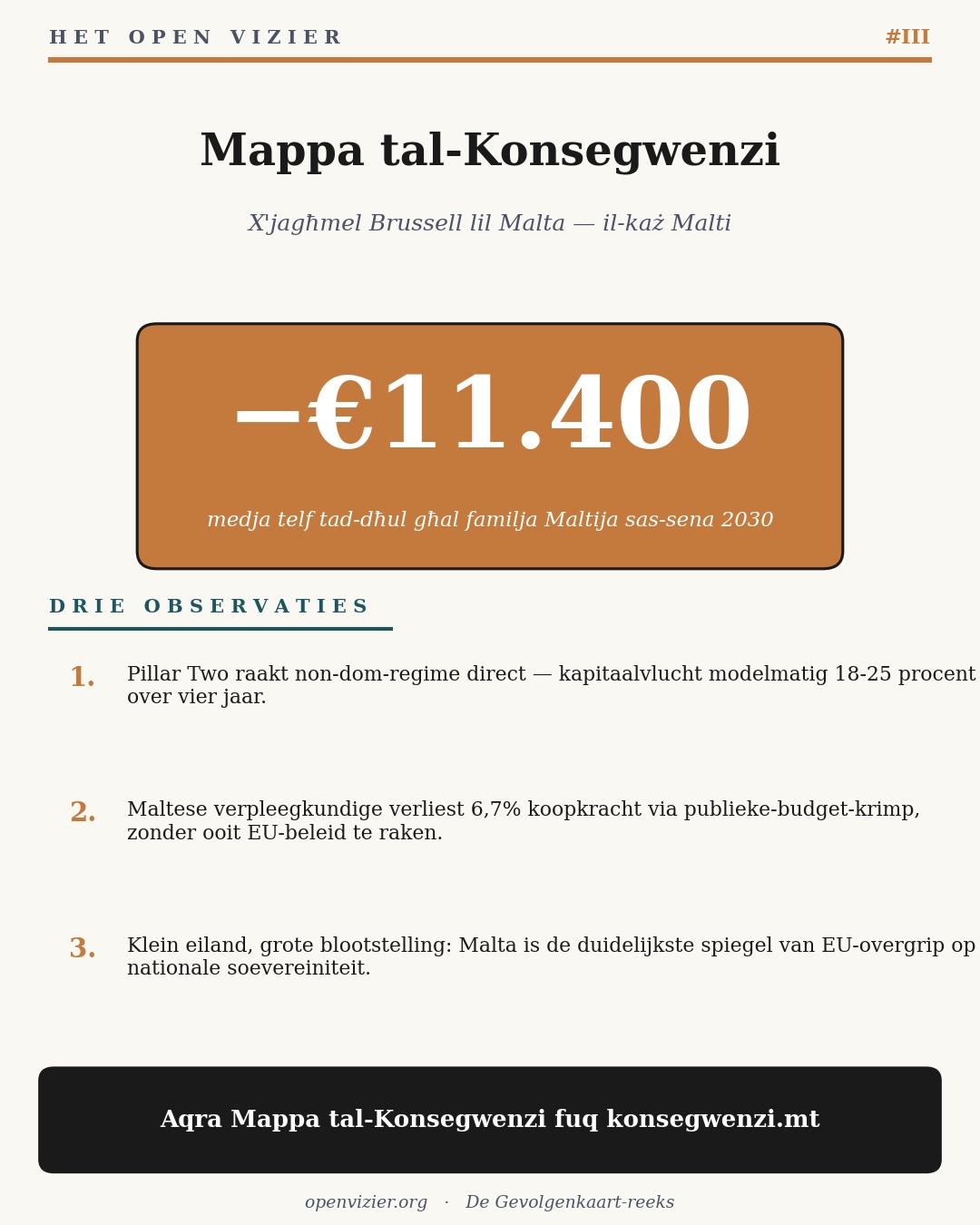
Infographic uit de Communicatiekit — kerncijfer voor Malta. De volledige twintig scenario's verschijnen op konsegwenzi.mt zodra het platform live gaat.
Wat Malta uniek maakt
Asymmetrie — een halve miljoen inwoners, maar volledig binnen het systeem dat EU-richtlijnen uitvaardigt. Elke richtlijn is een nationale schok; geen enkele kan worden vermeden.
Drie EU-instrumenten stapelen — Pillar Two ontmantelt de non-dom structuur, CBAM raakt industriële inputs, het Migratiepact verandert de absorptie-capaciteit van microstaten.
De Mappa is geen pleidooi voor Mexit — wel voor een andere relatie. Malta als kanarie in de EU-kolenmijn van overcentralisering.
Het opiniestuk
Why Malta loses €11,400 per family by 2030
**Titel: Why Malta loses €11,400 per family by 2030 --- and what the vote can still change**
Catarina is a nurse in a Sliema public hospital. She earns eighteen thousand euros a year. She has never met an American client, never invested in a fintech, never voted for anything except Labour. By 2030, the Mappa tal-Konsegwenzi calculates she will lose six point seven percent of her purchasing power --- about twelve hundred euros a year.
Not because of inflation. Not because of incompetence. Because of a cascade she is too distant from to see: Brussels Pillar Two implementation that drives Maltese non-dom fintech capital toward Texas; reduced corporate tax revenue that shrinks Maltese public spending; nursing budgets cut as a result; her wage and benefits compressed. Three orders down, the bill arrives at her kitchen table.
Catarina is one of twenty scenarios in the Mappa tal-Konsegwenzi, the Maltese sister-piece of the Gevolgenkaart series. It uses the same three-order cascade model --- direct, macro, cascade --- applied to twenty Maltese cases: a non-dom fintech professional, a construction worker, a cruise-tourism operator, a pensioner in Mellieha, a graduate emigrant in Berlin, and so forth. The picture is uniformly red, except for one column.
What stands out about Malta is its asymmetric exposure. With only half a million people, Malta is small enough that every EU directive lands as a major national shock --- but large enough to be inside the system that decides those directives. Pillar Two does not affect a Maltese household directly; it affects Maltese corporate tax structure, which affects state revenues, which affects nursing wages. The same logic applies to CBAM, to Fit-for-55, to the Migration Pact, to NGEU expenditure rules. Five EU instruments stack on the Maltese household.
What this means for the political question is uncomfortable. The traditional Maltese political debate is between Labour and Nationalist. The Mappa tal-Konsegwenzi shows that --- under current Brussels parameters --- both produce nearly identical third-order outcomes for households like Catarina's. A Labour government tries to soften the blow through public-sector wage increases; a Nationalist government tries to soften the blow through corporate tax stability. Both lose the model arithmetic by 2030.
This is not a critique of PL or PN. It is a critique of the corridor in which they operate. The Maltese government, like the Dutch and German and Italian, executes Brussels policy more than it makes its own. Roughly seventy percent of new Maltese law in 2024 was direct transposition of EU directives. The Maltese parliament debates how to implement, not whether.
The Mappa tal-Konsegwenzi does not propose to leave the EU. That would be economically catastrophic and politically impossible. What it proposes is a different relationship: Malta as the canary in the coal mine of EU overcentralization. Malta has, by virtue of its size, the moral standing to say what Germany cannot: that the Pillar Two implementation as currently designed is not in the interest of smaller members; that the CBAM as currently designed punishes peripheral economies; that the Migration Pact distribution does not respect the existing absorption capacity of microstate societies.
The reference column in the Mappa --- labeled Nova Democratia / VMP --- assumes exactly such a relationship. Malta argues vocally inside Brussels for a renegotiation of Pillar Two with a competitive European bandwidth (fifteen to twenty-five percent corporate tax with productivity deductions). Malta refuses the binding distribution mechanism of the Migration Pact and instead argues for selective inflow based on contribution-capacity. Malta keeps its bilateral relationships with London and Washington alive as leverage. Under this scenario, Catarina actually gains six point seven percent purchasing power by 2030, instead of losing it.
This is a model output. It is not a guarantee. It assumes coordinated political courage that small countries rarely sustain. But it is the only column that ends in green --- meaning that without that column, the only available trajectories are degrees of red.
The Maltese voter therefore faces a more interesting question than 'PL or PN'. The question is: 'PL or PN --- within which Brussels relationship?' The Mappa tal-Konsegwenzi makes that meta-question visible for the first time, with numbers attached. Read the full piece at konsegwenzi-dot-mt. Then vote.

Jacobus van Merksteijn
Hoofdredacteur van Het Open Vizier. Ondernemer, ontwikkelaar van industriële en governance-innovaties (Carbon-Alert Ltd, TerraClean Ltd, GuardSkin Ltd). Schrijft over economische, ecologische en politieke systeemvraagstukken vanuit ervaring met de Brusselse en Haagse besluitvormingsmachine.