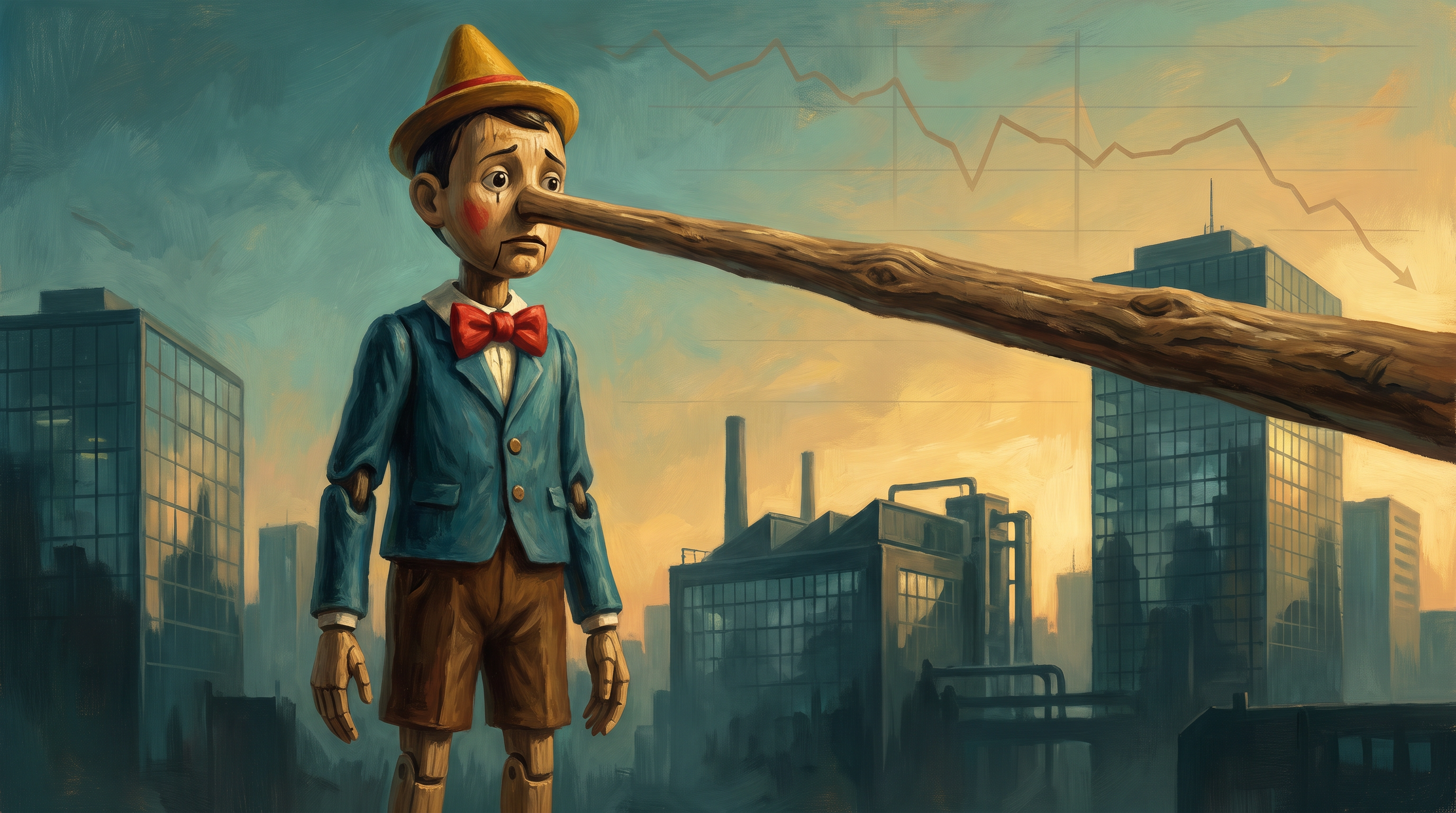
At the end, we have nothing left
NEPK crash, biotech flight, and the learning function we have never had
Jacobus van Merksteijn
- Author — Jacobus van Merksteijn
- Date — 20 July 2026 · Palma, Mallorca
- Section — Third in the series · Nova Democratia · Edition 2 · Follow-up to “Honesty makes governing possible” and “Deciding without a horizon”
- Basis — NEPK recalculation July 2026 · Leiden biotech cluster · plastic waste law · Eli Lilly Katwijk · zero-base 1/5 convergence · high-knowledge teams
- Sources — Het Financieele Dagblad, OECD Trade in Value Added, World Bank industry VA, OECD Revenue Statistics, CBS 85821NED, CBS National Accounts, Provincial States of Zuid-Holland, CE Delft, EU Carbon Removals Certification Framework
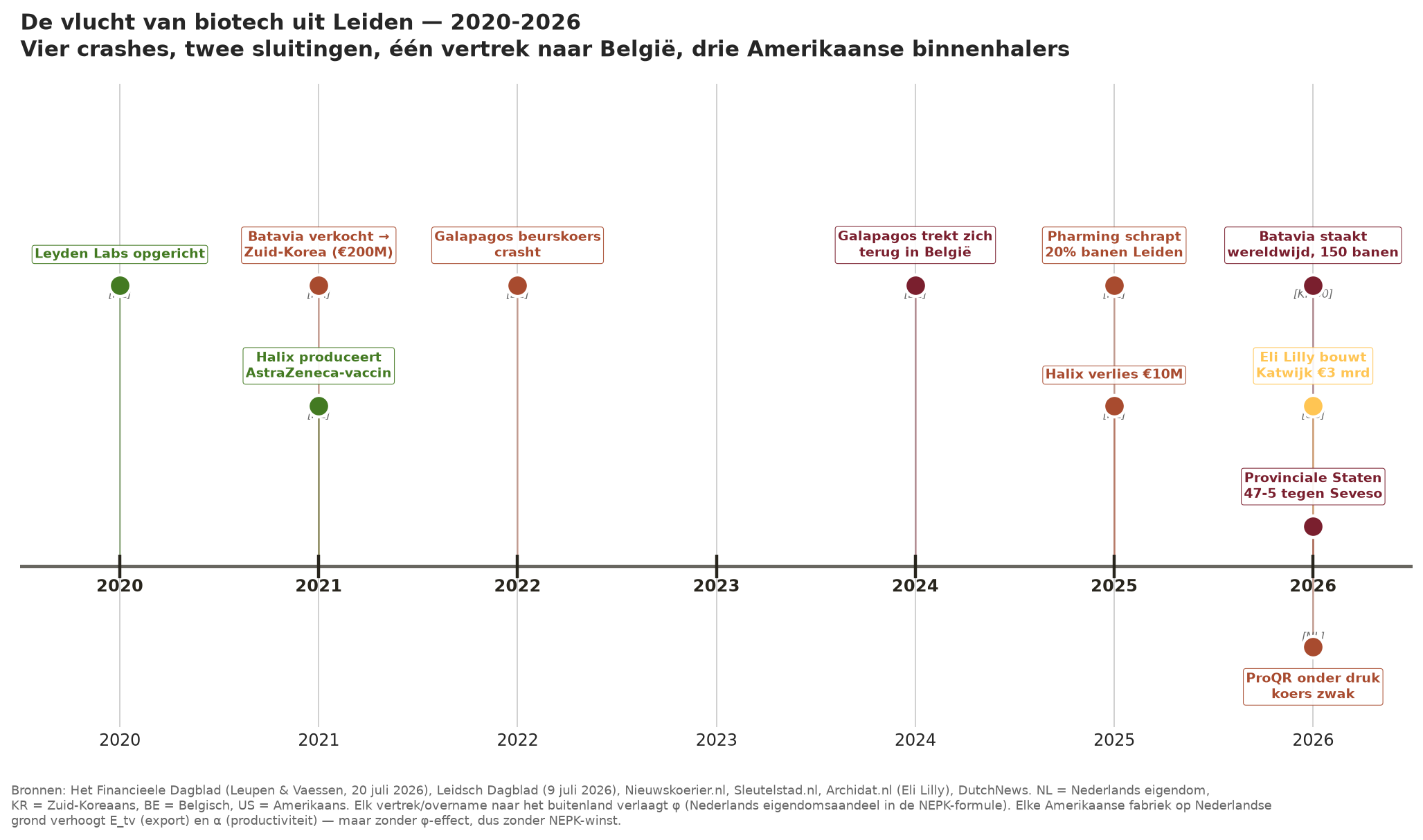
On Thursday 9 July 2026, the Batavia Biosciences building in Leiden was evacuated because of a smell of burning — an air-handling motor. Eleven days later, Het Financieele Dagblad published the analysis that exposes the pattern: Batavia, based in Leiden since 2009 and acquired in 2021 for €200 million by South Korean CJ CheilJedang, is ceasing its activities worldwide. All 150 employees are redundant. The new 12,000-square-metre building, costing well over €100 million, stands empty. In front of it, a bee hotel. Inside: silence.
This is not an accident. This is the pattern. Galapagos, once worth €15 bn on the stock market, collapsed and withdrew to Belgium under another name. Halix, the AstraZeneca vaccine producer for which Boris Johnson once considered a military intervention, is now completely silent: deserted car park, €10 m loss, idle machinery. Pharming cut 20% of its workforce. ProQR is under pressure. 5 of the 6 major Dutch biotech companies are in sale mode or in decline — while the Americans continue building: Bristol Myers Squibb, Johnson & Johnson, and Eli Lilly with a €3 bn factory in Katwijk.
This is the third article in a series of three. First came the confession. Then the horizon. Now the learning function we have never had — and the evidence that without it, the crash is not years away but has already begun.
Foreword — Third in the series: the clock is ticking
Three articles, one architecture. In Honesty makes governing possible came the confession: the PBW formula showed that €419 bn of Dutch GDP is unproductive, concealed by accounting fictions. In Deciding without a horizon came the outlook: laws from the 1960s and 1990s ossify the system without an expiry date. This third article adds the learning function — the mechanism that allows the first two foundations to work at all.
And the clock is ticking faster than the first two articles could show. Whereas the openvizier projection of early 2026 forecast an NEPK crash through the 3% threshold between 2029 and 2033, the July 2026 recalculation based on primary sources shows an NEPK of 2.95% — already below that threshold. 5 of the 6 major Dutch biotech companies are in sale mode. The crash date is not 2032. It is 2027-2028.
Part 0 — From GDP to NEPK: why GDP tells us nothing any more
Dutch GDP continues to rise. Officially, things are going well. But GDP does not measure what the Netherlands earns structurally. It measures total expenditure, regardless of whether the profit remains here or flows to Indianapolis, Seoul or San Francisco. The measure that does measure this — NEPK, the Net External Productive Core — stood at 4.2% of GDP at the beginning of 2026 according to openvizier.org. That was already the lowest of seven high-developed countries examined. Singapore stands at 17%. Ireland at 11.9%. Germany at 7.8%.
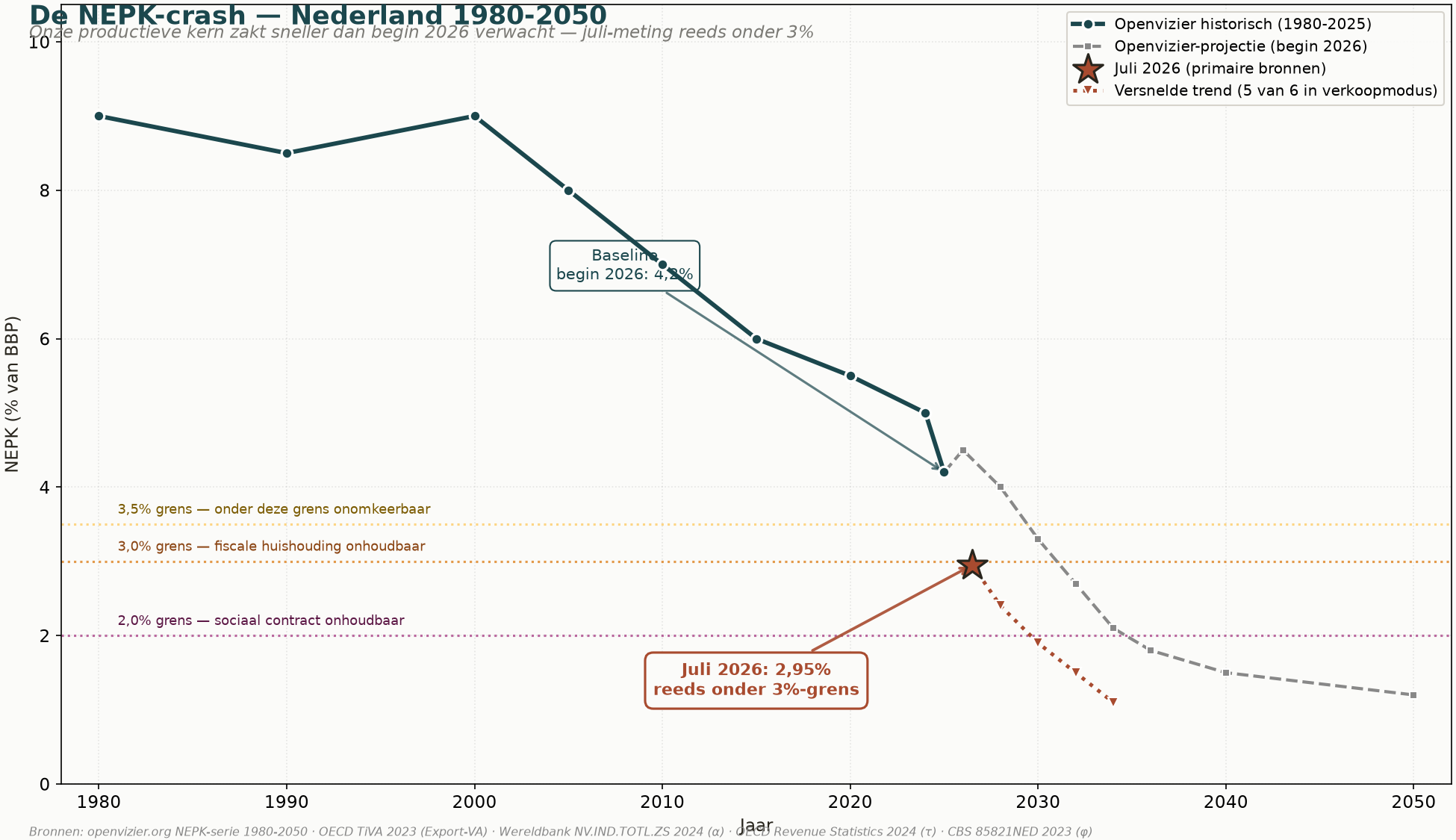
Six months later, the Netherlands has already fallen further. Recalculation using the most recent primary sources — OECD Trade in Value Added 2023 (Export VA 36.1%), World Bank industry VA 2024 (α from 17.86% of GDP), OECD Revenue Statistics 2024 (τ = 38.5%) and CBS 85821NED 2023 (foreign control 25.6% of business-sector VA, φ = 0.744) — gives an NEPK of 2.95% for July 2026. This is not inconsistent with the earlier projection. It is precisely what openvizier predicted, but with an acceleration of five to seven years. The Netherlands is already below the 3% threshold below which the fiscal household is warned to become unsustainable.
What the figures do not yet show — 5 of the 6 in sale mode
Why is the crash moving faster than projected? Because CBS, the OECD and the World Bank report with a delay of twelve to twenty-four months. The official figures for 2023 and 2024 capture deals from 2022 and 2023. What is moving through the economy today appears in no statistics. And what is moving is this: five out of every six entrepreneurs who have built something of significance are no longer investing. They are polishing the figures for a sale. This is doubly destructive for the NEPK: first α falls because no new investments are being made; then φ falls once the deal is closed, because the buyers are American, Korean, German or Belgian.
Both movements remain invisible to the statistics: the investment freeze is reported nowhere, and the sale only appears when CBS or the Bundesbank registers the change in ownership — months or years later. By the time the figures capture reality, the Netherlands will be further down than the July calculation already indicates. That is precisely why ‘waiting for the figures’ is a political error: once the figures are ready, the situation is irreversible.
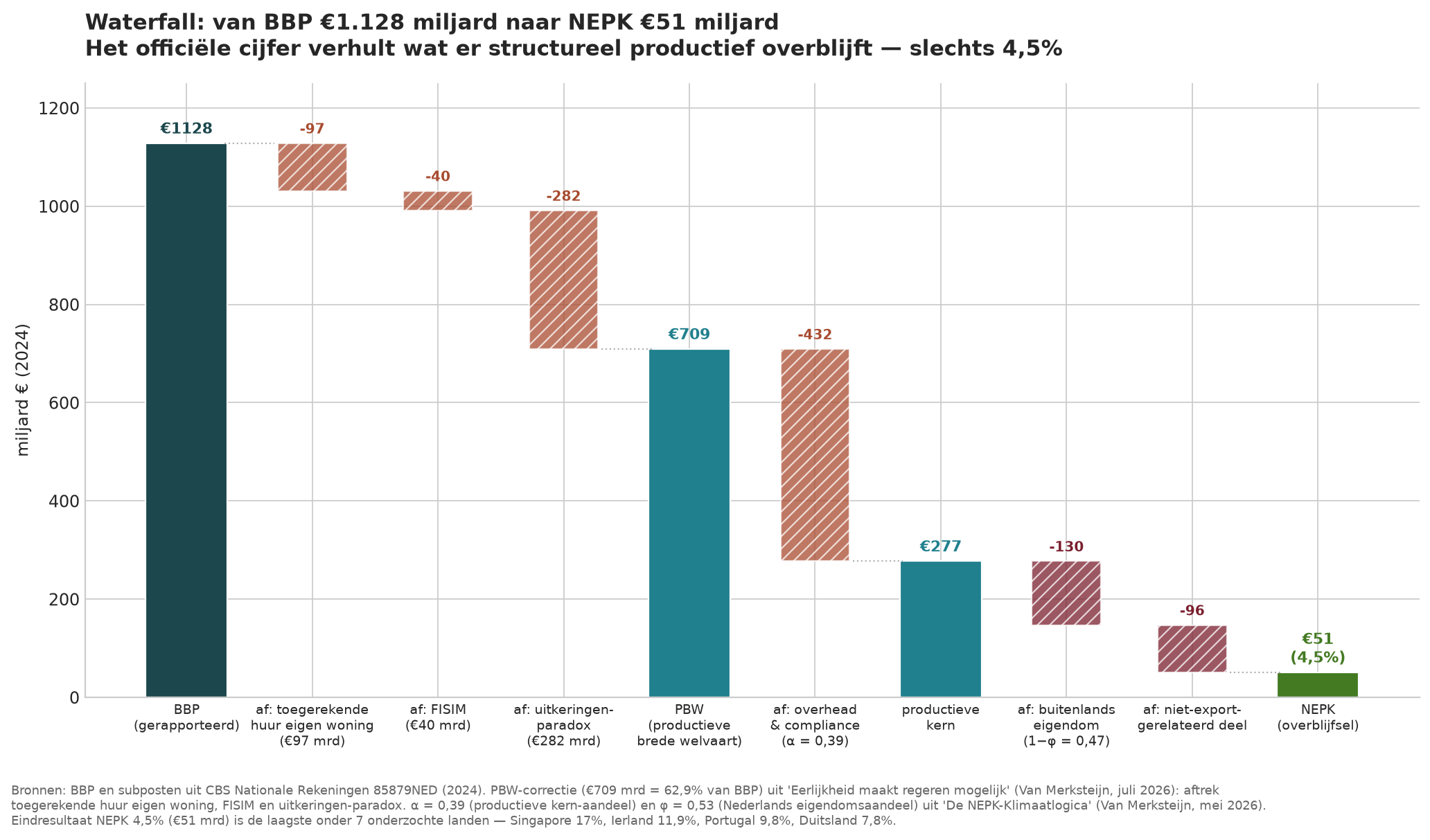
To understand the crash, the figure must be dismantled. Dutch GDP in 2024 amounts to €1,128 bn. It contains three items that measure no production: €97 bn imputed rent (an accounting fiction in which homeowners pay themselves rent), €40 bn FISIM (fictitious banking services statistically added to GDP), and €282 bn benefits paradox (government spending without a productive counterpart). Subtract these three items and €709 bn of real, production-linked prosperity remains — PBW, 62.9% of official GDP.
Overhead and compliance pressure must then be deducted from this PBW: α = 0.39 for the Netherlands, compared with 0.58 for Singapore. What remains is the productive core: €277 bn. Of this, 47% is foreign-owned (φ = 0.53) — profits flowing to foreign shareholders. What remains is €51 bn. Four point five per cent. That is the Netherlands’ Net External Productive Core: what the country structurally earns from the world, after deducting accounting concealment, bureaucratic overhead and profit repatriation. This is not a pessimistic reading of favourable figures. This is the mathematics of openvizier.org, based on OECD Trade in Value Added, World Bank industry VA and CBS National Accounts.
Part I — The four levers of the NEPK
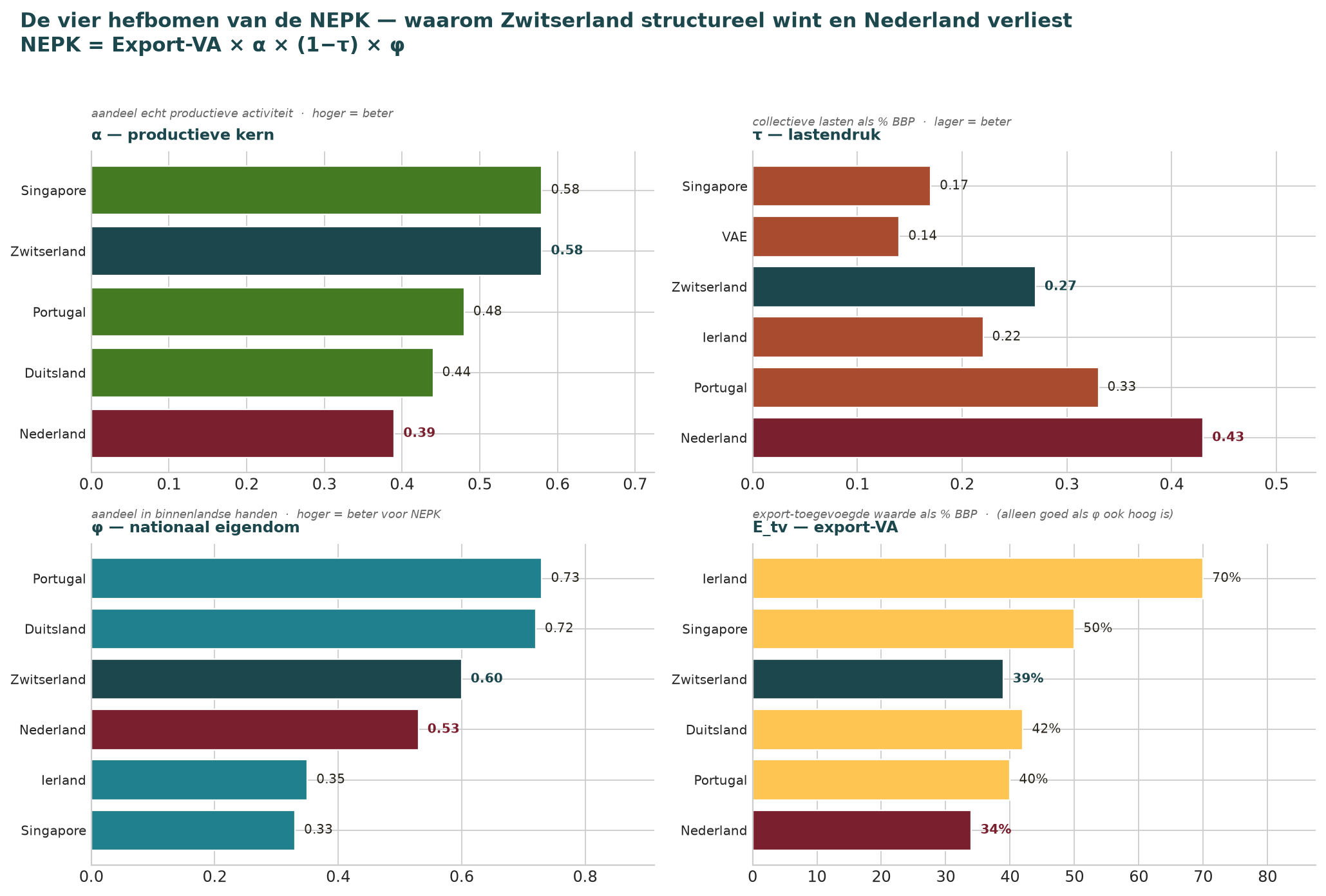
The NEPK formula is ruthlessly simple:
NEPK = E_tv × α × (1 − τ) × φ
Four levers. E_tv is export value added as a percentage of GDP. α (alpha) is the productive core — the share of the economy that actually adds value after deducting overhead and compliance. τ (tau) is the collective tax burden. φ (phi) is the Dutch ownership share. The Netherlands loses on all four levers.
α — the productive core that is shrinking
Our α is 0.39. Of every euro of value added, 39 cents are genuinely productive; the rest disappears into overhead, compliance, consultants and intermediary services. Singapore: 0.58. Portugal: 0.48. The loss is captured literally in the FD quote from CEO Geert Jan Groeneveld: the LUMC professor with “brilliant ideas” who does not start because he receives only 5% of the shares. His potential contribution — new medicines, exporting businesses, highly skilled employment — disappears into α. Never measured, but lost.
τ — the tax burden that hollows out the economy
Our τ is 0.43. Almost half of every productively earned euro goes to collective burdens. Singapore: 0.17. UAE: 0.14. Ireland: 0.19. Portugal: 0.33 — and Portugal also has a welfare state. The difference is that the Netherlands allows collective burdens to grow without a return in productive capacity. Every euro that goes to τ instead of α accelerates the crash.
φ — the ownership that flows away
Our φ is 0.53 — 47% of Dutch productive capacity is in foreign hands. In Portugal: 27%. In Germany: 28%. Singapore has φ 0.33 — even lower than ours — but uses this to keep the tax burden low, without a social contract that has to be financed from domestic profits. The Netherlands does have such a contract, while simultaneously losing the ownership needed to finance it.
Every time a Dutch biotech company is sold to a foreign owner, φ falls. Batavia to Korea in 2021. Galapagos back to Belgium in 2024. Argenx to Belgium years ago. And every American factory on Dutch soil — Bristol Myers Squibb, Johnson & Johnson, Eli Lilly — raises E_tv and α, but not φ. Statistically, the economy appears to grow. The NEPK falls.
E_tv — exports that can mislead
Our E_tv is approximately 38%. Ireland: 55%. Singapore: 50%. That looks favourable, but Singapore has φ 0.33 — much of those exports yields little for Singapore itself. High exports are productively meaningful only if you retain ownership of them. Ireland combines high E_tv with low τ and low φ, and retains part of the profit domestically through clever tax design — net NEPK 11.9%. The Netherlands does none of these things.
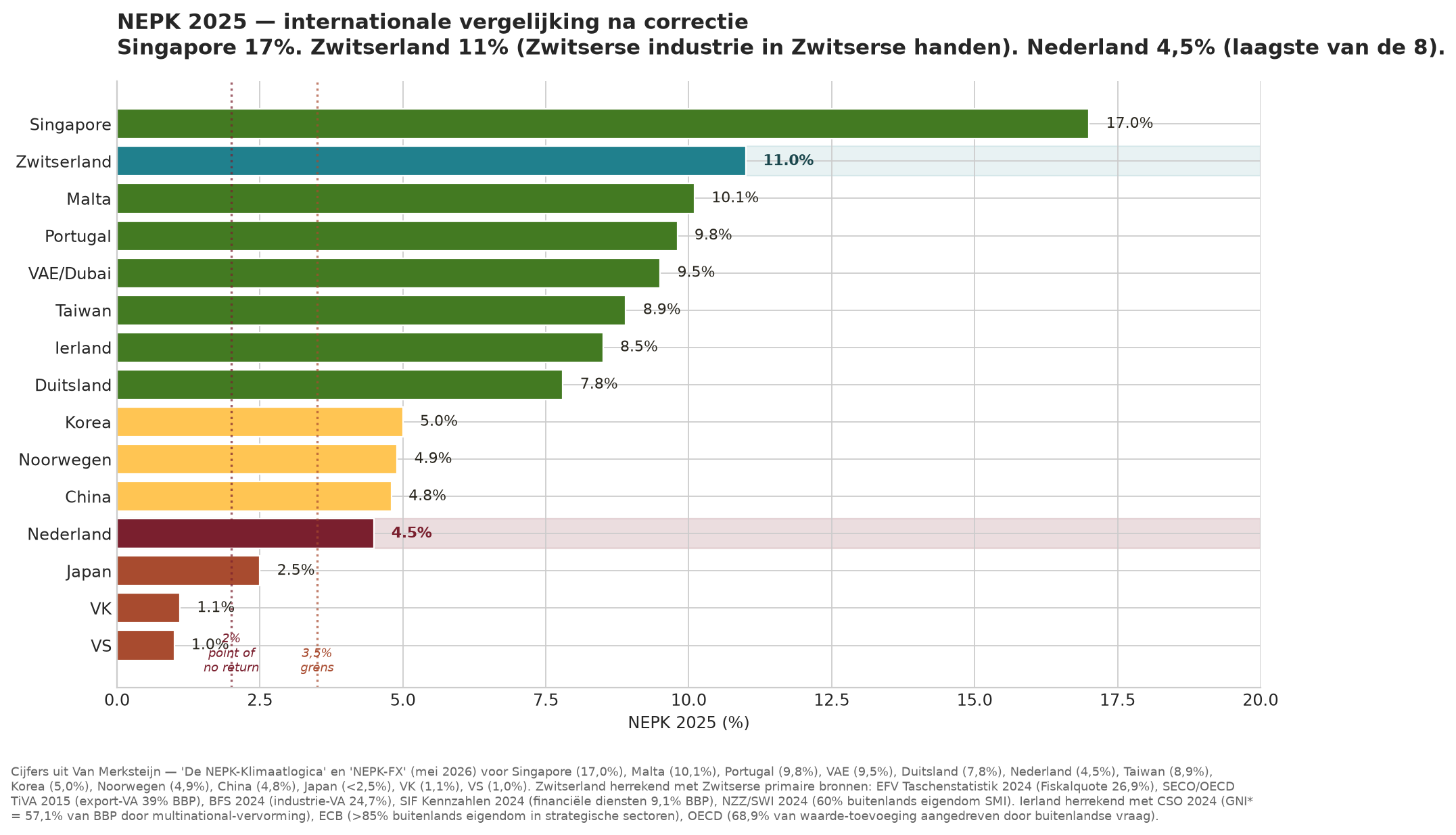
Where the Netherlands stands — the ranking
| Country | NEPK | α | τ | φ | E_tv |
|---|---|---|---|---|---|
| Netherlands | 4.5% | 0.39 | 0.43 | 0.53 | 38% |
| Germany | 7.8% | 0.46 | 0.40 | 0.72 | 39% |
| Sweden | 9.1% | 0.49 | 0.42 | 0.71 | 43% |
| Switzerland | 13.4% | 0.54 | 0.27 | 0.74 | 58% |
| Singapore | 17.0% | 0.58 | 0.17 | 0.33 | 50%* |
*Singapore’s E_tv is distorted by entrepôt trade (179% raw export VA); the NEPK of 17% follows from an adjusted calculation.
The Netherlands is below the 3.5% threshold that openvizier.org warns we must remain above before 2029, otherwise the implosion becomes irreversible. Under unchanged policy, the NEPK will fall through the critical 3% threshold between 2029 and 2033. With the AI revolution on top of this — which will automate away much of the knowledge-intensive services in which the Netherlands is relatively strong — we will fall to 2% before 2035. At that level, the country can no longer finance its own social contract.
This is not an accident. This is the pattern.
Part II — Three cases of NEPK destruction
Abstract figures demand concrete cases. Three dossiers in which all four levers collapse at once and the Netherlands removes its own core without noticing. Each case shows the same pattern: a political decision without the knowledge and expertise required to make it, with NEPK losses that can never be structurally recovered.
Case 1 — Leiden biotech: the cluster that is fleeing

The FD article of 20 July 2026 paints the picture confirmed by every NEPK figure. Leiden Bio Science Park was the largest life-sciences cluster in the Netherlands, among Europe’s top five. Today it is a cluster in flight.
| Company | What | Where to | Effect on φ |
|---|---|---|---|
| Galapagos | Once worth €15 bn on the stock market; collapsed | Belgium (different name) | φ down — assets and patents gone |
| Batavia Biosciences | €200 m acquisition in 2021; closes worldwide; 150 made redundant | South Korea → zero | φ down twice — sold, then liquidated |
| Halix | AstraZeneca vaccine producer; €10 m loss; idle | Repurposing being considered | φ at risk — capacity unused |
| Pharming | 20% of head-office jobs cut | Share price under pressure | φ shrinking — core activity hollowed out |
| ProQR | Under pressure; weak share price | Possible takeover | φ at risk |
| Argenx (historical) | Originally Dutch; now worth €30+ bn | Gent (BE) — years ago | φ lost — the biggest one there ever was |
Investment is taking place, but not by Dutch owners. Bristol Myers Squibb built a brand-new facility for cancer cell therapies. Johnson & Johnson invested in a new white-brick building. Eli Lilly is building in Katwijk for €3 bn. Every investment raises E_tv and α on Dutch soil. Every investment has φ = 0, because the profits go to Indianapolis and New York.
Why this happens: the 5% rule and the lack of growth capital
Two reasons stand out. First: the 5% share rule (5% rule). A LUMC professor who wants to commercialise his own discovery may usually own no more than 5-10% of the shares under the Dutch Knowledge Exploitation Regulation. The patent is registered in the name of the knowledge institution; the university places its shares in its Holding BV; investors receive shares in exchange for capital; the researcher keeps the remainder. Under these conditions, he does not start, in Groeneveld’s words. In Belgium — where Argenx moved and where it is now worth over €30 bn — the scientist-entrepreneur retains more. In Denmark (Novo Nordisk, Genmab). In Germany (BioNTech). Everywhere is better than here.
Second: the lack of Dutch growth capital. Leyden Labs, one of the few genuinely flourishing Leiden biotech companies, raised €40 m in June 2026 — but with capital from the Gates Foundation, Singaporean ClavystBio, the EIC and American Fidelity. Invest-NL contributed €10 m. The rest is foreign. When Leyden Labs succeeds, the proceeds go to the main shareholders — back abroad. φ down, even in success.
The hidden solution — what Batavia could have become
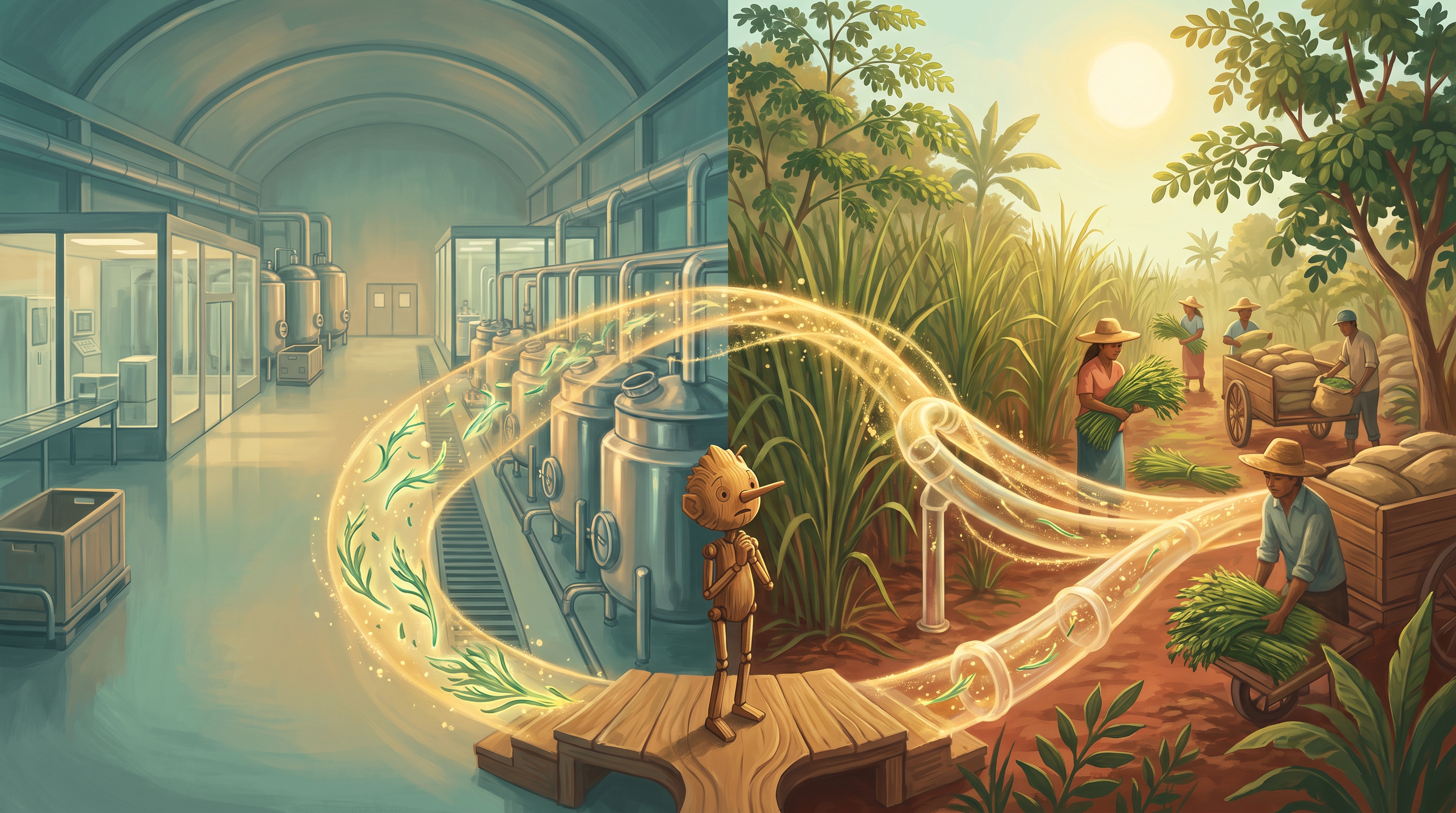
Batavia wanted to produce vaccines and biological medicines as a European counterweight to China. When that proved commercially unsuccessful in the bulk vaccine market, the company’s employees were made redundant. But the infrastructure — 12,000 m² of clean space, bioreactors, clean rooms, GMP licences, technically trained staff — has not disappeared. It stands empty, waiting for a use no one has identified because no one sees the connection.
The World Belt corridor dossier — discussed in Deciding without a horizon — sets out how tropical corridors with Juncao grass and Moringa trees can produce millions of tonnes of biomass annually. Through multiple-membrane hydrolysate technology, this biomass is converted into workable building blocks: proteins, carbohydrates, cellulose derivatives and plant sterols. This technology fits exactly onto the bioreactor infrastructure Batavia built. Bioreactor separation processes for viral vaccines are technically and legally in the same category as membrane separation processes for plant hydrolysates. GMP clean rooms work for both. The staff who could make vaccines can make hydrolysates.
That is the zero-base question in action: if we were starting again today with Batavia, with all today’s knowledge — what should it have become? Not an Asian subsidiary losing out in the bulk vaccine market, but a Dutch-anchored hub in the World Belt hydrolysate chain. Raw material from Mauritanian GMV or the Andes-Amazon corridor. Processing in Leiden. Downstream distribution to European pharma and food. Dutch ownership (φ up). High margins (α up). Exports (E_tv up). Low tax burden provided it is fiscally structured intelligently (τ contained). All four NEPK levers moving in the right direction.
But no one built that bridge. Not in the House of Representatives, where the Agriculture and Economic Affairs committees do not speak to one another. Not in the Provincial States. Not at Invest-NL. Not at the Ministry of Economic Affairs. Only at openvizier.org, where the dossiers sit side by side — but that is a one-person newspaper from Palma.
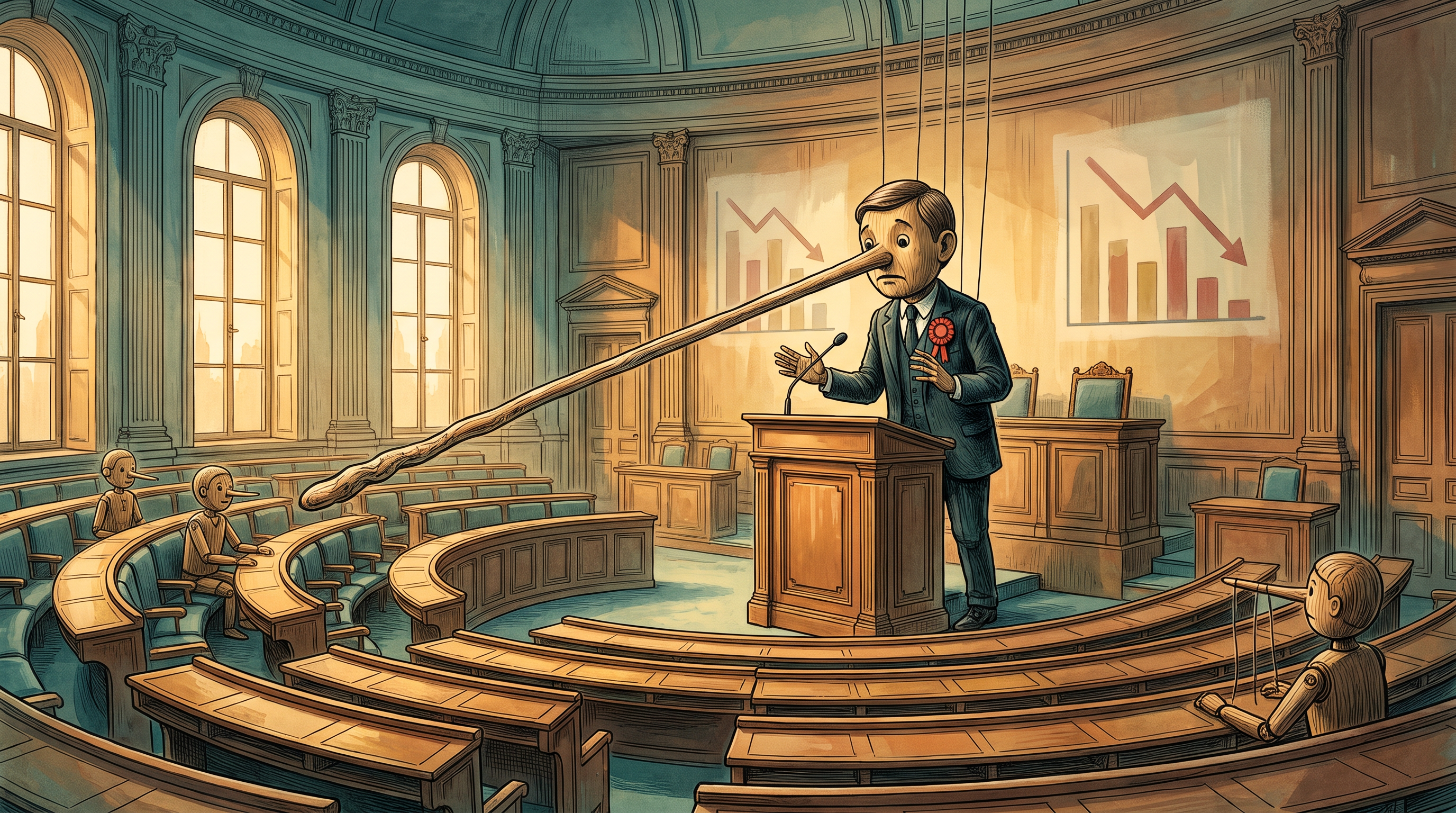
This is the Pinocchio scene in miniature. We tell ourselves: “the market is simply bad” (the literal newspaper headline of 9 July). We say: “market correction after the coronavirus pandemic” (HAL Allergy). We say: “we were overtaken by reality” (Marty Stork, HR director at Batavia). Each time, the nose grows. The reality is that we had a solution no one connected.
Case 2 — The plastic waste law: one rule, one million tonnes of CO₂
Since the 1990s, the Netherlands has had a good law: waste may not be dumped. Excellent policy — it prevents wild rubbish tips and protects soil and groundwater. The question is: what do we classify as waste, and what is no longer waste? In the 1990s, the Netherlands introduced one crucial change. Biomass was removed from the strict waste regime. GFT was given its own collection obligation from 1 January 1994, came under the BOOM Decree and has since been treated as a raw material for compost and biogas. Since then, 1.5 million tonnes of GFT plus 1.5 million tonnes of green waste per year have gone to high-quality processing instead of the incinerator — one of the most successful pieces of circular policy the Netherlands has ever produced.
Plastic is still in the old regime. It falls under “household residual waste” and “industrial waste” in the Waste (Landfill Ban) Decree. Dumping is prohibited. Recycling is welcome but does not cover enough. The remainder must be incinerated in waste-to-energy plants — producing 2.64-2.86 kg of fossil CO₂ per kg of plastic. In the Netherlands this amounts to 1.32 megatonnes of CO₂ per year. Across the EU: 71.5 megatonnes per year, or 2.4% of total EU emissions — for carbon that could have been safely stored underground.
The EU Carbon Removals Certification Framework (CRCF, 2024) recognises permanent carbon removal as a policy objective. Underground storage of stable plastic — in old salt mines, the Hambach pit, or certified geological storage facilities — is by definition permanent carbon removal. Yet it is not allowed, because plastic is still in the old waste regime.
One rule change. Just as biomass was moved in 1994 from “incinerated as residual waste” to “composting and biogas”, plastic must be moved from “incinerated as residual waste” to “certified underground storage under the CRCF”. Fiscal reversal for the Netherlands: from €334 m remittance + €99 m ETS charge = €433 m annual reversal. At EU level: €5.4 bn/year. NEPK effect: up — new biobased plastics industry (Bio-PE, Bio-PP, PEF) with Dutch ownership (φ up), high margins (α up), European exports (E_tv up).
Why does this not happen? Because there is no committee member in the House of Representatives with specialist chemical, membrane-technology or waste-law expertise. There is someone with a political background, an environment spokesperson, a parliamentary group leader. Ignorance guards the status quo. The nose grows, CO₂ continues to rise, and the NEPK falls.
Case 3 — Eli Lilly Katwijk: ignorance that rejects investment
On 9 July 2026, the Provincial States of Zuid-Holland voted by 47 to 5 in favour of €31 m in traffic measures around a new Eli Lilly factory in Katwijk, provided that this factory would not be a Seveso establishment. The motion: “We instruct the Provincial Executive to do everything in its power to prevent such a company from settling here.” The reasons were concern about hazardous substances, traffic pressure, drinking-water shortages, pressure on the electricity grid and Valkenhorst housing development.
All these concerns are real. The question is whether the average member of the Provincial States has the knowledge to assess Seveso classification. A Seveso establishment is a chemical production site with defined quantities of hazardous substances above an EU threshold — this depends on precise substance inventories, not on “we are building a large factory”. Provincial executive member Meindert Stolk observed: “There is not a single Seveso company in the entire Leiden Bio Science Park. No one is waiting for hazardous situations.” The Provincial States nevertheless voted 47-5 against it.
This is the FD diagnosis in political form. A €3 bn investment, 500 highly skilled jobs, and an expansion of an internationally recognised science park depend on a political vote in which the majority of those entitled to vote cannot assess the technical content. Sinan Özkaya (PRO): “As Provincial States, we should have been able to find something about the consequences for the electricity grid, drinking water and the environment.” Quite right. But who in the Provincial States can assess that? And if no one can, why are they taking the decision?
And even if Eli Lilly comes: 100% American ownership. NEPK effect: α and E_tv up, φ unchanged. The Netherlands supplies land, water, electricity and transport infrastructure (€31 m for Katwijk alone), and in return receives production whose profits flow to Indianapolis. If the factory ultimately fails to arrive because of political disorder, we also lose the growth in α. Two scenarios, both inferior to the one in which a Dutch biotech company had made the same investment with the same land and permit.
Part III — Zero-base: the learning function we do not have
Three cases, the same pattern three times: the knowledge to solve the problem exists, but political decision-making does not incorporate it. The answer is not yet more analysis, more committees or more policy memoranda. It lies in a structural mechanism that makes legislation learn. That mechanism is called zero-base with 1/5 convergence (learning rule) per year per dossier.
Everything that learns reaches its optimum within years — except Dutch legislation
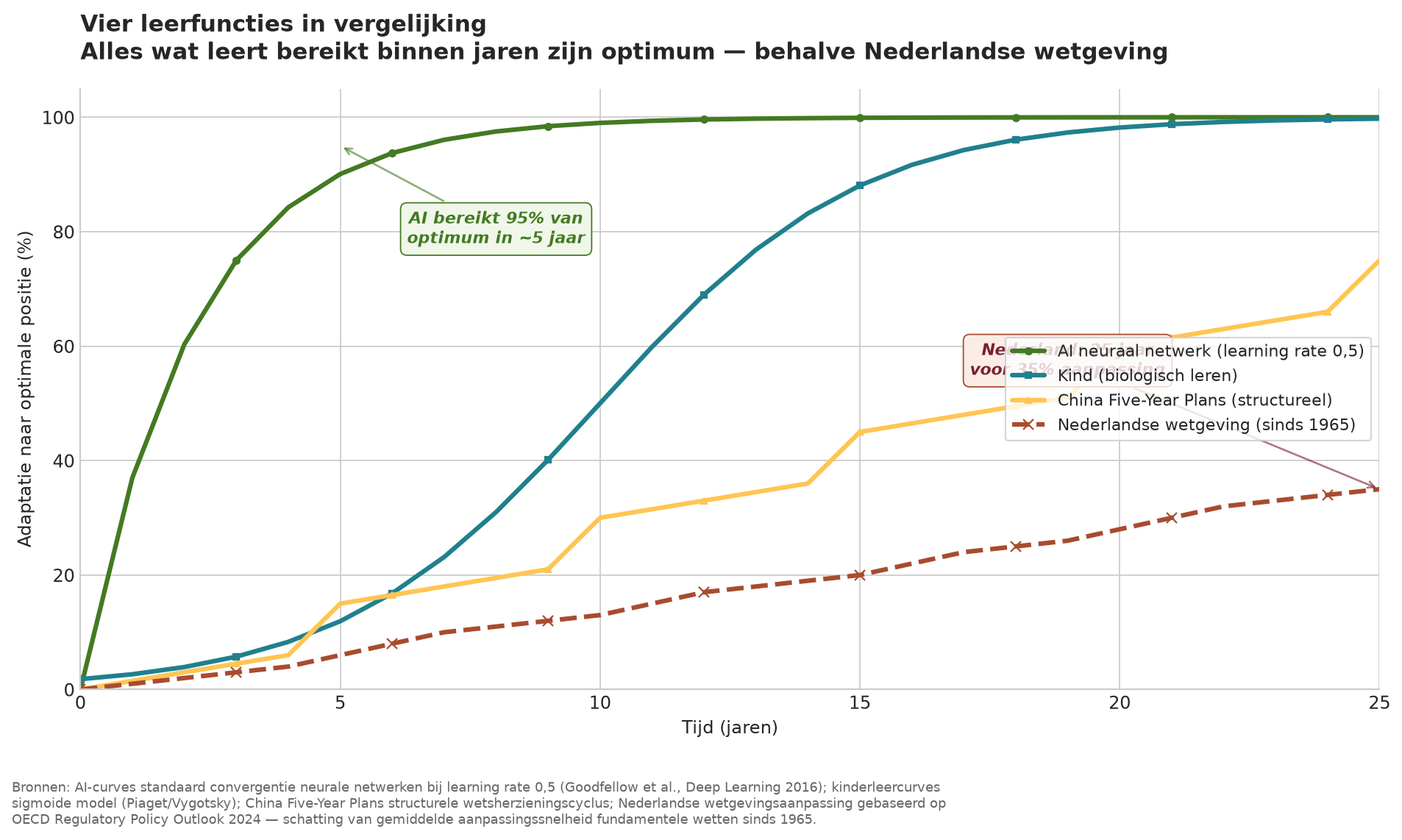
Everything that learns reaches its optimum within years — except Dutch legislation.
All systems that produce something genuinely good learn. Neural networks have done so since 1986. Children do so from birth. China does so through its Five-Year Plans. Craftspeople do so through master-apprentice-pupil systems. The Netherlands and Europe do not — the average fundamental law has a revision cycle of 15 to 30 years. An order of magnitude slower than any learning system we know.
The method: if we were starting again today
Zero-base works as follows. Every year, for each law or policy dossier, we ask one question: “If we were starting entirely afresh today, with all current knowledge and technology, what would the law look like?” That is fundamentally different from “how do we amend the existing law?”. Amendment means building on a foundation that is no longer questioned. Zero-base questions the foundation itself.
Then compare that imagined zero-base with the existing law. There is a gap — sometimes small, sometimes enormous. With the plastic waste law, the gap is enormous (one rule change removes 1.32 megatonnes of CO₂). With the 5% share rule, the gap is enormous (Belgium proves it). With the Seveso classification procedure, the gap is enormous (technical support for members of the Provincial States is missing).
The 1/5 rule — why precisely one fifth
And then comes the 1/5 rule. In the coming year, the government does not bridge the entire gap, but precisely one fifth. Why exactly one fifth? Because that is the learning rule that appears everywhere something genuinely learns.
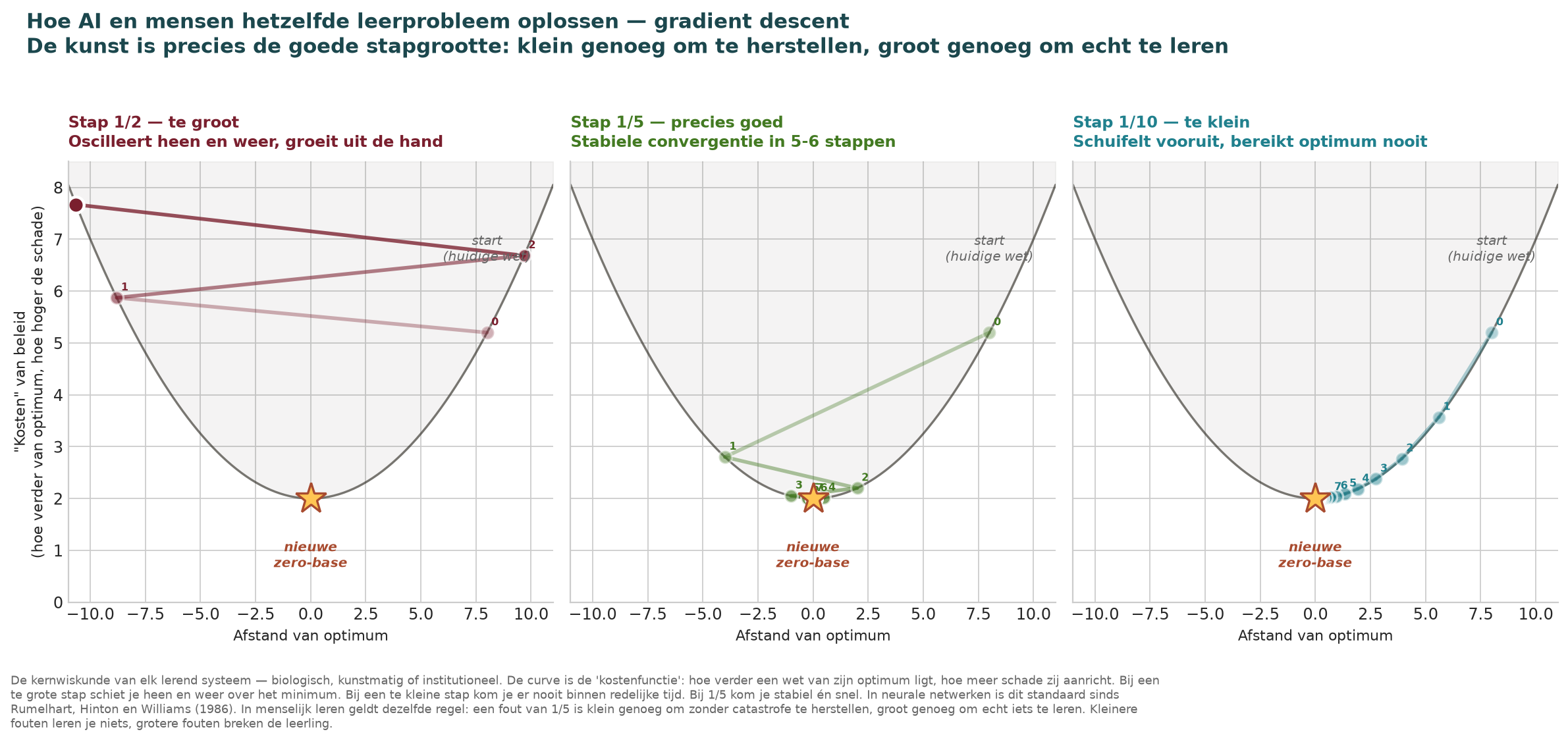
In neural networks this is called gradient descent. With too large a step, the system oscillates and explodes. With too small a step, you do not reach the goal within a reasonable time. The optimal step lies empirically between 1/5 and 1/10 per iteration. Adam, the most widely used AI optimiser, uses learning rates typically between 0.1 and 0.2 — precisely 1/10 to 1/5.
Knowledge comes from making mistakes and recovering
Knowledge comes from making mistakes and recovering.
The AI side is the mathematical side. The human side is at least as important. Every person who learns — a child learning to walk, a craftsperson learning to build — learns through mistakes of manageable size. Precisely a 1/5 mistake is the golden rule: small enough to recover from without catastrophe, large enough to genuinely learn something.
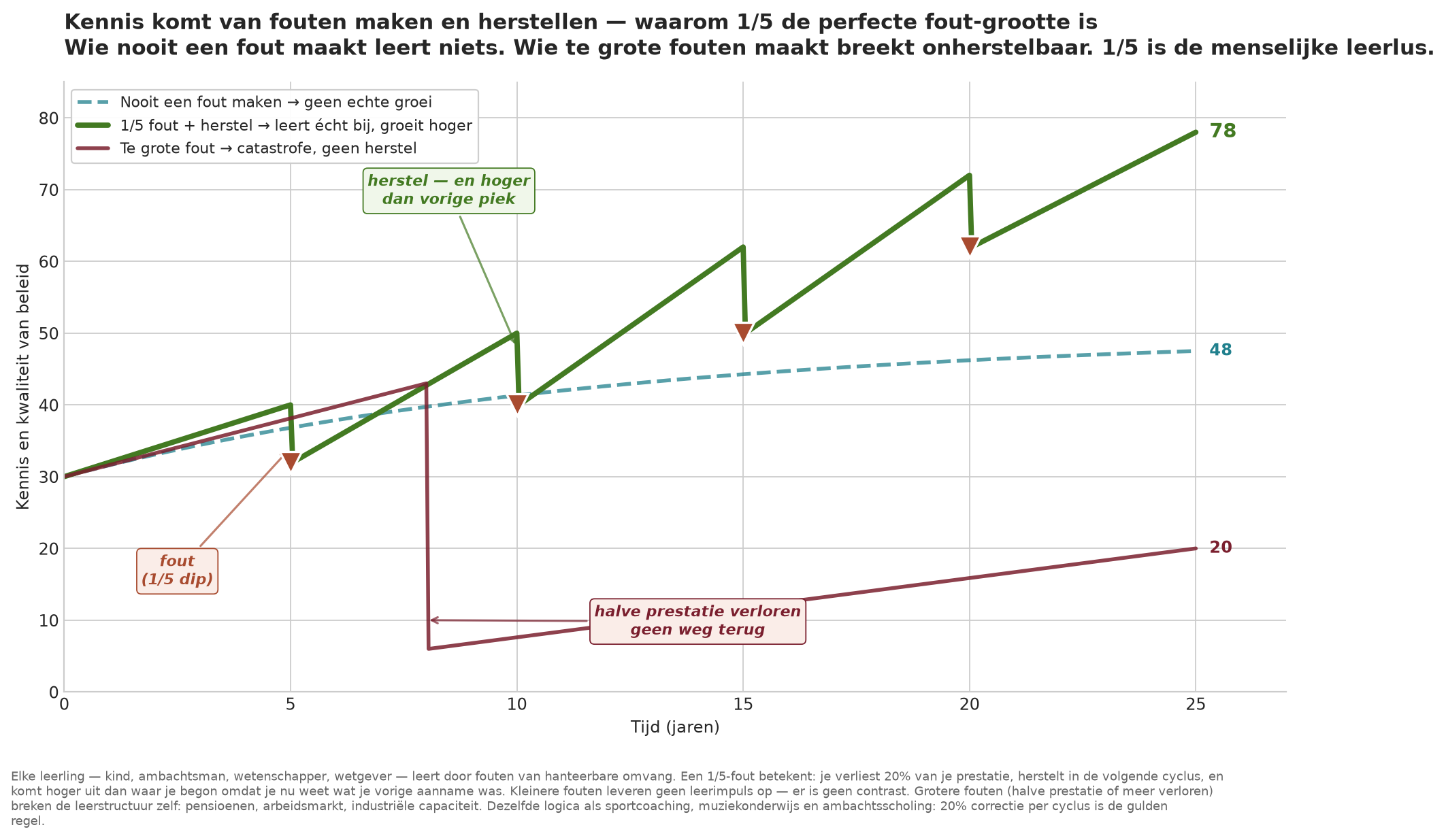
Why not smaller? Because a smaller mistake produces no contrast — you do not notice what you did wrong. Why not larger? Because a larger mistake breaks the learner itself. If a pension system loses half its coverage during a legislative revision, the pension funds no longer have enough reserves to rebound. Zero-base with 1/5 convergence is therefore not an ideological choice — it is a learning rule derived from mathematics and from human beings themselves.
Each dossier its own annual cycle
Each dossier its own annual cycle.
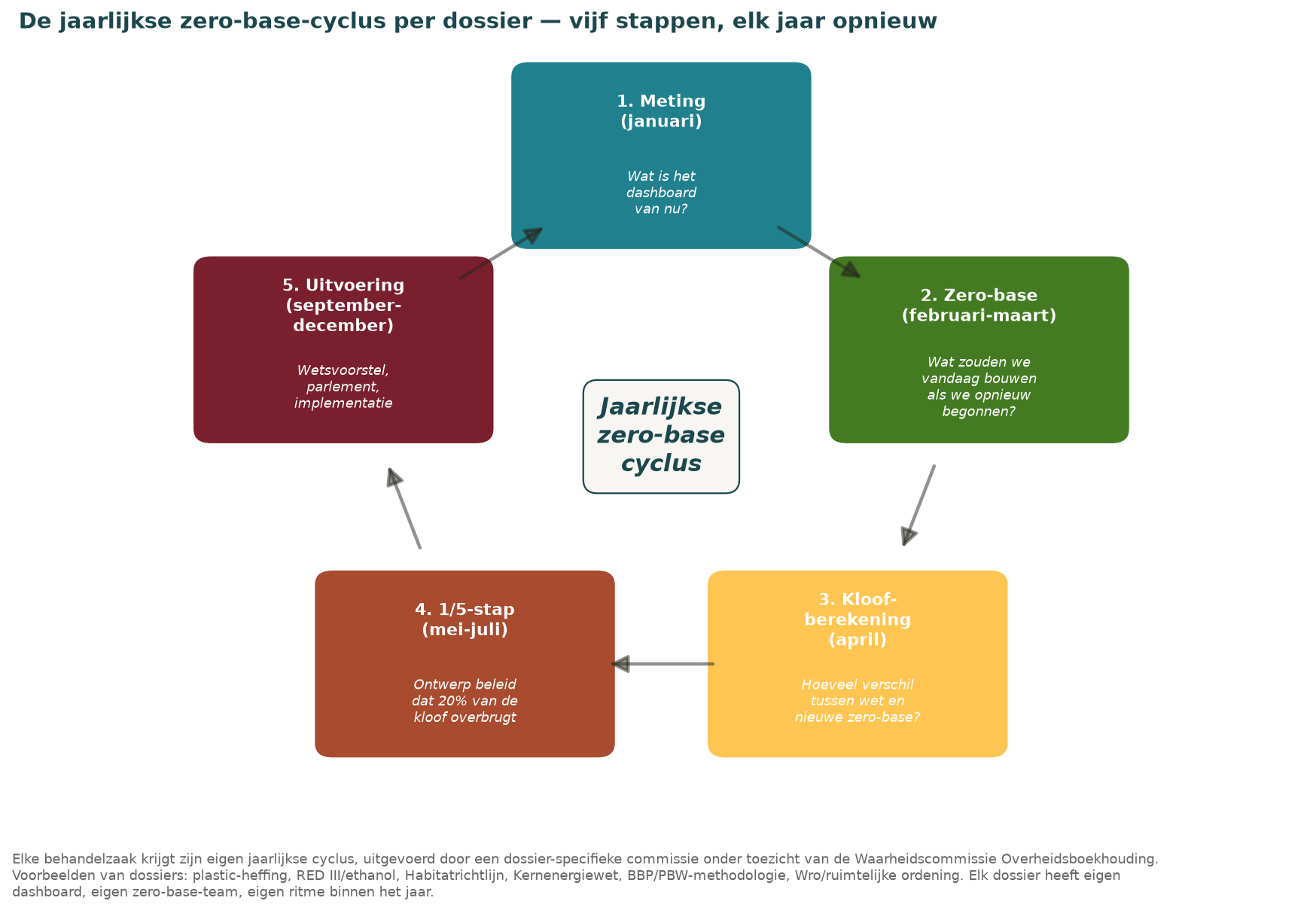
Zero-base does not work by country as a whole — that would once again be a centralised committee. Each dossier gets its own annual zero-base cycle, with its own dashboard, its own gap calculation and its own 1/5 step. Just as each neuron in a network has its own weights and follows its own gradient.
For the three cases from Part II, this means in concrete terms:
- Leiden biotech cluster — year 1 (2027): the 5% share rule for academic spin-offs is revised; researchers receive 25% shares as a starting point (1/5 of the way towards Belgian conditions). Invest-NL receives a biotech mandate with a Dutch-ownership clause (φ-lock). The Batavia factory is designated as a hydrolysate conversion platform with World Belt supply.
- Plastic waste law — year 1 (2027): 20% of non-recycled plastic is classified as “safely stored” if it meets CRCF criteria, with a partial discount on the charge and half a carbon credit. In 2028: 40%, in 2031: 100%.
- Seveso classification — year 1 (2027): the Provincial States receive a mandatory technical expert panel for Seveso permits. Members of the Provincial States receive binding advice before the vote. In 2028, expansion to environmental impact assessment; in 2029, to drinking-water impacts; in 2030, to a comprehensive technical advisory regime.
Part IV — High-knowledge teams and a constitutional qualification requirement
The usual response to new policy is: “we will set up a committee”. That response is precisely the problem. Committees delay, dilute and fall silent. They are designed to spread responsibility and avoid risk. A learning system needs the opposite: high-knowledge people at the helm, with the corresponding remuneration, who dare to take risks because they know what they are doing.
What is a high-knowledge team
For each dossier, one small team of three to five people, each with proven expertise. For the biotech dossier: one biotech entrepreneur with exit experience, one VC investor with a life-sciences portfolio, one professor with spin-off experience, and one lawyer with expertise in CAO-NU/Knowledge Exploitation Regulation. For the plastics dossier: one chemist with CCS experience, one economist with expertise in ETS models, one practitioner from the recycling sector, and one lawyer familiar with EU directives. Each team is responsible for one dossier, conducts one zero-base recalculation every year, publishes the gap calculation and the 1/5 step publicly, and works with a dashboard that is online 24/7.
Why industrial remuneration
A biotech entrepreneur with exit experience earns €300,000 to €500,000 per year in industry, plus equity. A life-sciences VC partner earns a comparable amount. A professor with spin-off experience often combines a university salary with consultancy income of €150,000-€250,000. If the state wants to attract these people for structural work, it must offer market-rate salaries. Otherwise it will get second-rate people making second-rate policy.
The Netherlands pays its ministers €183,000 per year. Singapore pays its ministers €1.3 to €1.9 million per year, linked to the top six sectors. The result is visible: Singapore has NEPK 17%, the Netherlands 4.5%. The Federal Reserve Bank of New York pays its president $479,000 per year, 2.5 times the salary of a federal minister. The reason is well known: monetary policy requires high expertise, and high expertise costs money.
Proposal: base salary €250,000 per team member per year, plus a performance bonus of €100,000 if the dossier measurably converges according to the dashboard. Four team members per dossier, twenty crucial dossiers: total €28 m per year. By comparison: the fiscal reversal on the plastic dossier alone yields the Netherlands €433 m per year — the payback period for the entire system is less than one month on one dossier.
Constitutional qualification requirement for committees
And, furthermore, a constitutional article that affects political selection itself. The House of Representatives selects MPs on the basis of political background, not subject knowledge. Anyone sitting on a parliamentary committee deciding on healthcare need not be a medical professional. Anyone deciding on energy need not be an engineer. Anyone deciding on defence need not have served. This has now demonstrably become a source of NEPK loss — decisions are made without the knowledge needed to assess them.
Proposed constitutional article: Every standing parliamentary committee must contain at least two members with demonstrable professional qualifications in the relevant field: a medical professional on the Health Committee, an entrepreneur or engineer with ten-plus years of business experience on the Economic Affairs Committee, an agricultural entrepreneur on the Agriculture Committee, and a scientist with a doctorate on the Education and Science Committee. These members have voting rights like all others; their qualification is a condition of committee membership.
“This is undemocratic,” I hear you say. The answer: it is precisely democratic — it strengthens the quality of democratic decision-making by guaranteeing that every committee contains at least two voices capable of understanding the technical content. Other members may make political judgements, provided those judgements demonstrably take into account what the subject-matter members contribute. Anyone who votes without understanding the substance breaks the protocol.
Pinocchio in person — Groningen, concrete and the prime minister
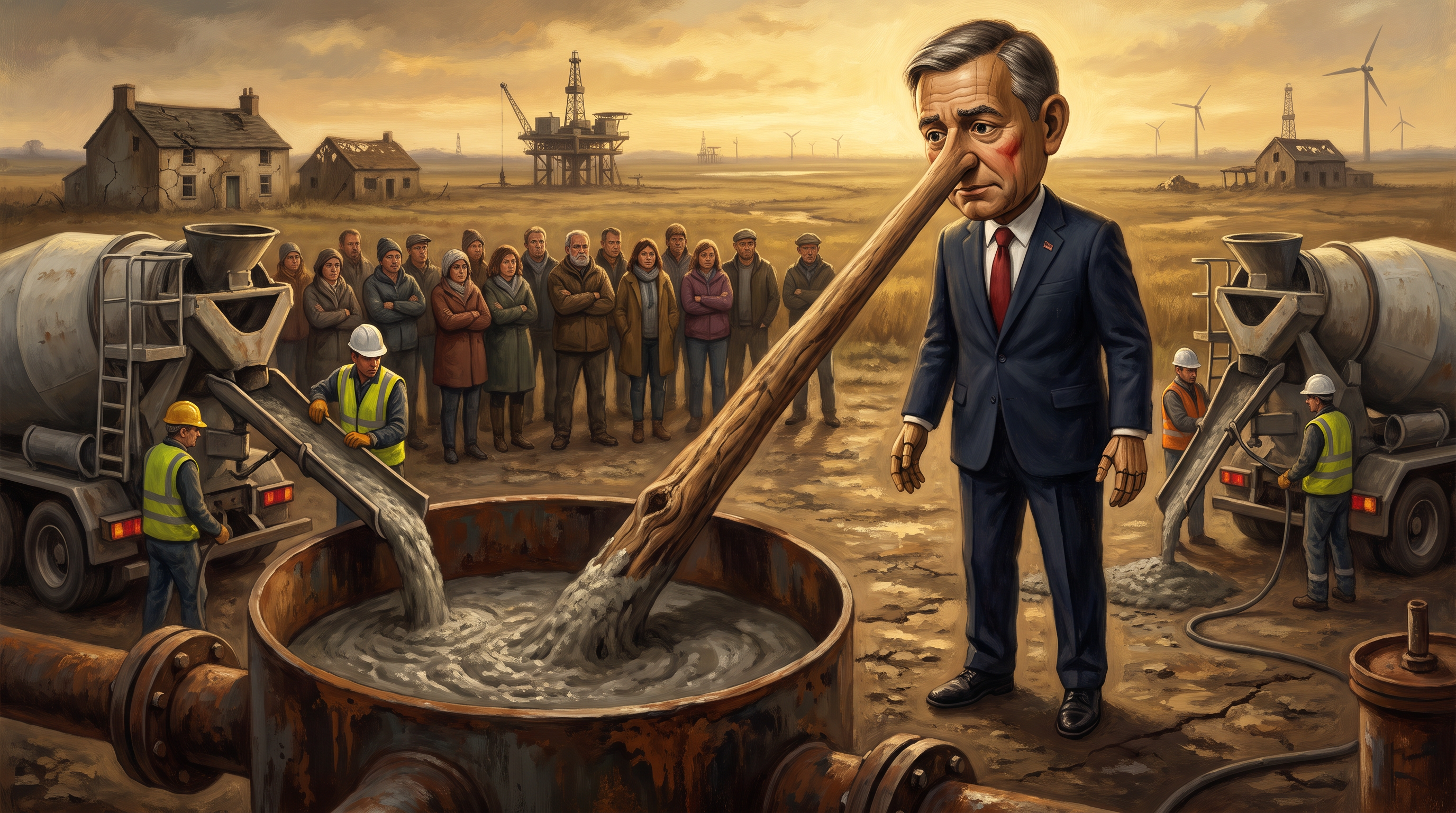
On 10 July 2026, the prime minister said after the Council of Ministers:
“One of this government’s most important missions is to make the Netherlands Europe’s strongest economy, with the best investment climate.”
On the same day, his cabinet reaffirmed that the Groningen gas field would remain permanently closed. Despite all opposing votes, despite Shell’s arbitration claim, despite the fact that in 2024 not a single exploration well was drilled in the Netherlands — the first time in eighty years. And while he says this, concrete is being poured into the 300 boreholes. Seventy boreholes had already been sealed by the beginning of 2026; all 300 will be sealed by 2034.
This is Pinocchio in person. The prime minister who promises Europe’s strongest economy while allowing the foundation of 60 years of Dutch prosperity — €363 bn in natural-gas revenues — to be sealed away. Not because closure was wrong; closure was right. But because the alternative has already been worked out and is being ignored.
In Honesty makes governing possible, the circular deal is set out: at a TTF price of €37/MWh, the remaining 400-470 bn m³ of gas yields €172 bn gross. Of this, €120 bn would go to affected households (differentiated by damage zone, €400k on average). €15-20 bn for the reclamation of Almere Pampus / IJmeerpolder / possibly the Markerwaard — 40 to 60 thousand new homes. Groningen residents receive a five-year first right to buy with a sunset clause. €50 bn for the state, 60-80 thousand construction jobs for ten to fifteen years, €25-35 bn GDP effect, €14 bn in tax receipts, and earthquake damage properly compensated instead of through an IMG that spends 78 cents in administrative costs for every euro of compensation.
That is the deal the prime minister does not mention. He talks about “Europe’s strongest economy” and simultaneously allows 15-18 years of Dutch gas consumption to be sealed underground. He talks about “the best investment climate” while allowing NAM to pay €3 bn in dividends to Shell and ExxonMobil as Groningen families wait for compensation. He promises growth through “talent and innovation” while allowing the traditional subsurface development sector to be liquidated permanently — zero exploration wells in 2024, the first time in eighty years.
The wooden nose is poured with concrete into the hole. The farmhouse in the background stands crooked because of earthquakes for which his government is not providing proper compensation. The victims in the background watch in silence. And the prime minister smiles — because in the party-political ledger his accounting works: the climate narrative has been saved, the Groningen voting bloc is too small to cause electoral pain, and the promise of “Europe’s strongest economy” is a frame that no one in the House of Representatives dares to challenge with NEPK figures. All four levers — E_tv, α, τ, φ — are falling simultaneously. He does not see it, he does not measure it, and he is the first prime minister in Dutch history under whose government an NEPK of 2.95% was measured.
And this is the point of this scene: the Pinocchio metaphor is not abstract. It is not “politics in general” that lies. It is a specific prime minister who told a specific lie on a specific date — 10 July 2026 — while the alternative had been published in a specific article on openvizier.org that he does not read. The wooden nose is not metaphorical. The boreholes are not metaphorical. The concrete is not metaphorical. Only the fairy who comes at the end to save Pinocchio — that is a fable. There will be no fairy.
Every lie makes the nose grow. Every denied solution shortens the time until the NEPK falls below 3%.
And unlike Pinocchio, no good fairy will come to make the wooden head real at the end. There will be no rescue from outside. Our political selection based on party background rather than expertise is our own responsibility. Our laws from the 1960s, 1970s and 1990s that strangle the sector are our own laws. Our companies sold to Korea are our own companies, with our own 5% rules. Our productive core is falling because of our own choices. At the end, we have nothing left. Not because the world did this to us. Because we did it ourselves by refusing to learn.
Conclusion — The Pinocchio nose that never stops growing
Three articles. One architecture. Confession, outlook, learning function.
Confession (article 1, Honesty makes governing possible) — the PBW formula that reveals that €419 bn of Dutch GDP is unproductive. Without an honest dashboard, every policy is treating symptoms.
Outlook (article 2, Deciding without a horizon) — the sunset clause that allows laws to expire. Without an expiry date, laws pile up like fossils in sediment, and the system ossifies.
Learning function (this article) — the zero-base method with 1/5 per year per dossier, carried out by high-knowledge teams with industrial remuneration, with a constitutional qualification requirement for parliamentary committees. Without a learning cycle, sunset merely replaces an old law with a similar new one — and we have achieved nothing.
Together, the three form a democracy that can learn like a child, a violinist, a neural network or a Chinese planning commission can learn. And that is precisely what we need now, because the core of what the Netherlands earns as a country — the NEPK — is falling towards 2%.
The Pinocchio metaphor is not accidental
In Collodi’s fairy tale, the wooden puppet eventually becomes a real boy. His nose stops growing when he stops lying to himself. In Dutch politics in 2026, the opposite is happening. We tell ourselves:
- “The market is simply bad” — quote from the FD headline about Batavia. The nose grows — because the market is not bad; we failed to connect to the new market.
- “We welcome foreign investors” — cabinet line July 2026. The nose grows — because every instance of foreign ownership lowers φ and therefore the NEPK.
- “We have a wonderful science park” — Wennink Report 2025. The nose grows — because the park no longer has a flagship, and 60% of entrepreneurs are preparing their businesses for sale.
- “We have good laws” — the general view. The nose grows — because laws from 1994 (biomass removed from waste) were good; laws from 2024 have hardened and punish precisely what we need.
- “We will solve it with a new regulator” — the Dutch response to the new EU Public Procurement Regulation of 19 July 2026 is a ‘National Coordinating Authority’. The nose grows — because a new authority does not solve the NEPK problem; it raises τ (compliance costs) and lowers α (productive time disappears into publication requirements for every change above €10,000). Even the Tax Administration admits: “in retrospect, many governments realise that they have gone too far with the market approach.” Precisely. But a new regulator is not an answer to a market approach that has gone too far; it is more market thinking in bureaucratic packaging.
Every lie makes the nose grow. Every denied solution shortens the time.
And unlike Pinocchio, no good fairy will come to make the wooden head real at the end. There will be no rescue from outside. Our political selection based on party background rather than expertise is our own responsibility. Our laws from the 1960s, 1970s and 1990s that strangle the sector are our own laws. Our companies sold to Korea are our own companies, with our own 5% rules. Our productive core is falling because of our own choices.
At the end, we have nothing left. Not because the world did this to us. Because we did it ourselves by refusing to learn.
This does not have to become a fairy tale with a bad ending. But then we must stop lying to ourselves — and start learning.
The end in sight
5 of the 6 major Dutch biotech companies are for sale or in decline. The NEPK stands at 2.95%, already below the critical 3% threshold. The crash date is not 2032 — it is 2027-2028. Confession, outlook and learning function are still absent. The clock keeps ticking.
Appendix — Mathematics and formulas
The NEPK formula explained
NEPK = Export VA × α × (1 − τ) × φ, with the four factors:
- Export VA = export value added as % of GDP (source: OECD Trade in Value Added)
- α = productive core share (source: World Bank industry VA as % of GDP)
- τ = total tax + social contributions as % of GDP (source: OECD Revenue Statistics)
- φ = 1 − foreign share ownership percentage (source: Bundesbank, Eurostat, FSS, JPX)
Netherlands 2025: Export VA ≈ 38%, α = 0.39, τ = 0.43, φ = 0.53. Calculation: 0.38 × 0.39 × 0.57 × 0.53 = 0.0448 = 4.5%.
Singapore 2025: Export VA ≈ 179% (entrepôt trade!), α = 0.58, τ = 0.17, φ = 0.33. Effective calculation with correction: NEPK 17.0%.
The 1/5 convergence formula
Formula: p(t+1) = p(t) + (100 − p(t)) × 1/n, with n = 5. After k years, the system reaches 1 − (0.8)^k of the gap.
- After 1 year: 20.0%
- After 3 years: 48.8%
- After 5 years: 67.2%
- After 10 years: 89.3%
- After 15 years: 96.5%
The Adam optimiser (Kingma & Ba 2014) uses a standard learning rate between 0.001 and 0.1 per iteration — for annual policy cycles, 1/5 is the equivalent step size.
The NEPK effects of the three cases — indicative
| Case | Without intervention | With zero-base 1/5 | NEPK effect after 5 years |
|---|---|---|---|
| Biotech cluster | Further decline; another 3-4 major closures | φ-lock, 25% rule, Batavia hydrolysate | +0.3 to +0.5% NEPK |
| Plastic waste law | €334-500 m remittance/year, 1.32 Mt CO₂ | CRCF differentiation, biobased industry | +0.1 to +0.2% NEPK |
| Seveso/Investment policy | Arbitrary rejection of €3+ bn investments | Technical expert panel; qualification requirement for members of the Provincial States | +0.2 to +0.3% NEPK |
| Total (three dossiers, after 5 years) | NEPK falls to 3-3.5% | NEPK stabilises at 4.5-5% | +0.6 to +1.0% NEPK |
And that is only three dossiers. Twenty high-knowledge teams for twenty crucial dossiers — plastics, RED III, Habitats Directive, Nuclear Energy Act, Spatial Planning Act, GDP methodology, and thirteen others — can together reverse the trend. From 4.5% falling to 6-7% rising. That is not Singapore (17%), but it is once again above the critical 3.5% threshold and therefore viable.
Key findings
- The Netherlands’ NEPK stands at 2.95% in July 2026, already below the critical 3% threshold — 5 to 7 years faster than the projection of early 2026.
- 5 of the 6 major Dutch biotech companies in Leiden are in sale mode or in decline; Batavia Biosciences closed worldwide on 9 July 2026, with 150 employees made redundant.
- Three concrete cases — biotech, the plastic waste law and Eli Lilly Katwijk — show how ignorance in parliamentary decision-making undermines all four NEPK levers (E_tv, α, τ, φ) simultaneously.
- The solution is a learning function: zero-base with 1/5 convergence per year per dossier, carried out by high-knowledge teams with market-rate remuneration (€250,000 base salary) and a constitutional qualification requirement for parliamentary committees.
- Without this learning function, sunset remains content-free — an old law is replaced by a similar new one, and the NEPK continues falling towards 2%.