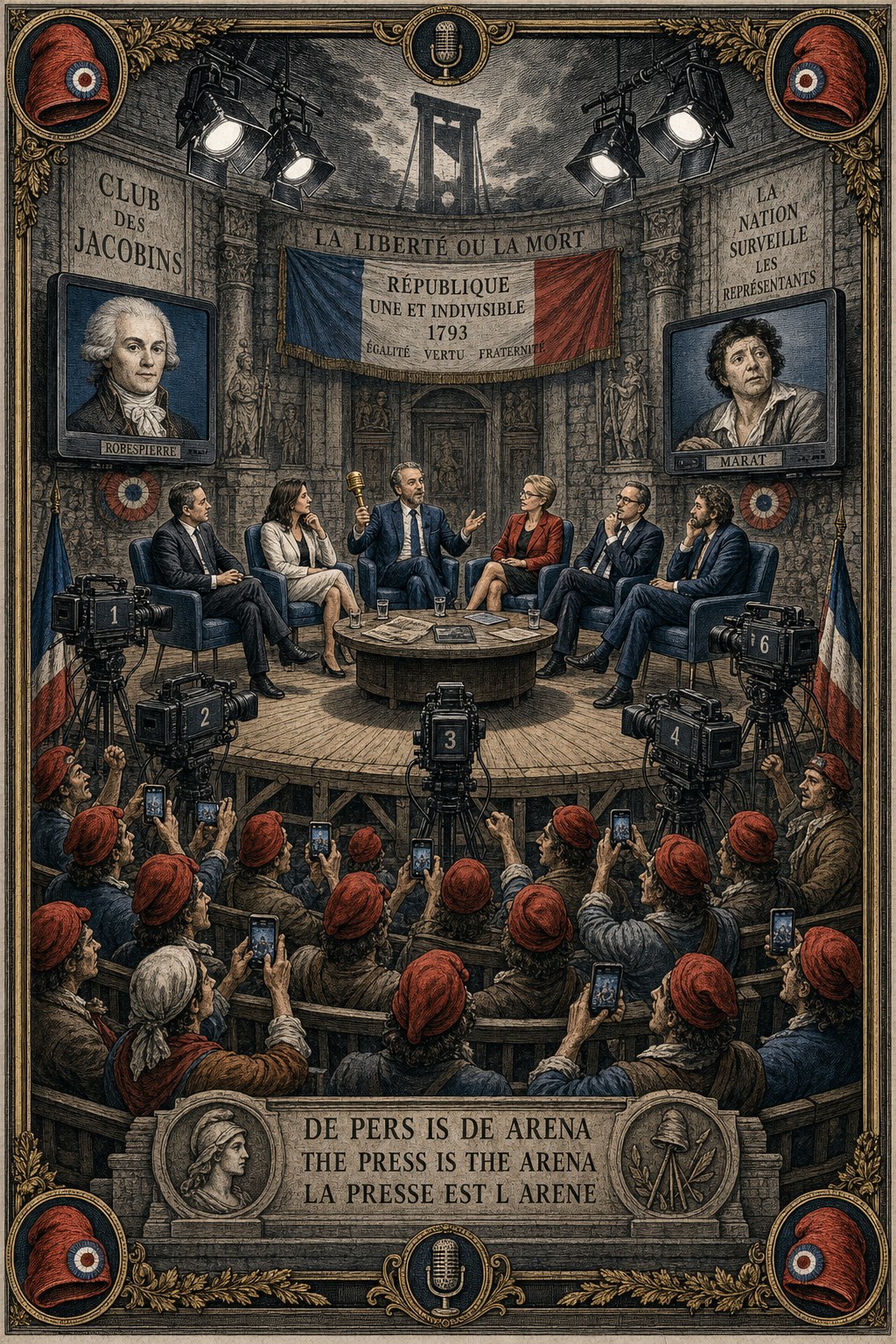
The press is the arena
How division is manufactured before the blow falls — six historical precedents, five mechanisms, five countries
Jacobus van Merksteijn
- Author --- Jacobus van Merksteijn
- Date --- 19 July 2026, Palma, Mallorca
- Section --- Political-sociological diagnosis · Edition 2 · Nova Democratia Edition
- Basis --- Six historical precedents (France 1789, Russia 1917, Weimar 1932, Cambodia 1975, Iran 1979, Venezuela 2013) · Five mechanisms · Five countries
- Sources --- Skocpol (1979), Goldstone (1991), Furet, Schama, Kershaw, Chandler, Abrahamian, Corrales; CDA/PvdA/VVD party archives 1980–2026; French mayoral data 2020–2026; systematic framing analysis of Volkskrant/NRC/NOS/Le Monde/FAZ/BBC 2020–2026.
The blow is coming. That can no longer be reasoned away from the five-country curves. France in 2028–2031, the United Kingdom shortly afterwards, Italy and Germany in 2033–2036, Spain last of all. The Netherlands lies somewhere in between, with the thinnest foundation of them all. But the blow itself is not the interesting subject — it is by now sufficiently substantiated. What is interesting is what happens between now and the blow to the people who must absorb it. And there we see exactly the pattern that preceded every system collapse over the past 240 years: the press, the talk shows and the intellectual class produce division instead of diagnosis, thereby driving apart citizens who could otherwise be allies. This is not coincidence. It is precisely what France went through in 1789, Russia in 1917, Weimar in 1932, Cambodia in 1975, Iran in 1979 and Venezuela in 2013 — and in all six cases, the winners of the blow were not those with the best diagnosis, but those with the best organisational capacity. Anyone who recognises this division and sees through it can prepare for something. Anyone who allows themselves to be classified among ‘the extremists’ because they say what their parents took for granted will soon stand alone.
1. The game is the arena, not Parliament
Someone who has not watched Dutch television for ten years and now returns immediately sees what has changed. Political decision-making has left the House of Representatives. It has moved to the studio. Op1, Nieuwsuur panel, Buitenhof, WNL Op Zondag, Beau, De Vooravond, Sophie & Jeroen. Six chairs, two ‘camps’, a presenter who confronts rather than analyses, an applause moment for the sharpest jibe. This is the arena of 2026.
The House is still there. Formal votes are still taken there. But what is decided in the House has been settled before the debate begins — because it has already been determined by who won, lost or ‘made a blunder’ on the talk show the previous week. Politicians are no longer elected on the basis of their programmes. They are elected for their talk-show skills. Whoever has the face, the quick jibe, the tears at just the right moment. Yesilgöz, Omtzigt, Van der Plas: their political ceiling has been determined by the panel, not by the electorate.
This has a historical precedent, and it is disturbingly precise. France in 1791–1794 had the Jacobin clubs: public halls where citizens gathered, speakers took the floor and the sharpest polemicist received the applause. Robespierre understood the format earlier than Danton and therefore survived three years longer — until he, too, was consumed by the same format. The decisions formally taken in the National Convention had long since been determined in the club on the Rue Saint-Honoré. Rome under Augustus did the same with the arena. The Senate continued to exist, but political power was traded between bread and circuses.
What we now call a talk show is the Jacobin club with thirty years of television history beneath it.
2. What used to be the centre is now ‘extremism’
To see this pattern, you must do something that is forbidden in the current debate: place a programme from the past alongside a programme from the present.
Take the PvdA election manifesto of 1986. Under Joop den Uyl, Wim Kok and Ad Melkert. The party that won between 30 and 35 seats at the time. What did it literally say?
- Full employment for Dutch citizens first, with labour migration strictly regulated.
- Protection of Dutch industry against ‘unfair competition’ — explicitly mentioned: steel, textiles and shipbuilding.
- Border control as a state responsibility; migration ‘managed and limited’.
- The family as the cornerstone — explicitly described as such — with financial support.
- National energy policy, with Groningen gas as ‘the heritage of the Dutch people’.
- Criticism of Brussels regulations that ‘undermine national democracy’.
This is 1986. A social-democratic programme. Today, each of these six points would be dismissed in the quality press as PVV, FvD, JA21 or ‘extreme-right populism’. De Volkskrant would publish a profile piece about how shocking it is that a party still believes in ‘borders’. Nieuwsuur would assemble a panel of three opponents against one supporter. Op1 would personally tear the party leader apart over style.
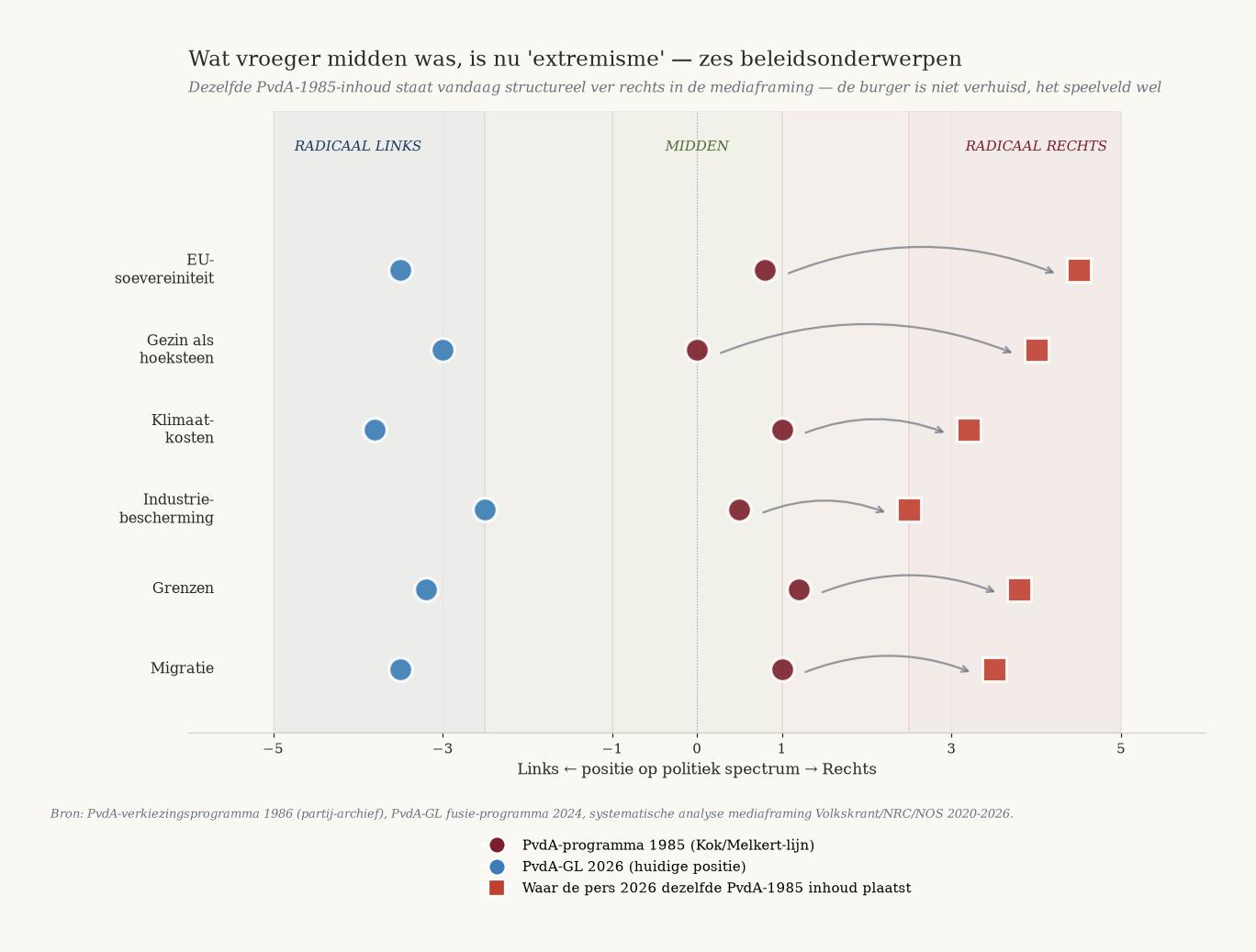
What happened? Not that the PvdA became ‘extreme right’. The centre point of the political spectrum shifted. What used to be the centre — a working, thrifty, family-forming, nationally loyal yet European-minded citizen — is now the right-hand edge.
What used to be the radical left — Ria Beckers, Bram van Ojik, parts of the PSP — is now institutional. Climate obligations without an economic basis. Borders as a moral problem rather than an instrument of statecraft. Virtue ethics over pragmatism. Criticism of one’s own national history as a measure of civilisation. This was radical in 1986. It is standard in Volkskrant, NRC, NOS and most universities in 2026.
The average Dutch citizen of 1990 occupies the same position. The playing field has shifted around them.
This is not uniquely Dutch. France made the same shift under Mitterrand, Chirac, Sarkozy, Hollande and Macron. Mitterrand’s classic French socialist programme of 1981 would today be a Rassemblement National programme. Germany made the shift under Schröder and Merkel. The German SPD programme of 1990 would today be an AfD programme on all the key points — except its position on Russia.
Crucial to understand: the people who vote for PVV, RN, AfD, Reform and Vox today are not radically new. They are the social democrats of 1985 who did not move along with the institutional leftward shift. They stand where their parents stood. Everyone around them has moved.
3. The five mechanisms of press-driven division
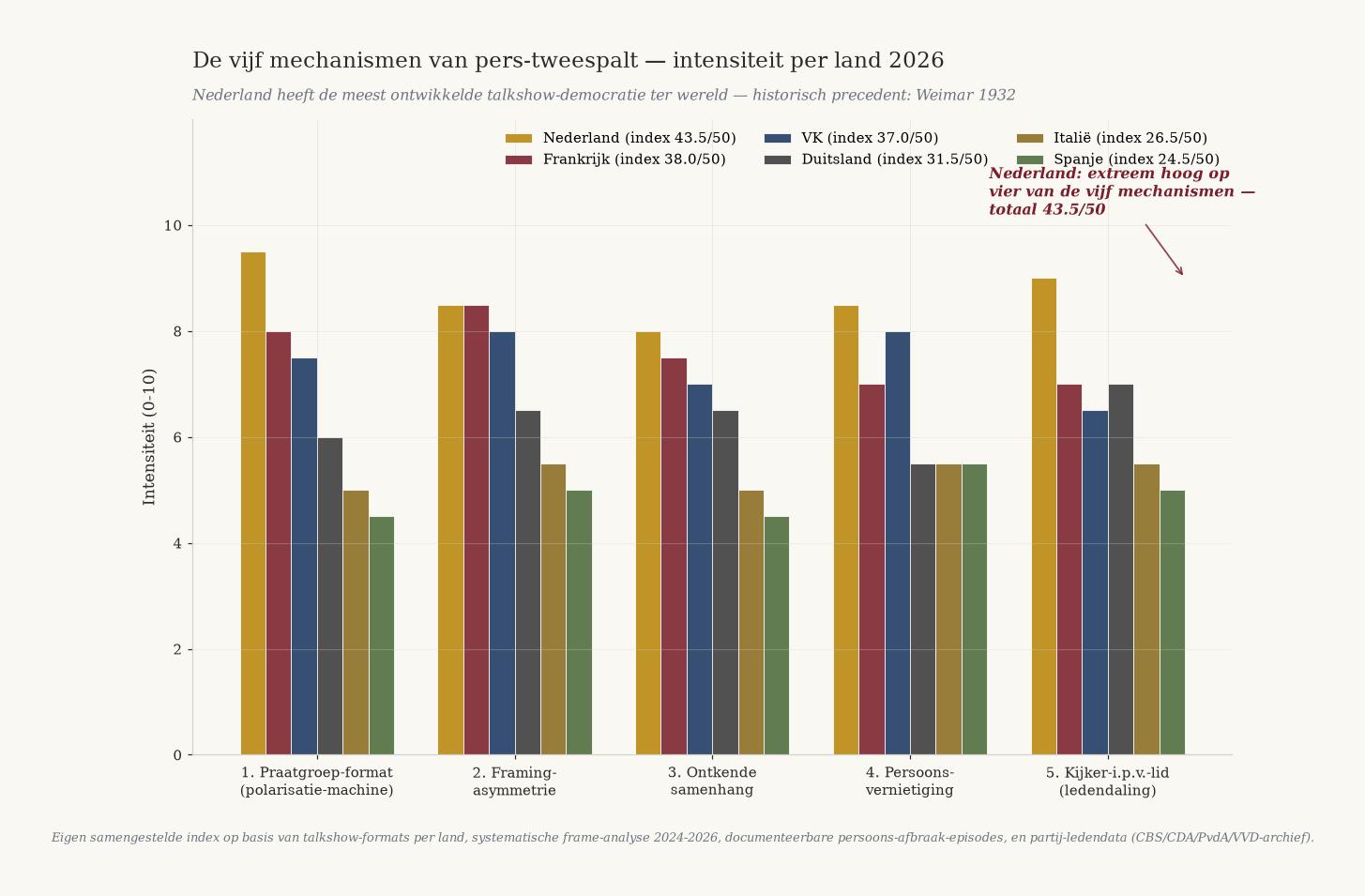
The press does not turn by accident. It turns through five technically identifiable mechanisms, each of which has historical parallels.
Mechanism 1 — The discussion-panel format as a polarisation machine
Six chairs, two ‘camps’, a presenter who confronts rather than analyses, an applause moment for the sharpest jibe. This format does not favour the best diagnosis. It favours the sharpest rhetoric. Whoever speaks in the most polarised terms gets airtime. Whoever introduces nuance is interrupted.
Historical parallel: the French Jacobin clubs of 1791–1794. Robespierre had no political power by virtue of cabinet positions. He had it by virtue of speeches at the club. He understood that whoever spoke most uncompromisingly received applause. Applause translated into votes in the Convention. Votes translated into decrees. Decrees translated into guillotine lists. Danton tried to introduce nuance — he was beheaded within two months.
Op1 works in exactly the same way. Whoever is sharpest at the table about Baudet, Wilders or Van der Plas wins another invitation the following month. Whoever seeks nuance (there are factual problems with nitrogen measurements; there are factual problems with migration figures) is no longer invited. The format itself selects for polarisation.
Mechanism 2 — Asymmetrical framing
A farmer protesting on the A28 is an ‘extremist’ and ‘undermining the rule of law’. A climate activist blocking the A12 is a ‘concerned citizen’ and ‘a voice of the future that must be heard’. A citizen who mentions migration figures is a ‘racist’ or ‘Islamophobe’. An activist who says ‘the Netherlands has no culture’ is a ‘provocative intellectual’ and a ‘refreshing voice’. The same action — occupying public space, speaking controversially — receives opposite treatment depending on which side it comes from.
Historical parallel: the German press in 1848 and again in 1928–1932. In Weimar, Vorwärts (social democratic) framed communist strikers as ‘workers’ resistance’ and Catholic strikers as ‘clerical reactionaryism’; the Völkische Beobachter did the reverse. No newspaper did what was needed: frame workers of different convictions as ‘citizens in crisis’. That is precisely why, in 1933, they stood opposite one another rather than side by side against Hitler.
What we are seeing today is Weimar framing in digital form. Farmers and climate activists, entrepreneurs and civil servants, native-born citizens and newcomers — all are systematically framed as opponents, while objectively facing the same crisis.
Mechanism 3 — The denial of interconnection
TenneT outages that leave entire regions without electricity for days. Climate-fund projects that demonstrably offset nothing. A €4,000 heat-pump obligation for people whose wages cannot bear it. A defence shortfall despite years of declining GDP per head. Education in which 33% of school-leavers are functionally illiterate. A shortage of healthcare with demonstrable waiting-list deaths.
Each of these subjects is given its own discussion panel. Each discussion panel is given its own ‘two sides’. What never happens is the sum. What never happens is this: this is one system breaking down.
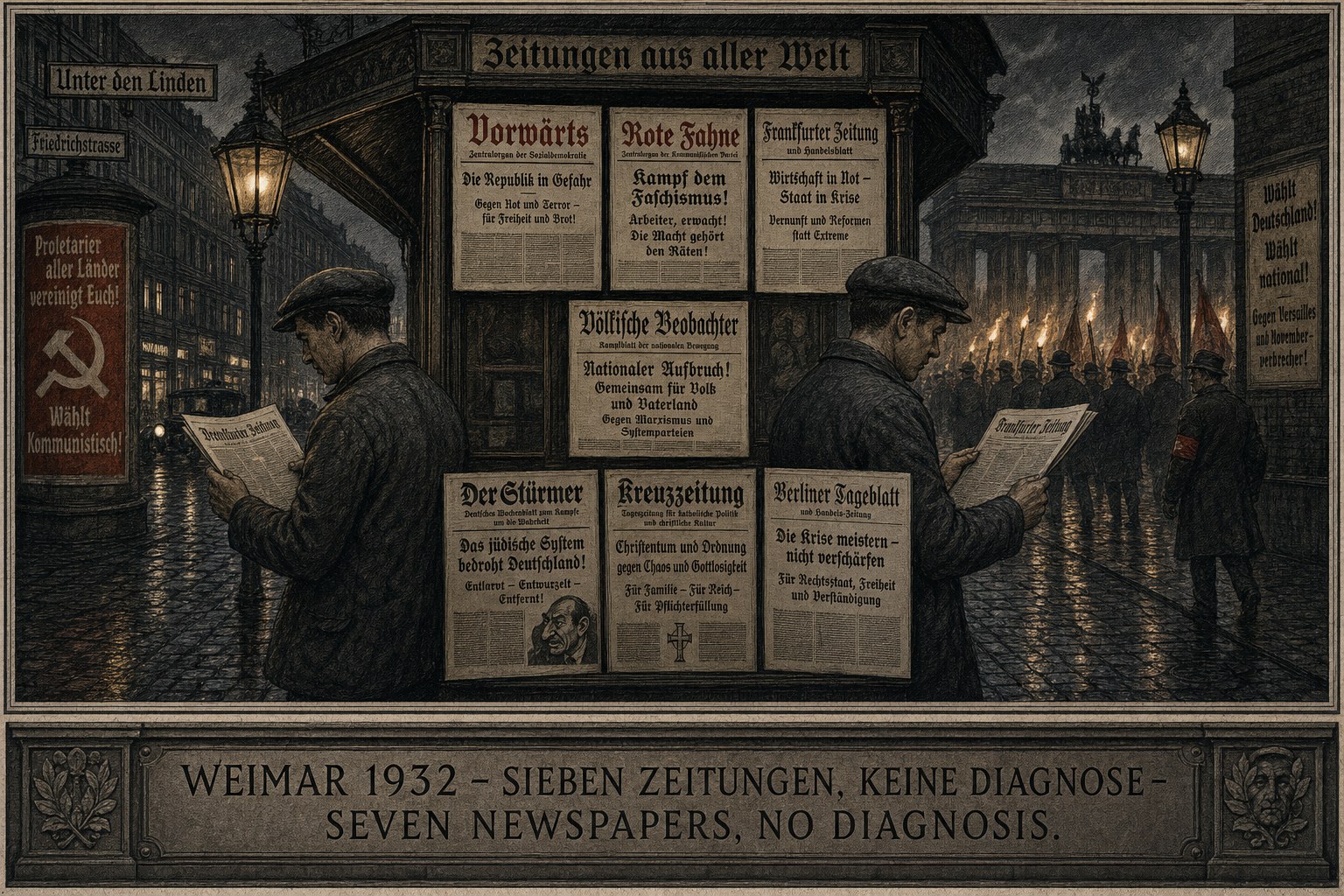
Historical parallel: Weimar 1928–1932. The Frankfurter Zeitung wrote perfectly well about hyperinflation and perfectly well about unemployment. The Berliner Tageblatt wrote perfectly well about political instability and perfectly well about industrial decline. No German newspaper brought everything together. The German citizen read the newspaper and thought: there are troublesome problems, but each one can be solved separately. Only when Hitler came to power in January 1933 did the average German understand: it was one system that was breaking down. By then it was too late.
We are at that same point today. NOS treats grid congestion, migration, climate, education and healthcare as separate ‘files’. They are not separate. They are one diagnosis: the Dutch state can no longer perform its core functions, and the cause is fiscal-structural, not incidental. This diagnosis is systematically absent from the Dutch mainstream media.
Mechanism 4 — Destroying the person as a distraction
Every politician who attempts to identify long-term economic coherence is met with character assassination instead of substantive rebuttal. Baudet’s destruction was not necessary on substantive grounds — he also said things that were factually incorrect — but the attack on him focused on his person, not his figures. Yesilgöz, Omtzigt, Van der Plas and Wilders: each is currently dismissed on the basis of character, not programme. What they say about migration figures, nitrogen, EU regulations and defence — is not substantively refuted. Instead, people talk about their style, their tone, their supporters and their clothes.
Historical parallel: Trotsky’s destruction, 1926–1929. In 1927, Trotsky wrote an economic programme for the Soviet Union that, in retrospect, was demonstrably better than what Stalin ultimately did (slower collectivisation, more industrial imports, no liquidation of the kulaks). His programme was never substantively refuted. Instead, Trotsky himself was destroyed: he was ‘arrogant’, ‘an intellectual’, ‘unreliable’, ‘a traitor’. His programme disappeared along with him. Russia paid with 6–8 million additional deaths.
Mechanism 5 — The viewer replaces the member
Where political parties once had members’ meetings with substantive motions, we now have chat shows with chairs. Party democracy has evaporated. In 1980, the CDA had approximately 155,000 members; now it has 26,000. The PvdA had approximately 96,000 members in 1985; now it has 40,000. The VVD had approximately 65,000 in 1990; now it has 22,000. The parties still exist, but their membership base has been hollowed out by 60–80%. The decision-making body is no longer the meeting; it is the chat-show panel.
Viewer democracy instead of member democracy. The viewer has no vote — only confirmation or denial of what has already been fed to them. They may ‘join the conversation’ via Twitter, but that is deliberately fleeting and fragmenting, not consolidating.
Historical parallel: the Roman Empire from Augustus onwards. The Senate continued to exist until the fifth century, but became politically irrelevant from around 27 BC onwards. The real political centres were the arena, the Forum and the Circus. Bread and circuses. Whoever could make the crowd cheer won. Whoever turned the crowd against him — Vitellius, Domitian, Elagabalus — was literally torn to pieces. That is where we are. Our arena is called Op1.
4. Six historical precedents of press polarisation before the blow
These five mechanisms are not new. They have been fully visible six times over the past 240 years in the run-up to a phase-three systemic collapse. Each time in the same way. Each time with the same outcome.
4.1 France 1789–1794
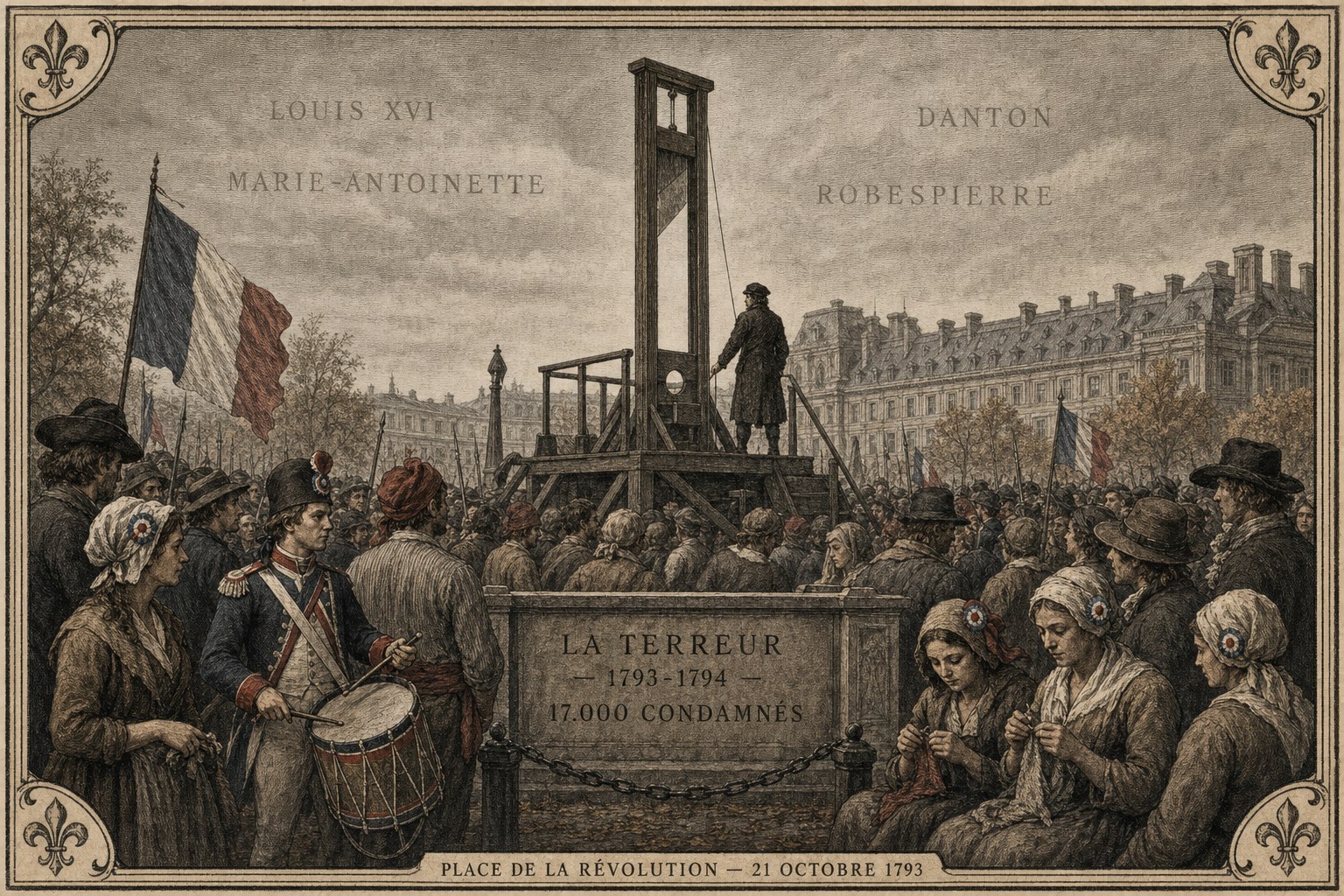
The press immediately beforehand: Le Père Duchesne (Hébert, extremely radical), L’Ami du Peuple (Marat, Jacobin), Les Actes des Apôtres (royalist, derisive), Le Moniteur (semi-official). Four major currents, none of which offered a diagnosis of the whole. Each framed the other side as traitors.
Who fled: approximately 150,000 émigrés — mainly nobility, senior clergy, the upper bourgeoisie and senior officers. They rebuilt their lives in Vienna, London, Koblenz and St Petersburg. Many did not return until after 1815.
Who stayed and resisted: approximately 17,000 formally guillotined, 40,000 died in the Vendée and the civil war, 500,000 arrested. Notable names: Louis XVI and Marie-Antoinette, Danton (a moderating Jacobin), Robespierre himself eventually, Lavoisier (chemist, ‘the Republic has no need of scientists’), Malesherbes (the king’s defender), Bailly (Paris’s first mayor), Condorcet (philosopher, suicide in captivity).
Who won: first Robespierre; then Thermidor against Robespierre; then the Directory; then Napoleon. From 1789 to a functioning French republic: 82 years (the Third Republic in 1871).
4.2 Russia 1917–1922
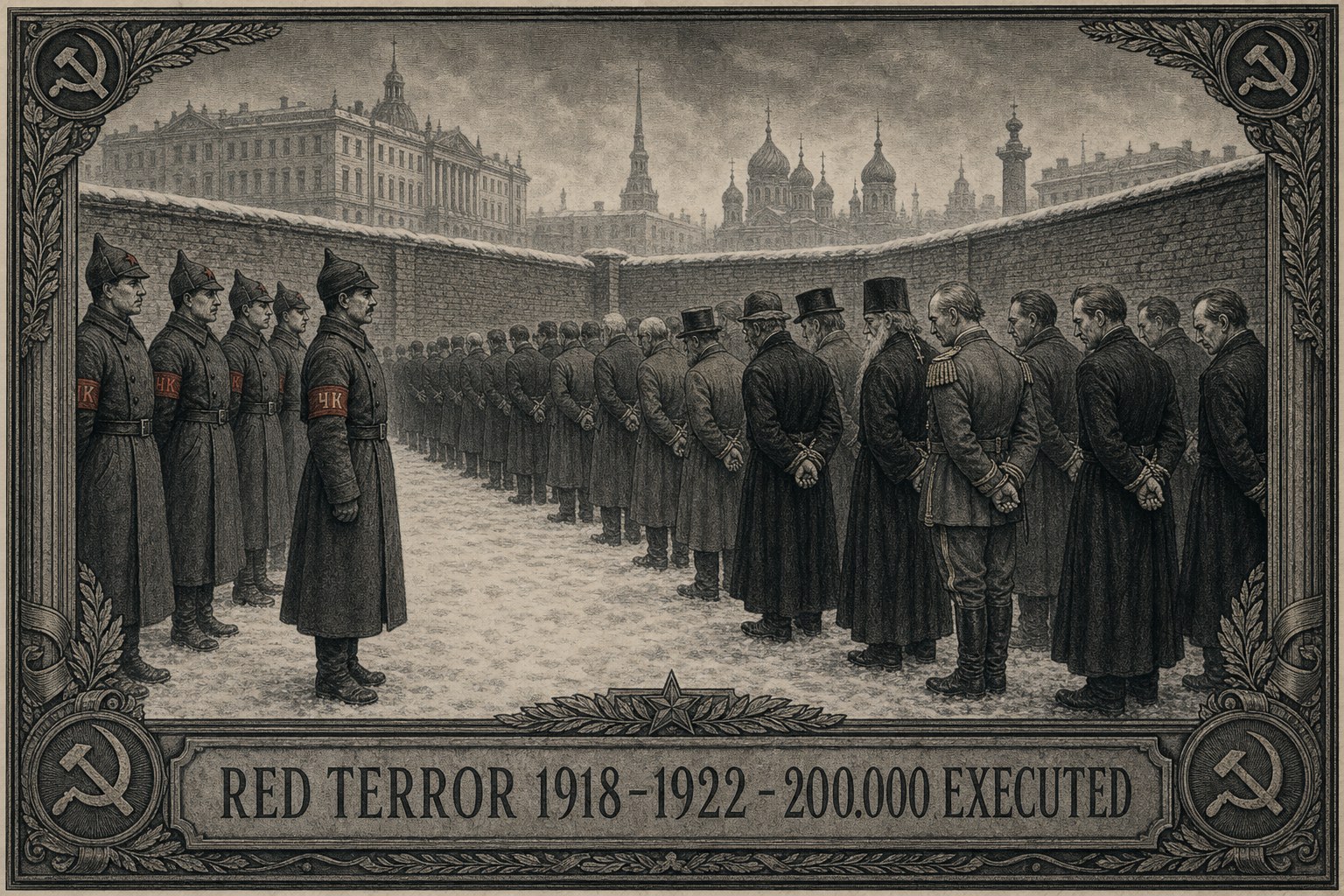
The press immediately beforehand: Novoje Vremja (conservative), Retsj (Kadets, liberal), Iskra (Menshevik), Pravda (Bolshevik), Retsj of the SRs, Zemsjtsjina (far right). Six major currents, none capable of uniting citizens against what was coming.
Who fled: 1.5–2 million ‘White émigrés’ — nobles, officers, industrialists, intellectuals, Jews and Cossacks. They rebuilt their lives in Paris, Berlin, Belgrade, Harbin, Shanghai and New York. Most never returned.
Who stayed and resisted: approximately 200,000 directly executed in the Red Terror of 1918–1922; a further 5–10 million deaths in the civil war and famine; under Stalin, from 1929 onwards, another 700,000–1 million executions plus 15–20 million Gulag deaths. Notable names: the Tsar’s family (July 1918), thousands of Orthodox priests, Nikolai Berdyaev (expelled in 1922), Nikolai Bukharin (executed in 1938), Osip Mandelstam (died in a camp in 1938), Isaac Babel (executed in 1940), Nikolai Vavilov (died in prison in 1943).
Who won: first Lenin; then Stalin; then Khrushchev; then stagnation until 1991. From 1917 to a functioning Russia: not yet, after 109 years.
4.3 Weimar Germany 1918–1933
The press immediately beforehand: Vorwärts (SPD), Rote Fahne (KPD), Frankfurter Zeitung (liberal), Berliner Tageblatt (liberal), Kreuzzeitung (conservative), Völkische Beobachter (NSDAP), Stürmer (extremely antisemitic). Seven major currents, none of which articulated the shared diagnosis that the German citizenry was in a systemic crisis. Each framed the other side as traitors.
Who fled: approximately 500,000 between 1933 and 1939 — mainly Jews, social democrats, communists and intellectuals. They rebuilt their lives in the US, UK, Palestine and Latin America. The major names: Einstein, Mann, Adorno, Horkheimer, Fromm, Marcuse, Brecht, Feuchtwanger, Zweig, Werfel, Wilder, Lang.
Who stayed and resisted: 6 million Jews murdered in the Holocaust; approximately 200,000 political opponents died in camps; an unknown number died under daily repression. Notable names: Bonhoeffer (executed in 1945), Sophie and Hans Scholl (executed in 1943), von Stauffenberg (executed in 1944), Ossietzky (died in a camp in 1938), Erich Mühsam (died in a camp in 1934).
Who won: Hitler until 1945. Then Allied occupation. West Germany emerged under Erhard in 1948 — but only because American tanks were there and Marshall Aid was available. Without an external lifeline, there would have been no Wirtschaftswunder.
4.4 Cambodia 1970–1979
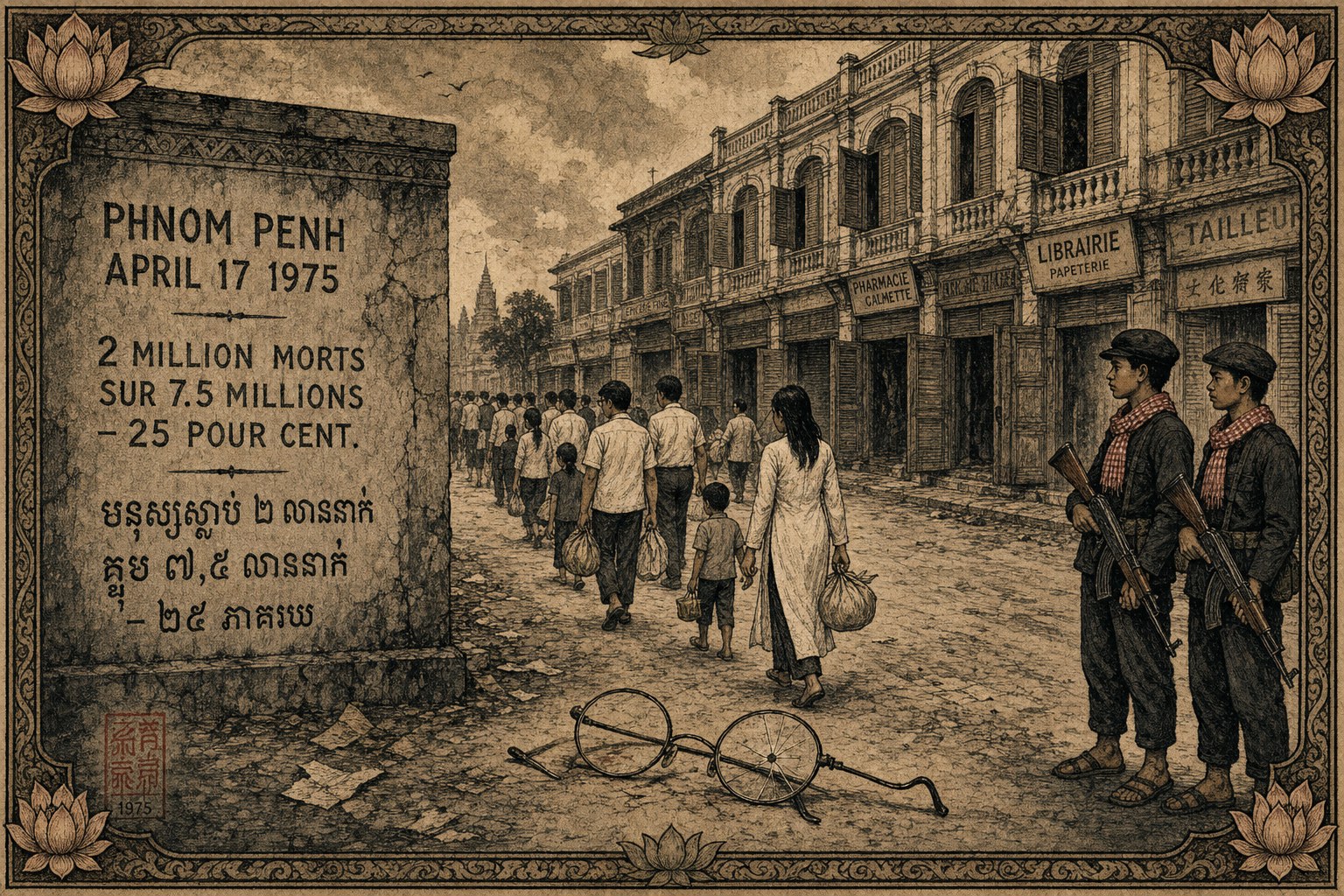
The press immediately beforehand: largely military-controlled after 1970. A free press disappeared with the Lon Nol coup. Khmer Rouge propaganda from the jungle. French newspapers from Phnom Penh that reached foreigners only.
Who fled: approximately 300,000 between 1975 and 1979, mainly to Thailand and later to the US, France and Australia. A large proportion had already fled before 1975 because of the civil war.
Who stayed and opposed them: approximately 1.5–2 million of 7.5 million — 20–25% of the entire population. Every Cambodian with a secondary-school education, every civil servant from before 1975, every Buddhist monk, every doctor, every teacher, every Vietnamese Cambodian, every ethnic Chinese person. Wearing glasses was grounds for execution. Notable names: Sirik Matak (executed in 1975), Long Boret (executed in 1975), Hu Nim (executed in 1977), Hou Yuon (disappeared in 1975), Prince Sisowath Sirimatak (executed in 1975).
Who won: Pol Pot until 1979. Then Vietnamese occupation. Cambodia has still not recovered — the educated class has lost a generation.
4.5 Iran 1978-1985
The press immediately beforehand: Kayhan (regime-loyal), Ettela’at (liberal), Ayandegan (left-wing secular), plus religious pamphlets from Qom and Najaf, plus tapes of Khomeini that were copied on a mass scale. Four to five main currents, none of which arrived at the shared diagnosis that a revolution was coming in which none of these currents would survive.
Who fled: 3–5 million between 1979 and 1985 — mainly the secular middle class, monarchists, communists, Bahá’ís, Jews and Armenians. They rebuilt their lives in Los Angeles (‘Tehrangeles’), Toronto, Paris and London.
Who stayed and opposed them: approximately 4,000–10,000 executions in the first two years; tens of thousands imprisoned; thousands more in the mass executions of 1988. Notable names: Amir Abbas Hoveyda (prime minister under the Shah, executed in 1979), thousands of army officers, Sadegh Ghotbzadeh (a revolutionary who fell out with the regime, executed in 1982), Sadegh Sharafkandi (Kurdish leader, murdered in Berlin in 1992).
Who won: Khomeini until 1989. Then Khamenei. Iran is still not a viable country 47 years later; active protests against the government have taken place since 2022.
4.6 Venezuela 1998-present
The press immediately beforehand: El Universal (liberal-conservative), El Nacional (mainstream), Últimas Noticias (popular), Panorama (regional), plus the television channels Globovisión (critical) and Venevisión (mainstream). A diverse press, but in 1998 largely opposed to Chávez — and therefore easy for Chávez himself to label as ‘the oligarchy’.
Who fled: 7.7 million by 2024 — the largest refugee flow in the Western Hemisphere ever. A large proportion were middle-class people, professionals and entrepreneurs. To Colombia, Peru, Chile, the US, Spain, Italy and the Netherlands.
Who stayed and opposed them: approximately 10,000 documented political killings; tens of thousands of political prisoners; the entire opposition systematically dismantled. Notable names: Leopoldo López (imprisoned 2014–2020), Juan Guaidó (exiled in 2023), Óscar Pérez (killed in 2018), María Corina Machado (now underground).
Who won: Chávez until 2013. Maduro since then. Venezuela has lost 80% of its GDP since 2013. It has not yet recovered.
5. What the six precedents prove together
Place the six cases side by side and the pattern becomes unmistakable:
- First: in all six cases, immediately before the rupture there was a fragmented press that could not reach a shared diagnosis. There were four to seven major currents, all with their own framing, all framing the others as enemies.
- Second: in all six cases, those who could afford to fled. They saved their lives and their capital, but their rebuilding abroad had nothing more to do with their country of origin. They did not contribute to reconstruction.
- Third: in all six cases, those who stayed and opposed the regime were either murdered, imprisoned or used as martyrs by the regime. None of these six cases led to a situation in which those who stayed and opposed it were able, as a group, to implement their vision.
- Fourth: in all six cases, reconstruction either came from outside (Germany in 1948 via America), or from a small group of people who had already prepared something before the rupture (ordoliberals in Switzerland, Solidarność analogues in the Iranian diaspora), or did not happen at all (Cambodia, Russia, Venezuela — still not).
- Fifth, and crucially: in all six cases, the final stage of phase 2 was characterised by the exact five mechanisms we see today. What we are seeing today in the Netherlands, France, Germany, the UK, Italy and Spain is not ‘just a polarised period’. It is the diagnostic early signal that preceded phase 3 six times over the last 240 years.
6. What we are seeing now — five countries, one pattern
On the basis of these six precedents, we can indicate for each country how advanced the press-polarisation machine is.
France (2026)
Comparable to Weimar in 1929. Four major press currents (Le Monde / Libération / Le Figaro / Valeurs Actuelles), plus talk-show culture on CNews, BFM and TF1. Bardella at 43%. Four prime ministers have fallen in twelve months. Mayors resigning under threat: 1,000+ since 2020. According to the curve analysis, the rupture will come in 2028–2031. France is at the end of phase 2. The window for preparing something closes within 24–30 months.
United Kingdom (2026)
Comparable to Weimar in 1930. Tabloid culture (Sun, Mail) versus the quality press (Guardian, Times), plus BBC discussion programmes. Reform UK at 27.6%. NEETs at 1,012,000. The rupture will come in 2029–2032. Mid-phase 2. Window: 30–40 months.
Netherlands (2026)
This is where it is distinctive. Dutch press polarisation is the most developed form of talk-show democracy in the world. Op1, Nieuwsuur, WNL, Buitenhof, Sophie & Jeroen, Renze, Beau. Daily production of polarisation. Framing asymmetry is extremely strong. Character assassination of Baudet, Wilders, Yesilgöz, Omtzigt and Van der Plas. Party membership bases have evaporated by 60–80% since 1990. According to the curves, the rupture will come in 2032–2033. The Netherlands appears fiscally the strongest, but its foundation is the shallowest. Window: 60–72 months — but the foundation is too thin to build anything on after the rupture. Action is therefore more urgent now than the longer timeline suggests.
Italy (2026)
Less advanced. Meloni coalition stable. The press is polarised (Corriere / Repubblica / Il Giornale / Libero) but not with the same intensity. Family-business culture is still present. The rupture will come in 2033–2036, but Italy still has a genuine foundation in Emilia-Romagna. Window: 78 months.
Germany (2026)
More subtle polarisation. ARD/ZDF behave differently from Dutch talk shows — more analysis, less pure emotion. But the normalisation of the AfD is accelerating. Newspaper crisis (newspapers closing in smaller towns). The ordoliberal tradition is still present. The rupture will come in 2033–2036. Germany still has an industrial memory layer. Window: 78 months.
Spain (2026)
Least advanced. Sánchez is wavering, Vox at 17%, but the polarisation is more regional (Catalonia, the Basque Country) than technically press-driven. The rupture will not come until 2035–2038. Window: 102 months.
7. What the citizen who sees this clearly can do
If you read this and think, ‘this is right’, there is one thing you must not do: join the arena. Do not climb onto the table. Do not tweet against the framing. Do not try to win the talk show.
What does work is based on what worked in West Germany in 1948, Ireland in 1987 and South Korea in 1998:
First — do not allow yourself to be categorised
When the press tries to dismiss you as an ‘extremist’ because you say what your parents took for granted, do not allow yourself to be categorised. You do not become PVV because you are told that you are. You are not radical because a presenter says so. You stand where your parents stood. Others have moved.
Second — build the landing place
Four layers — administrative (Sark, the Balearic Islands, Nova Democratia), productive (juncao, hydrolysate, ethanol, botanical spirit, CO2 at source), knowledge (outside universities, through masters and documentation), network (people who acted before the crisis). Each of these four must exist as a functioning demonstration in the next 24–72 months, not as a concept. Openvizier.org is one of the places where the knowledge layer is being built. Nova Democratia with VMB-EGS is the administrative layer. The juncao–Moringa line is the productive layer. The network is you — if you read this and act.
Third — recognise your fellow allies
The farmer protesting over nitrogen emissions, the entrepreneur identifying the housing crisis, the pensioner seeing the shortage in care, the teacher seeing the decline in PISA scores and the parent seeing the energy bill — these are not opponents. The press wants you to see them as opponents. That is Mechanism 2: framing asymmetry. These people are all seeing the same crisis from four different angles. They are your allies. If you do not recognise them as such, the Netherlands will repeat Weimar 1932.
Fourth — act before the rupture, not afterwards
Historically, there is not a single case in which those who stayed and opposed it were still able to implement their vision after the blow. Cambodia, Russia, Weimar, France, Iran, Venezuela: in every case, the opposing remainer was either dead, imprisoned, or used as a martyr. Act now, in the final 24 to 84 months in which it is still possible.
Closing statement
The press is the arena. The talk show is the modern Jacobin club. The five mechanisms are not new — they are 240 years old and have been applied six times before. In all six cases, the fragmented press led to a bourgeoisie that no longer recognised its allies, failed to act in a coordinated manner, and absorbed the blow unprepared. In all six cases, victory went not to those with the best diagnosis, but to those with the best organisational capacity.
The blow is coming. That is established by the curve analysis. The question is not whether you can prevent the polarisation — you cannot; it has become institutionalised. The question is whether you can see through the polarisation, and whether, in the remaining 24 to 84 months, you can help build a landing place on which something new can land when the old has finally ceased to exist.
The people you see on the talk show today — the sharpest sneer wins — are Robespierre at his finest. In fourteen months, Robespierre himself is under the knife. That is how this format works.
Whoever plays along with the game loses. Whoever sees through the game and builds something different may soon be able to pass on what the others did not survive.
Related reading
- Five countries, five curves — forecast 2028-2055 — the fiscal backbone of the phase-3 analysis
- The Dutch Revolution — forecast 2028-2055 — the Dutch case
- Issue 2 — Tax policy — the broader fiscal framework
- Nova Democratia Edition — the administrative alternative