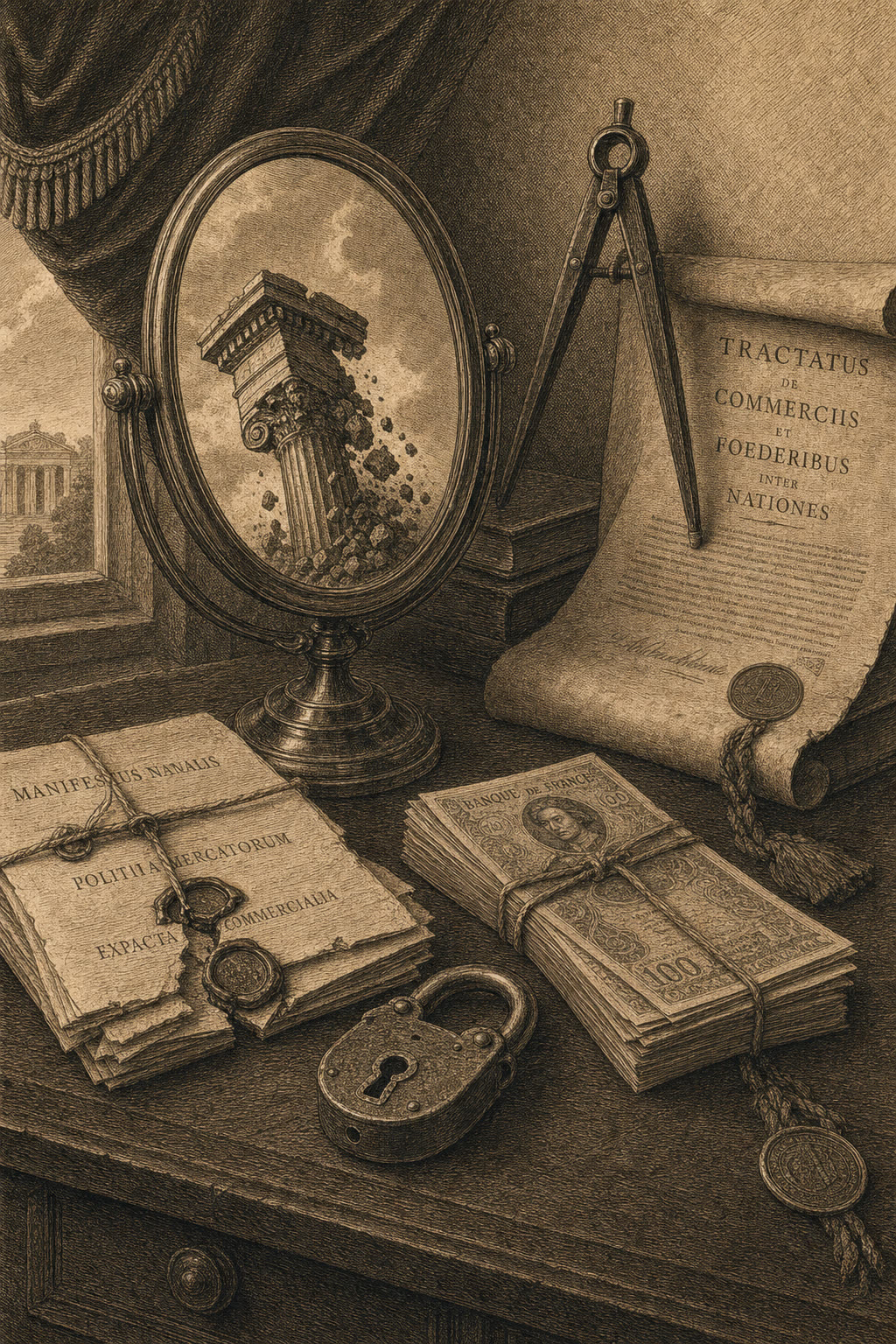
The fifth piece in the Consequences-map series. Trump is no American problem — Trump is a European problem and a European mirror. Twenty European scenarios against ten Trump-II instruments.
Trump as mirror
What Trump-II does to Europe — and what the mirror shows us
Jacobus van Merksteijn · Malta, June 2026
The Trump mirror in one matrix
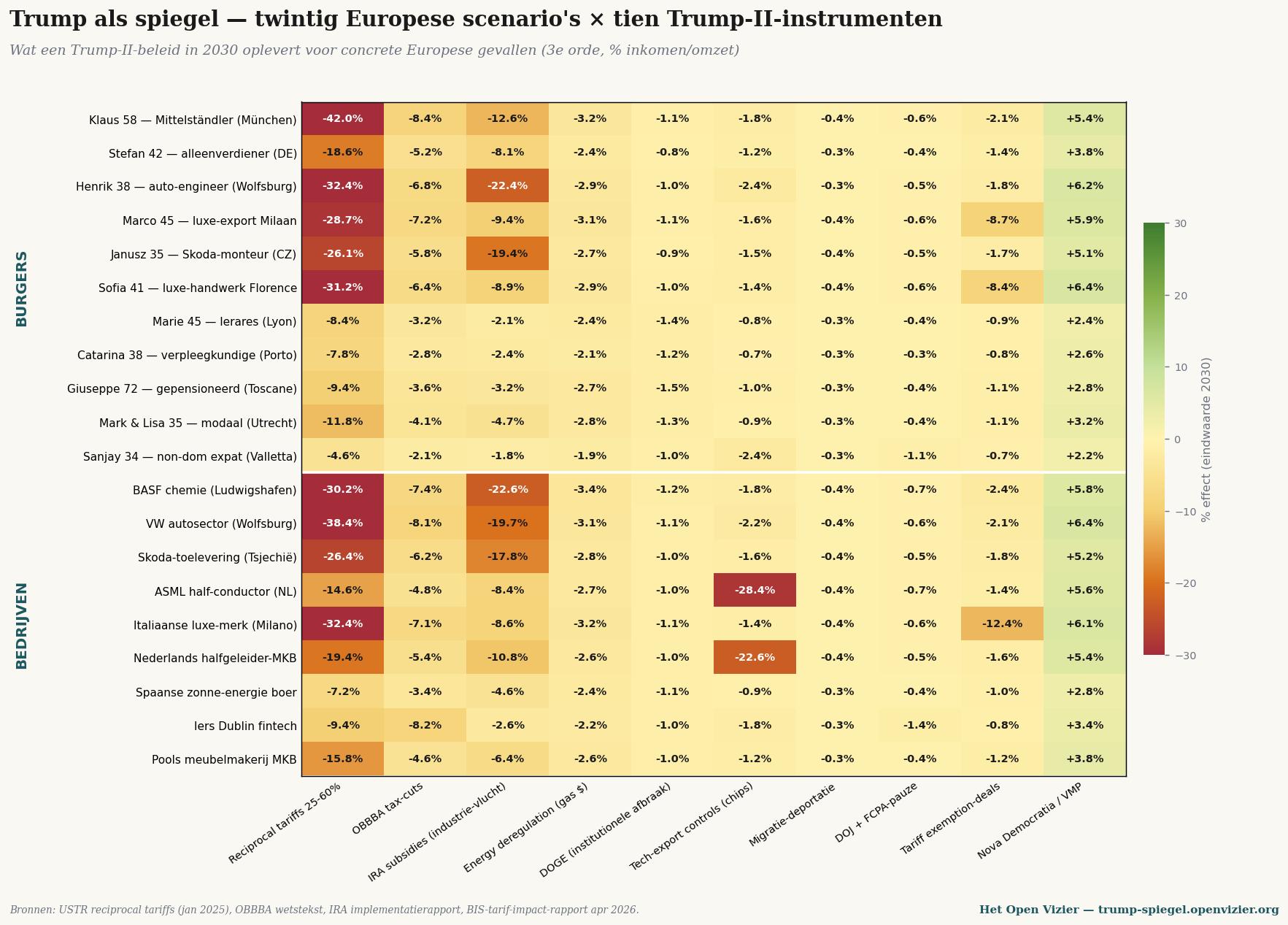
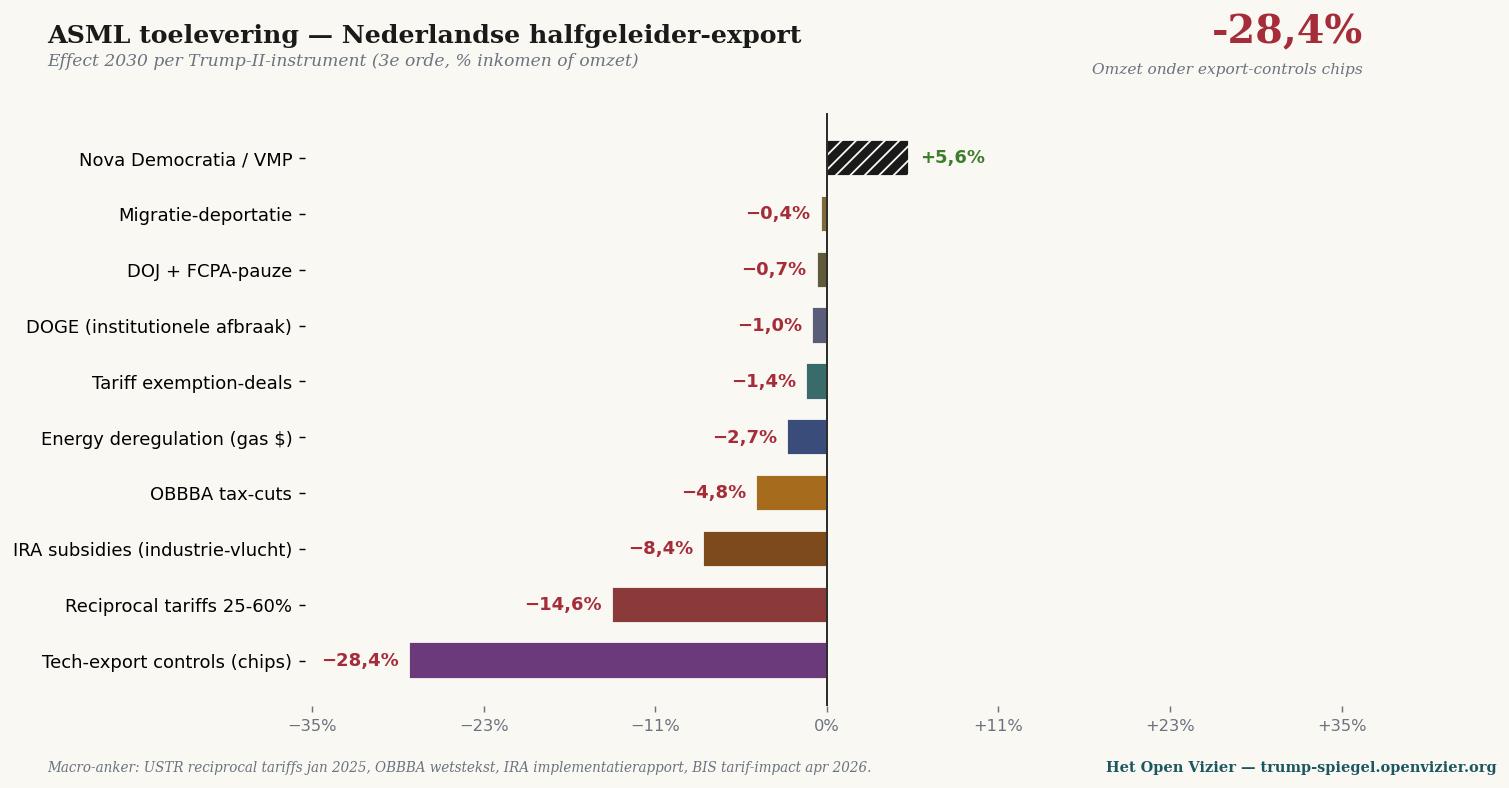
Twenty European scenarios × ten Trump-II instruments. Reciprocal tariffs hit the Mittelstand hardest. ASML supply loses 28.4% of turnover through tech export controls. Nova Democratia / VMP column: positive in every scenario.
What the matrix says
The Mittelstand pays — Klaus (Munich) and Henrik (Wolfsburg) lose 32 to 42 per cent. Not through incompetence. Through tariffs plus the IRA flight to Texas.
The semiconductor sector stands alone — ASML supply loses 28.4% via chip export controls. No other European country has comparable exposure.
The green column works — taking over Trump's goals without his means: positive in 20 out of 20 scenarios.
Four profiles — who pays the Trump bill
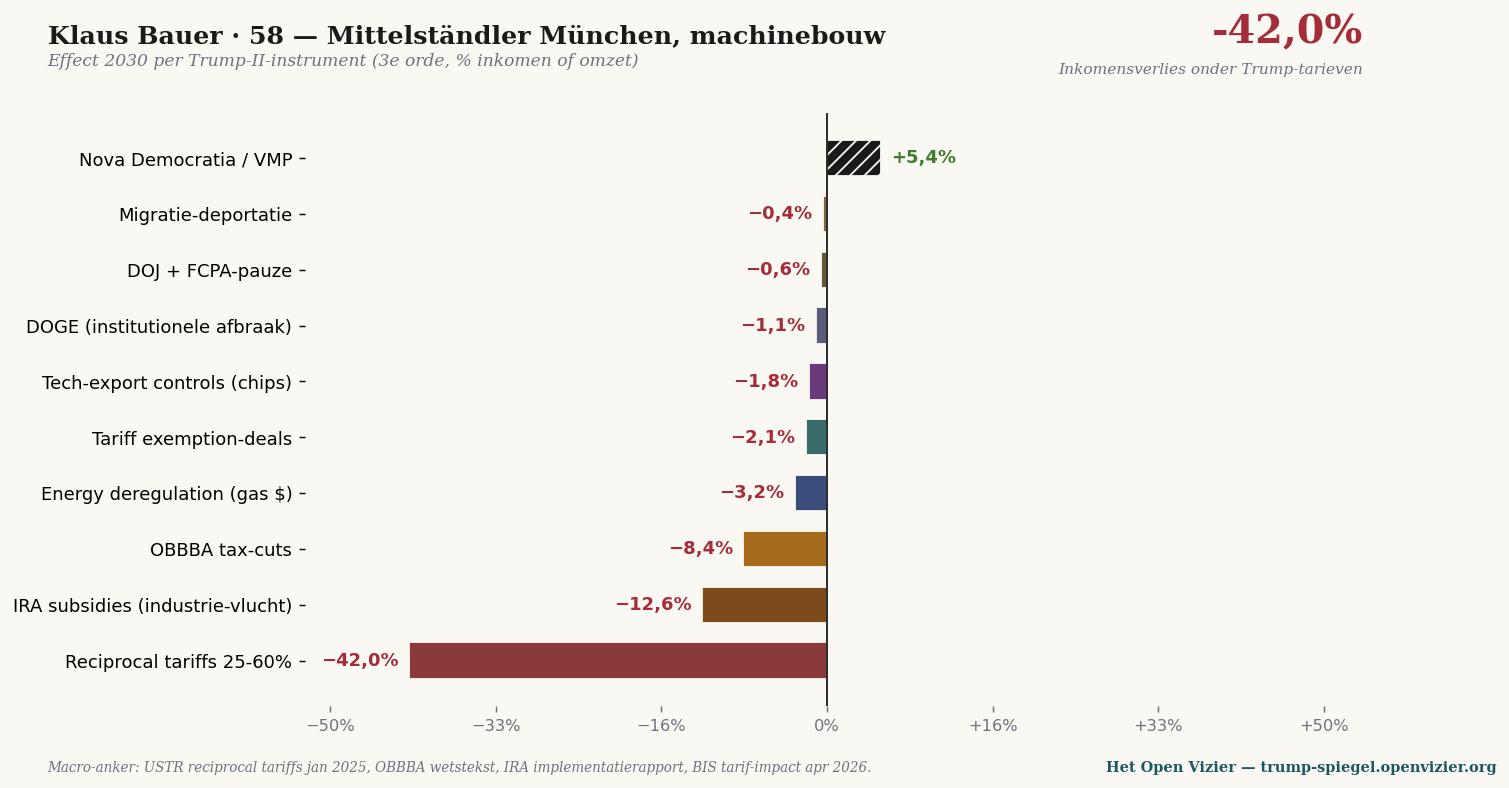
For four Europeans: all ten Trump-II instruments on one bar plate.
Klaus Bauer · 58
Mittelständler Munich, machine-building GmbH. Loses 42 per cent of income under Trump tariffs — 25 to 60 per cent reciprocal tariffs on German machine-building. He has done nothing wrong: he produces what Europe has always produced.
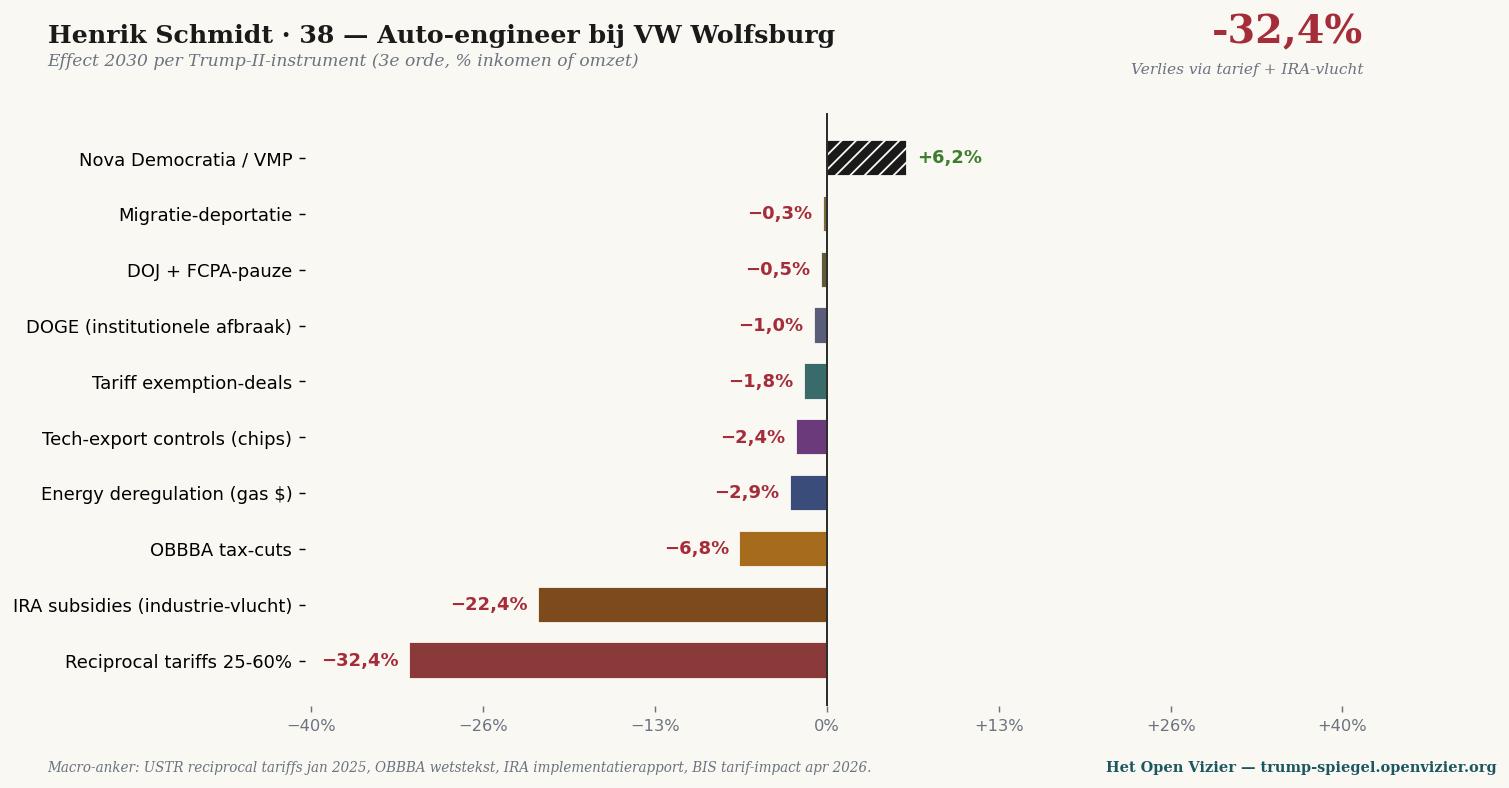
Henrik Schmidt · 38
Auto engineer at VW Wolfsburg. Loses 32 per cent via tariff and IRA subsidies — VW moves capacity to Mexico and Tennessee. Two shocks at once: trade and industrial flight.
ASML supply
Dutch semiconductor export. Loses 28.4 per cent of turnover under Trump's chip export controls. Not through tariffs — through direct licence denial for export to Chinese customers. Isolated on one unique axis.
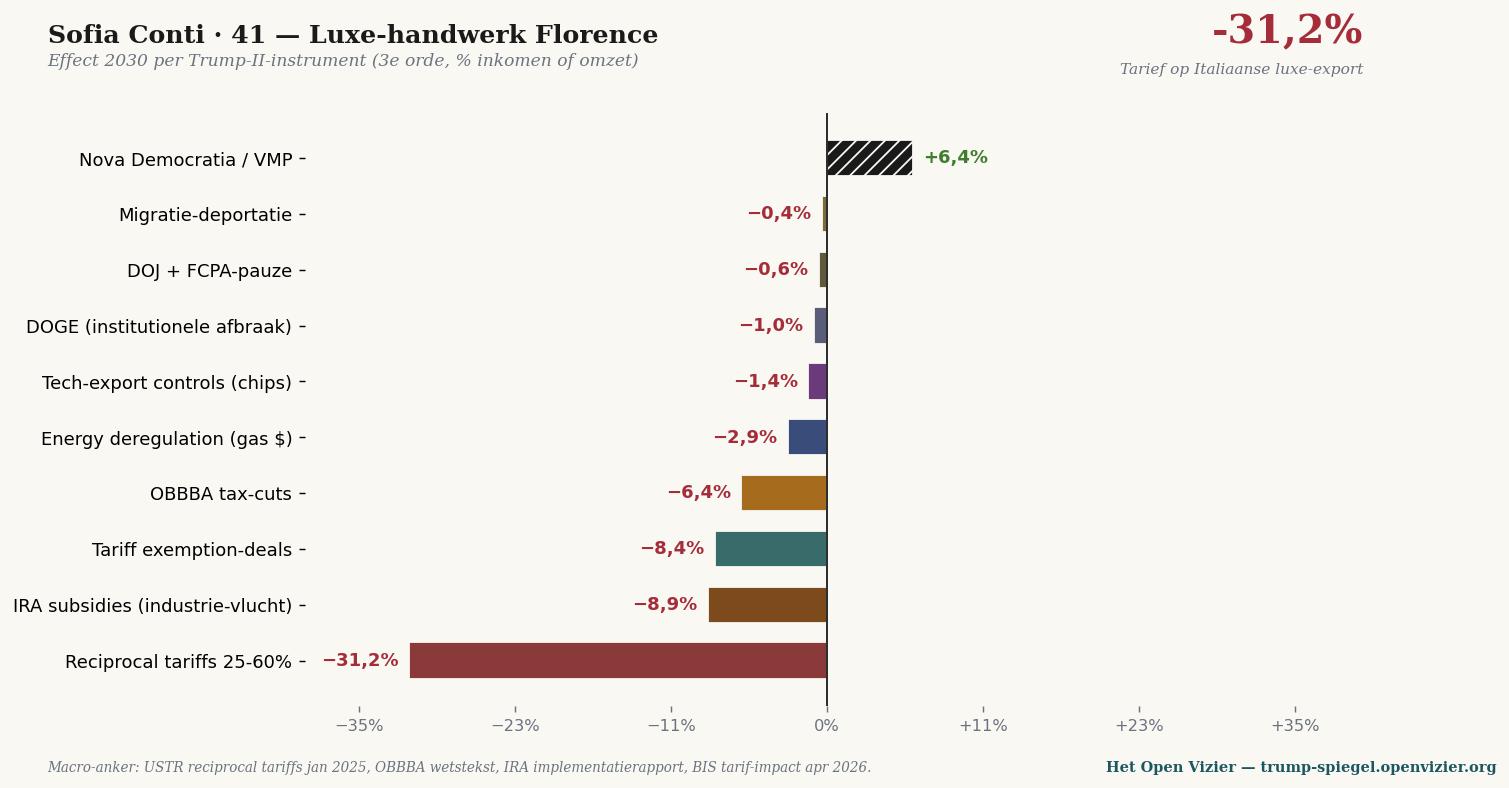
Sofia Conti · 41
Luxury craft Florence. Loses 31.2 per cent via tariff and exemption deals: Trump offers Swiss luxury firms more favourable conditions. Two blows without a negotiating position.
Five observations — what the Trump matrix shows
OBSERVATION I
Mittelstand loses most — not through incompetence
Reciprocal tariffs of 25–60 per cent hit auto, machine-building and chemistry hardest. The German Mittelstand model — exporting family firms — was designed for an American market that is now closing.
OBSERVATION II
The semiconductor sector is isolated
Trump's chip export controls hit the Netherlands uniquely. No other European country has comparable exposure. The Dutch sovereign dependency on one technology becomes visible — and painful.
OBSERVATION III
Luxury export is hit twice
Italian luxury export loses via tariffs and via Trump's selective exemption deals with other countries (CH, UK, JP). A double blow without a negotiating position.
OBSERVATION IV
Southern Europe stays off-radar
Catarina and Marie lose less under Trump than under Brussels. It is the German Mittelstand that pays the Trump bill — not the Portuguese nurse. The Brussels Consequences-map shows the reverse.
OBSERVATION V
Nova Democratia +5.4% on average
Adopting Trump's goals — energy autonomy, industrial rebuilding, renegotiating Pillar Two — without his means. Positive in every scenario. Not as utopia, as a calculation.
Silent explanation
Trump is not an opponent, Trump is a mirror
**Title: Trump is not an opponent. Trump is a mirror Europe must look into**
The narrative in European media about Trump-II is monotone. Trump is dangerous, Trump is irrational, Trump is an attack on the international order. All of that is largely true. But it is incomplete. Whoever limits themselves to rejecting Trump misses the mirror Trump holds up to Europe.
The fifth piece in the Consequences-map series, 'Trump as mirror', works it out. Twenty European scenarios — citizens and firms from seventeen EU member states plus the UK — measured against ten Trump-II instruments. The picture is uniformly red: a German Mittelständler loses 42 per cent of income, BASF-like chemistry 30 per cent of turnover, Skoda supply 26 per cent. But that is not the most important figure.
The most important figure stands in the last column of the matrix. There — under the label 'Nova Democratia / VMP' — stand green numbers between two and fourteen per cent positive. That is no utopia, no party propaganda, no shadowy hope. It is a model outcome showing that Europe, provided it adopts Trump's goals without his means, can be a winner in 2030 instead of a loser.
Three tensions lie beneath this conclusion.
First tension: Trump's tariffs precisely hit Europe. The narrative is 'America first, China first-hit'. The second-order effect is that 'America first' inevitably means 'Europe later' — a European export engine running on American markets creaks under 25 to 60 per cent tariffs. The German auto sector, the Italian luxury export, the Dutch semiconductor supply, Czech auto parts, all of them.
Second tension: Brussels already makes Europe vulnerable to that pressure. Had Europe been in a healthy starting position, Trump's tariffs would have been painful but surmountable. But through ten years of Pillar Two, Fit-for-55, CBAM and the Migration Pact, the European welfare base is already weakened. Trump strikes a weakened victim.
Third tension: Trump says something with his policy that European leaders do not dare say. That prosperity is a choice, that industrial capacity must be cherished, that energy costs determine production, that tax arbitrage relocates talent. He says it with instruments Europe morally rejects — tariffs, populism, breaking international law. But the goal beneath those instruments is exactly what Europe should want.
The question is then not: for or against Trump. The question is: how to take Trump's diagnosis seriously without adopting his means.
Five concrete consequences.
One: energy autonomy by 2030. No tariff needed — cheap energy needed. Nuclear high on the agenda, LNG permitting accelerated, and the end of the Net-Zero-by-2050 split in which high prices are accepted as if they were free. A European gas MWh price of four euros is feasible; now it sits at twelve.
Two: industrial rebuilding without a subsidy roulette. No 'Made in Europe' via tariffs, but a single market that works for industry. An end to the bidding war between member states for one semiconductor plant while the total shrinks.
Three: renegotiate Pillar Two. Trump's OBBBA shows that low corporate tax attracts talent and capital. Europe now chooses Pillar Two conformity and loses outflow to the US. A European bandwidth with production allowances remains competitive.
Four: meritocracy as a weapon. Trump's 'Buy American' is in effect meritocratic selection in favour of American suppliers. Europe can do the same by replacing diversity quotas with capacity quotas.
Five: reopen the Migration Pact for productive migration. Not Trump's deportation extreme, not Brussels's distribution extreme — selection on knowledge, skills and contribution capacity.
That is not a copy of Trump. That is taking Trump's diagnosis seriously without adopting his instruments. Nova Democratia, the political project on which the Consequences-map series is building, translates these five points into a European manifesto. The reference column in the matrix shows what it yields in modelling terms.
Whoever rejects Trump without reforming Europe implicitly chooses slow grinding between Brussels flour and Washington's shock. Whoever copies Trump sells his own democratic and legal foundations. Whoever adopts Trump's goals without his means finds the only path on which Europe wins in the model. The choice is on the table. Read the full analysis at trump-spiegel-dot-openvizier-dot-org and choose.

Jacobus van Merksteijn
Editor-in-chief of Het Open Vizier. Entrepreneur, developer of industrial and governance innovations (Carbon-Alert Ltd, TerraClean Ltd, GuardSkin Ltd). Writes on economic, ecological and political system questions from experience with the Brussels and The Hague decision-making machine.