
Every year the Netherlands spends €1.5 billion to get businesses to invent. The government calls the scheme, the WBSO, a textbook example of effective policy: implementation costs just 1.4% of the budget.1 Who looks beyond the counter sees something else. The small business owner is bled dry by forms. A handful of multinationals drains the pot. And the invention is built abroad, where electricity and labour are cheaper.
The Netherlands pays the costs of the invention, the multinational keeps the profit, and a foreign country gets the factory.
SMEs are being sucked dry
The WBSO is a reduction in payroll tax for those who conduct research in the Netherlands. In 2025, 18,932 companies used it, 97% of them SMEs.2 On paper, it is a scheme for the small innovator. In practice, it is a bureaucratic merry-go-round.
The official evaluation shows it for itself. For 80% of applications, a paid adviser is needed. A quarter of companies spend more than 500 hours a year on the WBSO: a quarter of an employee’s time spent solely filling in forms. In almost a quarter of audits, the hours are adjusted; in 40% of cases, the costs. And 28% of start-ups cannot even use the benefit awarded in full, because they pay too little payroll tax.3
Work it out for a small user with a €10,000 benefit. One hundred hours of their own administration, an adviser and a few hours with an accountant, at €350 to €450 per hour, soon add up to €8,500. What remains is a pittance, with the risk of an adjustment later. For the average user, with a €65,752 benefit,4 about a third goes on applying for it. No wonder 18% of users themselves say that the benefits do not outweigh the effort.5
| Annual benefit | Cost of obtaining it | Share used up | |
|---|---|---|---|
| Small user | €10,000 | ~€8,500 | ~85% |
| Average user | €65,752 | ~€22,600 | ~34% |
| Large company | ~€900,000 | ~€75,000 | ~8% |
Table 1. How much of the WBSO benefit is used up by applications, administration, advisers and accountants. Author’s calculation based on the evaluation; see notes.
The smaller the company, the larger the share that disappears into the merry-go-round. The rules are equally onerous for everyone, but the small business has to bear them with a fraction of the turnover. SMEs thus pay for the administrative infrastructure of a scheme from which large companies benefit most.
The multinational cashes in, but not here
At the other side of the table sits big business. It is only about 3% of WBSO users, but receives 37% of the money: €513 million.6 On average, a large company gets around €900,000 a year, an SME around €47,000. Nineteen times as much. For a corporation with its own tax department, five hundred hours of administration are a rounding error.
Then comes the second sugar pot: the innovation box. Profit from its own patents is taxed there at 9% instead of 25.8%. Of the roughly €2.7 billion this costs annually,7 90% goes to three large companies.8 Together, around €2.4 billion a year, from all taxpayers, goes to three companies whose names do not appear in the public figures.
Nearly 19,000 companies receive support for their research. But only around 3,200 companies ever book profits here from their innovation through the innovation box.9 The costs are incurred here. The proceeds go to a few giants, or disappear abroad.
The foreign country gets the factory
The Netherlands is a nation of inventors. With 388 European patent applications per million inhabitants, it ranks fifth in the world.10 But inventing is different from building. In 2025, the Netherlands attracted only 159 foreign investment projects, compared with 409 in 2016.11 An industrial-scale electricity user pays €116 per megawatt-hour for electricity here, and €51 in France.12
This is how the chain works. A multinational conducts some of its research in the Netherlands and receives the WBSO for it. It books the profits from patents here at 9%. It builds the factory where electricity, labour and regulations are cheaper. The Netherlands helps pay the costs, gives a tax break on the profits and misses out on the jobs. The WBSO measures how much research is carried out. No one measures where the factory goes.
The bill
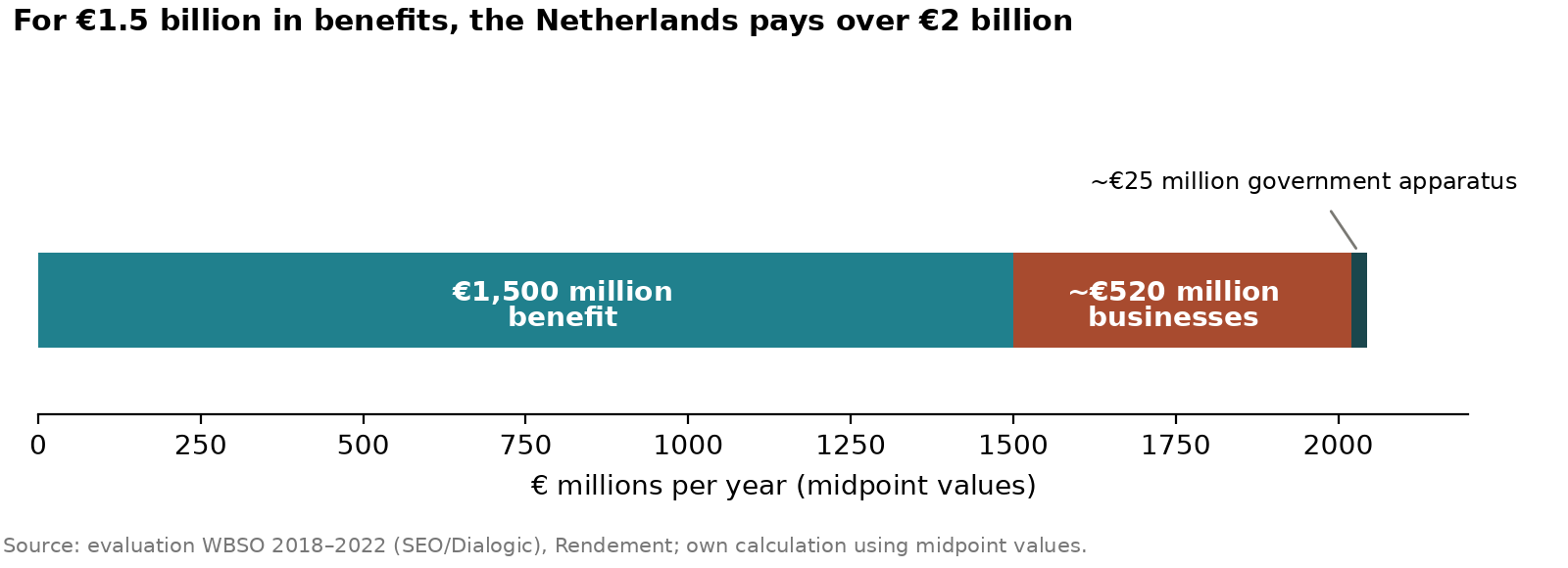
Figure 1. What the WBSO costs annually, midpoints. Costs for businesses and the government apparatus are the author’s calculations; see notes.
Add it all up and the picture is clear. The taxpayer forgoes €1.5 billion in payroll tax. Businesses collectively spend about half a billion on their own hours, advisers, directors and accountants. The government spends around €25 million on administration. Total: over €2 billion a year, to get €1.5 billion to businesses.
And who pays? The Netherlands has 2,433,985 companies.13 More than 99% of them receive nothing from the WBSO, but still contribute: through tax, and through the higher prices into which users’ administration costs are passed on. The citizen pays for everything.
What the Netherlands gets in return
According to its own evaluation, every euro of WBSO yields 41 cents of additional research and development work, and in the broader sense 81 cents of additional R&D.14 Less than the euro that goes in. The rest is a discount on research that companies would have done anyway. The CPB already wrote in 2020 that the additional R&D “probably leads to few additional innovations” and may even have “little or even negative social value”.15
The innovation box is even more meagre: 27 cents of additional research per euro of tax relief.16 An international study cited by the CPB shows that such patent boxes mainly lead to more patents on paper, not to more research.17
Thumbing their nose at the public
The government knows all this. It is in its own evaluations. Yet the Cabinet calls the burdens “proportionate” and the implementation “modest”,18 and the WBSO budget will rise next year to almost €2 billion.19 The 1.4% implementation costs count only its own office. The entrepreneur’s hours, the bill from the adviser and accountant, and the start-up’s losses are not included. What the public pays and what small and medium-sized businesses lose are not measured, so they do not exist. That is how a scheme that delivers less per euro than it costs can be called a success year after year.
Why do they exist, then?
The honest answer is in the CPB: the innovation box “is used mainly to create a tax-favourable business climate”.20 It is not innovation policy, but tax competition to get multinationals to book their patent profits here. The Cabinet itself says that abolition would make the Netherlands “less attractive for tax purposes”.21
In addition, the schemes have a firm support base: large companies that benefit most from them, hundreds of consultancy firms that make their living from applications, and a civil service that implements, monitors and evaluates the scheme. Those who make their living from a scheme defend it. That is the author’s assessment, but it explains why a scheme with a return of less than one euro per euro is never called into question.
What if they disappeared?
| WBSO | Innovation box | |
|---|---|---|
| Less R&D per year | ~€1.0–1.2 bn (81 cents per euro) | Small; mainly fewer patents on paper |
| Revenue for the Treasury | ~€1.5 bn | ~€0.4 bn according to the CPB, because some of the profit leaves |
| Administration eliminated | ~€0.5 bn for businesses | Small |
Table 2. Consequences of abolition. Sources: evaluation WBSO (2025), CPB (2020); amounts rounded.
The Netherlands would lose around €1 billion in R&D per year, a quarter of the amount channelled through these two schemes, but mainly research that large companies would have done anyway. In return, around €1.9 billion would be freed up for the Treasury, and small and medium-sized businesses would be spared half a billion in administration. The real risk is that a few multinationals move their patent profits to a country with a lower tax rate. The Netherlands would then be left without a sugar pot, but also without the illusion that those profits create factories here.
What needs to be done
Abolish the WBSO and the innovation box. That would bring the Treasury around €1.9 billion a year, and half a billion in business administration would disappear overnight.
Give it back through lower taxes on work and on reinvested profits. Let residents and businesses decide for themselves what to invest in. Then every entrepreneur, large and small, keeps more, without an office, without an adviser and without an inspector. Those who earn invest themselves in the next innovator, as in California, where almost thirty times as much venture capital goes to start-ups per capita as in the Netherlands.22
Make building in the Netherlands possible again. As long as electricity here is twice as expensive as in France, every innovation subsidy remains a subsidy for foreign factories.
Conclusion
The WBSO and the innovation box are not innovation policy. They are redistribution machines. They collect money from everyone, make the small business owner work for it, give most of it to a few giants and do not ask where the factory will be. For every euro, they deliver less than a euro’s worth of research. The government knows it, writes it down, and increases the budget. The Netherlands thus exports its own knowledge every year, and pays for it too.
Notes
Measured figures come from the evaluation of SEO and Dialogic (2025), RVO, the parliamentary letter on the evaluation, CBS and the other sources in the footnotes. The author’s calculations: costs at businesses (~290 hours per user × €60, advisers ~€5,000 per user according to the evaluation, directors 10–20 hours × €150–250, accountants for half of the users 5–15 hours × €350–450; total €460–580 million), the government apparatus outside RVO (€100,000–130,000 per FTE), the average per large and small and medium-sized business (distribution 2022 combined with the number of users of 2025), the costs at a large company (~500 hours × €60, advisers ~€25,000, accountants and lawyers ~€20,000), the loss of R&D upon abolition (WBSO benefit × 81 cents) and venture capital per capita (California ~39 million, the Netherlands ~18 million inhabitants).
Dialogic, Evaluation WBSO 2018–2022, project page, https://dialogic.nl/projecten/evaluatie-wet-bevordering-speur-en-ontwikkelingswerk-2018-2022/↩︎
RVO, Focus on research & development: the WBSO in 2025, https://www.rvo.nl/sites/default/files/2026-05/Focus-Jaarverslag-WBSO-in-2025_0.pdf↩︎
SEO Economic Research and Dialogic, Evaluation WBSO 2018–2022, final report (February 2025), https://app.1848.nl/static/pdf/89/5a/895a7613ef5b1ab336cf1e6c0d58c882c9d3087d.pdf↩︎
SEO Economic Research and Dialogic, Evaluation WBSO 2018–2022, final report (February 2025), https://app.1848.nl/static/pdf/89/5a/895a7613ef5b1ab336cf1e6c0d58c882c9d3087d.pdf↩︎
SEO Economic Research and Dialogic, Evaluation WBSO 2018–2022, final report (February 2025), https://app.1848.nl/static/pdf/89/5a/895a7613ef5b1ab336cf1e6c0d58c882c9d3087d.pdf↩︎
Parliamentary letter on the evaluation of WBSO, appendix with breakdown by business size (April 2025), https://www.tweedekamer.nl/downloads/document?id=2025D14692↩︎
Business policy in focus, Innovation Box, https://www.bedrijvenbeleidinbeeld.nl/beleidsinstrument/i/innovatiebox↩︎
Accountancy Vanmorgen, Money from the Innovation Box disappears into the pockets of three large companies to the tune of 90% (13 Apr. 2026), https://www.accountancyvanmorgen.nl/2026/04/13/geld-uit-innovatiebox-verdwijnt-voor-90-in-zakken-van-drie-grote-bedrijven/↩︎
Taxence, Cabinet response to the evaluation of the Innovation Box (Dec. 2023), https://www.taxence.nl/nieuws/kabinetsreactie-evaluatie-innovatiebox/↩︎
EPO, Patent Index 2025 at a glance, https://link.epo.org/web/about-us/statistics/en-technology-dashboard-2025-at-a-glance.pdf↩︎
Accountant.nl, The attractiveness of the Netherlands' investment climate is declining (July 2026), https://www.accountant.nl/nieuws/2026/7/aantrekkingskracht-nederlands-investeringsklimaat-wordt-minder/↩︎
FME, Less bad is not good enough (29 Sept. 2026), https://www.fme.nl/nieuws/minder-slecht-niet-goed-genoeg↩︎
CBS StatLine 81588NED, Businesses; business size and legal form (as at 1 July 2026), https://www.cbs.nl/nl-nl/cijfers/detail/81588NED↩︎
SEO/Dialogic, Evaluation WBSO 2018–2022, summary submitted to the Senate (April 2025), https://www.eerstekamer.nl/overig/20250403/evaluatie_wet_bevordering_speur_en/document↩︎
CPB, Promising innovation policy, update 2020, https://www.cpb.nl/sites/default/files/omnidownload/CPB-Kansrijk-innovatiebeleid-update-2020.pdf↩︎
SEO/Dialogic, Evaluation WBSO 2018–2022, summary submitted to the Senate (April 2025), https://www.eerstekamer.nl/overig/20250403/evaluatie_wet_bevordering_speur_en/document↩︎
CPB, Promising innovation policy, update 2020, https://www.cpb.nl/sites/default/files/omnidownload/CPB-Kansrijk-innovatiebeleid-update-2020.pdf↩︎
Parliamentary letter on the evaluation of the WBSO (8 April 2025), https://www.tweedekamer.nl/kamerstukken/brieven_regering/detail?id=2025Z06388&did=2025D14692↩︎
Accountancy Vanmorgen, WBSO budget rises to almost €2 billion (17 Sept. 2026), https://www.accountancyvanmorgen.nl/2026/09/17/wbso-budget-stijgt-naar-bijna-e2-miljard-tarieven-blijven-gelijk/↩︎
CPB, Promising innovation policy, update 2020, https://www.cpb.nl/sites/default/files/omnidownload/CPB-Kansrijk-innovatiebeleid-update-2020.pdf↩︎
Taxlive, Answer to questions about the evaluation of the Innovation Box (Dec. 2025), https://www.taxlive.nl/nl/documenten/vn-vandaag/antwoord-op-vragen-over-evaluatie-innovatiebox/↩︎
NVCA, 2026 Yearbook: California $191.2 billion in venture capital in 2025; the Netherlands €2.64 billion according to Dealroom (Searchlab), https://nvca.org/2026-nvca-yearbook/↩︎