The Political Landscape
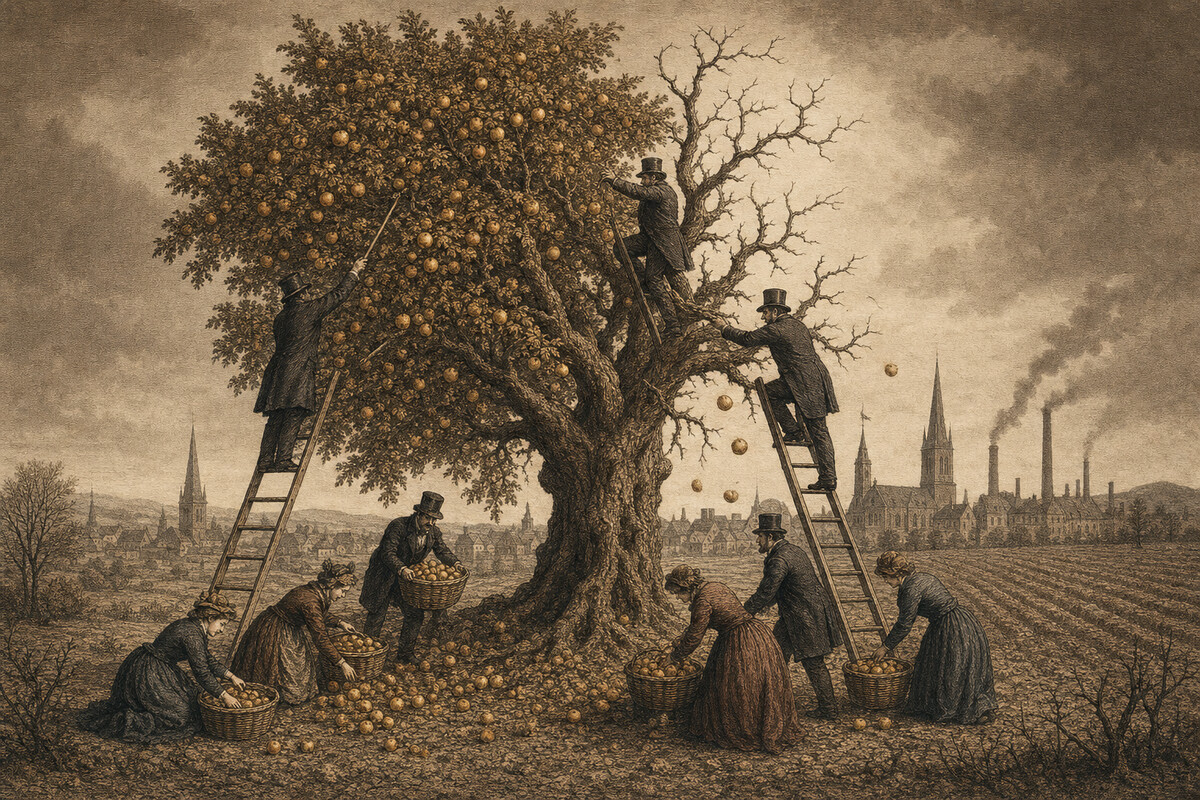
Placement based on public statements and voting behavior, May–June 2026.
If we established in the previous parts that we chose this ourselves, we must now honestly map out exactly who we chose. Which party wanted what. Which trade union demanded what. What the employers were clamoring for. And what Brussels — intended as the engine of the continent — is making of it right now.
This is not a pamphlet. This is an honest cartography. Because only when you know who is sitting on which side of the table can you understand why the train won't get back on the rails. Everyone is pushing a different wagon, and no one is looking at the locomotive.
The Netherlands — the Polder Pushes Left
GroenLinks-PvdA
The clearest plundering coalition. On 4 June 2026, in the Tweede Kamer, Jesse Klaver literally hammered on a "fair tax on high profits and large wealth." The position is consistent: maintaining the welfare state by taxing the top more heavily, not by asking the bottom to work more or making the system more austere. The party views wealth as democratically suspicious, entrepreneurship as useful as long as it is regulatable, and successful Dutch people as candidates for extra contributions.
Their electorate: highly educated civil servants, teachers, healthcare workers, people in the public sector. People who have no wealth themselves and who are not affected by the extra tax. It is electorally logical and morally self-satisfying at the same time. What is missing is any substantive analysis of what happens when the cash cow refuses to graze any longer.
FNV — the trade union
The FNV actively supports this course. The trade union movement's ultimatum on 4 June 2026 regarding the budget cuts — submitted to the cabinet — is not about working for what you get. It is about: keep benefits at their current level, pay for it with money from the "wealthiest." Tuur Elzinga has consistently propagated this message. In 2026, the trade union is no longer an organization for workers. It is an organization for protecting the social contract as it once was, financed by others. This is a fundamental difference from the FNV of say 1985, which still negotiated wages in exchange for productivity.
D66
Voted for the new box 3-wet on 12 February 2026. Not out of conviction, but because the electorate expects it. D66 primarily does not want to be known as antisocial. The party that once embraced entrepreneurship has, in two decades, changed into a progressive-bureaucratic movement that follows the zeitgeist. International competitiveness is occasionally mentioned, but never consistently translated into policy.
VVD
The party that is supposed to defend entrepreneurs also voted for box 3. There is a tragedy in that. Over the past fifteen years, the VVD has lost the moral basis to be against wealth taxation. By supporting public spending for decades that is now unaffordable, the party is complicit in the problem it rhetorically fights. The result: soft opposition, with an occasional brave statement from an individual MP that no one quotes.
CDA and NSC
Also voted for box 3. Centrist politics that primarily sees itself as a bridge and therefore bends in every direction. The CDA tradition of protecting the family business is hardly to be found in the current generation of politicians. Pieter Omtzigt and NSC took up budgetary discipline in the 2023 campaign but without fundamentally challenging the redistribution model.
PVV and BBB
This is where it gets interesting. Wilders says: "ordinary Dutch people are going to pay for the consequences of immigration," and wants the problem solved by closing borders and not giving migrants benefits for fifteen years. That is a different reading of the same problem, but without involving the productive class in the analysis. The BBB has an agrarian undertone — the farmer as a victim of Hague policy — but does not broaden that to the wider entrepreneurial class.
Both parties capture the anger that will soon become much greater. But neither has a coherent story about how productive wealth is built. They point, rightly, to the problems. They do not offer a solution.
VNO-NCW and the employers
Here lies the most striking silence. VNO-NCW publicly criticized the new box 3-heffing on 22 May 2026 and advocates for a capital gains tax instead of a wealth growth tax. That is technically the correct argument. The Dutch Startup Association literally called on the Eerste Kamer not to process the law further, because it "undermines confidence in the business climate."
But the discussion is being conducted on the terrain of technique, not principle. The question of whether the Dutch state even has the right to tax wealth annually — a new form of taxation that is not linked to what a person earns but to what they have built up — is not asked by VNO-NCW. Too politically incorrect. The result: the employers' organization loses the debate even in its most defensive form, because its argument is technical and the opponent's argument is moral. Moral arguments always win over technical ones, even when they are wrong.
Germany — the coalition cracks under its own words
SPD
Wants to increase the Spitzensteuersatz from 42 to 49 percent, and supports the idea of a wealth tax for those with a net worth of more than twenty million euros. Marcel Fratzscher of the DIW has presented the calculation: a two percent wealth tax would generate about 42 billion euros. "The state could use that money to lower taxes on labor and companies," he says. With this, he sells the German wealth tax as if it were a net positive for entrepreneurs. This is academically clever and politically deceptive: as soon as the levy exists, the idea of compensation always disappears into the general funds.
CDU and CSU
Officially oppose increasing the top tax rate and wealth taxation. But cracks are already appearing. At the end of May 2026, the first Union politicians showed themselves "ready for compromise" on increasing the Reichensteuersatz from 45 to 47.5 percent. The course is beginning to bend, not because the CDU leadership is convinced, but because the SPD no longer wants to cooperate on other tax cuts unless the "rich contribute more." This is how principles evaporate in coalition politics.
Bündnis 90/Die Grünen
Karl Haeusgen — interestingly, he himself is the head of the Greens' entrepreneur network and former president of the German mechanical engineering federation VDMA — advocates for higher income tax and higher inheritance tax. This is remarkable: a prominent entrepreneur who nonetheless advocates for heavier taxation because he believes that "wealthy entrepreneurial families must bear a greater tax burden." A rational self-destruction, fed by the guilt of the successful German.
AfD
Captures the anger on the other side. Not about plundering, but about what they do with the plucked money — especially migration, asylum care, and climate spending. The same pattern as with the PVV: a pointing party, not a constructive one.
DGB — the German trade union confederation
This is where it gets tough. On 3 June 2026, deputy chairman Stefan Körzell repeated the DGB proposal: tax every euro of wealth above one million euros net, for married couples above two million. Plus an extra Vermögensabgabe of ten percent on all wealth above ten million — spread over twenty years. Revenue: 350 billion. "Instead of taking the red pen to ordinary working people, the government must finally tackle the profiteers of unequal distribution," says Körzell.
The language is telling. "Profiteers." That is what the German trade union calls the entrepreneurs who run the factories where DGB members work. Who pay the pension premiums that DGB members expect to enjoy in twenty years. Who provide the tax money from which the DGB secretaries are financed. Profiteers of a society that would not be a society without them.
BDI and Die Familienunternehmer
The German employers' side. The BDI protests against every new levy, but cautiously. Die Familienunternehmer, the German family business association, goes further: they literally warn of the "substanzvernichtende Wirkung" of wealth taxation. Substance-destroying. That is technically correct — a wealth tax on non-liquid business assets forces the sale or fragmentation of the company to pay the levy. It is the cruelest form of industrial damage, because it comes slowly and is irreversible.
Are they being listened to? Not really. In the German media, Familienunternehmer is the voice of what are called "the rich." In DGB reports, the employees of those same family businesses are presented as victims of capital. The same company is divided along two axes: the owner as profiteer, the employee as victim. No attention is paid to the fact that without the former, the latter would not exist either.
France — the arena under pure tension
La France Insoumise (LFI)
Mélenchon and his ilk advocate for the full reintroduction of the ISF — the wealth tax that Macron abolished in 2017 — plus a tax on "super-profits," plus a large-scale reform of inheritance tax. The program is consistent: SMIC to 1700 euros, retirement back to 60, restore ISF, tax dividends as wages. It is the purest variant of plundering in Europe, presented under the flag of justice.
Parti Socialiste
Lighter, but in the same direction. The socialists propose reintroducing a wealth tax on assets above one hundred million euros — the Zucman norm, the same two percent that is on the ballot in California. Olivier Faure positions this as a "socially acceptable" alternative to the 44 billion euros in cuts the government wants. A deliberate moral framing: choose between withholding from the poor or taxing the super-rich. The middle way — namely: promising less, living more austerely — is not mentioned.
Rassemblement National (RN)
Marine Le Pen has primarily opposed limiting the CPF — the personal training account — not taxes on holdings or the scaling back of the Pacte Dutreil for family businesses. The RN champions the underdog of the working class but leaves the attack on the productive top end cheaply unchallenged. A tactically smart position: don't defend the rich, as that is electorally unsellable; do present the ordinary Frenchman as a victim.
Renaissance and Les Républicains
Macron's movement and the Gaullists are fighting a battle behind the scenes. At the end of May 2026, Prime Minister Sébastien Lecornu filed an appeal with the Conseil constitutionnel to have three fiscal measures against "the rich" tested before they take effect. This reflects the center-right position: not fundamentally against extra taxation of wealth, but concerned about legal sustainability. The same pragmatism that D66 and VVD show in the Netherlands. Bending cautiously, hoping it will be less severe than the left wants.
Medef — the French employers
Protesting, but cautiously. Medef has systematically lost ground in public debate in recent years. Patrick Martin, the current chairman, speaks in technical terms about "investment climate" and "competitiveness." No one listens. The French intellectual climate views the entrepreneur as a suspect, and that does not change with business logic.
The three patterns revealing themselves
Whoever lays the Dutch, German, and French party landscapes side by side sees three patterns that are the same everywhere.
One — the left wants to pluck more, and does so with moral clarity. GroenLinks-PvdA, SPD, LFI, Parti Socialiste, partly Bündnis 90: they have a coherent story and a reliable base. Their moral framing — "the strong must contribute more" — is electorally robust and culturally dominant. Whoever opposes them carries the burden of proof.
Two — the center-right bends because it has no other choice. VVD, CDU, Renaissance, Les Républicains: they vote for what they rhetorically oppose. Their problem is that they have supported the welfare state for decades and now have no moral basis to act against its financing. They lose every discussion because they cannot clearly articulate why taxing wealth is wrong while they find taxing income normal. The difference between the two — taxing profit when it is realized, or taxing wealth when it doesn't even exist yet — is technically crystal clear, but morally impossible to explain to an electorate that thinks in soundbites.
Three — the populist right points but does not build. PVV, AfD, RN, BBB, FvD: they capture the anger that the plundering produces, but they direct it elsewhere. At migrants. At Brussels. At the "elite." Not at the plundering itself. That is electorally logical — their voters have no wealth and do not feel addressed by a defense of it — but it means that even a shift to the right across Europe would not stop the plundering. It would only change the scapegoat.
My opinion: What is actually missing in all of Europe is a political movement that says what is simply true: the welfare state as we have built it is structurally no longer fundable from the production we still deliver. We must choose between producing more or distributing less. A third option — "letting the rich pay more" — exists only as an accounting fiction, not as a sustainable solution. No European party dares to say this. Not the left, because it undermines their moral starting point. Not the center-right, because it damages their votes. Not the right-wing populists, because it would explain to their electorate that they do have responsibility. The silence is unanimous, and therefore total.
Brussels — the engine is running, but it doesn't know which way to go
Above this national stage sits the European Commission, which officially must be the engine of European resurrection. What is it doing in June 2026?
On 3 June, the Commission presented the 2026 European Semester Spring Package. Roxana Mînzatu and Valdis Dombrovskis spoke in Brussels about a "significant shift" — competitiveness measured by human capital, skills, and social resilience. The recommendations fall into four categories: fiscal stability, innovation, business climate, energy, and social justice.
Sounds reasonable. It is empty.
Read the specific recommendations to the member states and you find almost nothing concrete about what must happen to protect the productive class in Europe. Plenty of language about "investment in skills," "improvement of working conditions," "protection of standards of living." It is administrative rhetoric that can be filled in any direction. A trade union leader hears solidarity measures in it. An entrepreneur hears deregulation in it. Both are right: nothing clear is written.
The Draghi story
In 2024, Mario Draghi wrote three hundred pages of research for the Commission on how Europe should restore its competitiveness. Investments of 800 billion euros per year. A European AI strategy. A common capital market. Energy independence. It is the most serious piece of work delivered by a former Italian Prime Minister and ECB President.
Of that 800 billion, fifteen percent has been realized in two years. The European Banking Federation reported on 10 June 2026 that the "competitiveness bill" now totals not 800 billion but 1.4 trillion — nearly a doubling, because the problem has grown due to inactivity. The engine is running, but in neutral. No one dares to shift it into gear.
Why Brussels doesn't know how to move forward
This is not incompetence. It is a structural problem built into the very architecture of European institutions.
One — Brussels cannot levy taxes. The European Commission has no fiscal sovereignty. It can propose directives — like the planned European minimum exit tax — but implementation lies with the member states. When Germany says: we are increasing our wealth tax, Brussels can do nothing. When Italy increases its 24-bis-regime to €300,000, Brussels can do nothing. The Commission can "recommend" competitiveness, but it cannot enforce it.
Two — Brussels calculates on the wrong timeline. The Commission works on seven-year budgets (2028-2034), on strategic plans for 2030, on AI roadmaps for 2035. Nice on paper. But the productive exodus is happening now, in 2026. The 16,500 British millionaires who left last year are not coming back because the Commission might coordinate a tax measure in 2030. By 2034, when the budget period begins, the European capital fabric will be even thinner than it is now.
Three — Brussels is caught between the member states. The large countries — Germany, France, Italy, Spain — want more fiscal coordination and higher taxes on capital. The small countries — Ireland, the Netherlands, Luxembourg, Malta, Estonia — want to maintain fiscal sovereignty and their own space for competitive tax policies. The Commission cannot serve both parties at once and thus does nothing that truly makes a difference.
Four — Brussels doesn't understand production. The current Commission is filled with lawyers, economists, and political scientists. No engineers. No industrial entrepreneurs. No people who have ever run a factory or sold a patent. The result is a fundamental deafness to what productivity actually requires: space for risk, affordable energy, long-term certainty about fiscal policy, craftsmanship passed down from generation to generation. Brussels produces documents. Documents do not produce wealth.
Five — the Euro-bureaucracy has made self-preservation its goal. The Commission is not designed to restore Europe, because its raison d'être lies in coordination between member states. The weaker the member states, the stronger Brussels. A strong Europe with sovereign member states — as under Helmut Kohl and François Mitterrand — did not need Brussels. A weak Europe, which can no longer do anything on its own, does. It is institutional self-denial to speak about this out loud, but it is true.
What this means
The political map of Europe in June 2026 is this. A European left wing that plucks with moral certainty. A center-right that bends without knowing how to do otherwise. A populist right that points without building. A Brussels institution that produces documents but no products. Employers' organizations that protest technically but lose morally. Trade unions that indirectly help undermine their own employees by declaring employers the enemy.
None of these parties can solve the problem alone. That is the core. The productive class — the entrepreneurs, the inventors, the patent holders, the family business — no longer has political representation in Europe. Not the left, because they have been declared the enemy. Not the center-right, because it no longer dares to defend them. Not the populist right, because its attention is elsewhere. Not Brussels, because it can do nothing.
They stand alone. Statistically alone — less than five percent of the European electorate. Politically alone — no party dares to openly serve their interests. Culturally alone — the media present them as profiteers. Morally alone — no broadly supported story explains why they are valuable to the society that has plucked them.
And without that productive class — without the people who run factories, exploit patents, implement innovations — there is no European future. Not in fifty years, not in twenty, not in ten.
Conclusion of the five-part series
The train isn't stationary because there are no drivers. The train is stationary because every driver is pushing a different wagon in a different direction, and no one is looking at the locomotive.
The Dutch coalition bends. The German coalition cracks under its own words. The French Republic fights itself in its own Constitutional Court. Brussels produces documents of which fifteen percent are implemented and which, in the meantime, grow older than the problem itself.
And the people who create the wealth — we who in this series have called them the "productive class," the entrepreneurs, inventors, manufacturers, family businesses — watch from the other side of the station. They have already packed their bags. They are waiting for the right train. Not the train that can't get on the rails in Brussels, but the train to Singapore, to Dubai, to Texas, to Lugano, to Ticino.
When that train departs, and they are on it, Brussels will appoint a new commissioner to "combat the exodus." That will produce the 350th report on European competitiveness. That report will be discussed in 47 European meetings. Fifteen percent of it will be implemented. By the time it could have changed anything, the train will have arrived in Singapore.
We set this up ourselves. No one else. We vote. We support. We look away. We built the architecture in which nothing can change.
This is the political landscape. Whoever sees it also sees why there is no longer a way out within the system. The way out lies outside Europe. For the productive ones, anyway. For the rest of us, who voted for all of this, there is no way out anymore.

Jacobus van Merksteijn
Malta
Publisher of Het Open Vizier. Systems thinker on climate, energy and democracy.