
Drafted by the assistant (Perplexity Computer), 11 October 2026, following three observations by Jacobus van Merksteijn: that spending makes GDP rise, that the CPB (the Dutch Bureau for Economic Policy Analysis) only calculates the P of PID control and leaves the second- and third-order effects out of view, and that a worker loses about 78% of his wage to levies. The calculations are the assistant's; the calculation appendix at the end shows for each step where every figure comes from. The numbers in brackets refer to the list of sources.
The core
GDP measures how much is spent in the Netherlands, not how much is earned. When the government spends more, GDP rises, even if the country becomes poorer from it. In the second quarter of 2026 GDP rose by 1.3% compared with a year earlier, mainly because the government spent 2.5% more; investment rose by only 0.4% [1].
What you really notice is what you can buy in real goods. Everything that does not end up there is tax on the earner, whatever is done with it: wage tax, social contributions, compulsory pension, health insurance premium, local levies, VAT, excise duties and the taxes that companies build into their prices, down to the VAT and import levy on a parcel from China. Of every extra euro an employer pays for you, you receive 20.7 cents in real goods. For an average household that is €13,678 a year. That is the real spending room, and that is what this article is about.
Every euro the government makes you pay extra therefore costs you 53 cents in goods: had you been allowed to spend that euro yourself, another 47 cents would have gone on VAT and taxes in prices when buying. All amounts per household in this article have been converted into goods in this way.
With all consequences included, the decisions in this article cost an average household €3,789 in goods a year, 27.7% of its real spending room of €13,678. If KLM then collapses, it is €4,159, 30.4%. €9,519 in goods remains, 221,000 jobs disappear and unemployment rises from 3.9% to 6.0%. With the cut in civil servants that will not be achieved, the extra work at the UWV (the Dutch employee insurance agency) and 5.5% higher pay in the public sector, it becomes €4,877, 35.7%, and €8,801 remains. Add the American blockade of ASML and a Schiphol that renews less, and it is €5,163, 37.7%, with €8,515 remaining.
The cabinet presents only the direct amount of each decision. But whoever pays more tax spends less; the state then misses VAT, taxes from prices and wage tax, and pays more unemployment benefit. To pay for the decision anyway, it must levy even more tax. For every euro a decision costs, the state therefore has to collect €1.75. This article therefore calculates every decision with that full bill.
The real economy is what the Netherlands earns abroad with its own production, the NEPK. In 2021 it was still 3.25% of GDP; it is now 2.87%, €33.7bn. Because of the higher taxes on labour and the defence spending, it falls to €32.6bn. The cabinet does not calculate this.
What each decision costs you
Every euro the government spends is ultimately paid by a household itself, through tax or through higher prices. That is why every amount has been divided by the 8.43 million households [2].
How to read this, using defence as an example. The cabinet spends an extra €19.3bn a year; that is €2,289 per household. Because the state then misses VAT, price taxes and wage tax and pays more unemployment benefit, it must collect €2,289 × 1.75 = €4,010 per household. Of every euro of tax you could have bought 53 cents in goods; the rest would still have gone on VAT and taxes in prices when spending. So you can buy €4,010 × 53% = €2,127 less in goods. That is €2,127 / €13,678 = 15.6% of your real spending room. The basis of €13,678 is: all labour costs in the Netherlands in 2025, €557.3bn [3], × the 20.7% that reaches the worker as real goods, / 8.43 million households. It is therefore not a percentage of GDP.
| Decision | What the cabinet spends, per household | What the state actually has to collect (× 1.75) | Fewer goods per household (× 53%) | Share of €13,678 |
|---|---|---|---|---|
| Defence: €19.3bn a year extra from 2031 [4] | €2,289 | €4,010 | €2,127 | 15.6% |
| Higher taxes on labour: €5.8bn from 2027 [5] | €688 | €1,205 | €639 | 4.7% |
| European production instead of Chinese, 30% more expensive | €518 | €907 | €481 | 3.5% |
| Emergency shelter for asylum seekers: €2.4bn a year [6] | €285 | €499 | €265 | 1.9% |
| Groningen, damage and reinforcement: €1.15bn a year [7] | €137 | €240 | €127 | 0.9% |
| Higher airport charges Schiphol: €0.48bn a year [8] | €57 | €100 | €53 | 0.4% |
| Tata Steel, additional costs: €0.48bn a year [9] | €57 | €99 | €53 | 0.4% |
| Nitrogen, lost income: €0.40bn a year [10], [11] | €48 | €84 | €44 | 0.3% |
| Total per year | €4,078 | €7,142 | €3,789 | 27.7% |
| If KLM collapses: extra | €697 | €370 | 2.7% | |
| Total with the collapse of KLM | €7,839 | €4,159 | 30.4% | |
| What remains of €13,678 | €9,519 | 69.6% |
In addition there are amounts that are spent once. Here too the state must collect 1.75 times as much:
| One-off | What the cabinet spends, per household | What the state actually has to collect | Fewer goods per household | Share of €13,678 |
|---|---|---|---|---|
| Childcare benefits recovery operation: €11.3bn [12] | €1,340 | €2,348 | €1,246 | 9.1% |
| Buy-out of livestock farms: €6.2bn [13] | €735 | €1,288 | €683 | 5.0% |
| Tata Steel, subsidy: €2.0bn [9] | €237 | €416 | €220 | 1.6% |
| Total one-off | €2,313 | €4,051 | €2,149 | 15.7% |
Because of these decisions, an average household gives up 27.7% of its real spending room every year, and on top of that 15.7% once. If KLM collapses, it becomes 30.4% every year.
If a spending item is paid for by borrowing instead of tax, the bill does not disappear. It comes later, with interest, to the same households or their children.
How the 79% was calculated
Jacobus van Merksteijn states that a worker loses about 78% of his wage to social contributions, taxes, excise duties, the business share of taxes, advisory costs and all other levies. He had not yet included box 3 (the Dutch tax on savings and investments) and inheritance tax. The assistant checked this per €100 that an employer pays for an average employee.
| What is deducted from €100 of labour costs | Amount | Source |
|---|---|---|
| Employer contributions, including pension | −€22.9 | [3] |
| Wage tax and employee contributions | −€20.3 | [14] |
| Employee pension contribution | −€4.6 | [15] |
| Net wage | €52.2 | |
| Health insurance premium and deductible | −€5.7 | [16], [17] |
| Municipality, province and water board | −€2.7 | [18] |
| Box 3 and gift and inheritance tax | −€2.2 | [19], [20] |
| VAT, excise duties and energy tax | −€7.7 | [21] |
| Taxes, contributions, pension and compliance costs of companies, built into prices | −€11.8 | [22], [23] |
| What the worker keeps in real goods value | €22.1 |
On average 77.9% is lost. Of an extra euro earned, 79.3 cents is lost and the worker keeps 20.7 cents. That is more than the 78% Jacobus van Merksteijn calculated earlier.
For every extra cost item, the worker has to earn an extra euro. Of that extra euro, 20.7 cents reaches the worker as real goods: €13,678 per household per year. The rest, 79.3 cents, is tax on the earner.
The decisions one by one
Defence
Defence spending reaches €28.9bn in 2027 [24]. From 2031 an extra €19.3bn is added every year [4]. The norm is a percentage of GDP, and the spending itself counts in GDP: the more is spent, the higher the amount the norm prescribes. 40% of the money goes directly abroad, and 15,100 extra people are needed in a labour market that is already tight [25].
Of what is made in the Netherlands, at least another 27% comes from imported components and raw materials; that is the average for all spending in the Netherlands [26], and for manufacturing it is higher. Of the €19.3bn, at least €10.8bn, 56%, therefore goes abroad. What stays in the Netherlands, at most €8.5bn, is not sold abroad; the real economy does not grow from it.
What it costs you: €2,127 in goods per household per year, 15.6% of your real spending room of €13,678 a year.
Higher taxes on labour
From 2027 the taxes on labour rise by €5.8bn [5]. Entrepreneurs feel such a loss about twice as heavily as it is [27]: for them it feels like €11.6bn. It is on that feeling that they decide whether to keep investing.
What it costs you: €639 in goods per household per year, 4.7% of your real spending room of €13,678 a year.
Emergency shelter for asylum seekers
Reception of asylum seekers cost €3.7bn in 2025, of which €2.4bn went to emergency shelter in hotels and cruise ships, among other places [6]. Emergency shelter is about twice as expensive as regular reception [28]. In GDP this counts as growth: the more expensive the shelter, the more it contributes.
What it costs you: €265 in goods per household per year, 1.9% of your real spending room of €13,678 a year. Half of this comes from the extra costs of emergency shelter.
Groningen
The Groningen gas field earned the state €363.7bn [29], still €15.4bn a year in 2013 [30]. Since 2024 extraction has been banned by law [31]. For damage repair and reinforcement, €6.9bn has been budgeted up to and including 2031 [7]. Every repaired wall counts as growth, while the income that used to pay for this has disappeared.
What it costs you: €127 in goods per household per year, 0.9% of your real spending room of €13,678 a year.
Schiphol and KLM
Schiphol raised its airport charges; the income from them rose by 34% to €1,888m, €479m more than the year before [8]. KLM pays €254m of this, 61% of its operating result of €416m [32], [33]. Those costs come back in the ticket price.
What it costs you: €53 in goods per household per year, 0.4% of your real spending room of €13,678 a year.
Tata Steel
The cabinet wants to give Tata Steel a subsidy of up to €2bn [9]. On top of that, according to SOMO, come about €480m a year in additional costs for energy, grid tariffs and slag, the midpoint of their estimate [9]. Up to 2045 the bill can rise to €10.8bn [34].
What it costs you: €220 in goods per household once, and then €53 a year, 0.4% of your real spending room of €13,678 a year.
Nitrogen
€6.2bn has been set aside for buying out livestock farms [13]; 779 livestock farmers have stopped [35]. Each stopped livestock farm, with the businesses around it, generated €0.52m a year [10], [11]. That income is gone, every year again: €0.40bn a year. After 15 years the lost income is greater than the entire buy-out amount.
What it costs you: €683 in goods per household once, and then €44 a year, 0.3% of your real spending room of €13,678 a year.
Childcare benefits recovery operation
The recovery operation for the childcare benefits scandal costs €11.3bn in total [12]. Of what is still spent from 2026, a quarter goes to the implementation itself [12]. A mistake by the government is repaired with taxpayers' money, and that counts as growth in GDP.
What it costs you: €1,246 in goods per household once, 9.1% of your real spending room of €13,678 a year.
European production instead of Chinese
Europe relies more and more on cheap imports: in 2025 €559.4bn worth of goods came from China [36]. If Europe has to make that itself again, it becomes more expensive. The sources mention 15% to 40% higher costs; this article uses 30%, because that figure appears in two sources: for batteries for electric cars [37] and for companies bringing production back [38]. For Dutch households, the products they now buy from China then become €4.4bn a year more expensive [39], [40].
What it costs you: €481 in goods per household per year, 3.5% of your real spending room of €13,678 a year.
What happens next: the second and third order
In the first round a household has 15.8% less to spend, and it starts saving. Research by Markteffect shows on what: 69% of Dutch people already save on groceries, 55% on clothing, 46% on outings and 40% on holidays [41]. Holidays are the largest discretionary expense: the Dutch spent €32.8bn on them in 2025, of which €27.1bn abroad [42].
For holiday flights: for every percent less to spend, 2% fewer flights [43]. Because a loss feels twice as heavy as it is [27], 15.8% less feels like 31.6% less, and 63% fewer holidays are booked. The whole chain is shown below.
| Step | Per year |
|---|---|
| First order: less to spend because of the decisions | €34.4bn |
| of which fewer holidays (63% of €32.8bn [42]) | €20.8bn |
| of which less in Dutch shops, hospitality and services | €13.6bn |
| Second order: less value added for Dutch companies | €16.0bn |
| Jobs that disappear | 95,900 |
| Third order: less wage tax and contributions | €3.3bn |
| Third order: less VAT and excise duties | €6.4bn |
| Third order: less corporate income tax | €1.0bn |
| Third order: extra unemployment benefits (70% of the wage [44]) | €4.1bn |
| Budget gap | €14.7bn |
How the three starting points were calculated
1. The Dutch share of a euro. In 2023, €256.7bn was imported for spending in the Netherlands: €121.5bn directly and €135.2bn through processing in Dutch products [26]. Spending in the Netherlands that year was about €956bn: €1,047.9bn in 2025 [45], scaled back using GDP of €1,068bn in 2023 [46] and €1,170.6bn in 2025 [47]. Of every euro spent in the Netherlands, 27 cents is therefore imports and 73 cents Dutch value added.
2. Which KLM passengers are affected. Of the passengers at Schiphol, 36.6% only transfer [48]; many of them come from outside Europe and are not affected by these decisions. For KLM, only the 63.4% who start or end their journey at Schiphol have therefore been included.
3. How the cabinet closes the gap of €14.7bn. There are three ways to do so, and all three have been calculated:
| Way | Fewer goods per household | Share of €13,678 | Jobs lost | What happens next |
|---|---|---|---|---|
| Higher taxes, as now [5] | €3,789 | 27.7% | 168,000 | The chain repeats itself, each round 43% smaller |
| Borrowing | €2,164 | 15.8% | 95,900 | Debt €14.7bn a year higher, €1,750 per household per year (€928 in goods), to be paid by the children |
| Cutting government spending | €2,164 | 15.8% | 200,400 | €23.9bn fewer government services, €2,832 per household (€1,503 in goods) |
None of the three ways is free. Higher taxes cost the most spending room, borrowing passes the bill on to the children, and cutting spending costs the most jobs.
If the cabinet chooses higher taxes, as it does now, the final position is:
| Final position, first to third order | Per year |
|---|---|
| Less to spend, all households together | €60.2bn |
| Fewer goods per household | €3,789 |
| Share of the real spending room of €13,678 | 27.7% |
| What remains in goods per household | €9,889 |
| Jobs that disappear | 168,000 |
The second and third order make the bill 75% larger than the first order the cabinet presents: not 15.8% but 27.7% of the real spending room, and 168,000 jobs.
Further starting points: of value added, 47.6% goes to labour costs (€557.3bn of €1,170.6bn [3], [47]); a job costs on average €79,600 in labour costs a year and the average gross wage is €61,400 [3].
What this means for KLM and Schiphol
| KLM, first round | Per year |
|---|---|
| Passengers who start or end at Schiphol [48] | 63.4% |
| Of these, fewer holiday flights | 63% |
| Lower revenue (65% holiday share of €9,414m passenger revenue [32], [49]) | −€2,454m |
| Operating result (now €416m [32]) | −€2,038m |
| Cash from ordinary operations (now €1,179m [32]) | −€1,275m |
KLM cannot do without new aircraft. The fleet is on average 11.6 years old, the freighters 25.7 years [32]. A new A321neo uses 21% less fuel per seat and makes half the noise of the aircraft it replaces [32]. KLM is therefore investing €7bn in new aircraft [50]; at the end of 2025, €6.7bn of this was still outstanding [32], about €1.34bn a year up to and including 2030. Even now, after investments and lease payments, KLM is €418m a year short [32].
With this decline the shortfall rises to €2.9bn a year, and the reserve of €3.0bn [32] is used up in about a year.
KLM can then only cut wages. Staff costs are €4,124m a year [32]. Just to absorb the loss of €2,038m, KLM must cut 49% of its staff costs; to pay for the new aircraft as well, 70%. Jacobus van Merksteijn expects this to lead to a major round of strikes.
Schiphol lives from KLM: KLM operates 53.1% of all flights at Schiphol [33]. With fewer holiday flights, Schiphol receives €454m less in airport charges [8], [51]. To keep that income, charges for the remaining flights must rise by 32%. If KLM disappears, they must rise by 113% to raise the same income. Higher charges drive the remaining airlines away again. Jacobus van Merksteijn expects Schiphol to become ever more expensive in order to survive, until the candle goes out.
The ride: from decision to malaise
Below, the outcomes are shown one after another: first what arises directly, then what follows from it, and then what that means afterwards. On the right, each step shows how much of the real spending room of €13,678 per household has been lost cumulatively, and how many jobs.
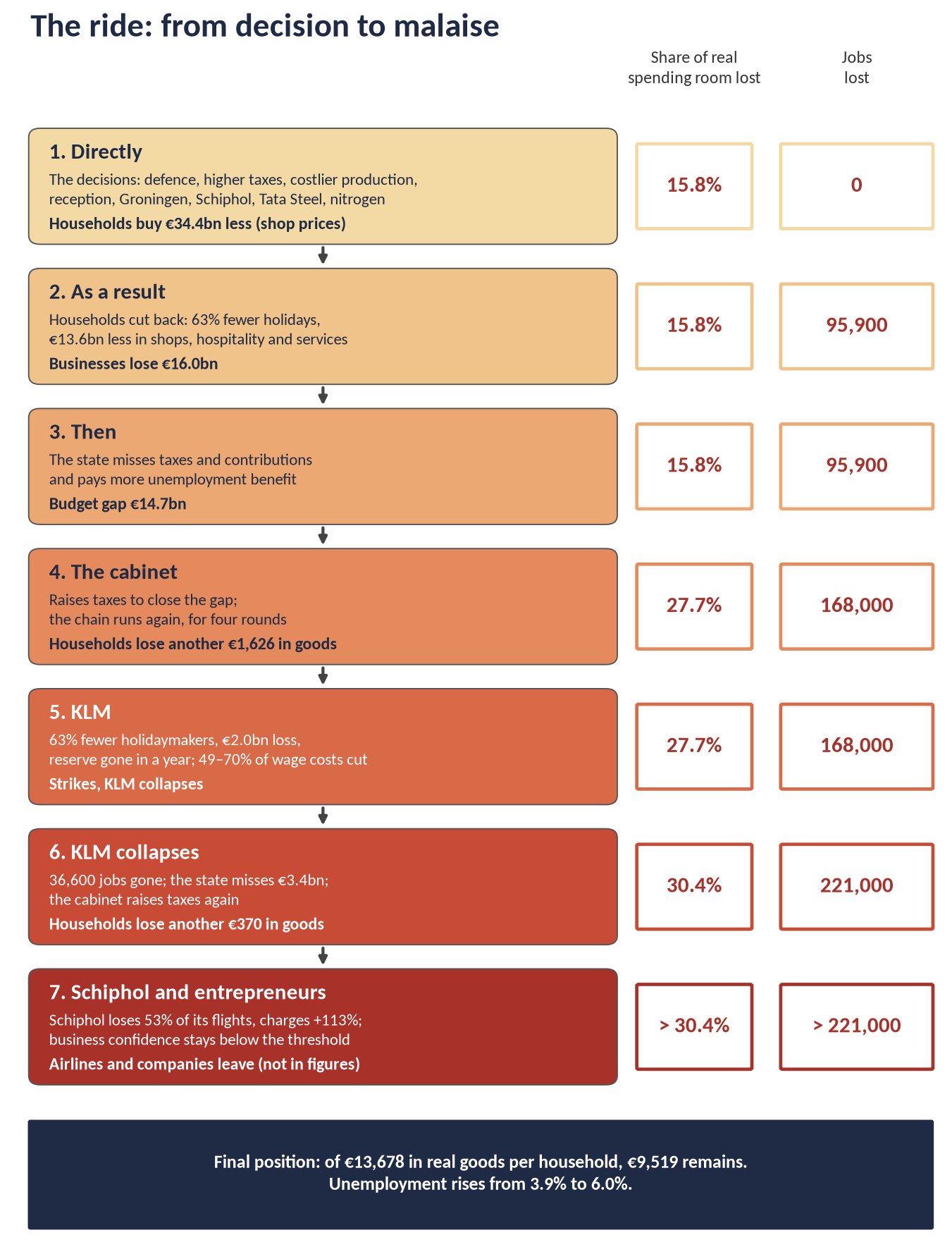
Step 6 was calculated as follows. KLM employs 36,600 people and has €4,124m in staff costs [32]. If KLM disappears, the state misses 43.2% of those labour costs in tax and contributions, €1.8bn, and pays €1.6bn in unemployment benefit (70% of the wage [44]). The cabinet closes that gap of €3.4bn again with taxes, and the chain runs again: €370 in goods per household and another 16,400 jobs. Jobs at Schiphol and at KLM's suppliers are not yet included.
Unemployment rises from 396,000 to about 617,000 people, from 3.9% to 6.0% of the labour force of 10.2 million [52].
| Per average household per year | Real goods |
|---|---|
| Now | €13,678 |
| Lost through the whole ride | −€4,159 |
| What remains | €9,519 |
Each step follows from the previous one. The cabinet sees only step 1. Step 7 can no longer be captured in figures, but it points in one direction: a country that loses its earning base also loses its companies and its people. That is the malaise.
Why the costs keep rising
The ride ends at 30.4%, but it does not stop there. Four things come on top.
Fewer civil servants, but redundancy pay
The cabinet wants to cut the civil service: €900m in 2027, rising to €3.5bn from 2035 [53]. Central government has about 161,000 full-time jobs, 45% more than in 2017 [54]. In 2025 another 2,800 were added, and according to the Netherlands Court of Audit the cut of the previous cabinet did not lead to fewer civil servants [55].
A dismissed central government civil servant receives 70% of his last wage, even above the maximum of the ordinary unemployment benefit, for up to 38 months. Anyone who at dismissal is at most eight years from the state pension age and has ten years of service keeps that 70% until the state pension age [56]. The gross wage is 77% of labour costs, so the redundancy pay is 70% × 77% = 54% of what the civil servant cost. In the first years the state therefore saves at most 46 cents per euro: of the €3.5bn, at most €1.6bn. Former top civil servant Roel Bekker says the same: forced dismissal is expensive and actually costs money within a cabinet term [57].
The CPB considers at most €200m of the €1.4bn this cabinet wants to cut feasible, 14% [54]. The assistant applies that share to the whole €3.5bn: €0.5bn is saved and a gap of €3.0bn remains. That gap is closed with taxes: €356 per household, the state must collect €623, and that costs €331 in goods, 2.4% of the real spending room.
Less to spend requires more civil servants
A smaller spending room does not make the government's work smaller but larger. In the ride, unemployment rises from 396,000 to 617,000 people, 56% more. In 2025 the UWV spent €830m on administering unemployment benefit [58]; 56% more is €465m a year. That costs a household €51 in goods, 0.4%. On top of that comes more work for benefits, debt assistance and their control, and the 15,100 extra people for defence [25]; those amounts have not been calculated because the figures are missing.
The unions ask for more
The FNV demands 5.5% higher wages for 2027 plus €80 a month, including automatic price compensation [59]. The CNV asks for 3 to 5.5% [60]. Central government civil servants already received 2.7% in 2026, after the wage freeze was dropped [61].
In the public sector this costs the taxpayer money directly. In 2024 the government paid €97.5bn in wages and contributions [62]. 5.5% of that is €5.36bn. Of this, 43.2% comes back directly as contributions and wage tax, so net €3.05bn. That is €361 per household; the state must collect €633, and that costs €336 in goods, 2.5%. The €80 a month is not yet included.
In the private sector, 5.5% higher pay is €25.3bn in extra labour costs. Of that, 79.3%, €20.1bn, goes to tax, contributions, pension and the taxes in prices; the worker receives €5.2bn in goods. Even that €5.2bn is worth less, because companies pass the higher labour costs on in their prices. A pay rise is therefore mainly a tax increase for the earner.
To earn back the 30.4% in goods that the ride costs, labour costs would have to rise by 30.4%. The 5.5% now being demanded covers less than a fifth. Every following wage round ends up in prices, in exports and in KLM's tickets, and then more is demanded again.
'Only 44% public debt'
Dutch government debt was 43.7% of GDP in mid-2026 [63]. The European limit is 60%, but Greece is at 143.5%, Italy at 138.9%, France at 117.6%, Belgium at 109.1% and Spain at 101.6% [64], and that is tolerated. That gives unions and parties the argument that there is still room to ask for more.
According to De Nederlandsche Bank, the coalition agreement pushes debt above 60% from 2034 [65]. If the cabinet chooses borrowing in the ride, €14.7bn is added every year: 1.2% of GDP of €1,234bn [66]. Debt is spending room that the children will have to give up later.
| What comes on top | Fewer goods per household | Cumulative share of €13,678 |
|---|---|---|
| The ride, with the collapse of KLM | €4,159 | 30.4% |
| Civil service cut that is not achieved | €331 | 32.8% |
| More unemployment-benefit work at the UWV | €51 | 33.2% |
| 5.5% higher pay in the public sector | €336 | 35.7% |
| Total | €4,877 | 35.7% |
| What remains of €13,678 | €8,801 | 64.3% |
With what is already fixed or on the table, an average household loses €4,877 in goods a year, 35.7% of its real spending room. €8,801 remains. The wage demands in the private sector and the following wage rounds are not yet included.
According to Jacobus van Merksteijn, not informing voters correctly gives the government hopeless outcomes: nobody wants to cooperate any more.
The American blockade of ASML
On top of the cabinet's decisions comes a blow from outside. The United States is preparing a law, the MATCH Act, that would forbid ASML to sell any more DUV immersion machines to China and to service the machines already there. The Netherlands gets 150 days to introduce that ban itself; if it does not, the US will impose it [67]. US Congressman Moolenaar wants the law passed before the end of 2026, and the US is stepping up the pressure despite Jetten's talks with Trump [68], [69]. The dispute over Iran has only postponed the ban [67].
China has prepared for it. By early 2026, Chinese chip factories had an estimated 343 ASML DUV immersion machines in place [70]. An American think tank, the Center for Technology & Statecraft, wants a ban for all of China, with stricter rules on servicing and spare parts [71].
ASML expects 2026 sales of €43 to €45bn, with a gross margin of 54 to 56% [72]. About 20% of sales come from China [73]; in 2025 that was still 29.1%, and outside China demand for DUV machines stayed weak [74]. The assistant therefore assumes that other customers will not fill the gap.
| When | What happens | What it costs ASML |
|---|---|---|
| Until end of 2026 | The law is passed; China buys as much as it still can | Sales stay high |
| Around June 2027 | 150 days later, sales and servicing in China stop | €8.8bn in sales a year gone; half of that in 2027 |
| From 2028 | The full loss, every year | €4.8bn less gross profit, €4.0bn less net profit |
About 60% of ASML's employees work in the Netherlands, more than 25,000 people [75]. If ASML shrinks by a fifth, about 5,000 jobs disappear there. In the expansion in Eindhoven, 20,000 jobs at ASML go with 70,000 jobs in total, suppliers included [76]. At the same ratio, about 17,500 jobs disappear.
For the state this means €0.6bn less wage tax and contributions, €0.8bn less corporate tax, since ASML pays about 17% tax on its profit [77], and €0.75bn more unemployment benefit. Together that is a gap of €2.2bn a year. With the same calculation as for the decisions, the state must raise €452 per household to cover it. That costs an average household €240 in goods a year, 1.75% of its real spending room. Unemployment rises from 6.0% to 6.2%.
The cabinet has just pledged €1.7bn for roads, housing and talent in the Eindhoven region, and the region itself €800m, to let ASML grow in the Netherlands: 20,000 extra jobs at ASML and 45,000 at suppliers within ten years, with 100,000 new homes in the region [78]. According to the assistant, that money has been set aside for growth that largely disappears with the blockade.
China strikes back and catches up
With the blockade, China is gone as an ASML customer in one stroke around 2027. The question then is how quickly China also becomes a competitor for the rest of the world.
Since export controls were tightened, China has put more than $150bn into its own chip equipment [79]. Over about four years that is some $37bn a year, about seven times the €4.7bn ASML spends on research [80]. That amount covers all chip equipment, not only lithography (assistant's calculation). Fifty times ASML's research spending would be €235bn a year, almost five times what China bought in chip equipment in total in 2025, $49.3bn [81]. China's third chip fund, Big Fund III, has $47.5bn [82].
Where China stands now:
The state manufacturer Shanghai Aishengna is making about 5 of its own DUV immersion machines this year and wants to make 20 in 2027; ASML delivers about 130 a year. Many critical components still come from Japan [83].
Less than 5% of the lithography in China is domestic; for 2030, 10% is the optimistic expectation [84].
Of all chip equipment in China, 35% is domestic. New factories must use half domestic equipment, and the target is 70% in 2027 [85].
The Chinese EUV prototypes reach 100 to 150 watts; ASML reached 250 watts back in 2017 and is now at 600 watts [79].
Chinese sources cite 2030 for the first working chips made with a domestic EUV machine; Western intelligence services expect 2032 to 2035 [79]. Another forecast expects world-class Chinese DUV machines in the mid-2030s and EUV at the end of the 2030s [82]. For the Chinese market, ASML is therefore gone around 2027; for the rest of the world, China becomes a competitor in the 2030s.
China can also strike back. It already uses its grip on rare earths as leverage: on 4 October 2026 it blacklisted American processors, and US imports of magnets from China fell by 21% in August [86]. According to the assistant, such metals and magnets are also in the machines ASML supplies to the rest of the world. What a Chinese countermeasure against the Netherlands would cost has not been calculated.
An ant on a world scale
The Netherlands accounts for 1.13% of the world economy [87]; measured by what money can buy, 0.72% [88]. So decisions about ASML are not made in The Hague, but in Washington and Beijing. Washington decides whom ASML may supply; Beijing decides how quickly it learns to build for itself and how it retaliates. The Netherlands only decides what it does itself with its levies, its rules and its earning base.
| Period | What happens | Real spending room lost |
|---|---|---|
| 2021 to now | The real economy (NEPK) falls from 3.25% to 2.87% of GDP | — |
| 2026–2027 | Cabinet decisions with second and third order, fall of KLM, severance pay, wage demands | 35.7% |
| From mid-2027 | ASML loses China; Schiphol renews less | 37.7% |
| 2030s | Chinese DUV machines reach the world market | Cannot be calculated |
The last row is the most dangerous. The other blows come from Dutch decisions and can be reversed; this one comes from outside and cannot be reversed.
Schiphol capped: no growth, but less renewal
Schiphol is not allowed to grow. The cabinet keeps the cap at 478,000 flights a year, 4% fewer than the earlier 499,000, and wants 10% fewer night flights [89]. CDA and D66 will take no step towards growth in this cabinet period [90].
Schiphol wants to invest €10bn between 2025 and 2035, not in expansion but in renewal and overdue maintenance [91], [92]. To pay for it, charges are going up [93]. In the first half of 2026 Schiphol invested €801m, of which €317m was a one-off for relocating KLM buildings [91]. Without that one-off item, that is about €1.0bn a year.
If KLM disappears, Schiphol cannot absorb that with more flights, because it is not allowed to grow. The only choice left is between even higher charges and less renewal. Higher charges drive away the remaining airlines; the assistant therefore assumes that renewal comes to a halt.
| What disappears in construction | Per year |
|---|---|
| Less construction output: 1.0% of €97bn [94] | −€1.0bn |
| Construction jobs, at 522,000 workers [95] | −5,400 |
| Budget gap: missed taxes and contributions plus extra unemployment benefit | €0.42bn |
| What the state must raise per household | €87 |
| Fewer goods per household | €46 |
| Share of €13,678 | 0.34% |
Comparable examples at home and abroad
What is calculated here has happened before. Each time it involved a country that leaned on one company or one sector.
Fokker, 1996
In 1987 the state helped Fokker with 212 million guilders, for fear of losing eight thousand jobs [96]. In 1996 Fokker went bankrupt anyway: of the 5,664 employees, fewer than 1,000 found a place in the units that remained; about 4,700 jobs were lost, the biggest layoff in Dutch history [97]. The blow crossed the border: at Shorts in Belfast, which made the wings, 700 people lost their work, and at Daimler-Benz Aerospace in Germany 1,200 jobs were at risk [97].
Lesson: state aid kept Fokker going for nine more years, but did not save it.
Sabena, 2001
When Sabena went bankrupt in November 2001, about 7,300 people lost their jobs [98]. Zaventem lost almost half its flights in one stroke [99]. Passenger numbers fell by more than 26% between 2001 and 2002, and direct employment at the airport dropped in one year from 26,784 to just under 21,000 jobs [100]. In 2000 more than 21 million people travelled through Zaventem; years later it was not even 15 million [99].
Lesson for Schiphol: if the home carrier disappears, more than a quarter of the passengers and a fifth of the jobs at the airport vanish within a year.
Swissair, 2001
On 2 October 2001, about 260 Swissair aircraft stayed on the ground because there was no more money for fuel; 19,000 passengers were stranded [101], [102]. With 25,000 employees, Zurich airport was the largest employer in the region, and a committee spoke of 100,000 livelihoods affected directly or indirectly [101]. 17 billion francs of shareholder value was lost, the biggest bankruptcy in Swiss history [103]. The federal government eventually lent 1.45 billion francs [102].
Lesson: even a rich country that takes its own decisions could not save its home carrier once the money had run out.
Nokia and Finland, 2008–2014
In 2000 Nokia was 4% of the Finnish economy, 21% of exports and 14% of corporate tax; later it was only 0.4% of the economy [104]. Phone exports fell from €6.9bn in 2007 to €0.9bn in 2012 [105]. The direct decline was about 2.5% of GDP, and more with the knock-on effects [106]. Nokia explains a third of the fall in Finnish GDP and a fifth of the job losses; the Finnish economy shrank by 1.4%, 0.8% and 0.7% in 2012, 2013 and 2014 [107].
Lesson for ASML: when one company carries a large share of exports and taxes, its fall drags the whole economy down with it, for years.
The German solar industry, 2011–2012
In 2011 more than 150,000 people worked in the German solar industry; 100,000 jobs were lost, and China now makes 90% of all solar panels in the world [108]. In 2008 China made 33% of solar cells, in 2011 already 57% [109]. The solar cell maker Q-Cells went bankrupt in April 2012 [109].
Lesson: China took over in three years a market that Germany led. The pace at which China learns is the pace that counts.
Nikon and Canon versus ASML
In 1995 Nikon and Canon together had 77.6% of the lithography market; ASML had 15.9% [110]. In 2002 ASML went in one year from 28.8% to 54.3%, and Nikon from 39.4% to 27.5% [111]. In 2006 ASML had more than 60%, in 2010 more than 80% and in 2021 95% [110].
Lesson: ASML is itself the proof that a market leader can be overtaken in about ten years. What ASML did to Nikon, China can do to ASML.
The new sum
| What is added | Fewer goods per household | Cumulative share of €13,678 |
|---|---|---|
| What is already fixed or on the table | €4,877 | 35.7% |
| American blockade of ASML | €240 | 37.4% |
| Schiphol renews less: less construction | €46 | 37.7% |
| Total | €5,163 | 37.7% |
| What remains of €13,678 | €8,515 | 62.3% |
With the blockade of ASML and a Schiphol that renews less, an average household loses €5,163 in goods a year, 37.7% of its real spending room. €8,515 remains. Another 22,900 jobs disappear.
What has not yet been calculated
There are more consequences that the assistant cannot calculate because the figures are missing:
the hotels, restaurants, logistics and suppliers around Schiphol and Lelystad;
the housing market and the facilities in the Eindhoven region if ASML's growth stops;
the value of the pension funds if ASML's share price falls;
China's countermeasures, including rare earths;
the part of the real economy (the NEPK) that depends on ASML; the Dutch ownership share needed for this is missing.
Each of these items makes the deficit bigger and sends the chain round again. The 37.7% is therefore a lower limit.
Why entrepreneurs leave
An entrepreneur does not leave when things have already gone that far, but as soon as he sees that policy works out badly in the second and third order.
This has been measured. When the CBS business confidence indicator falls below average, investment stops growing half a year later; above it, investment grows by an average of 9% a year [112], [113]. Of the last nineteen quarters, confidence was below it fifteen times. As a result, about €17.8bn a year in investment is left undone (assistant's calculation).
It can also be seen in what companies do:
Shell stopped building a biofuels plant in Rotterdam because the project was 'insufficiently competitive' [114], and is selling its onshore solar and wind farms [115].
Little is left of the hydrogen plans in the northern Netherlands; in the whole country one small hydrogen plant is under construction [116], [117].
Dow is cutting 605 of its 2,800 jobs in the Netherlands because of energy costs and regulation [118], [119]. Sabic is selling its European chemicals business [120]. At Chemelot, Fibrant closed three of its seven plants [121].
These decisions were taken before the official figures showed the decline. What matters is not what the cabinet says, but the consequences of what it does.
Why the cabinet does not see this
The CPB assesses plans on the budget balance, purchasing power and employment for the next four years [122]. In the language of engineering, that is the P of a PID controller: the deviation of now. What the CPB does not calculate:
the I: the damage that accumulates over the years, such as the closed companies and the lost export income;
the D: the pace at which the earning base crumbles;
the second order: what a decision does to suppliers, processors and carriers;
the third order: what then happens to tax revenue, regions, confidence and investment.
That the second and third order are not calculated is deliberate policy. Cabinets and ministries decide which questions the CPB receives, and choose to leave those consequences outside the assignment. Whoever does not draw up the bill does not have to account for it either.
Voters reinforce this. They reward a government mainly on their income in the months just before the elections [123], and they reward help after a disaster, but not its prevention [124]. Politicians feed this with purchasing-power charts; the entrepreneur sees the consequences and leaves. Jacobus van Merksteijn sums it up as: 'Undermining the economy together is the motto.'
This form of government worked as long as the economy grew and the Groningen gas covered the mistakes. Now that the earning base is shrinking, it breaks that base down.
Beneath this, Jacobus van Merksteijn sees a Dutch thought pattern: 'as long as I come out well' and 'after me, the flood', and a narcissism that has grown through dismissal protection as envy of 'the rich'. In his view, that is what will break the Netherlands and Europe, and they will not make it with the base that this article lays bare.
What has to change
The proposals are the assistant's.
Growth in two columns. From now on, CBS publishes growth separately as earned (production) and as spent (government spending, subsidies and compensation schemes).
A PID controller in law. Every year it is measured how far the real economy (the NEPK) is below target (P), how much damage has built up (I) and how fast it is getting worse (D). From this follows what must be corrected in the same year, without borrowing. With the current backlog that is about €13bn a year; after this cabinet's decisions about €19bn (assistant's worked example).
For every law, a twenty-year assessment in advance, including the second and third order, and what it costs an average household as a share of its real spending room. Parliament votes only once it is public.
Accounting afterwards. After five and ten years, the assessment is compared with reality, with the names of those who made it.
Every payslip shows what the employer really pays, and how much of it the worker keeps freely.
Calculation appendix
All calculations were made by the assistant with fixed scripts that give the same results with the same input.
| Input | Value | Source |
|---|---|---|
| Private households | 8,430,352 | [2] |
| Labour costs 2025; gross wages; employer contributions | €557.3; €429.9; €129.5bn | [3] |
| Real goods from an extra euro earned | 20.7% | calculation, table 79% |
| Real spending room per household | €557.3bn × 20.7% / 8,430,352 = €13,678 | calculation |
| Goods per euro of extra tax | €0.53 (= 20.7 / 39) | calculation |
| Imports from China for Dutch spending | €14.55bn | [39], [40] |
| Cost difference Europe–China | 30% (sources: 15% to 40%) | [38], [37], [125] |
| A loss feels heavier than a gain | 2 times (average of 607 measurements) | [27] |
| Fewer holiday flights per percent less room | 2% | [43] |
| KLM: passenger revenue; holiday share; operating result | €9,414m; 65%; €416m | [32], [49] |
| KLM: cash from operations; shortfall after investment; reserve | €1,179m; −€418m; €3.0bn | [32] |
| NEPK | 2.87% of GDP (€1,170.6bn [47]) | assistant's calculation |
| ASML: sales 2026; China share; gross margin | €44bn; 20%; 55% | [72], [73] |
| ASML: tax on profit; employees in the Netherlands | 17%; 25,000 | [77], [75] |
| Total jobs per job at ASML | 70,000 / 20,000 = 3.5 | [76] |
| Schiphol: renewal per year; construction output; construction workers | €1.0bn; €97bn; 522,000 | [91], [94], [95] |
| Formula | Used for |
|---|---|
| Cost per household = amount / 8,430,352 | All decisions |
| What the state must collect = cost × 1 / (1 − 0.429) = cost × 1.75 | All decisions |
| Fewer goods = what the state collects × 0.53; share = fewer goods / €13,678 | All decisions |
| Dutch share of a euro = 1 − €256.7bn / €956bn = 73% | Second order |
| Each following round = gap / less to spend = €14.7 / €34.4 = 43%; final position = first order / (1 − 0.43) | Second and third order |
| KLM loss = €9,414m × 65% × 63.4% × 63% | KLM |
| KLM wage cut = loss / €4,124m staff costs | KLM |
| Price shock = €14.55bn × 30% | European production |
| Jobs = less value added × 47.6% / €79,600 | Second order |
| Gap = labour costs × 43.2% + less spending × 18.5% + corporate tax + jobs × 70% × €61,400 | Third order |
| Fewer flights = 2 × 2 × 15.8% | KLM |
| KLM revenue loss = €9,414m × 65% × fewer flights | KLM |
| Redundancy pay = 70% × 77% of labour costs = 54%; saving in first years ≤ 46% | Civil servants |
| Civil service gap = €3.5bn × (1 − €0.2 / €1.4bn) | Civil servants |
| Extra UWV = €830m × 56% | UWV |
| Public sector wages net = €97.5bn × 5.5% × (1 − 43.2%) | Unions |
| ASML sales lost = €44bn × 20% = €8.8bn; gross profit lost = €8.8bn × 55% = €4.8bn | ASML |
| Corporate tax lost = €4.8bn × 17% = €0.8bn; net profit lost = €4.8 − €0.8 = €4.0bn | ASML |
| Jobs = 25,000 × 20% × 3.5 = 17,500 | ASML |
| ASML gap = 17,500 × €79,600 × 43.2% + €0.8bn + 17,500 × 70% × €61,400 = €2.2bn | ASML |
| Construction jobs = €1.0bn / (€97bn / 522,000) = 5,400 | Schiphol |
| Construction gap = 5,400 × €79,600 × 43.2% + 5,400 × 70% × €61,400 = €0.42bn | Schiphol |
| China investment per year = $150bn / 4 years = $37bn ≈ 7 × €4.7bn | China |
| NEPK = exports × industry share × (1 − tax burden) × domestic ownership | Real economy |
Sources
[1] CBS, Economie groeit met 0,4 procent in tweede kwartaal 2026: https://www.cbs.nl/nl-nl/nieuws/2026/31/economie-groeit-met-0-4-procent-in-tweede-kwartaal-2026
[2] CBS, Huishoudens; typering naar grootte (70133ned): https://www.cbs.nl/nl-nl/cijfers/detail/70133ned
[3] CBS, Beloning en arbeidsvolume van werknemers (85919NED): https://www.cbs.nl/nl-nl/cijfers/detail/85919NED
[4] Reformatorisch Dagblad, Dit zijn de defensieplannen van het kabinet: https://www.rd.nl/artikel/vele-miljarden-extra-dit-zijn-de-defensieplannen-van-het-kabinet
[5] Raad van State, advies Miljoenennota 2027: https://www.rijksfinancien.nl/sites/default/files/bestanden/Advies-Raad-van-State-Miljoenennota-2027-en-Septemberrapportage.pdf
[6] Metro, Opvang asielzoekers kostte vorig jaar 3,7 miljard euro: https://www.metronieuws.nl/in-het-nieuws/binnenland/2026/08/opvang-asielzoekers-kostte-vorig-jaar-3-7-miljard-euro/
[7] Officiële Bekendmakingen, Raming schadeafhandeling en versterking t/m 2031: https://zoek.officielebekendmakingen.nl/blg-1242698.pdf
[8] Royal Schiphol Group, persbericht jaarcijfers 2025 (AFM-register): https://www.afm.nl/downloadregisterfile.aspx?type=openbaarmaking-voorwetenschap&enc=7Rpj0BBaMD5lzfwUlyQ9TIe+XbKYS1JE7+GVfXY2PxNqAT3NVNKp3QCQcI2WUb5gS/PYmhvg5EA+E7FpgiengZj0NLAMUDbP/oPnUtKH27VA0/CZGu7E4hLGdYYwwWpdTyp/cuqK9u2A7er37RJifIgIQgJPUx0rX+idELnNZwnCQvW4DIjhG+Y0dnrGGDKEsdcM13qnsOtKrRBeT0QMcrGUMVIl+vkhduSYQV1kWu1/PTMVluYh/rZepIJyTBPC92zS/gj2vU8gYmMZhk7m+O7tX/ixYVA3QZ9n15glOSo=
[9] Tweede Kamer, Antwoorden over de intentieverklaring met Tata Steel: https://www.tweedekamer.nl/downloads/document?id=2026D05323
[10] WUR, Staat van Landbouw, Visserij, Voedsel en Natuur 2024: https://edepot.wur.nl/677360
[11] CBS, Landbouw; gewassen, dieren en grondgebruik naar gemeente (80781NED): https://www.cbs.nl/nl-nl/cijfers/detail/80781NED
[12] Tweede Kamer, Vragen en antwoorden 22e voortgangsrapportage hersteloperatie toeslagen: https://www.tweedekamer.nl/downloads/document?id=2026D12437
[13] ESB, De stikstofcrisis oplossen met uitkoop werkt niet: https://esb.nu/wp-content/uploads/2026/06/D-000-000_MI_Mulder.pdf
[14] Tax Foundation, Tax Burden on Labor in Europe 2026 (OESO Taxing Wages): https://taxfoundation.org/data/all/eu/tax-burden-on-labor-europe/
[15] OESO, Non-tax compulsory payments as an additional burden on labour income: https://www.oecd.org/content/dam/oecd/en/topics/policy-issues/tax-policy/non-tax-compulsory-payments.pdf
[16] CPB via Eerste Kamer, Raming nominale zorgpremieopbrengst 2025: https://www.eerstekamer.nl/overig/20230411/beantwoording_vragen_cpb_inzake/document
[17] Zorginstituut Nederland, Normbedragen risicoverevening 2025 (raming eigen risico €3.395,2 mln): https://www.zorginstituutnederland.nl/site/binaries/site-content/collections/documents/2024/10/10/wor-1222-definitieve-rapportage-normbedragen-rv-2025/WOR+1222+-+Definitieve+rapportage+Normbedragen+RV+2025.PDF
[18] COELO via VNG, Lokale lasten 2025: https://vng.nl/nieuws/stijging-lokale-lasten-in-2025-lager-dan-vorig-jaar
[19] Tweede Kamer, Antwoorden over de opbrengst van box 3: https://www.tweedekamer.nl/downloads/document?id=2025D08309
[20] Ministerie van Financiën, Financieel jaarverslag van het Rijk 2025: https://www.rijksfinancien.nl/financieel-jaarverslag/2025
[21] Europese Commissie, Taxation Trends, tabel 79: impliciet tarief consumptie: https://taxation-customs.ec.europa.eu/document/download/73ab0a07-7577-415d-87ab-8d18208f7fd5_fr
[22] PwC, De totale belastingbijdrage van het Nederlandse bedrijfsleven in 2025: https://www.pwc.nl/nl/actueel-publicaties/assets/pdfs/de-totale-belastingbijdrage-van-het-nederlandse-bedrijfsleven-in-2025.pdf
[23] MKB-Nederland, Regeldruk ondernemers stijgt schrikbarend: https://www.mkb.nl/artikelen/onderzoek-mkb-nederland-regeldruk-ondernemers-stijgt-schrikbarend
[24] NRC, Kabinet legt afgesproken miljarden voor Defensie vast: https://www.nrc.nl/nieuws/2026/09/11/kabinet-legt-afgesproken-miljarden-voor-defensie-in-komende-jaren-vast-a4936433
[25] ESB, Samenstelling defensie-inkoop bepaalt druk op arbeidsmarkt: https://esb.nu/samenstelling-defensie-inkoop-bepaalt-druk-op-arbeidsmarkt/
[26] Tweede Kamer, Antwoorden Beleidsagenda Buitenlandse Handel: bestemmingsverdeling van de invoer 2023: https://www.tweedekamer.nl/downloads/document?id=2025D45444
[27] Brown, Imai, Vieider en Camerer, Meta-analysis of Empirical Estimates of Loss Aversion, Journal of Economic Literature 2024 (gemiddelde 1,955): https://www.aeaweb.org/articles?id=10.1257/jel.20221698
[28] Officiële Bekendmakingen, Antwoorden begroting Asiel en Migratie: https://zoek.officielebekendmakingen.nl/blg-1245788.pdf
[29] FD, Gaswinning in Groningen leverde €428 mrd op: https://fd.nl/economie/1446676/gaswinning-in-groningen-leverde-428-mrd-op
[30] CBS, De invloed van aardgaswinning: https://www.cbs.nl/-/media/imported/documents/2015/49/2015dne06-de-invloed-van-aardgaswinning.pdf?sc_lang=nl-nl
[31] Tweede Kamer, Kamerstuk over beëindiging gaswinning Groningenveld: https://zoek.officielebekendmakingen.nl/ah-tk-20242025-2736.pdf
[32] KLM, Annual Report 2025: https://www.klmannualreport.com/wp-content/uploads/2026/03/KLM-Annual-Report-2025-download.pdf
[33] Wikipedia, Luchthaven Schiphol (vliegbewegingen per maatschappij 2025): https://nl.wikipedia.org/wiki/Luchthaven_Schiphol
[34] Milieudefensie en SOMO, Factsheet subsidiefuik Tata Steel: https://milieudefensie.nl/actueel/factsheet-onderzoek-subsidiefuik-tsn/@@download/file/Factsheet%20Onderzoek%20Subsidiefuik%20TSN.pdf
[35] NRC, Uitkoop van veehouderijen levert minder stikstofwinst op dan verwacht: https://www.nrc.nl/nieuws/2026/01/08/uitkoop-van-veehouderijen-levert-minder-stikstofwinst-op-dan-verwacht-veel-boeren-trekken-zich-terug-a4917169
[36] Eurostat, Trade in goods with China in 2025: https://ec.europa.eu/eurostat/web/products-eurostat-news/w/ddn-20260410-2
[37] IMF, World Economic Outlook oktober 2025, hoofdstuk 3: Industrial Policy: https://www.imf.org/-/media/files/publications/weo/2025/october/english/ch3.pdf
[38] BBH, The great fracturing: from globalization to regionalization: https://www.bbh.com/us/en/insights/capital-partners-insights/the-great-fracturing-from-globalization-to-regionalization.html
[39] Ondernemersplein (Rijksoverheid), Landeninformatie China: https://ondernemersplein.overheid.nl/landeninformatie/china/
[40] CBS, Aandeel van China in goederenimport verder toegenomen in 2021: https://www.cbs.nl/nl-nl/nieuws/2022/46/aandeel-van-china-in-goederenimport-verder-toegenomen-in-2021
[41] Markteffect via MarketingReport, Nederlanders besparen opnieuw het meest in de supermarkt (november 2025): https://marketingreport.nl/nederlanders-besparen-opnieuw-het-meest-in-de-supermarkt
[42] CBS, Vakanties van Nederlanders; kerncijfers 2025 (85302NED): https://www.cbs.nl/nl-nl/cijfers/detail/85302NED
[43] CE Delft, Price elasticities in aviation and marine shipping: https://cedelft.eu/publications/price-elasticities-in-aviation-and-marine-shipping-literature-study/
[44] UWV, Hoogte WW-uitkering: https://www.uwv.nl/nl/ww/hoogte-ww
[45] CBS, Wat zijn de nationale rekeningen? (nationale bestedingen 2025): https://www.cbs.nl/nl-nl/economie/macro-economie/wat-zijn-de-nationale-rekeningen-
[46] CBS, Hoe groot is de Nederlandse economie? (bbp 2023): https://longreads.cbs.nl/nederland-in-cijfers-2024/hoe-groot-is-de-nederlandse-economie/
[47] Eurostat, GDP and main components (nama_10_gdp): https://ec.europa.eu/eurostat/databrowser/view/nama_10_gdp/default/table
[48] Royal Schiphol Group, Traffic review 2025 (36,6% transferpassagiers): https://www.schipholannualtrafficreview.nl/2025/files/1.pdf
[49] TravMagazine, Vakantieganger belangrijker voor Schiphol dan gedacht (SEO/ANVR): https://www.travmagazine.nl/vakantieganger-belangrijker-voor-schiphol-dan-gedacht/
[50] KLM, Eerste Airbus A350 voor KLM aangekomen op Schiphol (€7 mrd vlootvernieuwing): https://nieuws.klm.com/eerste-airbus-a350-voor-klm-aangekomen-op-schiphol/
[51] Vlieghinder.nl, Vakantievluchten van levensbelang voor Schiphol (SEO/ANVR): https://www.vlieghinder.nl/nieuws/artikel/vakantievluchten-van-levensbelang-voor-schiphol
[52] CBS, Arbeidsdeelname 2025 (86047NED): https://www.cbs.nl/nl-nl/cijfers/detail/86047NED
[53] Rijksoverheid, Een sterke democratie met meer betaalbare woningen (Miljoenennota 2027, 15 september 2026): https://www.rijksoverheid.nl/actueel/nieuws/2026/09/15/een-sterke-democratie-met-meer-betaalbare-woningen
[54] NRC, Het moet kunnen met minder ambtenaren (17 april 2026): https://www.nrc.nl/nieuws/2026/04/17/het-moet-kunnen-met-minder-ambtenaren-a4925780
[55] NRC, Externe inhuur overheid gedaald, maar nog altijd groeide het aantal ambtenaren (20 mei 2026): https://www.nrc.nl/nieuws/2026/05/20/externe-inhuur-overheid-na-jaren-stijging-gedaald-maar-nog-altijd-groeide-het-aantal-ambtenaren-a4928162
[56] CAO Rijk, Uitleg cao-partijen: aanvulling op WW-uitkering bij einde dienstverband: https://www.caorijk.nl/cao-rijk/5.-uitleg-van-cao-partijen/uitleg/uitleg-aanvulling-op-ww-uitkering-bij-einde-dienstverband
[57] WNL, Oud-topambtenaar: geplande miljardenbezuinigingen op rijksdienst onhaalbaar (4 september 2026): https://wnl.tv/2026/09/04/oud-topambtenaar-noemt-geplande-miljardenbezuinigingen-op-rijksdienst-onhaalbaar
[58] UWV, Jaarverslag 2025: toelichting op de staat van baten en lasten: https://jaarverslag.uwv.nl/jaarverslag-2025/jaarverslag/jaarrekening/toelichting-op-de-staat-van-baten-en-lasten
[59] FNV, Looneis en arbeidsvoorwaardenagenda: 5,5% + €80 erbij (september 2026): https://www.fnv.nl/nieuwsbericht/algemeen-nieuws/2026/09/looneis-en-arbeidsvoorwaardenagenda-fnv
[60] NOS, Vakbond CNV wil tot 5,5 procent meer loon (11 september 2026): https://nos.nl/artikel/2630545-vakbond-cnv-wil-tot-5-5-procent-meer-loon-en-hogere-reiskostenvergoeding
[61] Rijksoverheid, 2,7% loonstijging voor rijksambtenaren in 2026: https://www.rijksoverheid.nl/actueel/nieuws/2026/04/30/27-loonstijging-voor-rijksambtenaren-in-2026
[62] CBS, Uitgaven overheid richting 500 miljard euro (beloning werknemers 2024): https://www.cbs.nl/nl-nl/longread/diversen/2025/overheidstekort-toegenomen-in-2024-schuld-relatief-laag/3-uitgaven-overheid-richting-500-miljard-euro
[63] CBS, Overheid kwam 8 miljard euro tekort in eerste helft van 2026: https://www.cbs.nl/nl-nl/nieuws/2026/39/overheid-kwam-8-miljard-euro-tekort-in-eerste-helft-van-2026
[64] Eurostat, Government debt at 88.9% of GDP in euro area (eerste kwartaal 2026): https://ec.europa.eu/eurostat/web/products-euro-indicators/w/2-21072026-ap
[65] De Nederlandsche Bank, Overheidsfinanciën: https://www.dnb.nl/actuele-economische-vraagstukken/overheidsfinancien/
[66] Ministerie van Financiën, Bijlagen bij Miljoenennota 2026 (bbp 2026): https://www.rijksfinancien.nl/miljoenennota/2026/bijlage
[67] Newsbit, Ruzie over Iran redt ASML van Amerikaans chipverbod, voorlopig: https://newsbit.nl/ruzie-over-iran-redt-asml-van-amerikaans-chipverbod-voorlopig/
[68] Newsbit, VS voeren druk op ASML op ondanks gesprekken Jetten met Trump: https://newsbit.nl/vs-voeren-druk-op-asml-op-ondanks-gesprekken-jetten-met-trump/
[69] NL Times, US preparing to force Netherlands to ban ASML selling to China (20 augustus 2026): https://nltimes.nl/2026/08/20/us-preparing-force-netherlands-ban-asml-selling-china
[70] South China Morning Post, China stockpiles ASML lithography tools, spurring US calls for complete export ban (2 oktober 2026): https://www.scmp.com/tech/tech-war/article/3369557/china-stockpiles-asml-lithography-tools-spurring-us-calls-complete-export-ban
[71] High-Tech Systems Magazine, Amerikaans rapport: volledig exportverbod duv-immersiesystemen naar China: https://hightechsystems.nl/artikel/amerikaans-rapport-volledig-exportverbod-duv-immersiesystemen-naar-china/
[72] ASML, Q2 2026 financial results (verwachting 2026: €43–45 mrd omzet, brutomarge 54–56%): https://investor.asml.com/news-releases/news-release-details/q2-2026-financial-results
[73] ASML, Transcript investor call Q2 2026 (aandeel China): https://ourbrand.asml.com/asset/1fd3908a-0381-47b5-9b69-a3094f656651/2026_07_15-ASML-Transcript-investor-call-Q2-2026.pdf
[74] ASML, Jaarverslag 2025, financiële resultaten (China 29,1% van de omzet): https://ourbrand.asml.com/m/419103cb23dfeaa4/original/asml-2025-annual-report-financial-performance-section.pdf
[75] Rabobank, Chips: de onzichtbare motor achter de Nederlandse economie: https://www.rabobank.nl/kennis/d011517432-chips-de-onzichtbare-motor-achter-de-nederlandse-economie
[76] Stadszaken, Groen licht voor uitbreiding ASML op Brainport Industries Campus: https://stadszaken.nl/artikel/6259/groen-licht-uitbreiding-asml-op-brainport-industries-campus
[77] ASML, Jaarverslag 2025, strategisch deel (belasting op de winst ongeveer 17%): https://ourbrand.asml.com/m/8ab959d4926657b/original/asml-2025-annual-report-strategic-report-section.pdf
[78] Businesswise, Operatie Beethoven: zo bleef ASML dan toch in Nederland: https://www.businesswise.nl/strategie/asml-blijft-in-nederland-operatie-beethoven-brainport~62e1245
[79] Foreign Affairs Forum, The Silicon Chokepoint: ASML, China, and the Geopolitics of the World's Most Important Machine (6 juli 2026): https://www.faf.ae/home/2026/7/6/the-silicon-chokepoint-asml-china-and-the-geopolitics-of-the-worlds-most-important-machine
[80] ASML, Jaarverslagen (omzet 2025, medewerkers, toeleveranciers, onderzoek): https://investor.asml.com/annual-reports
[81] Meticulous Research, China Semiconductor Equipment Market 2026–2036 (SEMI: $49,3 mrd in 2025): https://www.meticulousresearch.com/product/china-semiconductor-equipment-market-6952
[82] AI Futures, A forecast of Chinese DUV and EUV: https://blog.aifutures.org/p/a-forecast-of-chinese-duv-and-euv
[83] Tom's Hardware, Chinese chipmaking tool roadmaps examined (4 augustus 2026): https://www.tomshardware.com/tech-industry/semiconductors/chinese-chipmaking-tool-roadmap-examined
[84] Faxian Gongchang, China semiconductor equipment 2026: https://faxiangongchang.com/en/reports/china-semiconductor-equipment-2026
[85] Tech Times, China chip equipment hits 35%; vacuum valves and RF power remain 80% foreign (29 augustus 2026): https://www.techtimes.com/articles/325956/20260829/china-chip-equipment-hits-35-vacuum-valves-rf-power-remain-80-foreign.htm
[86] East Asia Brief, Export controls tracker (oktober 2026): https://eastasiabrief.com/tracker/export-controls
[87] Worldometers, bbp per land 2026 (IMF, nominaal): https://www.worldometers.info/nl/bbp/bbp-per-land/?source=imf®ion=worldwide&year=2026&metric=nominal
[88] IMF, World Economic Outlook DataMapper, aandeel in de wereldeconomie naar koopkracht: https://www.imf.org/external/datamapper/PPPSH@WEO/EU/IND/BRA/RUS/ZAF
[89] NL Times, Cabinet ready to slash Schiphol flights 4 pct, overnight flights 10 pct (30 september 2026): https://nltimes.nl/2026/09/30/cabinet-ready-slash-schiphol-flights-4-pct-overnight-flights-10-pct
[90] NU.nl, CDA en D66: deze kabinetsperiode geen eerste stap naar groei Schiphol: https://www.nu.nl/politiek/6411442/cda-en-d66-deze-kabinetsperiode-geen-eerste-stap-naar-groei-schiphol.html
[91] Royal Schiphol Group, Schiphol in eerste halfjaar 2026 recordbedrag aan investeringen in kwaliteit: https://nieuws.schiphol.nl/schiphol-in-eerste-halfjaar-2026-recordbedrag-aan-investeringen-in-kwaliteit-verstilling-zet-verder-door/
[92] Royal Schiphol Group, Schiphol zoekt vaste bouwpartners voor onderhoud en vernieuwing luchthaven: https://nieuws.schiphol.nl/schiphol-zoekt-vaste-bouwpartners-voor-onderhoud-en-vernieuwing-luchthaven/
[93] Upday, 10 miljard euro investering: Schiphol zegt vaarwel aan goedkoop beleid: https://www.upday.com/nl/binnenland/10-miljard-euro-investering-schiphol-zegt-vaarwel-aan-goedkoop-beleid/wm5rssj
[94] EIB, Verwachtingen bouwproductie en werkgelegenheid 2025: https://www.eib.nl/publicaties/verwachtingen-bouwproductie-en-werkgelegenheid-2025/
[95] Techniek Nederland, Monitor bouwketen najaar 2025: https://www.technieknederland.nl/media/mwgbn1ye/monitor-bouwketen-najaar-2025-definitief-2.pdf
[96] Historisch Nieuwsblad, De trage crash van Fokker: https://www.historischnieuwsblad.nl/de-trage-crash-van-fokker/
[97] The New York Times / International Herald Tribune, Fokker declares 3 units bankrupt; 4,700 jobs to go (16 maart 1996): https://www.nytimes.com/1996/03/16/IHT-fokker-declares-3-units-bankrupt-4700-jobs-to-go.html
[98] Knack, Twintig jaar geleden viel het doek over Sabena: https://www.knack.be/nieuws/twintig-jaar-geleden-viel-doek-over-sabena/
[99] Knack, De wonden van Zaventem: https://www.knack.be/magazine/de-wonden-van-zaventem/
[100] Vlaamse overheid, studie economisch belang luchthaven Zaventem: https://publicaties.vlaanderen.be/view-file/34259
[101] NZZ, Grounding am 2. Oktober 2001: der letzte Tag der stolzen Swissair: https://www.nzz.ch/zuerich/grounding-am-2-oktober-2001-der-letzte-tag-der-stolzen-swissair-ld.10024395
[102] Blick, Die Chronologie: vor 25 Jahren kam es zum Swissair-Grounding: https://www.blick.ch/life/wissen/geschichte/die-chronologie-vor-25-jahren-kam-es-zum-swissair-grounding/1x0ee43
[103] NZZ, Swissair's last CEO Mario Corti breaks his silence: https://www.nzz.ch/english/swissairs-last-ceo-mario-corti-breaks-his-silence-ld.1648788
[104] Wired, Finland and Nokia: an affair to remember: https://www.wired.com/story/finland-and-nokia/
[105] BSI Economics, Finland at the heart of both a structural and cyclical crisis: https://bsi-economics.org/finland-at-the-heart-of-both-a-structural-and-cyclical-crisis/
[106] ETLA, Brief 76: de Finse crisis vergeleken met vergelijkbare landen: https://www.etla.fi/wp-content/uploads/ETLA-Muistio-Brief-76.pdf
[107] El Confidencial, Finlandia: hay vida (económica) después del declive de Nokia (23 juni 2016): https://www.elconfidencial.com/mundo/2016-06-23/finlandia-economia-nokia_1221115/
[108] IG Metall, Solar industry: rising from the ruins: https://www.igmetall.de/en/politik-und-gesellschaft/umwelt-und-energie/solarindustrie-auferstehen-aus-ruinen
[109] Der Spiegel, Q-Cells bankruptcy heralds end of German solar cell industry (april 2012): https://www.spiegel.de/international/business/q-cells-bankruptcy-heralds-end-of-german-solar-cell-industry-a-825490.html
[110] 36Kr, Can Canon give a hand to Japan's semiconductor equipment industry?: https://eu.36kr.com/en/p/3438089402862983
[111] SemiWiki, Can Nikon or Canon ever catch ASML in the lithography market?: https://semiwiki.com/forum/threads/nikon-renews-patent-battle-with-asml-final-capitulation-by-nikon-in-lithography.9238/
[112] CBS, Conjunctuurenquête derde kwartaal 2026: ondernemersvertrouwen: https://www.cbs.nl/nl-nl/longread/rapportages/2026/conjunctuurenquete-nederland-derde-kwartaal-2026/2-ondernemersvertrouwen
[113] CBS, Bbp, productie en bestedingen; kwartalen (85880NED): https://www.cbs.nl/nl-nl/cijfers/detail/85880NED
[114] Shell, Shell hervat bouw biobrandstoffenfabriek in Rotterdam niet: https://www.shell.nl/over-ons/nieuws/2025/shell-hervat-bouw-biobrandstoffenfabriek-in-rotterdam-niet-.html
[115] Reformatorisch Dagblad, Shell verkoopt duurzame projecten: https://www.rd.nl/artikel/shell-verkoopt-duurzame-projecten-en-wil-meer-investeren-in-fossiele-brandstoffen
[116] Driek.us, De Groninger waterstofdroom: https://driek.us/2026/06/30/de-groninger-waterstofdroom-even-vluchtig-als-waterstof-zelf/
[117] RTV Noord, Waarom van de Groningse waterstofdroom nog maar weinig terechtkomt: https://www.rtvnoord.nl/economie/1440013/video-waarom-van-de-groningse-waterstofdroom-nog-maar-weinig-terechtkomt
[118] Eurofound, Dow Chemical: internal restructuring: https://apps.eurofound.europa.eu/restructuring-events/detail/300581
[119] VNCI, Dow schrapt 605 banen in Nederland: https://www.vnci.nl/nieuws/nieuwsbericht/dow-schrapt-605-banen-in-nederland
[120] Tweede Kamer, Kamervragen over de verkoop van Sabic-fabrieken: https://zoek.officielebekendmakingen.nl/ah-tk-20252026-1024.html
[121] NOS, Hoge energiekosten en concurrentie: Chemelot kijkt met zorg naar toekomst: https://nos.nl/artikel/2623928-hoge-energiekosten-en-concurrentie-chemelot-kijkt-met-zorg-naar-toekomst
[122] CPB en PBL, Aansluiting tussen analyses van verkiezingsprogramma's: https://www.pbl.nl/uploads/default/downloads/cpb-pbl-notitie-aansluiting-tussen-analyses-verkiezingsprogrammas-cpb-en-pbl.pdf
[123] Achen en Bartels, Democracy for Realists (voorpublicatie): https://api.pageplace.de/preview/DT0400.9781400882731_A26663019/preview-9781400882731_A26663019.pdf
[124] Healy en Malhotra, Myopic Voters and Natural Disaster Policy: https://www.cambridge.org/core/journals/american-political-science-review/article/abs/myopic-voters-and-natural-disaster-policy/039708A3223EC114365ADF56F1D26423
[125] IMF, World Economic Outlook oktober 2025, hoofdstuk 3 (bijlagen): https://www.imf.org/-/media/files/publications/weo/2025/october/english/ch3onlineannexes.pdf