Vortex-Hair™ Adaptive Dimple Golf Ball
A revolutionary golf ball technology concept integrating flexible micro-filaments into every dimple to improve flight performance by an estimated 5–15% extra carry distance.
By Jacobus van Merksteijn · Business plan v1.0 · March 2026
Executive Summary
The idea
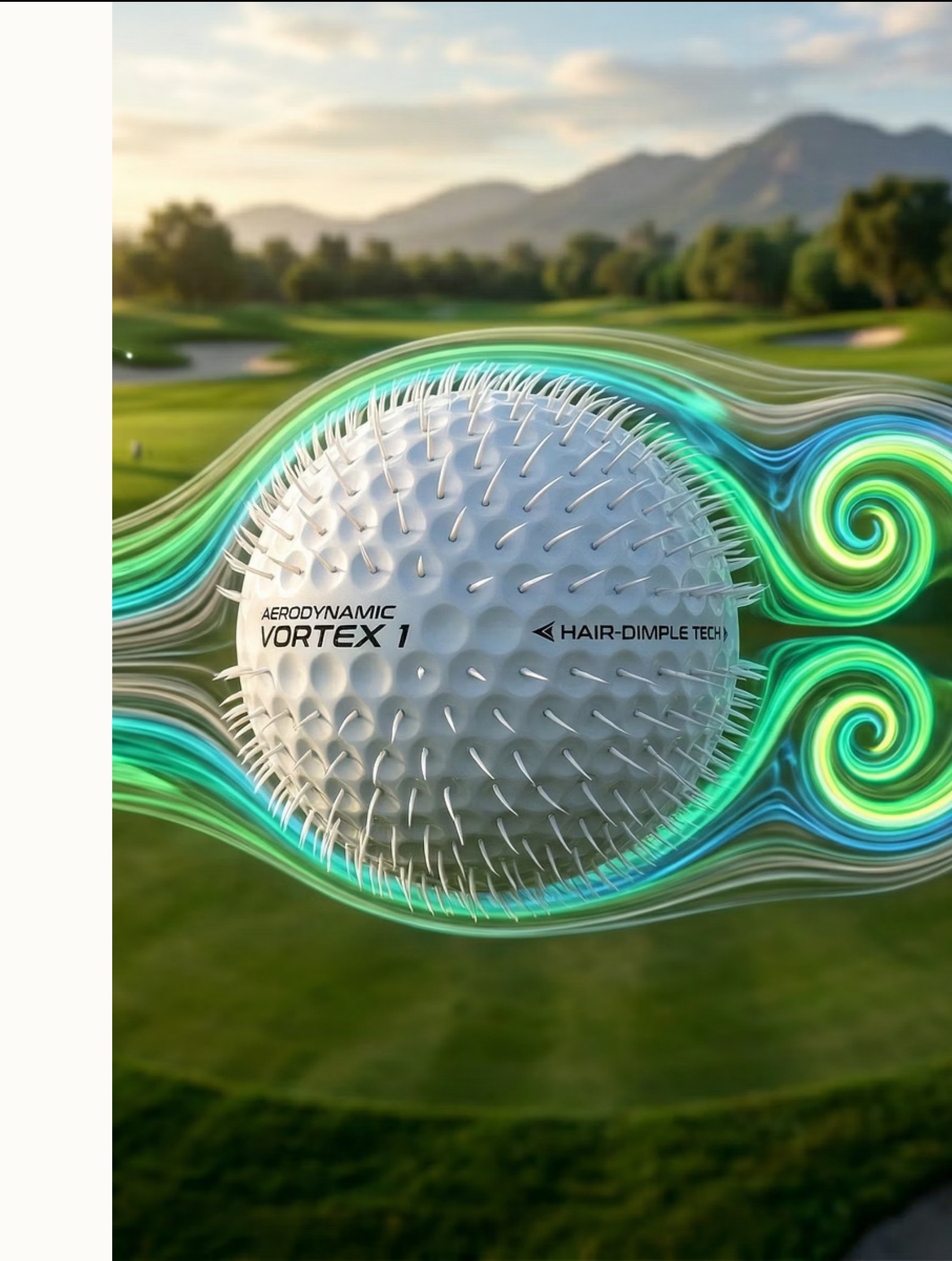
In the centre of every dimple a conical, flexible "hair" is placed that bends in the flow, generates local vortices and extends flight distance by 5–15%.
The opportunity
Golf balls are aerodynamically highly optimised, but every extra percentage of distance is enormously valuable in a market worth more than 1 billion dollars per year.
The business model
No own mass-production. Goal: development, testing, patenting and then licensing or sale of IP to 1–3 major golf ball manufacturers.
The solution
Vortex-Hair™ introduces into every dimple a micro-bore (trumpet hole) with a conical, flexible filament of 2–3× the dimple depth. The hair bends in the flow, generates a controlled vortex and reinforces the turbulent boundary layer — adaptive and scale-following.
How does Vortex-Hair™ work?
Expected Performance
Note on USGA/R&A: The design and licensing position will be aligned with the applicable distance limits. Positioning as "fit-dependent" technology that remains within test standards.
Development Trajectory: 3 Phases
IP Strategy & Patents
Patent family
Strong, internationally protected claims on:
- Dimple-with-hair geometry (shape, length ratio, cone angle)
- Working principle: flexible filaments generating vortices during flight
- Manufacturing methods: micro-boring, filament insertion, co-moulding
Approach: national priority application (NL/EP) → PCT within 12 months. Coverage: US, EU, Japan, Korea, China.
Costs & Differentiation
Indicative IP costs:
- First filing + FTO: €20–40k
- PCT + national phases: €100–200k over 3–5 years
Differentiation vs. existing patents: Flexible, flow-following hair vs. rigid geometry. Specific ratios (2–3× dimple depth) and dynamic vortex formation.
Licensing and Sale Models
Exclusive Worldwide Licence
Upfront fee: €2–5M + royalty €0.01–0.03 per ball. At 20M balls/year → €200–600k/year royalty. Additional milestones on USGA/R&A approval.
Non-Exclusive Licences
Maximum 3 OEMs. Upfront fee per OEM: €1–2M + royalty €0.005–0.02 per ball. Comparable total potential with greater risk distribution.
Full Sale of Patent Family
Lump sum: €5–20M depending on evidence, FTO room and number of serious bidders. Optionally royalty tail: €0.005/ball for 5 years.
Market & Potential Buyers
Golf ball market
Global revenue: USD 1.2–1.5 billion/year, growing to ~1.5 billion by 2033. The premium tour-ball segment is the most margin-rich. Major manufacturers filed more than 1,000 ball-related patent applications in the US since 2014.
Economic impact for OEM: assume 50M premium balls/year at €4 retail. A +5% market-share shift already quickly generates €5–15M extra gross margin/year.
Highest probability
TaylorMade, Callaway, Bridgestone, Srixon — strong innovation marketing, want visible technology.
Very valuable
Titleist/Acushnet — IP-conscious, large ball base, but risk-averse while the USGA distance debate continues.
OEM Approach Strategy
Roadmap & Key Milestones
CFD shows clear vortex formation and lower local drag
Range data shows ≥5% average distance gain vs. top tour ball
PCT filed + first search report positive
At least one OEM signs Letter of Interest/Intent
Term sheet signed for licence or sale
Risks & Mitigation
| Risk | Impact | Probability | Mitigation |
|---|---|---|---|
| Performance gain <5% | High | Medium | More geometry iterations; focus on niche segments (wind, high swing speeds) |
| Manufacturing too complex | Medium | Medium | Adapt concept to "partial coverage"; co-design with OEM |
| IP conflict with existing patents | High | Medium | Thorough FTO; draft claims tightly on flexible, adaptive hairs rather than fixed structures |
| USGA/R&A restrict maximum distance | Medium | Medium | Position as "fit-dependent" tech; conformity tests; possibly focus on non-tour segments |
| OEMs want to develop their own variant | High | Medium | Broadest possible claims; strong data; approach multiple OEMs in parallel |
Summary for Investors
Unique Principle
Building on proven vortex-dimple technology, but introducing a new class of flexible, adaptive vortex generators.
IP Play
The goal is not own bulk production, but value creation through patents and sale/licensing in a highly IP-driven market.
Limited Capital
Capital requirement: €0.3–0.6M to serious OEM conversations; €0.5–1.0M to deal.
Potential Return
Lump sum of several to tens of millions of euros on sale/licence, plus a royalty stream on adoption in premium balls.
Vortex-Hair™ Adaptive Dimple Golf Ball — In Brief
The Vortex-Hair™ golf ball integrates a conical, flexible micro-filament of two to three times the dimple depth into every dimple. The hair bends in the airflow, generates local vortices and keeps the turbulent boundary layer attached for longer — delivering an estimated five to fifteen percent extra carry distance compared to a standard tour ball.
The business model focuses on value creation through intellectual property: no own mass-production, but development, patenting and then licensing or sale to one to three major golf ball manufacturers. Capital required to reach serious OEM conversations is three hundred to six hundred thousand euros; a deal could yield a lump sum of five to twenty million euros plus royalties.
The development programme covers three phases over three years: CFD study and wind-tunnel test, working prototypes tested with TrackMan, and an industrial manufacturing concept. The patent family covers dimple-with-hair geometry, the working principle and manufacturing methods, with PCT coverage in the US, EU, Japan, Korea and China.