Het Open Vizier · Leadership edition
A newspaper for thinking without blinkers
★ Leadership edition
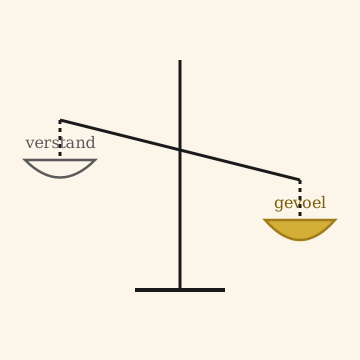
Twelve articles that develop the sharpest political and organisational question of our time: who leads with what. The reason-led leadership now in fashion paralyses the organism it governs. Feeling-led leadership — primal feeling, courage, knowledge of people — is what truly moves things.
★ The thesis of this edition
The reason-led leadership that has become dominant since the nineteen-nineties has produced a particular kind of executive: data-driven, risk-averse, legally embedded, and above all afraid of the judgement of those around him. The result is a leadership that reports abundantly and moves little.
Feeling-led leadership is the older, more original model. The leader who knows what is good for the people he leads — not because a spreadsheet tells him so, but because his primal feeling gives him the signal. He dares to decide before the numbers are complete. He dares to correct when it turns out he was wrong.
Reason-led leadership produces managers. Feeling-led leadership produces leaders. An organisation needs both, but in the right order.
★ Administrative renewal
A design conceived, thought through and calculated here. Ten municipalities in numbers, plus an open proposal for whoever dares.
ANALYSIS · TEN MUNICIPALITIES · JUNE 2026
What happens to a city when half of its city hall disappears? Ten municipalities worked through.
Read the analysis →OPEN PROPOSAL · TWENTE REGION · JUNE 2026
An open proposal to whoever dares — who takes the first step?
Read the proposal →★ I · The foundation
Four articles that explain the principle — what the primal feeling is, how it works in the three brain layers, and why a person who leads primarily from his prefrontal cortex is not a leader but a manager.
Edition 3 · foundation
The principle that precedes all later layers. How the primal feeling arises, what it does, and why every good leader works with it more than he admits.
Read the foundation article →Edition 3 · structure
Reptile, mammal, human — a leader who operates only from the third layer is missing two thirds of his capacity. The three brain layers as a tool for the leader who wants to use all three.
Read the structure →Manifesto · call to action
An open call to restore the primal feeling to its place in governance, education and business. Not as an esoteric concept, but as a concrete working instrument that reason-led leadership has banished.
Read the manifesto →Edition 3 · communication
How two leaders communicate with each other through a layer that neither of them explicitly names. Why a good leader in a meeting gets more information from the tone than from the words.
Read about communication →★ II · The practice
Three articles that show what feeling-led leadership looks like in practice. A CEO who leads with it, the primal feeling as a daily tool in six professions, and the sharp metaphor of who sits on the box and who sits on the luggage rack.
Edition 4 · key article
The key article of this edition. A good CEO leads from his primal feeling, not from fear of the rational judgement of those around him. What makes the difference — for the company, for the people, and for the leader himself.
Read about the CEO →Edition 3 · professional practice
Concrete and direct: how the primal feeling works through six different professions — from the doctor to the teacher, from the entrepreneur to the craftsman. Not only for leaders, but for anyone who has anything to say at all.
Read about professional practice →Triptych · June 2026
A triptych about three kinds of leadership without subsidy dependency. Who sits on the box and who sits on the luggage rack — and what the difference means for who sets the direction and who comes along for the ride.
Read the triptych →★ III · The counter-model
Three articles that show what goes wrong when reason takes over the leading role from feeling. The actor who makes himself the rule, the retrospective of a generation that went too far in rationalisation, and the counter-manifesto.
Principle · system
Whoever acts creates the rule. A principle that reason-led leaders structurally forget — they think the rule acts. Here the sharp correction: without an actor with primal feeling, no rule is workable.
Read the principle →Edition 3 · retrospective
Looking back at what the post-war generations have and have not passed on. Which precious elements have been lost in the over-rationalisation — and which we can recover.
Read the retrospective →Edition 2 · manifesto
A manifesto for a democratic form that stands above party. A political system where feeling-led leadership is permitted again, and where the leader is accountable to the person, not to his party executive.
Read the manifesto →★ IV · The examples
Two articles from Edition 5 on seven concrete leaders and seven concrete tools — the people who have demonstrated feeling-led leadership in their work, and the instruments with which they did it.
Edition 5 · seven people
Seven Swiss leaders who throughout their careers consistently acted from their primal feeling — and thereby gave the continent a different course at critical moments. What they had in common, and what we can learn from them.
Read about the seven →Edition 5 · seven tools
Seven instruments with which the Carbon Alert architecture was built — not by management, but by leadership. The tools that made the difference, and the kind of leader who holds them.
Read about the seven →For executives and CEOs: this edition is not an attack on rationality. It is a correction to the overdose of it. Reason remains your engine — but the primal feeling is your compass. Whoever drives at full speed without a compass will get hurt.
For young leaders: in your training you are told that data and process are what matter most. Here you will hear that you also have something else — your primal feeling. Use it.
For coaches, HR professionals and management educators: here is the material to restore the primal-feeling layer to its place in the leadership development you facilitate. Without abolishing reason-led leadership — by placing feeling-led leadership alongside it and above it.