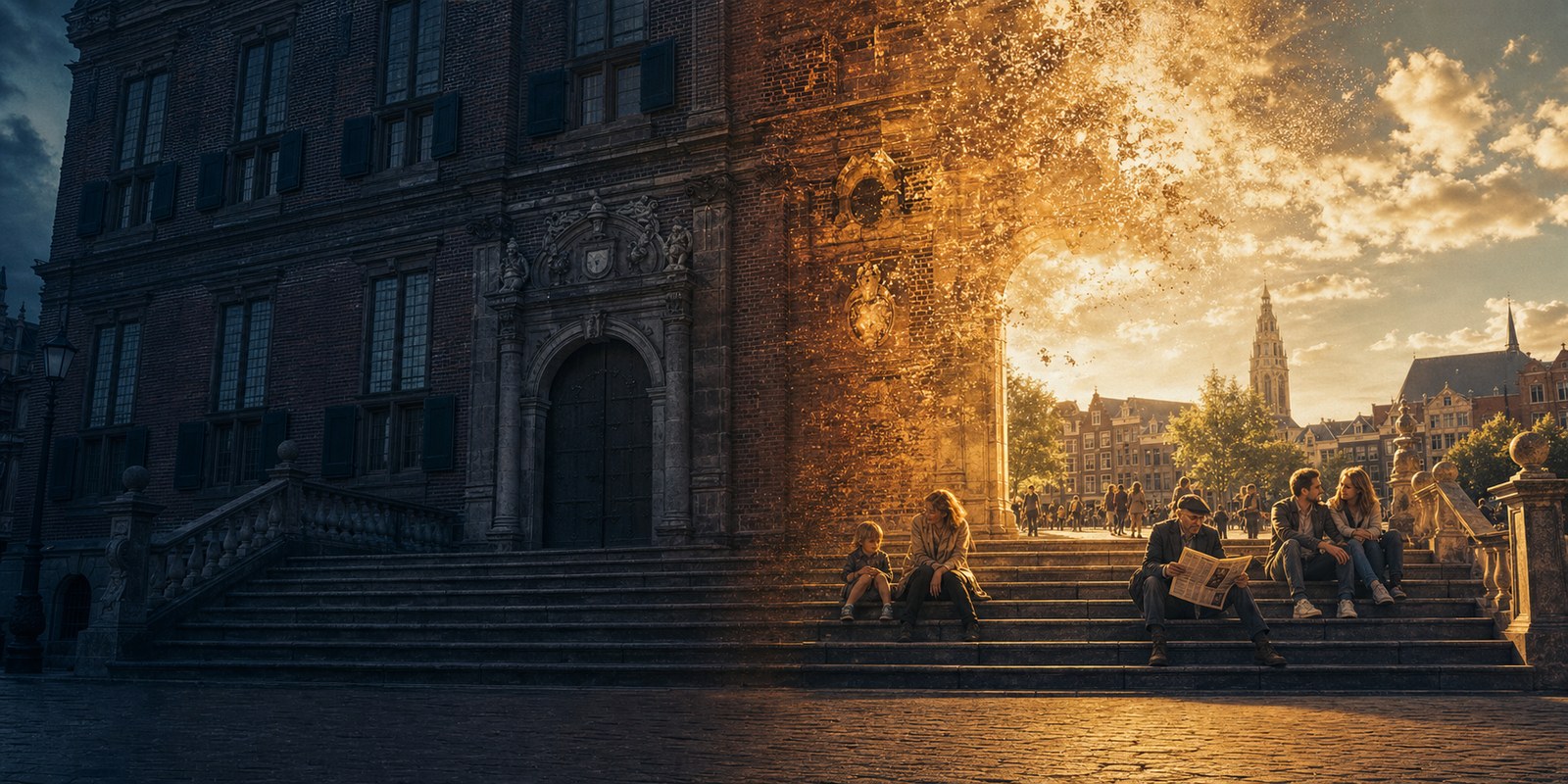
Imagine: tomorrow a Dutch city decides to run its government differently. Not with a council and an executive board, but with blocks — neighbourhood blocks for the neighbourhoods, district blocks for the districts, a top block for the whole city. Citizens govern, no professional politicians. A system registers every decision, checks whether they have read their documents, and keeps the history so that a wrong decision can always be undone.
It is called VMB-EGS. Not a British or Swiss experiment, not an import from another country. A design conceived, thought through and worked out here.
The question is simple: what happens to a city if it fully introduces this system?
Ten municipalities, one system
To make the discussion concrete: ten examples, across the Netherlands. From world city to Twente commuter town. One system, ten instances, the same zero-base method. The numbers are based on published annual reports and the 2024 Municipal Personnel Monitor.
| Municipality | Inhabitants | Current FTE | VMB-EGS FTE | Now /inh. | Future /inh. |
|---|---|---|---|---|---|
| Amsterdam | 941,873 | 17,900 | 2,430 | € 2,123 | € 293 |
| Rotterdam | 657,000 | 14,342 | 1,800 | € 2,183 | € 304 |
| The Hague | 575,000 | 10,193 | 1,578 | € 1,878 | € 304 |
| Utrecht | 380,000 | 5,600 | 954 | € 1,770 | € 272 |
| Eindhoven | 250,000 | ~1,700 | 735 | ~€ 1,100 | € 312 |
| Groningen | 240,000 | ~3,000 | 703 | ~€ 1,500 | € 308 |
| Arnhem | 165,000 | ~1,700 | 505 | ~€ 1,100 | € 309 |
| Enschede | 162,671 | 1,830 | 527 | € 944 | € 329 |
| Maastricht | 121,000 | ~1,500 | 395 | ~€ 1,200 | € 339 |
| Borne | 25,038 | ~150 | 90 | ~€ 560 | € 296 |
A civil-service organisation a fraction the size of today's. A budget a fraction of today's cost. No cost-cutting drive, but a consequence of a different design.
Under VMB-EGS the per-inhabitant cost ranges between €272 (Utrecht) and €339 (Maastricht) — a spread of factor 1.25. That is a normal scale-difference for public services. It shows that the system is scale-independent: the same codebase, different settings.
But it is not that simple — and that is why it is larger
Whoever looks only at this table misses half the story. A civil-service organisation is not only salaries. It is buildings that need heating, computers that draw electricity, cars driving into the rush hour, parking garages taking up space, paper being printed. When the organisation shrinks to a third, all these items shrink along. And some items disappear entirely.
For Enschede that means the following. The city office on Hengelosestraat is 16,000 m². Adjacent buildings add 8,900 m² and 5,800 m². Together roughly 30,000 m² of office space for civil servants. Reduce the number of civil servants from 1,830 to 527, and you need about 6,500 m² — a fifth of the current area. The other four-fifths come free.
Add to that: an empty office no longer needs heating and cooling. The energy bill drops by about € 600,000 per year. The parking places around the city hall — 400 to 650 spots — can be returned to city ground. Traffic into and out of the centre falls by 1,500 to 2,000 vehicle movements per day.
For Amsterdam the numbers are dramatic. There the equivalent of many times that office space comes free, in an inner city where every square metre counts. Estimated real-estate yield alone: € 30 to 50 million per year.
These are not margins. These are substantial urban changes.
The sum
What disappears in salary, ICT, buildings, energy and external hire, combined with what is added in real-estate yield — leads per city to a structural annual gain:
| Municipality | Current apparatus cost | VMB-EGS | Gain /year |
|---|---|---|---|
| Amsterdam | € 2,000 mln | € 276 mln | € 1,770 mln |
| Rotterdam | € 1,434 mln | € 200 mln | € 1,260 mln |
| The Hague | € 1,080 mln | € 175 mln | € 920 mln |
| Utrecht | € 672 mln | € 103 mln | € 580 mln |
| Groningen | € 360 mln | € 74 mln | € 290 mln |
| Eindhoven | € 275 mln | € 78 mln | € 200 mln |
| Arnhem | € 182 mln | € 51 mln | € 134 mln |
| Enschede | € 154 mln | € 54 mln | € 100 mln |
| Maastricht | € 145 mln | € 41 mln | € 105 mln |
| Borne | € 14 mln | € 7.4 mln | € 7 mln |
For these ten together: about € 5.4 billion per year. Adding all 342 Dutch municipalities, the order of magnitude becomes € 10 to 15 billion per year. That is beyond this article — an extrapolation that deserves separate working-out.
This money does not leave the city. It shifts. Part goes back to the taxpayer. Part can be invested in education, healthcare or climate adaptation. Part is freed in real estate that becomes productive again — as housing, as school, as sports hall.
And the inhabitant?
The inhabitant notices something larger than a lower tax. The inhabitant notices speed and voice.
A terrace permit now takes four to eight weeks. Under VMB-EGS: a few hours to three days. A neighbourhood investment of five thousand euros now takes three to five months. Under VMB-EGS: one to three weeks. A district project of half a million now takes six to twelve months. Under VMB-EGS: four to ten weeks.
Not only faster. Better informed too. Before someone may vote on a decision, they must have demonstrably read the documents — reading time tracked, two control questions answered, a declaration signed. After that a night must pass before they may vote. No impulse voting. No tick-mark without reading.
A neighbourhood block that discovers its decision is unworkable rolls back to the last stable state. No long procedure, no question of blame — a normal operation.
What the system does not do
Honesty belongs here. The system does not do three things.
It does not suddenly solve youth care. It does not change poverty. It does not bring into being housing that does not exist. What it does is make the approach to those problems faster, more transparent and reviewable. Not the solution itself — the way to it.
It also takes effort. A neighbourhood block works only if there are citizens willing to fill the chairs. In neighbourhoods where that does not work, the district block takes over — placing extra load on district members. Compensation for block roles must be realistic, otherwise the system dries up.
And the law must follow. The Municipality Act currently requires a council. The position of the mayor is constitutionally fixed. The GDPR limits what the system may process in personal data. Nothing insurmountable, but no design that can land without political adjustment.
Borne — the small example
Borne is interesting because it shows that the system also scales down without collapsing under its own weight.
Borne is an independent Twente municipality with 25,038 inhabitants, containing the villages of Hertme and Zenderen. Currently Borne has a council of 19, an executive, and a civil-service apparatus of around 150 FTE. Hertme and Zenderen formally have no voice of their own — they stand in the shadow of the Borne core, at most a village council with advisory rights.
Under VMB-EGS Borne gets a top block of five seats for the whole municipality. Below it three village blocks: one for Borne core, one for Hertme, one for Zenderen. Below those, about six neighbourhood blocks for streets and squares. The Selection block and the Oversight block are shared with neighbouring municipalities — for a municipality of 25,000 an own pool is not sustainable.
The apparatus cost drops from about € 560 to € 296 per inhabitant. Not the spectacular reduction Amsterdam sees, but that is logical: Borne's organisation was already smaller. What does emerge is something that is not there today — a municipality in which each of the three villages has its own voice.
For the inhabitant of Borne, more changes than for the inhabitant of Amsterdam. In Amsterdam VMB-EGS mainly means that the city hall becomes smaller. In Borne it means that Hertme and Zenderen for the first time have their own table — not one person, but five neighbours.
The pattern
The numbers show one clear pattern: the larger the municipality, the larger the reduction. Not because large municipalities are more wasteful, but because the administrative column (council, executive, districts, area commissions, executive secretariats) is heavier in large municipalities and relatively more of it falls away under VMB-EGS.
| Municipality | Reduction |
|---|---|
| Amsterdam | −86% |
| Rotterdam | −86% |
| The Hague | −84% |
| Utrecht | −85% |
| Groningen | −79% |
| Eindhoven | −72% |
| Arnhem | −72% |
| Maastricht | −72% |
| Enschede | −65% |
| Borne | −47% |
Even a clean, small organisation like Borne sees almost half disappear. For a world city the gain is well over four-fifths. The system scales with it.
A different image of the city hall
What we have called the city hall is a building where people work who write proposals, prepare documents, plan meetings, draw up accountabilities, evaluate policy. It is a productive organisation of decisions about decisions about decisions.
In the VMB-EGS model the city hall is an execution organisation. A care consultant goes to the kitchen table, a youth worker sits beside the teenager, an enforcement officer stands in the street, a counter worker hands out a passport, a permit officer processes an application. What is no longer in the city hall is the whole column of people who meet, write, check, evaluate, communicate and mandate around that execution.
That column has not been organised away in this design. It disappears because it is no longer needed. The system does what the column did.
What remains
A city where decisions lie closer to the inhabitant. A municipality where every decision is visible in a public Track — who voted what, on which documents, with what effect afterwards. A real-estate portfolio that has room in its jacket, with buildings that can be returned to the city. A street with less traffic around the city hall. A lower tax, or a higher investment in the city.
And a village that finally decides for itself about the tree on the square. Not one village. Three villages, in Borne. And in every other municipality where a neighbourhood today has no voice of its own.