The Seven of Bern
A collegial democracy as keystone — what Switzerland did in 1848 that we could have adopted, and what the NEPK figures from twenty-one countries reveal.
Keystone · 15 min read
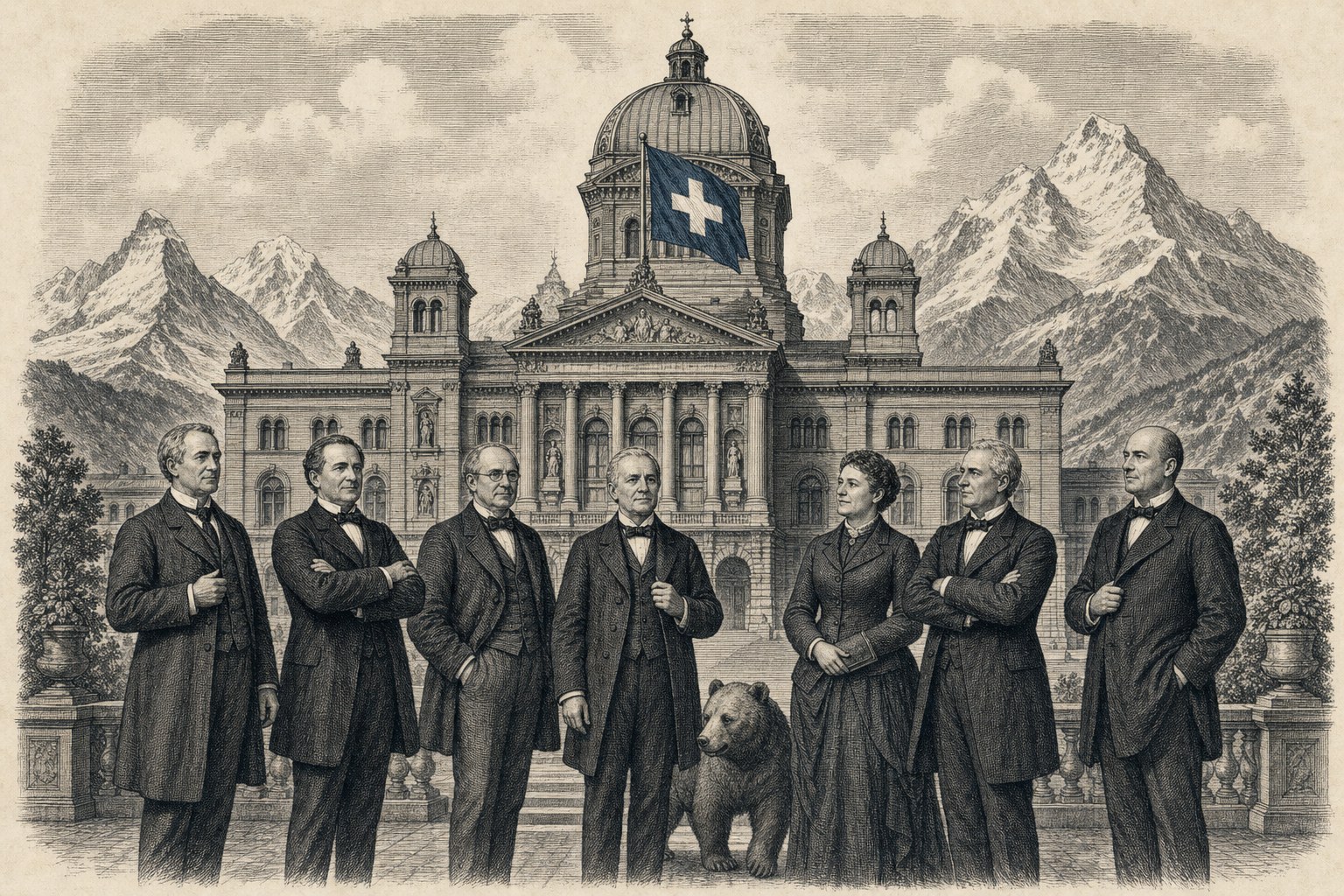
In the first article of this edition I referred to 七つ道具 — the seven tools of Benkei, the warrior monk who defended a bridge with seven different weapons. In this closing article I refer to seven other people. Not seven weapons of one person, but seven persons who together govern one country. They are the Federal Councillors of Switzerland, elected for four years by parliament, each with their own department, and with a presidency that rotates annually between them.
Whoever places these seven beside the Benkei seven sees not only a literary parallel. They see the solution to what all the preceding articles in this edition have laid bare.
The American Design Flaw
In 1787 the Founding Fathers designed a constitution in Philadelphia that was progressive for its time. Separation of powers, a bicameral legislature, indirect election of the president via the Electoral College, an independent judiciary. But on one point they made a choice that has not withstood the test of time: they concentrated executive power in one person, elected for four years, with ongoing real authority over an immense apparatus.
The Founders were themselves aware of the risks. James Madison warned explicitly in Federalist Paper No. 10 against what he called factions — groups that can allow their own short-cycle interests to dominate the general welfare. What he could not foresee was what the mass-media democracy of the twentieth century would do with this concentration: one person wins a popularity election on one or two dominant themes, and subsequently receives four years of executive authority over all themes simultaneously. The voter standing in the polling booth thinking about migration or tax cuts implicitly gives their approval to decisions on semiconductor policy, infrastructure, monetary course, and foreign trade — subjects they were not consulted on and about which they can generally form no judgment.
This is precisely the ranking error I described in article 03 — The Forgotten Order — now at the highest level of political design. One popularity vote is multiplied across all orders simultaneously. A third-order concern elevates a person to first-order decision-maker.
The Swiss Correction of 1848
In 1848 the Swiss constitutional commission met in Bern. They looked to the American constitution as a model. They adopted much from it: federal structure, bicameral parliament, separation of powers, fundamental rights. But on the point of executive authority they deliberately diverged.
Where America installed one president, Switzerland chose seven Federal Councillors — a collegial executive body. Each member heads one of the seven federal departments. The presidency — the Swiss Bundespräsident — changes every year between the seven, on the basis of seniority. No one builds personal power. No one becomes a charismatic leader. The Bundespräsident is literally primus inter pares — first among equals — for one year, and then steps back.
On top of this the Swiss built a second correction. Where the Americans installed a filter between people and president via indirect suffrage, the Swiss chose the opposite: direct democracy on concrete questions. Three to four times per year Swiss citizens are presented with a specific proposal — a law, a constitutional amendment, an international treaty — and they vote yes or no. No disguising of a political preference through a person. No blank cheque. One subject at a time, clearly formulated, one vote.
The effect of these two design choices is that in Switzerland a ranking error is extraordinarily difficult to make. Whoever wants a first-order decision to be taken through a third-order vote must first convince seven Federal Councillors from different parties, then two parliamentary chambers, and possibly thereafter a referendum in which the citizen votes not on a person but on the substance. The system has a built-in filter that separates the third order from the first.
What the Figures Show
The effect of this design difference is visible in cold statistics. Switzerland — a small country without natural resources, without a sea port, with four official languages and complex internal divisions — ranks in the top three on virtually every measure of prosperity. GDP per capita stands in 2024 at roughly 106,000 dollars — more than one and a half times that of the Netherlands (65,000) and well over twice that of Germany (52,000). Productivity per hour worked stands at 98.5 dollars (PPP) — comparable to Singapore and above every EU member state.
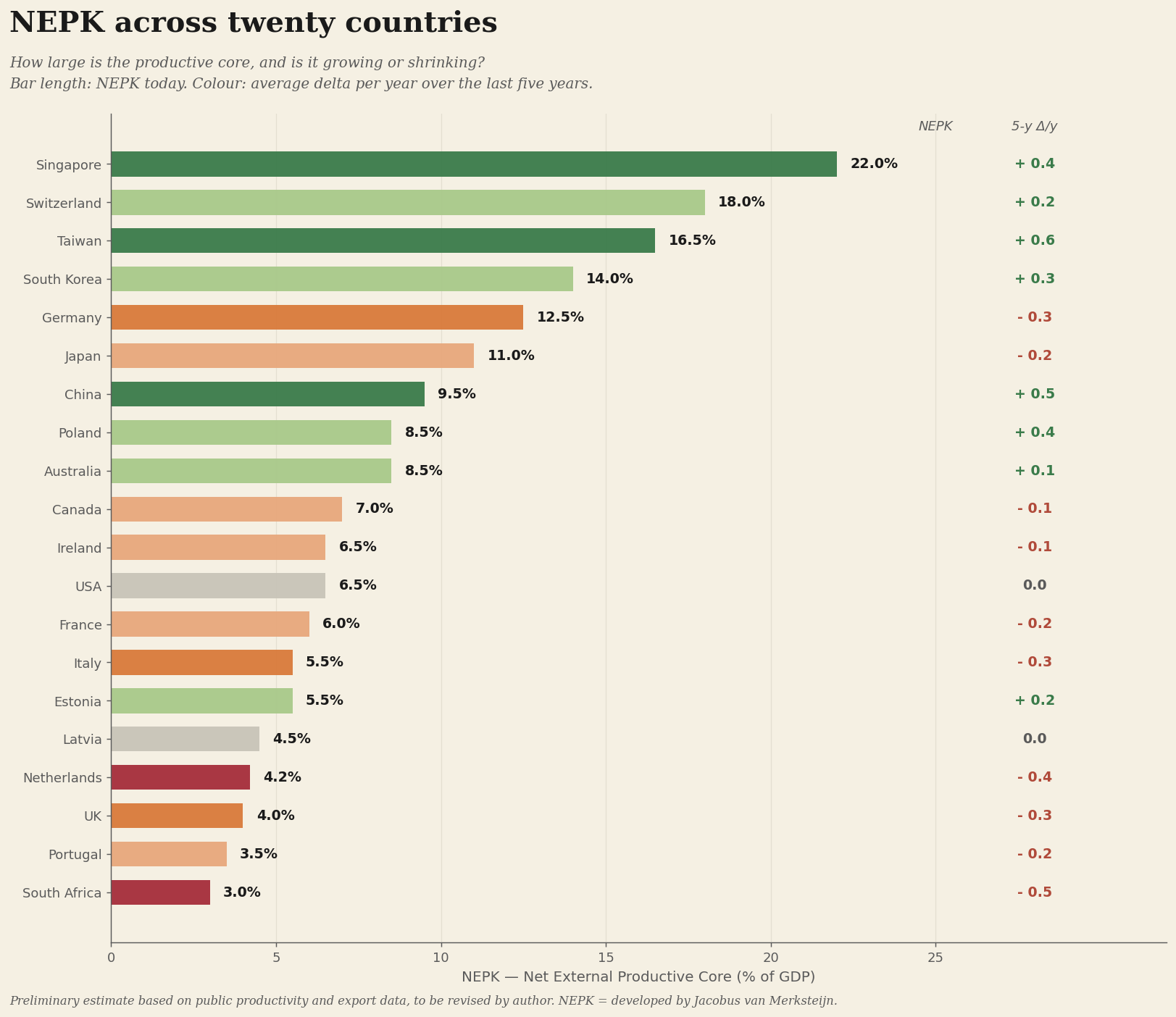
More important than these individual figures is the pattern that emerges when we place the NEPK [Netto Externe Productieve Kern — Net External Productive Core, a measure the author developed to look through the GDP figure at what a country genuinely produces and retains for its citizens, independent of transit flows, financial shadow accounting, and foreign ownership of productive assets] of Switzerland beside that of other countries.
What the graph shows is no coincidence. Two countries stand at the top: Singapore and Switzerland. Both have built ranking-order protection into their system of government — Singapore through a dominant-party technocracy with explicit legitimacy for long-term economic policy, Switzerland through collegial power and direct democracy on substantive matters. Two opposite paths, the same result: a productive core that is large and grows steadily.
In the upper middle tier stand Taiwan, South Korea, and — colourfully enough — China, all three with green delta figures indicating a still-growing productive core, built on the Japanese quality discipline discussed in the first article.
Also notable are two EU laggards that turn out not to be laggards at all. Poland scores 8.5 percent, on a par with Australia, but with a considerably larger annual increase of +0.4 percentage points — the highest in the entire European Union. Poland has since 2004 systematically built up its manufacturing industry in close cooperation with the German industrial chain, making it the quiet winner of the European reshuffling. Estonia — a small country of only 1.3 million inhabitants — shows a comparable increase of +0.2 at a lower base level, built through a digital-economy design (e-residency, digital government, ICT-oriented exports). Poland and Estonia are the two European countries that have deliberately pursued ranking-order discipline on productivity over the past five years, and the figures show the result.
The remaining European laggards — Germany, France, Italy, the UK, the Netherlands, Malta, Portugal — show orange and red colours. Not only the Netherlands is losing productive core; virtually all of Europe is doing so. But the Netherlands stands at 4.2 percent towards the front of the lower half, with the second-largest annual decline of 0.4 percentage points per year. Only South Africa — a country beset by industrial instability and political turbulence — is declining faster.
Latvia stands at 4.5 percent with a stable delta just above the Netherlands — a Baltic country showing no decline and therefore structurally stronger than our country in 2026. Also striking is Ireland: with a GDP per capita well above the Netherlands, it scores poorly on NEPK (6.5 percent), because much of Irish production is multinational transit that does not become available to the Irish citizen as lasting purchasing power.
This is not a ranking to be proud of. It is a warning.
The Three European Laggards
What the graph additionally shows, and what is never presented this way in the Dutch press, is that the three large European economies with the heaviest centralised governance structures — France, the United Kingdom, and the Netherlands — all stand in the lower half and are all declining. What they have in common is not their size or location. What they have in common is a strongly personalised system of government with dominant executive leaders — a French president, a British prime minister, a Dutch prime minister — each repeating the American design flaw in their own variant.
Germany stands somewhat higher due to its federalism, which is a diluted version of what Switzerland has pursued to the extreme. But Germany too is losing ground, at 0.3 percentage points per year. That is no coincidence. Since 2018 Germany has actively hollowed out its productive core through energy policy, regulation, and the offshoring of industrial capacity to Poland and the Czech Republic. The Federal Chancellor — the German variant of the personalised leader — has decided on dossiers about which he was not questioned during his election campaign. A collegial Swiss design would not have allowed such decisions to be taken so easily.
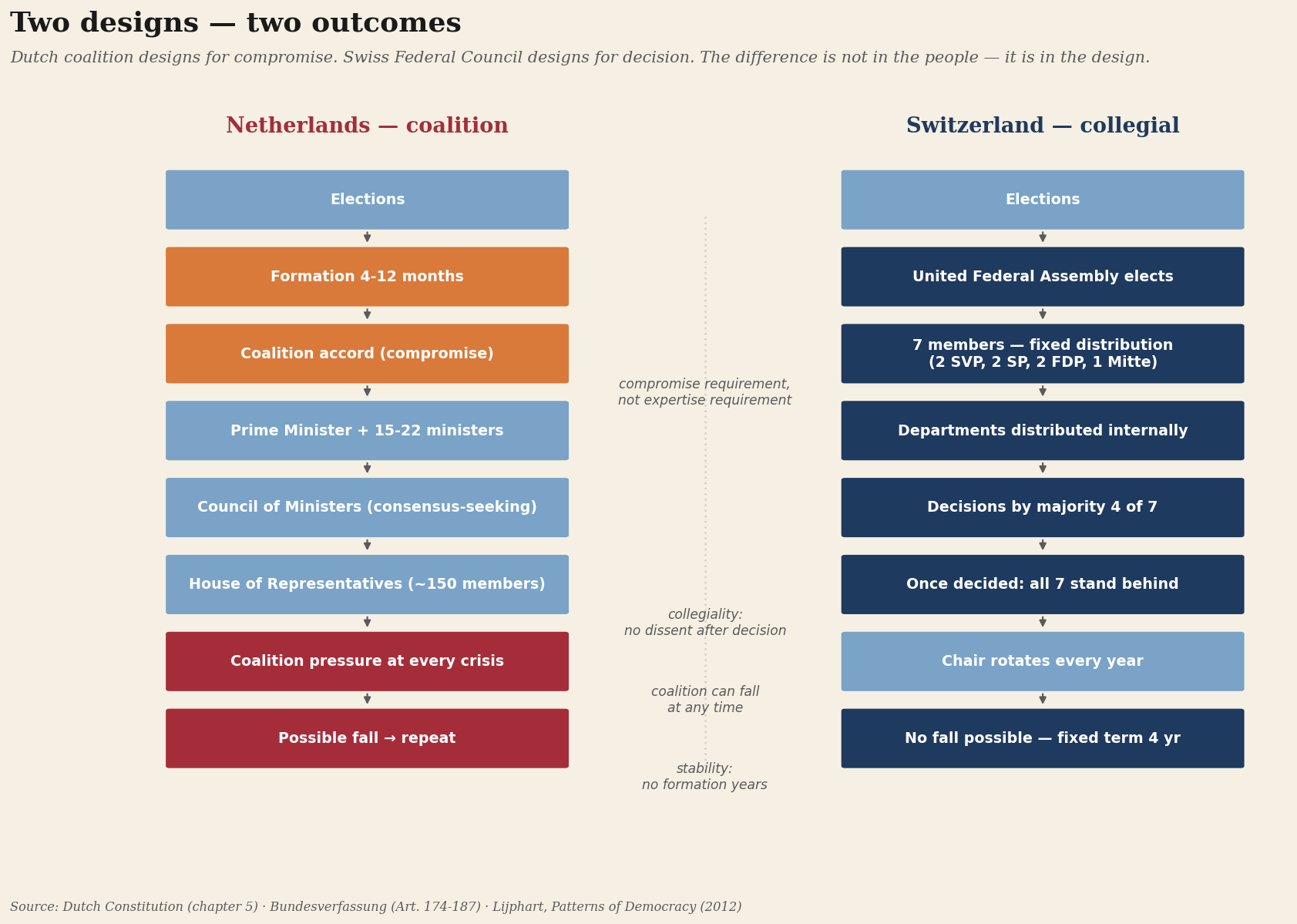
Placed side by side, the two governance designs are virtually mirror images of each other on every point. The Netherlands designs for compromise: a formation lasting months, a coalition agreement as a lowest common denominator, a prime minister as keeper of compromises, a cabinet that collapses with every crisis or must forge new compromises. Switzerland designs for decision: a fixed distribution formula based on party size, a collegial Federal Council in which a majority of four suffices, and once taken — all seven stand behind it. The difference is not in the people. It is in the design.
What This Could Mean for the Netherlands
Adopting the Swiss design wholesale is not feasible for the Netherlands. Dutch history is different, the population is accustomed to different structures, and the European context compels certain choices that Switzerland can avoid by not being an EU member state. But elements of the Swiss design are certainly transferable, and on those elements the Netherlands can within one generation chart a fundamentally different course.
Three concrete elements, in order of feasibility:
First — Independent technocratic institutes with explicit domain-specific legitimacy. The Netherlands already has a few: De Nederlandsche Bank [the Dutch central bank], the Centraal Planbureau [Central Planning Bureau], the Court of Audit. They operate at a remove from the daily political cycle. What is standard practice in Switzerland and could be expanded in the Netherlands: more domains in which an independent institute, shielded from popularity votes, maintains the first-order ranking. An independent Education Institute. An independent ICT Authority. An independent Nitrogen and Climate Authority, not as a policy-maker but as a ranking guardian — one that can compel the cabinet to give explicit account when policy allows a third-order factor to dominate.
Second — Direct democracy on concrete questions. Not as a replacement of the parliamentary system, but as a correction when first-order questions are at risk of being swept along by a politician's popularity bonus into third-order decisions. The binding corrective referendum — which was abolished in 2018 — would be a first step. A second would be: for every law above a certain threshold of lasting impact, a mandatory public consultation on the specific substance, not on the party.
Third — Collegial prime ministership. This is the heaviest step, but also the purest. A Dutch cabinet already formally consists of collegially operating ministers — but in practice the prime minister has become dominant. A design choice to rotate the prime ministership, on the Swiss model, annually between the parties of a coalition, would structurally break the personalisation of power. No Rutte doctrine, no Schoof course — only the cabinet as a whole, as equals, with the chairmanship rotating.
Fourth — Recruit ministers from society, not from politics. This is the most concrete design element and the most urgent. Today Dutch ministers are recruited from the Lower House, from the party apparatus, or from the circles connected to them. Their expertise in the department they are to lead is generally secondary to their political loyalty. The consequence is that a minister upon taking office is professionally dependent on their own civil servants — they know less about the dossier than their director-general. In practice the minister thereby becomes an ambassador of the civil service to parliament, rather than a manager with substantive authority.
The solution does not lie in better training afterwards. It lies in the recruitment itself. Abandon the Balkenende norm [the cap on public-sector salaries, introduced in 2006] and open the ministerial post as an executive directorship position. A domain-focused application procedure, with a market-rate salary that can attract the administrator from the top of an industrial enterprise, a hospital, an infrastructure company, or an academic institution. Appointment on the basis of demonstrated executive experience and domain knowledge, not on the basis of political election results. A minister of Finance who has led a bank or a large accountancy firm; a minister of Health who has been a hospital executive; a minister of Education who has run an educational institution; a minister of Climate and Green Growth who knows petrochemistry or a grid operator from the inside.
The Balkenende norm — introduced in 2006 to limit public remuneration — was intended to prevent excesses, but has had the unintended side effect of making the Dutch ministerial post financially unattractive to top executives from the private sector. A director who in their current role earns three to five times the Balkenende ceiling will not relinquish their profession for four years for a position in which they take a financial step backward and moreover lose their substantive command to their civil servants. The result is that our country structurally receives ministers who are not capable of managing their own civil service apparatus — who are the subordinates of their own director-general, rather than their superior.
This is arranged differently in virtually every country with which we compete in the NEPK graph. Swiss Federal Councillors almost always come from business, the military, or the cantonal sphere; in Singapore the ministerial post is a top executive career with top executive remuneration; in Poland and Estonia a ministry is a career step you enter on the basis of executive experience. Only in the Netherlands, and in a handful of comparable Western European democracies, is the ministerial post structurally a political reward rather than a professional directorship. These are not coincidentally the same countries that are declining in the NEPK graph.
This is a radical thought. It is also precisely what Switzerland did in 1848, at a time when the American model was considered the most modern. Switzerland looked at America, saw the design flaw, and did it differently.
Keystone
Edition 5 began with the Seven of Benkei — seven weapons of one person. It ends with the Seven of Bern — seven persons who together govern one country. Between those two sevens lies the entire argument of this edition: that reality is hierarchically distributed, that ranking-order discipline makes the difference between prosperity and decline, and that democratic-political design too can respect or ignore this ranking-order discipline.
We have ignored it. Other peoples have embraced it, in two very different forms. The figures show who has done better.
That is not the fault of the Dutch voter. The voter can do nothing other than cast their vote within the system presented to them. The question is whether we are prepared to redesign the system, or whether we will continue to neglect what has worked in Bern for 178 years already.
Sources: Federal Council (Switzerland) — Wikipedia); Swiss National Museum — Switzerland and the USA: sister republics; Library of Congress — Americans and the Swiss Constitution of 1848; Cato Institute — A Nation Worth Emulating; Wikipedia, List of countries by labour productivity; Worldometers GDP per capita 2024; James Madison, Federalist Paper No. 10, 1787; NEPK figures: preliminary estimates by the author based on public productivity and export data.
In the first article of this edition I referred to 七つ道具 — the seven tools of Benkei, the warrior monk who defended a bridge with seven different weapons. In this closing article I refer to seven other people. Not seven weapons of one person, but seven persons who together govern one country. They are the Federal Councillors of Switzerland, elected for four years by parliament, each with their own department, and with a presidency that rotates annually between them.
Whoever places these seven beside the Benkei seven sees not only a literary parallel. They see the solution to what all the preceding articles in this edition have laid bare.
The American Design Flaw
In 1787 the Founding Fathers designed a constitution in Philadelphia that was progressive for its time. Separation of powers, a bicameral legislature, indirect election of the president via the Electoral College, an independent judiciary. But on one point they made a choice that has not withstood the test of time: they concentrated executive power in one person, elected for four years, with ongoing real authority over an immense apparatus.
The Founders were themselves aware of the risks. James Madison warned explicitly in Federalist Paper No. 10 against what he called factions — groups that can allow their own short-cycle interests to dominate the general welfare. What he could not foresee was what the mass-media democracy of the twentieth century would do with this concentration: one person wins a popularity election on one or two dominant themes, and subsequently receives four years of executive authority over all themes simultaneously. The voter standing in the polling booth thinking about migration or tax cuts implicitly gives their approval to decisions on semiconductor policy, infrastructure, monetary course, and foreign trade — subjects they were not consulted on and about which they can generally form no judgment.
This is precisely the ranking error I described in article 03 — The Forgotten Order — now at the highest level of political design. One popularity vote is multiplied across all orders simultaneously. A third-order concern elevates a person to first-order decision-maker.
The Swiss Correction of 1848
In 1848 the Swiss constitutional commission met in Bern. They looked to the American constitution as a model. They adopted much from it: federal structure, bicameral parliament, separation of powers, fundamental rights. But on the point of executive authority they deliberately diverged.
Where America installed one president, Switzerland chose seven Federal Councillors — a collegial executive body. Each member heads one of the seven federal departments. The presidency — the Swiss Bundespräsident — changes every year between the seven, on the basis of seniority. No one builds personal power. No one becomes a charismatic leader. The Bundespräsident is literally primus inter pares — first among equals — for one year, and then steps back.
On top of this the Swiss built a second correction. Where the Americans installed a filter between people and president via indirect suffrage, the Swiss chose the opposite: direct democracy on concrete questions. Three to four times per year Swiss citizens are presented with a specific proposal — a law, a constitutional amendment, an international treaty — and they vote yes or no. No disguising of a political preference through a person. No blank cheque. One subject at a time, clearly formulated, one vote.
The effect of these two design choices is that in Switzerland a ranking error is extraordinarily difficult to make. Whoever wants a first-order decision to be taken through a third-order vote must first convince seven Federal Councillors from different parties, then two parliamentary chambers, and possibly thereafter a referendum in which the citizen votes not on a person but on the substance. The system has a built-in filter that separates the third order from the first.
What the Figures Show
The effect of this design difference is visible in cold statistics. Switzerland — a small country without natural resources, without a sea port, with four official languages and complex internal divisions — ranks in the top three on virtually every measure of prosperity. GDP per capita stands in 2024 at roughly 106,000 dollars — more than one and a half times that of the Netherlands (65,000) and well over twice that of Germany (52,000). Productivity per hour worked stands at 98.5 dollars (PPP) — comparable to Singapore and above every EU member state.
More important than these individual figures is the pattern that emerges when we place the NEPK [Netto Externe Productieve Kern — Net External Productive Core, a measure the author developed to look through the GDP figure at what a country genuinely produces and retains for its citizens, independent of transit flows, financial shadow accounting, and foreign ownership of productive assets] of Switzerland beside that of other countries.
What the graph shows is no coincidence. Two countries stand at the top: Singapore and Switzerland. Both have built ranking-order protection into their system of government — Singapore through a dominant-party technocracy with explicit legitimacy for long-term economic policy, Switzerland through collegial power and direct democracy on substantive matters. Two opposite paths, the same result: a productive core that is large and grows steadily.
In the upper middle tier stand Taiwan, South Korea, and — colourfully enough — China, all three with green delta figures indicating a still-growing productive core, built on the Japanese quality discipline discussed in the first article.
Also notable are two EU laggards that turn out not to be laggards at all. Poland scores 8.5 percent, on a par with Australia, but with a considerably larger annual increase of +0.4 percentage points — the highest in the entire European Union. Poland has since 2004 systematically built up its manufacturing industry in close cooperation with the German industrial chain, making it the quiet winner of the European reshuffling. Estonia — a small country of only 1.3 million inhabitants — shows a comparable increase of +0.2 at a lower base level, built through a digital-economy design (e-residency, digital government, ICT-oriented exports). Poland and Estonia are the two European countries that have deliberately pursued ranking-order discipline on productivity over the past five years, and the figures show the result.
The remaining European laggards — Germany, France, Italy, the UK, the Netherlands, Malta, Portugal — show orange and red colours. Not only the Netherlands is losing productive core; virtually all of Europe is doing so. But the Netherlands stands at 4.2 percent towards the front of the lower half, with the second-largest annual decline of 0.4 percentage points per year. Only South Africa — a country beset by industrial instability and political turbulence — is declining faster.
Latvia stands at 4.5 percent with a stable delta just above the Netherlands — a Baltic country showing no decline and therefore structurally stronger than our country in 2026. Also striking is Ireland: with a GDP per capita well above the Netherlands, it scores poorly on NEPK (6.5 percent), because much of Irish production is multinational transit that does not become available to the Irish citizen as lasting purchasing power.
This is not a ranking to be proud of. It is a warning.
The Three European Laggards
What the graph additionally shows, and what is never presented this way in the Dutch press, is that the three large European economies with the heaviest centralised governance structures — France, the United Kingdom, and the Netherlands — all stand in the lower half and are all declining. What they have in common is not their size or location. What they have in common is a strongly personalised system of government with dominant executive leaders — a French president, a British prime minister, a Dutch prime minister — each repeating the American design flaw in their own variant.
Germany stands somewhat higher due to its federalism, which is a diluted version of what Switzerland has pursued to the extreme. But Germany too is losing ground, at 0.3 percentage points per year. That is no coincidence. Since 2018 Germany has actively hollowed out its productive core through energy policy, regulation, and the offshoring of industrial capacity to Poland and the Czech Republic. The Federal Chancellor — the German variant of the personalised leader — has decided on dossiers about which he was not questioned during his election campaign. A collegial Swiss design would not have allowed such decisions to be taken so easily.
Placed side by side, the two governance designs are virtually mirror images of each other on every point. The Netherlands designs for compromise: a formation lasting months, a coalition agreement as a lowest common denominator, a prime minister as keeper of compromises, a cabinet that collapses with every crisis or must forge new compromises. Switzerland designs for decision: a fixed distribution formula based on party size, a collegial Federal Council in which a majority of four suffices, and once taken — all seven stand behind it. The difference is not in the people. It is in the design.
What This Could Mean for the Netherlands
Adopting the Swiss design wholesale is not feasible for the Netherlands. Dutch history is different, the population is accustomed to different structures, and the European context compels certain choices that Switzerland can avoid by not being an EU member state. But elements of the Swiss design are certainly transferable, and on those elements the Netherlands can within one generation chart a fundamentally different course.
Three concrete elements, in order of feasibility:
First — Independent technocratic institutes with explicit domain-specific legitimacy. The Netherlands already has a few: De Nederlandsche Bank [the Dutch central bank], the Centraal Planbureau [Central Planning Bureau], the Court of Audit. They operate at a remove from the daily political cycle. What is standard practice in Switzerland and could be expanded in the Netherlands: more domains in which an independent institute, shielded from popularity votes, maintains the first-order ranking. An independent Education Institute. An independent ICT Authority. An independent Nitrogen and Climate Authority, not as a policy-maker but as a ranking guardian — one that can compel the cabinet to give explicit account when policy allows a third-order factor to dominate.
Second — Direct democracy on concrete questions. Not as a replacement of the parliamentary system, but as a correction when first-order questions are at risk of being swept along by a politician's popularity bonus into third-order decisions. The binding corrective referendum — which was abolished in 2018 — would be a first step. A second would be: for every law above a certain threshold of lasting impact, a mandatory public consultation on the specific substance, not on the party.
Third — Collegial prime ministership. This is the heaviest step, but also the purest. A Dutch cabinet already formally consists of collegially operating ministers — but in practice the prime minister has become dominant. A design choice to rotate the prime ministership, on the Swiss model, annually between the parties of a coalition, would structurally break the personalisation of power. No Rutte doctrine, no Schoof course — only the cabinet as a whole, as equals, with the chairmanship rotating.
Fourth — Recruit ministers from society, not from politics. This is the most concrete design element and the most urgent. Today Dutch ministers are recruited from the Lower House, from the party apparatus, or from the circles connected to them. Their expertise in the department they are to lead is generally secondary to their political loyalty. The consequence is that a minister upon taking office is professionally dependent on their own civil servants — they know less about the dossier than their director-general. In practice the minister thereby becomes an ambassador of the civil service to parliament, rather than a manager with substantive authority.
The solution does not lie in better training afterwards. It lies in the recruitment itself. Abandon the Balkenende norm [the cap on public-sector salaries, introduced in 2006] and open the ministerial post as an executive directorship position. A domain-focused application procedure, with a market-rate salary that can attract the administrator from the top of an industrial enterprise, a hospital, an infrastructure company, or an academic institution. Appointment on the basis of demonstrated executive experience and domain knowledge, not on the basis of political election results. A minister of Finance who has led a bank or a large accountancy firm; a minister of Health who has been a hospital executive; a minister of Education who has run an educational institution; a minister of Climate and Green Growth who knows petrochemistry or a grid operator from the inside.
The Balkenende norm — introduced in 2006 to limit public remuneration — was intended to prevent excesses, but has had the unintended side effect of making the Dutch ministerial post financially unattractive to top executives from the private sector. A director who in their current role earns three to five times the Balkenende ceiling will not relinquish their profession for four years for a position in which they take a financial step backward and moreover lose their substantive command to their civil servants. The result is that our country structurally receives ministers who are not capable of managing their own civil service apparatus — who are the subordinates of their own director-general, rather than their superior.
This is arranged differently in virtually every country with which we compete in the NEPK graph. Swiss Federal Councillors almost always come from business, the military, or the cantonal sphere; in Singapore the ministerial post is a top executive career with top executive remuneration; in Poland and Estonia a ministry is a career step you enter on the basis of executive experience. Only in the Netherlands, and in a handful of comparable Western European democracies, is the ministerial post structurally a political reward rather than a professional directorship. These are not coincidentally the same countries that are declining in the NEPK graph.
This is a radical thought. It is also precisely what Switzerland did in 1848, at a time when the American model was considered the most modern. Switzerland looked at America, saw the design flaw, and did it differently.
Keystone
Edition 5 began with the Seven of Benkei — seven weapons of one person. It ends with the Seven of Bern — seven persons who together govern one country. Between those two sevens lies the entire argument of this edition: that reality is hierarchically distributed, that ranking-order discipline makes the difference between prosperity and decline, and that democratic-political design too can respect or ignore this ranking-order discipline.
We have ignored it. Other peoples have embraced it, in two very different forms. The figures show who has done better.
That is not the fault of the Dutch voter. The voter can do nothing other than cast their vote within the system presented to them. The question is whether we are prepared to redesign the system, or whether we will continue to neglect what has worked in Bern for 178 years already.
Sources: Federal Council (Switzerland) — Wikipedia); Swiss National Museum — Switzerland and the USA: sister republics; Library of Congress — Americans and the Swiss Constitution of 1848; Cato Institute — A Nation Worth Emulating; Wikipedia, List of countries by labour productivity; Worldometers GDP per capita 2024; James Madison, Federalist Paper No. 10, 1787; NEPK figures: preliminary estimates by the author based on public productivity and export data.