The primal feeling in professional practice
Salesman, boss, consultant and banker — four professions, one instrument
Application · 22 min read
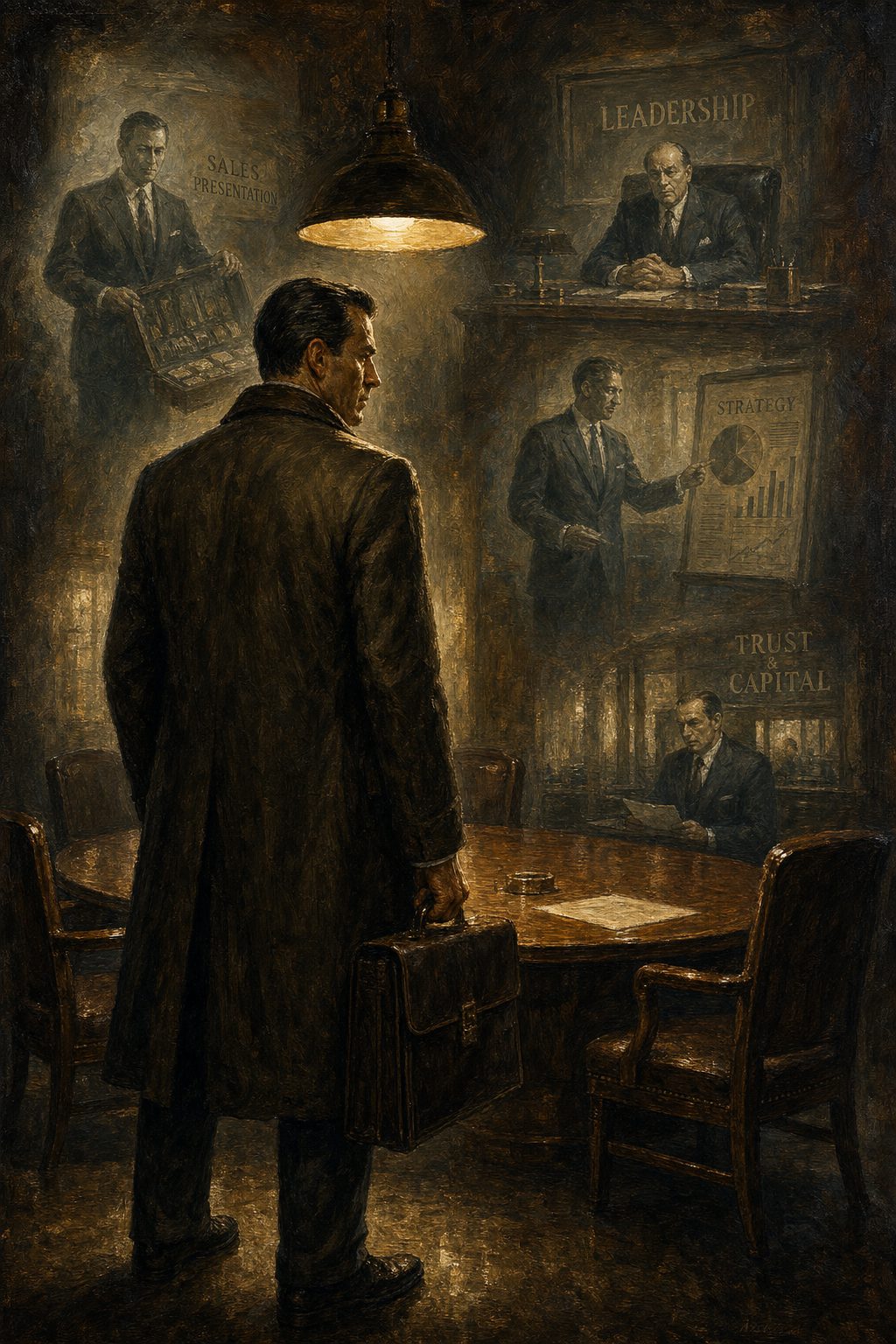
Why the salesperson, the boss, the consultant, and the banker all need the same instrument — and why three out of four are no longer allowed to use it
A four-year-old walks into an unfamiliar room and within ten seconds knows who is present. Who is angry, who is sad, who is friendly, who is lying. The child has learned no technique. It has no questionnaire. It has only something we are all born with and which we then, in the years that follow, allow to be systematically squeezed out: the primal feeling.
This article is about what happens when that same instrument — the human antenna that in ten seconds measures what no device can measure in ten years — disappears from the professions where it really matters. Salesperson. Manager. Consultant. Banker. Four professions that do essentially the same thing: make decisions about people, with people, for people. And four professions in which the instrument needed to do that is systematically switched off.
The salesperson
The sales rep who walks in on a client scans exactly the same thing in the first few seconds as the child entering the room. Not consciously. Not with techniques from a course. With the primal feeling. He senses whether this man is tense, tired, proud of something, afraid of his boss, lonely, rushed, uncertain about a decision he has to make today. That is not in words. That is in the set of the shoulders, the pace of breathing, the way the secretary announced him, the look when the coffee was poured.
The sale happens there. Not in the presentation. Not in the price negotiation. Not in the brochure. Those come later and are almost always rationalisations after the fact.
Most sales training works at the wrong level. SPIN method, five steps to the close, handling objections, question techniques — all the top layer. That only works if the bottom layer is already right. Does the client feel at the primal-feeling level that they are being seen, that they are not prey, that there is no hidden agenda? Then they accept the technique layered on top. Do they not feel that? Then they register every technique as manipulation and shut down.
That only works if the bottom layer is already right.
The best salespeople who ever walked the earth were almost never the slickest. They were people who came in calmly, actually looked, actually listened, and only spoke when they understood what the other person needed. They often sold by not selling — by saying "this product is not for you, but I know someone who can help you." After that, the client came back, and brought three others with them.
The boss
The same instrument, different scale. The entrepreneur who has built something from nothing — the baker who became a chain, the mechanic who became a factory, the inventor who started an industry — always used the primal feeling. He had no choice. He had no marketing department, no consultants, no dashboard. He had his gut. He sensed which client would come back, which supplier would let him down, which employee would grow, which product would click before the figures showed it.
That is not mysticism. That is the same antenna as the salesperson, only pointed at a broader field. Not one client in one meeting, but hundreds of people, markets, currents, moods. He senses when the staff are grumbling before anyone says it out loud. He senses when a market is turning before it's in the newspaper. He senses when a meeting is fake.
Here is where things change, and here is where the break occurs. The hired CEO is in nine out of ten cases someone who reached the top through the upper brain layer. He attended the right university, did the right internships, had the right mentor, climbed the right corporate ladder. He was selected by committees who also operate at the top layer. The whole filter sifted out the primal feeling, not kept it in.
That is why we see the same pattern time and again: a company built by an entrepreneur with antenna is taken over by a professional without antenna. The figures keep running well for a few years on the inertia of what the founder built. Then it starts to slide. The CEO doesn't understand why, because his dashboard is still showing green. He brings in consultants. They also have no antenna, because they were selected in the same way. Together they devise reorganisations that squeeze the last primal feeling out of the organisation — the old hands who still felt something are made redundant because they "no longer fit the strategy." Five years later the company is up for sale. The CEO leaves with a bonus and becomes CEO of the next one.
The consultant
And then comes the sharpest edge of all — the moment when an outsider must decide whether a near-bankrupt company still has life in it or not. The figures never give a definitive answer here. With large losses or large profits they do their job well enough — loss is loss, profit is profit, you don't need to feel anything. But in the narrow zone — the tiny plus, the just-about, the almost-round — the outcome hinges on something else. Two companies with identical figures can have opposite outcomes in this zone. One makes it through, the other sinks. The accountant builds two scenarios: with certain assumptions it works, with others it doesn't. The question is what is going to happen tomorrow, and that is nowhere in the figures.
The consultant who only works at the top layer — and that is the vast majority of turnaround managers, receivers, and restructuring advisors — fundamentally cannot answer this question. He can build models, run scenarios, do sensitivity analyses, but he cannot feel whether there is still life in this company. He can see whether the balance sheet can be made to work with a certain assumption, but he cannot see whether that assumption holds.
That is why we see the familiar outcomes: companies that according to every model could have been saved go under anyway after the restart, while other companies that according to every model were dead bloom again as soon as the right person takes the helm.
The consultant who still has his primal feeling walks into the company and knows within three days where it really sits. He talks to the receptionist, the driver, the oldest mechanic on the shop floor, the youngest secretary. He senses whether there is still pride, whether there is still craftsmanship, whether there is still someone who dreams about the company at night. He senses whether leadership still believes in what they do or whether they have been updating their CVs for months.
He sees whether the old founder is still somewhere in the shadows, or whether the company has been fully taken over by professionals without antenna. He sees whether customers still come out of love or only out of habit. He sees whether the product still has a soul somewhere or has become pure price.
These are all things you cannot measure but which completely determine the outcome. A company with figures in the red but with a shop floor that still glows can be saved. A company with figures barely in the plus but with a shop floor where nobody believes in anything anymore is dead — only it doesn't know it yet.
So there is a double requirement that is rarely recognised here. The consultant must not only have antenna himself, he must also be able to measure the antenna of the leadership. He must be able to sense whether the people who run the company still have feeling in them. That is a measurement at a level for which no instrument exists other than one's own primal feeling.
And this explains why most turnarounds fail. Not because the figures were miscalculated, but because the consultant measured at the wrong layer. He read the balance sheet and not the people. He assessed the business plan and not the look in the eyes of the director presenting it.
A restart that truly succeeds almost always follows the same pattern: there is someone who senses where the company came from and where it can go. Sometimes it is the founder coming back. Sometimes it is a new owner who has been an entrepreneur themselves and recognises what is still there. Sometimes it is a key figure from the shop floor who is promoted because they alone still sense what the company actually is. In all these cases, financing matters, but it comes second. Antenna first, then capital. The other way around doesn't work — capital without antenna is notoriously the recipe for slow loss.
The restart that fails also almost always follows the same pattern: a new owner without connection to the company, an interim manager from a pool of professionals, an advisory board full of people who have never made a product or served a customer. The figures get polished, cuts are made, the staff go on training courses, a new corporate identity arrives. Two years later the company is on the market again, this time for less than the first time.
The banker
And then comes the most devastating application of the whole model, because in the banks the primal feeling has not merely been lost — it is institutionally forbidden.
The village banker of fifty years ago, the director of the local branch who financed the farmer and the blacksmith and the baker, did precisely one thing well: he felt the human being sitting across from him. He knew whether this farmer got up at five in the morning or not. He knew whether that blacksmith had taught his son something or whether the business would end with him. He knew whether the baker's wife was quietly doing the bookkeeping because her husband couldn't manage it. He knew the children, the health, the temperament, the drinking.
On that basis he extended credit. The figures were there, but they were supporting evidence. The real question — will this person pay this money back — was answered at the primal-feeling level, with information that appeared nowhere in the books. And that banker was right. Default rates were low. Not because the system worked so well, but because the measurement was being taken at the right layer.
A bank today cannot work that way. Not because its bankers are less smart, but because the system forbids it. Every credit decision must be "substantiated." Substantiated means: traceable to figures, rules, scores, models. Someone who says "I'm giving this man credit because I can see in his eyes that he will pay it back" is immediately overruled by risk management. He cannot explain it to the audit committee. He cannot defend it before the regulator. So he doesn't do it.
What he is allowed to do: run a score based on the past. What was the cash flow for the last three years? How much collateral is there? What does the credit rating say? What does the sector analysis say? What do the stress scenarios say? All figures from yesterday, all mapped by models that assume the future resembles the past.
But a business that needs money needs it precisely because the past is no longer sufficient. It is in transition, or just starting, or turning around. The business that fits the past perfectly doesn't need the financing — it has its own cash flow. The request for credit comes by definition from a company trying something new. But the system measures precisely for the old. So the entrepreneur who is doing something new gets no loan, and the business that has been doing the same thing for years does get a loan — while the second is often on a dead-end road and the first is the future itself.
This is not merely unjust. It is systematically wrong. We have calibrated the measuring instrument in such a way that it picks up precisely the wrong signals.
We have calibrated the measuring instrument in such a way that it picks up precisely the wrong signals.
And the law that follows from this can be summed up in one sentence: they can only give credit to those who don't need it, and those who do need it they leave to drown.
This is not an unfortunate side effect. It is the logical outcome of a system that measures the past and ignores the future. Those who don't need it have by definition a beautiful past — cash flow, collateral, profitability, predictability. The model says green. The loan goes to someone who didn't need to ask for it. The bank earns safely. Those who do need it have by definition an unsettled past — a dip, a transition, a new start, a phase where it has yet to be seen whether it works. The model says red. The loan is refused to someone for whom it would have made the difference between surviving and going under. The bank "avoids risk."
And this is precisely the reverse of what a bank should do. A bank should bear risk. That is what it is paid for. Assessing risk in a way nobody else can — that is its social function. Otherwise it is not a bank, it is a pass-through.
Every entrepreneur knows this. The first time you need money, you can't get it. Because you have no history, no collateral, no track record. The next times, when you no longer need money, you get it — three banks call you unsolicited with offers, because now you have figures. So you have to survive the first phase without a bank. With your own money, family money, friends' money, supplier credit, customers who pay upfront, personal guarantees, your house as security, your pension as reserve. Those who have no family money, no house, no reserve — they have no access to the system called entrepreneurship. Full stop.
This is a filter that never names itself as such, but which in practice operates as a class mechanism. People with family capital get through. People without it don't. The inequality we then try to solve with taxes is at its core created at the moment the bank refused the first loan to someone who should have had it.
The pattern that repeats
Salesperson, boss, consultant, banker. Four professions, one instrument, one recurring problem. On the top brain layer — the human layer of rules, models, procedures, rationalisations — ever more is being built. On the bottom layer — the primal feeling that in ten seconds measures what no model measures in ten years — ever less is being trusted.
The same pattern every time: rules grow, judgement disappears, responsibility fragments, nobody is accountable anymore, and reality gets progressively worse while the reports get progressively better.
A healthy organisation has the right work at each layer. At the primal-feeling level: sensing what customers, employees, and markets really want. At the mammalian-brain level: building relationships, building trust, cultivating loyalty, carrying culture. At the human-brain level: structuring, planning, optimising, contracting, reporting.
What we have in most large organisations now: the top layer everywhere, the middle layer in HR-speak, the bottom layer nowhere. And then we wonder why employees burn out, customers leave, innovation stalls, and entrepreneurs suffocate.
Where this leads
A system that only gives credit to those who don't need it finances by definition the existing. The existing gets bigger, more powerful, more untouchable. The new gets no chance. The large companies get larger, the small ones stay small, the non-existent are never born.
This is not a free market. This is a privilege system that calls itself a free market. Competition is a fiction — whoever has no access to capital doesn't play. And whoever does have access is usually the one who has already won.
That is why we see what we see: a handful of large players per sector, untouchable positions, oligopolies in virtually every market, margins that competition no longer erodes, and fewer and fewer new companies that truly grow. New business formation is declining, average company size is rising, market concentration is increasing, social mobility is decreasing. All of this is one long downstream consequence of the fact that the people who decide about people are no longer allowed to see people.
The gap nobody names
And that is precisely what is never said out loud in the entire turnaround, consultancy, and banking world. The whole profession rests on a measurement that is no longer permitted. The consultant who wants to do his work well must covertly feel what he is officially not allowed to feel. The banker who wants to make a genuinely good loan must use his own instrument while the system forbids that instrument. The salesperson who truly wants to sell must unlearn the whole course he was obliged to follow.
Whoever still has antenna must keep it secret. Whoever no longer has antenna gets to build a career. This is not an exaggeration. This is precisely what we have built.
What the consultant can do who reads this
Don't go to the accounts first at the next company. Spend the first three days walking around. Talk to people who are normally not asked. Sense whether there is still someone somewhere who believes. Sense whether leadership still has antenna or whether they are only reading dashboards. Sense whether the shop floor is still glowing or whether it has already gone out.
Write your analysis only after that. Let the figures confirm the story your antenna has already told you. Not the other way around. If the figures say something different from your antenna, go back and look at what you missed — usually the antenna is right and the figure has a hidden assumption that doesn't hold.
Dare to write in your report what you feel, not only what you can substantiate. Not literally — "I feel that" will convince nobody — but through your formulation. "This company still has direction" is a conclusion you can defend without laying out the whole methodology beneath it. "This company has already stopped internally" likewise. Both are measurable, but not in the way taught at universities.
And know: you are the instrument yourself. Not your model. Not your software. Not your method. You. Whether your primal feeling is still intact determines whether your judgement is worth anything. Keep that instrument clean. Sleep enough. Walk away from conversations you can see turning toxic. Don't work for clients who switch off your antenna. It is your only real means of production.
In closing
The four-year-old who walks into the room and in ten seconds knows who is there — that child would be a better consultant than a department of fifty analysts. Not because the child knows something they don't, but because the child can still measure where they are no longer allowed to measure.
The question of our time is not how we refine our models. The question is how we get our antennae back. And that question begins, like everything, with the children we are raising now. But for those already in the profession, there is a second question: are you still willing to use your own instrument, even when the system forbids you to? Because without that willingness, your profession is a ritual dance around a patient who is quietly slipping away.
This is edition 3, article 9. It belongs to openvizier.org and to the earlier pieces on the primal feeling, the three brain layers, and what we do to children. For those curious about the underlying model: see the reference works "Denkbasis 7D-gevoelsmodel" and "Onderwijs en opvoeding in het AI-tijdperk".
The Primal Feeling in Professional Practice
A four-year-old enters a room and in ten seconds knows who is angry, who is sad, who is lying. Salesperson, manager, consultant, banker — all need the same instrument. Three out of four are no longer allowed to use it.
"The human antenna that in ten seconds measures what no device can measure in ten years — switched off in the professions where it matters most."
The salesperson and the boss
The rep who walks in scans exactly what the child scans: tense, tired, proud, afraid, rushed. The sale happens there — not in the presentation or the price. Most sales training works at the wrong level; technique only works if the client feels at the primal level that they are seen, not prey. The best salespeople were never the slickest. They looked, listened, and sometimes sold by not selling.
The boss is the same antenna, broader field. The founder senses which client returns, which supplier fails, which market turns — before the figures show it. Then the hired CEO arrives, selected through the upper brain layer by committees who also operate there. The whole filter sifts the antenna out.
The consultant
The sharpest edge: deciding whether a near-bankrupt company still has life in it. The figures never give a definitive answer in the narrow zone. The consultant who works only at the top layer can build models but cannot feel whether there is still life. The one who keeps his antenna walks the floor first — talks to the receptionist, the driver, the oldest mechanic — and senses whether there is still pride, still someone who dreams about the company at night.
A company in the red but with a shop floor that still glows can be saved. A company barely in the plus but where nobody believes anymore is dead — it just doesn't know it yet. Antenna first, then capital. The other way around is the recipe for slow loss.
The banker
The most devastating application, because here the primal feeling is institutionally forbidden. The village banker of fifty years ago financed the farmer and the baker by feeling the human across from him; default rates were low. Today every decision must be "substantiated" — traceable to scores and models built on the past. But a business that needs money needs it precisely because the past is no longer sufficient.
"They can only give credit to those who don't need it, and those who do need it they leave to drown."
A bank should bear risk — that is what it is paid for. Instead it has become a filter that lets people with family capital through and leaves the rest out. The inequality we try to fix with taxes is created the moment the bank refuses the first loan.
The pattern that repeats
Four professions, one instrument, one problem. On the top layer — rules, models, procedures — ever more is built. On the bottom layer — the primal feeling — ever less is trusted. Rules grow, judgement disappears, responsibility fragments, and reality gets worse while the reports get better. Whoever still has antenna must keep it secret. Whoever no longer has it gets to build a career.
The result: oligopolies in every market, declining new business formation, rising concentration, falling mobility — all one downstream consequence of the people who decide about people no longer being allowed to see people.
Close
For those already in the profession: go to the floor before the accounts. Sense whether someone still believes, whether the shop floor still glows. Let the figures confirm the story your antenna has already told. And know — you are the instrument yourself. Not your model, not your software. Keep it clean. Sleep enough. Don't work for clients who switch off your antenna. It is your only real means of production.
"The question of our time is not how we refine our models. The question is how we get our antennae back."