The three brain layers
Primal feeling, mammalian brain, human brain
Theory · 13 min read
By Jacobus van Merksteijn
There is an experience almost everyone knows but most people cannot explain. You study something intensively — a mathematical problem, a difficult situation, a question you can't let go. You can't crack it during the day. You go to sleep. The next morning the answer is there. Not as a conscious reasoning process, but as a present knowing that wasn't there before.
Poets have written about it. Scientists have attributed their breakthroughs to it. Kekulé saw the ring structure of benzene in a dream. Mendeleev saw his periodic table in a sleep vision. Poincaré described how an insight struck him the moment he stepped into a carriage, after weeks of fruitless conscious effort.
The conventional explanation is that the brain "keeps working in the background." That is not an explanation. It is a repetition of the observation in different words. The real question is: what is the brain doing exactly, and why does it work that way?
The answer begins with the architecture.
Three layers, three functions
The human brain is not a unity. It is a layered structure built up in layers over the course of evolution, one on top of the other, and which in daily functioning operates as a single whole — but is not always that.
The bottom layer is the oldest part: the brainstem and the structures coinciding with what the neuroscientist Paul MacLean called the "reptilian brain." The basal ganglia, the amygdala, the structures we share with reptiles and early mammals. This is the seat of the primal feeling: the direct, prelingual perception of reality. No words, no categories, no argument. Pattern recognition. Direct response to the situation. Faster than conscious thought can ever reason.
The middle layer is the limbic system — the mammalian brain. Here live feelings as colour and intensity: the terracotta of power, the deep blue of powerlessness, the purple of envy. No labels — because in the limbic layer, feelings are simply there. They have weight and direction. But they are not yet captured in a sentence. This is the layer we share with all the mammals that walked this earth before us, from wolves to elephants to dolphins.
The top layer is the neocortex — the linguistic brain. The great language-processing machine. The cortex names things. It categorises. It talks. "This is jealousy." "This is fear." "This is love." That naming is useful, but it is also a reduction: the feeling gets locked into a category, and the category is always too narrow for the actual experience. The cortex produces a great deal. It doesn't always understand what it produces.
The top layer is the neocortex — the linguistic brain.
Three layers, three functions: the primal layer reads directly, the limbic layer colours and processes, the cortex names and speaks. When all three work together — when the primal layer passes on its direct reading, the limbic layer deepens it into a felt pattern, and the cortex finally gives it words — a human being functions at its fullest. He knows what he feels, he feels what he knows, and he can talk about it.
But there is a movement that almost nobody explains, and which changes everything.
The daytime stream
The daytime stream runs upward: from the limbic system to the cortex. A feeling — a tension, a colour, an intensity — wells up from the limbic layer and seeks words in the cortex. "This is jealousy." "This is the feeling of not belonging." "This is the discomfort of a situation that's off."
That naming is useful. It lightens the cortex. It makes speakable what was previously only feelable. But the daytime stream is not the end of the story. Because what the cortex receives from below and dresses in words has not thereby been processed. It has been named. That is a different thing.
When the daytime stream gets blocked — when feelings no longer reach the cortex, or when the cortex refuses to receive what comes from below — what arises is what I call the learned empty-function: the feeling is there, in the limbic layer, but the cortex has learned to dismiss it. "Don't be so sensitive." "You're imagining things." "Can you back that up?" Decades of those sentences produce someone who no longer hears their own emotional life. The cortex has won. It has not merely overwritten the feeling — it believes its own overwriting.
That is the most widespread psychological condition of our time, and it has no name in the DSM.
The nighttime stream
The nighttime stream runs downward: from the cortex to the limbic system. This is what happens at night. This is the key.
During REM sleep — the phase with rapid eye movements, vivid dreams, the most intense neural processing — all external input streams are effectively cut off. The body is immobilised by muscle paralysis so that movement signals from the dream are not executed. The cortex cannot receive new information from outside. It is on its own.
In that closed-off state, the real processing begins. The experiences of the day are replayed, sorted, weighed. The cortex compares the new material against existing patterns in the deeper structures. Where there is tension between the new and the existing, the tension resolves. The result is that what was present as a word during the day gets integrated overnight into an existing pattern of felt sense. Knowledge descends.
This is the movement Kekulé knew. Not the benzene ring as conscious reasoning — the ring as a pattern that found its place at night, in the downward stream, in the deep structure of feeling. And that was present in the morning, when the cortex came back online, as a knowing that had not been there before.
Not the benzene ring as conscious reasoning — the ring as a pattern that found its place at night, in the downward stream, in the deep structure of feeling.
I describe this as "casting downward in closed phases": the cortex casts its material downward to the limbic system overnight, in a cycle protected from new external input. What appeared above as a word during the day descends at night as feeling. Knowledge becomes wisdom. Information becomes felt sense.
There is also a third stream: the primal stream, which runs from the primal feeling to the limbic layer. This is the continuous background stream. The primal feeling reads without ceasing — it is always active, always registering. The information rises like a constant underground river. When you walk into a room and feel that something is off — without being able to name it, without having perceived anything specific — that is the primal stream that has reached the limbic layer but not yet the cortex.
Why insight alone is not enough
Here is the practical consequence that virtually all psychotherapeutic schools miss or underestimate.
There are two types of knowing that differ qualitatively from each other. Cortex-knowing: the knowledge you can state, argue, defend. The knowledge that passes exams, writes papers, holds its own in a conversation. And limbic knowing: the knowledge you cannot explain but which steers your compass, which you feel directly in situations, which protects you from danger and guides you toward opportunities.
REM sleep is the bridge that converts the first into the second.
When someone has truly learned something — not as a cortex-fact but as a felt pattern — it has always been after a period of processing, of sleep, of nocturnal sedimentation. It is the difference between someone who has read a book about swimming and someone who has learned to swim. Both have knowledge. But the second has let the knowledge descend into the structure of his body, his limbic system, his primal feeling. He can swim.
This explains a phenomenon that therapists know but rarely name honestly: people who go to therapy for years, understand a great deal about themselves, but change very little in practice. They have acquired cortex-knowledge. They know their fear traces back to what happened in their early childhood. They know what their patterns look like. They can explain it. But the patterns are still there. The behaviour doesn't change.
That is not a failure of the therapist or the patient. It is the consequence of a system that works primarily through the cortex — through words, through insights, through conversation — and thereby serves the layer with the least power to change. The cortex names. The change lives below, in the limbic layer, and that layer is not reached through words. It is reached through the nighttime stream — through the nocturnal sedimentation of experiences gathered during the day that are given the chance to descend.
Good therapy facilitates that descent. Body-oriented approaches, ritual repetition, artistic interventions that touch the limbic layer directly through colour, rhythm, melody, movement — all of this works on the layer where real change lives. And sleep — sleep of sufficient quality and duration — is the most underestimated instrument for therapy and self-development that exists. Not sleeping is not merely unhealthy. It prevents the descent. Knowledge stays stuck in the upper layer, volatile and unanchored. The person does not grow wise from their experiences.
The painting as illustration
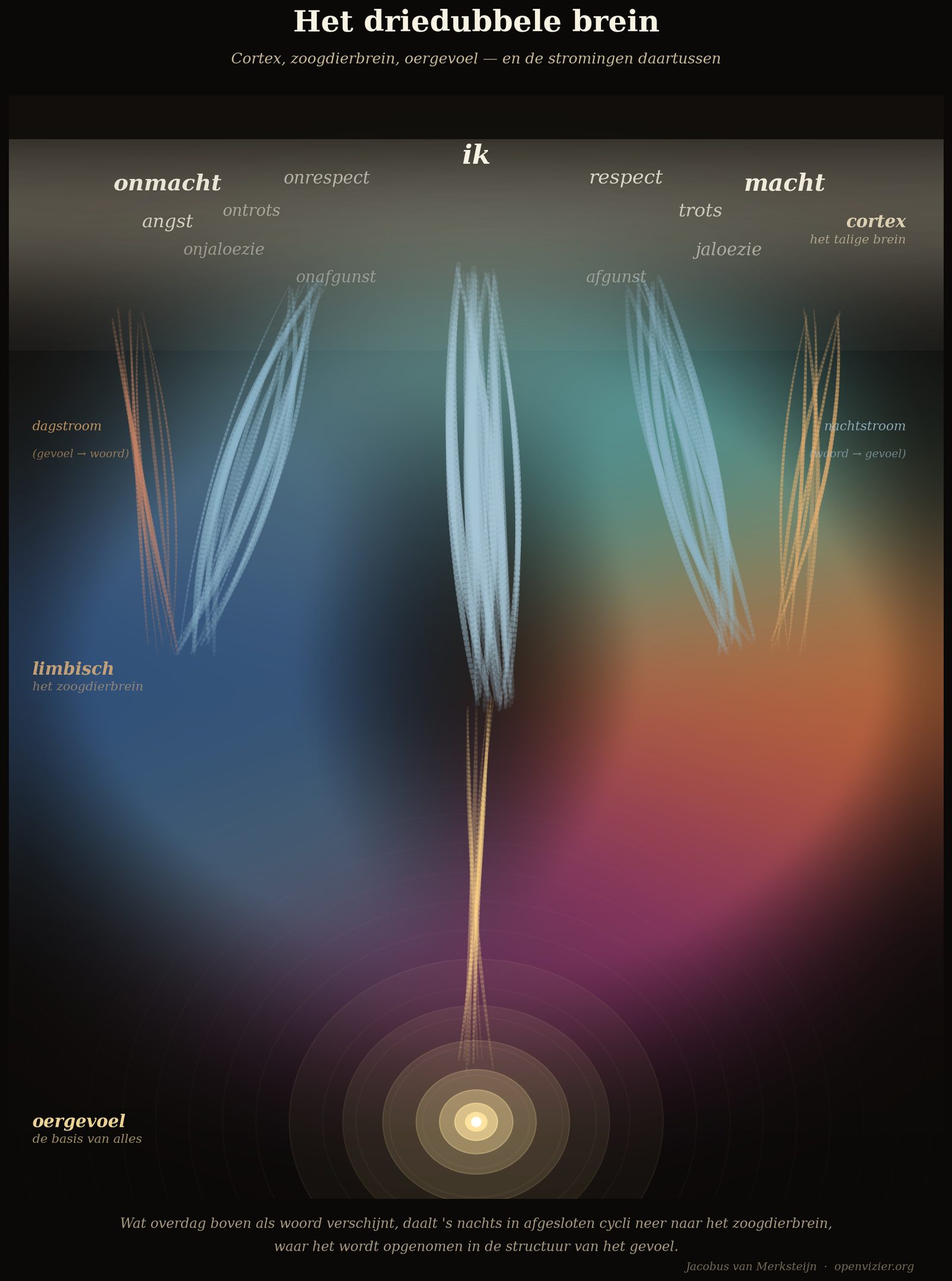
There is a painting that depicts the three brain layers in a way that goes beyond words. I had this painting made as an illustration for the theoretical work, and I refer to it here as a visual anchor for those who want to understand the model not only in words.
In the painting, the primal feeling appears as an intense point of light deep at the bottom, surrounded by rings of soft radiance spreading in all directions. The limbic layer is depicted as large, overlapping fields of colour: terracotta for power, teal for respect, deep blue for powerlessness, purple for envy. No labels — because in the limbic layer, feelings exist without words. The cortex is the thin band at the top, with words pulsing within it: respect, jealousy, pride, power, fear. The cortex names. It is the lightest layer, the most fleeting.
Between the layers run the streams. Upward the daytime stream — the welling of feeling toward word. Downward the nighttime stream — the downward processing in closed phases. And as a continuously sustaining stream, the primal stream, which wells up from the deepest point of light like an underground river that never stops.
Upward the daytime stream — the welling of feeling toward word.
The model is not mystical. It is architecture. Whoever understands the architecture also understands what they are standing before when they wake up in the morning knowing something they did not know the evening before.
The lesson for education
An educational system that overloads children with activity and robs them of the stillness and sleep needed for real learning configures them as machines that perform but do not grow wise. Cortex material piles up. The nighttime stream cannot process it — there is too little sleep, sleep is disturbed by screens, the stillness that protects the descent is systematically absent.
The result is children who know a great deal and feel very little. Who score highly on tests and have lost their compass. Who can retrieve factual knowledge but don't know what they want to do with it. Who arrive at university at eighteen with an impressive cognitive apparatus and a completely ungrounded inner life.
The education that takes the three brain layers seriously does the opposite: it protects the primal layer, it feeds the limbic layer through stories, movement, nature, and stillness, and it offers the cortex its words only when there is something for those words to rest on. Knowledge offered to an empty limbic layer dries up quickly. Knowledge that settles onto a rich emotional ground becomes wisdom.
That is the difference between a school system searching for the shortest path to a diploma, and a learning system taking the long path toward a human life.
For further reading: the complete elaboration of the three brain layers, the day and night streams, REM sleep as a neural learning technique, and the three types of empty-functions is in the work Denkbasis voor een 7-dimensionaal gevoelsmodel. The pedagogical consequences — what a school day looks like when the nighttime stream is taken seriously — are in the Manifest voor onderwijs en opvoeding. Both works are available for download on openvizier.org.
The pedagogical consequences — what a school day looks like when the nighttime stream is taken seriously — are in the Manifest voor onderwijs en opvoeding.
The Triple Brain and What Happens at Night
You wrestle with a problem all day, can't crack it, sleep — and the next morning the answer is simply there.
"'The brain keeps working in the background' is not an explanation. It is a repetition of the observation in different words."
Three layers, three functions
The brain is not a unity. The bottom layer — brainstem, basal ganglia, amygdala — is the seat of the primal feeling: prelingual pattern recognition, faster than thought. The middle layer, the limbic system, holds feelings as colour and intensity, with weight and direction but no words. The top layer, the neocortex, names and categorises — useful, but always a reduction, because the category is too narrow for the experience.
When all three work together, a human functions at his fullest: he knows what he feels, feels what he knows, and can talk about it.
The daytime stream and its blockage
The daytime stream runs upward: a feeling wells up from the limbic layer and seeks words in the cortex. Naming lightens the cortex — but a named feeling has not thereby been processed. When the stream is blocked, by "don't be so sensitive," "you're imagining things," "can you back that up?", the result is the learned empty-function: the feeling is there, but the cortex has learned to dismiss it.
That is the most widespread psychological condition of our time, and it has no name in the DSM.
The nighttime stream
The nighttime stream runs downward, from cortex to limbic layer. During REM sleep all external input is cut off; the cortex is on its own. The day's experiences are replayed, sorted, weighed against existing patterns. What was a word during the day descends overnight into felt sense. Knowledge becomes wisdom. This is the movement Kekulé knew when the benzene ring found its place in a dream.
Why insight alone is not enough
Two kinds of knowing differ qualitatively. Cortex-knowing: what you can state, argue, defend. Limbic knowing: what you cannot explain but which steers your compass. REM sleep is the bridge that converts the first into the second — the difference between someone who has read a book about swimming and someone who can swim.
This explains people who go to therapy for years, understand everything about themselves, and change nothing. They have acquired cortex-knowledge. The change lives below, and that layer is not reached through words. Sleep is the most underestimated instrument for self-development that exists.
Close
A system that overloads children with activity and robs them of sleep and stillness configures them as machines that perform but do not grow wise. The result: children who know a great deal and feel very little, who score highly and have lost their compass. The opposite is possible — protect the primal layer, feed the limbic layer, offer the cortex its words only when there is something for them to rest on.
"That is the difference between a school system searching for the shortest path to a diploma, and a learning system taking the long path toward a human life."