The primal feeling
What the first layer is and how we feel it
Chapter · 12 min read
By Jacobus van Merksteijn
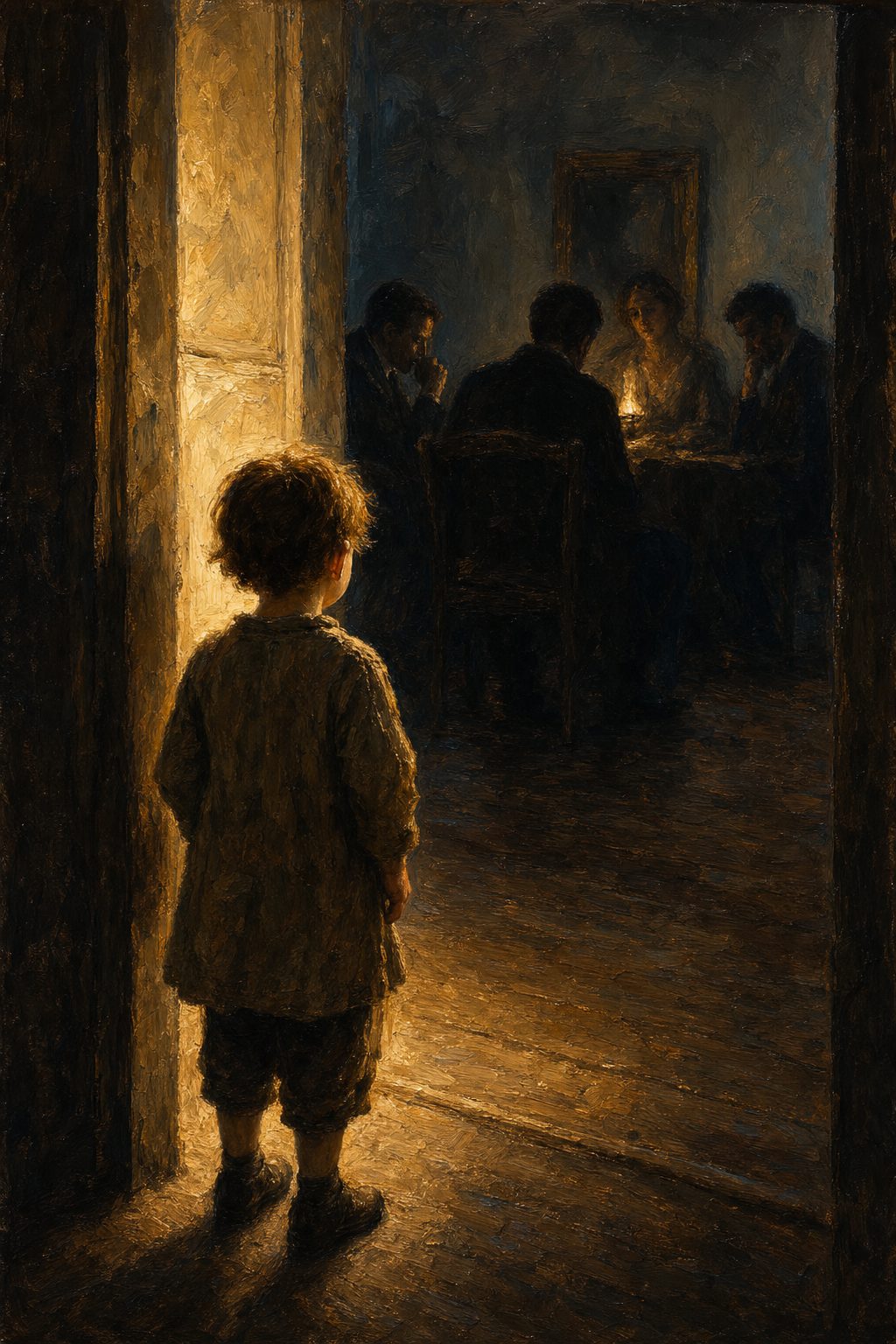
A four-year-old walks into a room. Three adults are sitting there. The child knows none of them. Within ten seconds, the child knows who's running the show. Not who holds power in any hierarchical sense — the child doesn't have that concept yet. But it knows who is genuinely present and who is performing. It knows who is afraid and who feels safe. It knows whose lap it wants to sit on. That knowledge needs no words. It needs no argument. It is simply there, immediate, complete — like a compass pointing north.
That is the primal feeling.
I described it in edition 2, but there as personal property — as something I happened to preserve because my mother, by shielding me from the world, also shielded me from the wear and tear that squeezes this capacity out of virtually everyone else. This article is not about me. It is about the capacity itself, and about what we as a society do with it.
What the primal feeling is and isn't
The primal feeling is not intuition in the fuzzy popular sense. Not the feeling that you should do something without knowing why, which mayor may not prove right later. That is guessing. The primal feeling is more precise than guessing. It is the direct connection between perception and insight, without the intermediate step of verbal reasoning. It operates in real time, on the situation in front of you. A dog assessing a human for fear or calm does exactly the same thing — and is strikingly accurate at it. A baby deciding whether a voice sounds safe, without knowing a single word, does exactly the same thing.
Neurologically, its seat is in the oldest parts of the brain — the amygdala, the basal ganglia, the structures we share with every mammal that walked this earth before us. Long before the neocortex appeared in evolution as a language-processing machine, these structures were already processing information about the outside world. They did so not through reasoning but through pattern recognition, through direct response to situations. Faster than the cortex can ever reason, and in many situations more reliable — because the cortex always filters, delays, and bends things in the direction of what it expects to see.
They did so not through reasoning but through pattern recognition, through direct response to situations.
The primal feeling is therefore not the opposite of thinking. It is thinking's predecessor. It is the foundation on which everything that comes later rests. Whoever loses that foundation has knowledge but no compass.
Why children and animals have it
Children and animals have the primal feeling relatively intact because they have not yet — or barely — experienced the pressure of social correction. A two-year-old who walks into a room and sees a stranger reacts directly — with joy, caution, or fear. That reaction is information. It contains an assessment that the child, with its limited cognitive resources, could not have arrived at any other way. The assessment is not always perfect. But it is not random either. It is functional — produced by a system that evolution has optimised for precisely this kind of rapid social reading.
A dog assesses a human for fear or calm within the first two seconds of contact. It asks for no justification. It takes no time for analysis. It reads the situation directly, and its assessment is statistically more reliable than most human cognitive judgements about the same situations. That is no miracle — it is evolutionary selection. In a world of immediate danger, rapid situational awareness is critical. A system that is too slow, that requires too many intermediate steps, is lethal in that world.
A system that is too slow, that requires too many intermediate steps, is lethal in that world.
Children in their earliest years are experts at the primal feeling, not despite their limited cognitive development but partly because of it. They have not yet fully deployed the cortex as a filter. What they feel, they still feel completely. They have not yet learned that feelings are dangerous, or unscientific, or immature. Those lessons come later. And they come systematically.
How the school system eradicates it
The most direct assault on the primal feeling is a sentence every child hears hundreds of times in their first years of school: "Can you back that up?"
The sentence is not inherently malicious. In the right context — a claim about reality that needs testing, a plan that needs thinking through — it is a perfectly legitimate question. But when it becomes the only legitimate question, when it becomes the default response to every direct perception a child expresses, it is devastating. Because the primal feeling works precisely by bypassing the cortex step. It is prelingual in nature. It does not deliver an argument. It delivers direct knowledge.
What happens next when a child is systematically told that knowledge without argument doesn't count: the child learns to distrust its own direct perceptions. "I feel that something is off here" gets replaced by "I'm not sure, I guess I'll believe it." By the time the child can actually provide the argument — because it does learn to reason, the system is good at that — the feeling itself is gone. The cortex has taken over. What remains is a reasoner who is not bad in itself, but who has lost its deepest source of information.
What happens next when a child is systematically told that knowledge without argument doesn't count: the child learns to distrust its own direct perceptions.
The Prussian skeleton of our education — sit still on cue, give the right answer as determined by someone else, respond when permitted — has this effect as a structural feature. Not as an unfortunate side effect, but as a feature. The system was designed for the industrial revolution, which needed obedient, predictable, group-coordinated workers. At that goal it succeeded brilliantly. But the price was the primal feeling, and that price is now visible in virtually everything that plagues civilisation.
And then there is screen time. Smartphones, tablets, streaming platforms — all designed to capture maximum attention through maximum stimulation. The primal feeling functions in stillness, in slowness, in uninterrupted presence with a single situation. It reads people and situations, but slowly and deeply. A child who has a screen for four hours a day is exposed for four hours a day to an environment that actively drowns out its direct perception. After years, not only is the primal feeling dulled — even the basic capacity for stillness has disappeared. And whoever cannot be still cannot hear themselves.
What society loses
Three crises, one cause.
At its deepest level, the climate crisis is not an information problem. The graphs are there. The scientific consensus is unambiguous. And yet behaviour doesn't change at the scale required. That is not indifference. It is the consequence of a population that has learned to understand reality as a system of numbers and arguments, but which has lost the ability to feel reality as a living whole of which it is part. Facts do not move people. Feeling does. The feeling has been systematically destroyed.
The polarisation crisis is not a crisis of opinions. Two people cannot enter genuine contact when they have lost the ability to directly feel what is present in the other. When the cortex is the only navigation tool, every disagreement becomes a positional battle, a power struggle, a contest over who has the more convincing argument. The direct perception — the capacity to know, before any words are spoken, what is really moving the other person, what their fear is, what they mean beneath the position they're defending — that capacity has disappeared. Without it there is no dialogue. There is only debate.
The burn-out and loneliness epidemics are crises of no longer hearing what the body says, and of no longer daring to show the true self. Burn-out is the moment when the body gives up on the cortex-override — the point at which decades of ignored signals finally present their bill. Loneliness is not the absence of other people's presence. It is the absence of real contact, of being seen at the layer on which you actually exist. And that layer is the feeling layer, which is only accessible via the primal feeling on both sides.
These are not three separate problems. It is one problem, manifesting in four domains: nature, politics, work, and relationships. The common denominator is the loss of the primal feeling as a functioning compass.
The industrial mistake of the first order
I want to be clear about the seriousness of what I am claiming, because it sounds large and people are inclined to relativise claims of this kind.
The modernisation of education after the industrial revolution has produced a system that, on a large scale, in an organised and deliberate fashion, trains away the most fundamental human capacity. Not in a minority, but in virtually everyone. Not as a side effect but as the structural result of what the system does. And this at a moment in human history when precisely that capacity is needed most — because the problems waiting for us are ones the cortex alone can never handle.
Climate change is not solvable by better-trained executors of existing frameworks. Ecological collapse cannot be stopped by more efficient adaptation of the existing production system. The geopolitical tensions arising from scarcity and inequality cannot be managed by experienced diplomats operating from the same cortex-consciousness that created those tensions. What is needed are people who can read reality differently than the available categories allow. People who still have the direct connection between their perception and their insight. People who dare to act from a sense of things that has not yet been worked out into a fully argued thesis.
Those people exist. They are rare — not because nature doesn't distribute this quality, but because the system has systematically pressed it out. Every child born has it. The system takes eighteen years to train it away. In most cases it succeeds completely.
That is an industrial mistake of the first order. Not in the sense of a technical fault — the system functions excellently at what it says it does. But in the sense of a fundamental misorientation: we built what we needed for the nineteenth century, and we keep running it as if we still live in the nineteenth century. The price is not abstract. The price is visible in every newspaper, in every conversation, in every mental health report, in every climate agreement that isn't kept.
The four-year-old who walks into a room and immediately knows who's running the show — that child possesses something that society desperately needs. The question is whether we are willing to stop squeezing it out.
For further reading: the complete theoretical elaboration of the primal feeling and the three brain layers is in the work Denkbasis voor een 7-dimensionaal gevoelsmodel, and the practical translation into education and upbringing is in the Manifest voor onderwijs en opvoeding. Both works are available for download on openvizier.org.
The Primal Feeling We Squeeze Out of Our Children
A four-year-old walks into a room with three strangers. Within ten seconds it knows who is genuinely present and who is performing, who is afraid and who feels safe.
"That knowledge needs no words. It needs no argument. It is simply there — like a compass pointing north."
What it is — and isn't
The primal feeling is not fuzzy intuition or guessing. It is the direct connection between perception and insight, without the intermediate step of verbal reasoning. Its seat is the oldest part of the brain — the amygdala, the basal ganglia, the structures we share with every mammal that came before us. Faster than the cortex can ever reason, and often more reliable, because the cortex always filters, delays, and bends things toward what it expects to see.
It is not the opposite of thinking. It is thinking's predecessor. Whoever loses that foundation has knowledge but no compass.
How school eradicates it
The most direct assault is a sentence every child hears hundreds of times: "Can you back that up?" In the right context it is legitimate. But when it becomes the only legitimate question, it is devastating — because the primal feeling works precisely by bypassing the argument step. The child learns to distrust its own direct perceptions. By the time it can supply the argument, the feeling itself is gone.
The Prussian skeleton of our education — sit still on cue, give the answer someone else determined, respond when permitted — has this effect as a structural feature, not a side effect. It was built for the industrial revolution. At that goal it succeeded brilliantly. The price was the primal feeling.
What society loses
Three crises, one cause. The climate crisis is not an information problem — the graphs are there, but facts do not move people; feeling does, and the feeling has been destroyed. Polarisation is not a crisis of opinions but of having lost the capacity to feel what is present in the other, leaving only debate. Burn-out and loneliness are the bill for decades of ignored signals and the absence of being seen at the layer on which you actually exist.
These are not three problems. It is one problem, in four domains: nature, politics, work, relationships.
Close
This is an industrial mistake of the first order. The system functions excellently at what it says it does — but we built what we needed for the nineteenth century and keep running it as if we still live there. Every child is born with the capacity. The system takes eighteen years to train it away, and in most cases it succeeds completely.
"The four-year-old who immediately knows who's running the show possesses something society desperately needs. The question is whether we are willing to stop squeezing it out."