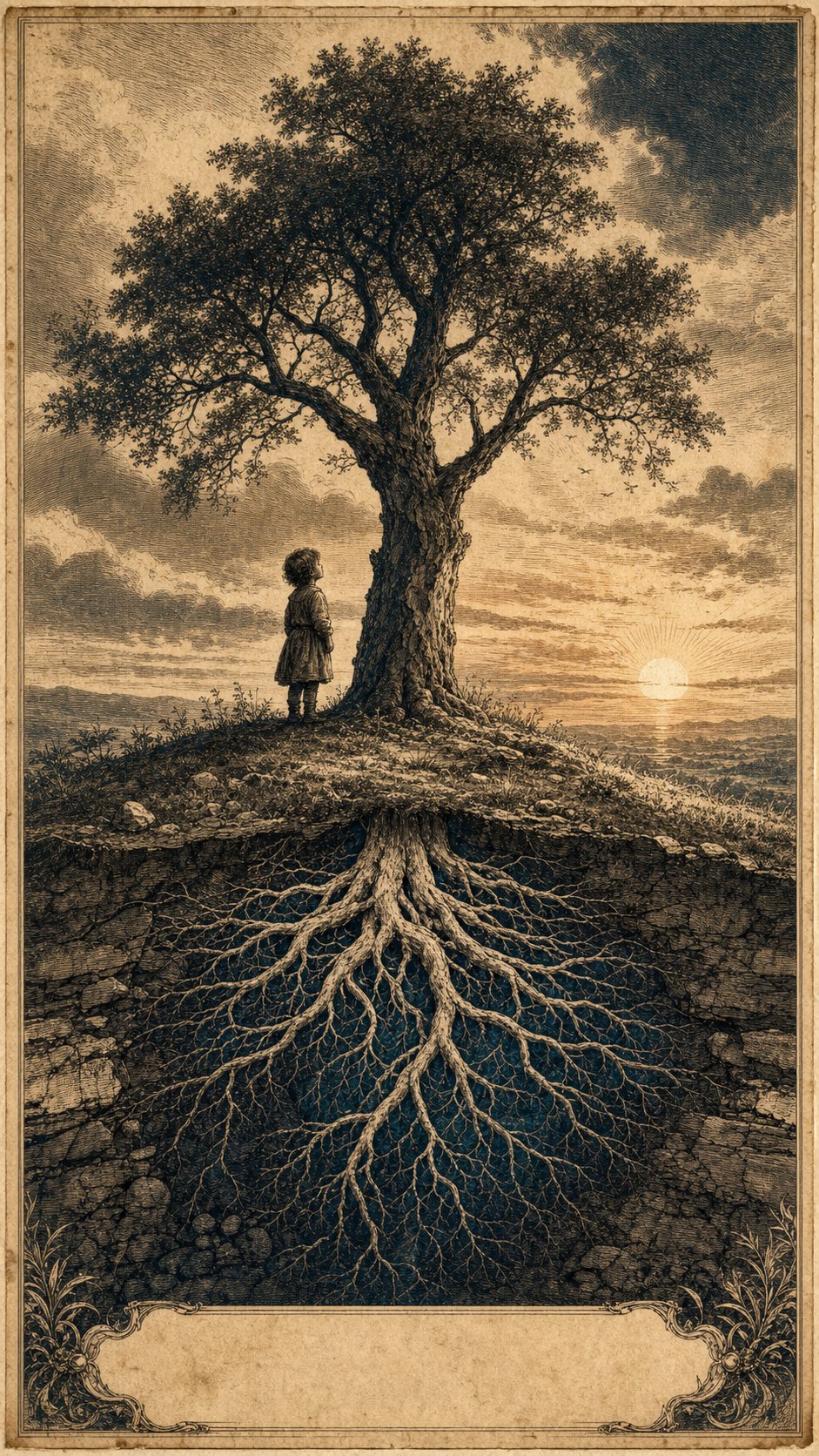
Room for the primal feeling
A manifesto for the preservation of human connection in an age of accelerating technology
Jacobus van Merksteijn · Malta, June 2026
Occasion
There is something present in the human being before he can speak, before he can read, before he names what he feels. It is neither mysticism nor technique. It is a direct, bodily form of understanding — an attunement between people that takes place before words or images mediate. I call it here the primal feeling. Other traditions speak of resonance, of attunement, of co-regulation. The name matters less than the fact.
This capacity does not disappear on its own. It is unlearned unconsciously, from the earliest years of life, through a system of upbringing and schooling that is entirely oriented towards the measurable, the linguistic, and the cognitive. What does not fit into a test is rendered invisible. What is rendered invisible dies out.
This manifesto asserts that preserving the primal feeling is not a pedagogical luxury, but a precondition for civilisation. In a century in which artificial intelligence, automation, and mediated communication will largely take over cognitive work, precisely what machines in principle cannot do — direct human presence, non-linguistic attunement, ethical judgement from experience, carrying the unspoken within a community — becomes the determining factor for whether a society remains liveable.
Diagnosis
What is being lost
The neuroscientist Iain McGilchrist has shown in two major works that Western culture has, since the Enlightenment, exhibited an increasing dominance of a narrow, analytically fragmenting mode of attention — at the expense of a broader, relationally integrating mode of perception that sees context, the implicit, and the whole.1 He calls it the meta-crisis: an accumulation of environmental, meaning, and health crises that all trace back to one underlying shift — we have learned to manipulate the world but have forgotten how to understand it.
Stephen Porges has demonstrated with polyvagal theory that the human nervous system develops through co-regulation — through calm, safe attunement with other nervous systems, in direct bodily proximity. This is not a sentimental idea but a neurophysiological fact: without that attunement, the system becomes permanently set to survival mode.2 A child confronted from an early age primarily with screens, stimuli, and performance assessment lacks the substrate upon which all later empathy, cooperation, and moral judgement rest.
How it disappears
The loss does not begin intentionally. It begins with the structure of the system itself:
- early formal literacy that gives priority to the symbolic over the sensory;
- continuous assessment that teaches children to look outward for validation rather than inward;
- screen time that replaces direct bodily presence with mediated stimuli;
- a curriculum that rewards the measurable and thereby automatically devalues the immeasurable;
- teacher training programmes that teach didactic technique but rarely the art of presence itself.
None of these elements is malicious in itself. Together they form a filter that cultivates one particular type of person — focused, productive, articulate, manageable — and allows another type of person, whom society needs most urgently right now, to slowly die out.
Why this matters now
Jonathan Haidt has documented in The Anxious Generation how, since 2010, the mental health of young people worldwide has collapsed, in direct correlation with the smartphone-based childhood.3 McGilchrist cites the figure that 85% of young people experience life as meaningless. These are not isolated symptoms. They are the measurable consequences of a culture that has abandoned the immeasurable.
At the same time, we stand at the beginning of a technological transformation in which systems such as this one — language models, autonomous agents, robotics — are increasingly taking over the cognitive, linguistic, and analytical work that schools have rewarded for decades. What the school taught us to optimise, the machine will soon optimise better. What remains as a specifically human contribution is precisely what the school has ceased to cultivate.
The manifesto
I propose the following — not as a pedagogical experiment but as a civilisational imperative:
1. Recognise the primal feeling as competence.
The capacity for direct, non-linguistic attunement with other people, with animals, with the natural environment is not a remnant from a prehistoric past. It is a high-order human skill that must be actively protected, developed, and valued — alongside and on equal footing with reading, arithmetic, and reasoning.
2. Delay formal literacy.
The first six to seven years of life belong to the body, the senses, relationships, and play. Finland — which does not formally teach its children to read until the age of seven — demonstrates that this does not come at the cost of cognitive outcomes; on the contrary.4 What is acquired in the years beforehand is not lost time but the foundation upon which all later learning rests.
3. Give unstructured time in nature the status of core curriculum.
Forests, water, weather, animals, and silence are not excursion destinations but learning environments. Research into nature-based early childhood education consistently shows better outcomes in social behaviour, language development, and respect for the living environment.5 Make this the standard, not the exception.
4. Protect silence, boredom, and one's own pace.
A child that is never bored never learns to listen inward. A day without constant stimulation, evaluation, or programme is not an empty day — it is the precondition for the emergence of an inner world of one's own. Permanent stimulation produces people who can only function with external input. That is not freedom.
5. Delay screens and mediated communication.
Until the nervous system has been able to form its foundation of direct resonance — roughly up to the age of twelve — a child needs the direct bodily presence of other people, not the smooth simulation of it on a screen. This is not cultural pessimism. It is what polyvagal theory and Haidt's research support empirically.
6. Train teachers in presence, not only in didactics.
The capacity of an adult to attune to a child without their own agenda is itself a skill that can be taught. Gerald Hüther and the movement Schule im Aufbruch show that this is practically workable and yields better outcomes on virtually every measurable dimension — and on the immeasurable ones that ultimately matter.6
7. Reorient assessment.
What we measure becomes what we reward, and what we reward becomes what we are. As long as the assessment system registers only the measurable, the immeasurable remains invisible and therefore worthless. A civilisation that takes its future seriously develops ways of making relational, ethical, and intuitive competences visible without reducing them to a number.
8. Protect the people who have retained the primal feeling.
They are not those left behind. They are the people who, in an age of accelerating technology, hold to the human scale. Education, work, and governance must make room for their way of perceiving and contributing, rather than forcing them to adapt to a system that cannot see their particular quality.
Closing
What this manifesto says is not new. It has been said in many traditions, in many languages, in many centuries. What is new is the urgency. We stand on a threshold where the technical mastery of the world is reaching a scale that no previous generation could have imagined — while the inner dimension of the human being, who must carry this technology, is shrinking faster than in any previous generation.
It is not technology that will save us. It is not even technology that is the problem. The problem is that we are systematically extinguishing, from birth, the people who can keep technology in the service of life.
Making room for the primal feeling is therefore not a romantic appeal. It is a sober, strategic decision about who we want to be on the other side of this century. The people who still carry this connection are not our inheritors of the past. They are the builders of what is to come.
Jacobus van Merksteijn
Malta, June 2026
openvizier.org · novademocratia.com
Jacobus van Merksteijn
Malta, June 2026
- Iain McGilchrist, *The Master and His Emissary* (2009) and *The Matter With Things* (2021). See also the interview: https://thebeautifultruth.org/life/psychology/iain-mcgilchrist-brains-hemispheres/.
- Stephen W. Porges, Polyvagal Theory — co-regulation as the biological basis of safety and social connection. Polyvagal Institute: https://www.polyvagalinstitute.org/whatispolyvagaltheory. See also Polyvagal Theory: A Science of Safety, Frontiers in Integrative Neuroscience (2022): https://www.frontiersin.org/journals/integrative-neuroscience/articles/10.3389/fnint.2022.871227/full.
- Jonathan Haidt, *The Anxious Generation* (2024). Movement and sources: https://www.anxiousgeneration.com. See also *End the Phone-Based Childhood Now*, The Atlantic: https://www.theatlantic.com/technology/archive/2024/03/teen-childhood-smartphone-use-mental-health-effects/677722/.
- Timothy D. Walker, *The Joyful, Illiterate Kindergartners of Finland*: https://taughtbyfinland.com/the-joyful-illiterate-kindergartners-of-finland/. Finnish children do not begin formal reading instruction until the age of seven and yet consistently rank among the world's top performers at later ages.
- *Nature-Based Early Childhood Education and Children\'s Outcomes*, Int. J. Environ. Res. Public Health (2022): https://pmc.ncbi.nlm.nih.gov/articles/PMC9142068/. See also NAEYC, *Take It Outside: A History of Nature-Based Education*: https://www.naeyc.org/resources/pubs/yc/fall2021/take-it-outside.
- Gerald Hüther, Akademie für Potentialentfaltung: https://www.gerald-huether.de/akademie-fuer-potentialentfaltung/. See also the initiative Schule im Aufbruch: https://schule-im-aufbruch.de/schule-im-aufbruch/ansatz/.