The CEO and the primal sense
What a leader loses when steering only by numbers
Practice · 11 min read
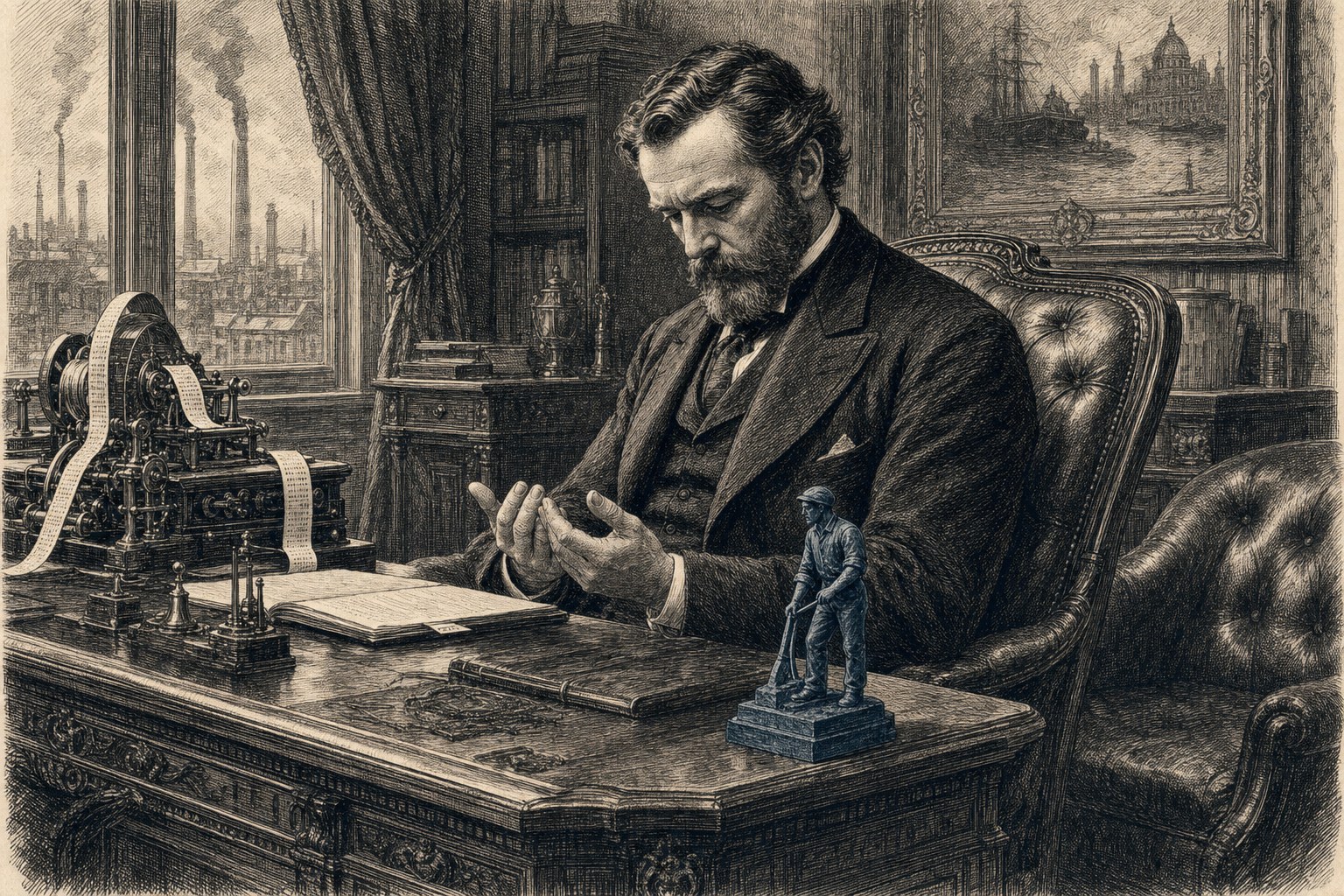
There is a kind of CEO I recognise the moment he walks into the meeting room. He arrives slightly late, laptop under his arm, phone in hand, apologies for the delay because the previous meeting ran over. He does not scan the room. He greets people quickly. He opens his laptop before he has sat down. And while everyone around him can feel who he is — how tense, how tired, how hollow — he himself has no idea who they are.
That is not his fault. He has been trained this way. He is surrounded by systems that instilled this behaviour in him. And he was selected by committees that are themselves exactly the same. But it is his problem — and the problem of every organisation that has appointed him.
The founder versus the functionary
Take a company that was founded in the nineties by someone who started with twenty-five thousand guilders and one employee. That man knew everything. He knew who his best customer was and what that customer really wanted, before the customer had articulated it themselves. He knew which supplier would let him down on the next delivery, because he had once seen him arrive too early in a suit that was too neatly pressed. He knew which employee would grow and which one would gradually coast — without a performance review, without a competency profile, without an HR consultant.
He did not do this from theory. He did it from an instrument he had developed through his years of survival: the primal sense. The capacity to assess a situation before the analysis is complete. The capacity to read a person before they have put down their business card. The antenna that measures everything that is not on paper.
That primal sense is not mystical. It is the bottom brain layer at work — the most basic, fastest and most accurate layer we possess, and also the first to disappear as soon as an organisation grows large enough to introduce procedures.
It is the bottom brain layer at work — the most basic, fastest and most accurate layer we possess, and also the first to disappear as soon as an organisation grows large enough to introduce procedures.
Because once that founder has let his company grow to two hundred, three hundred employees, something begins to shift. A CFO arrives. An HR manager. Quarterly reports. A supervisory board and a shareholders' meeting. And if the founder does not have the good fortune of a strong successor who also feels, then one day a CEO arrives from outside. A professional. Someone who can present handsome quarterly figures, reassure stakeholders, understand corporate governance. Someone who looks good in a press release.
What that CEO does not have is the primal sense that built the organisation.
What falls away at scale
I understand why the primal sense disappears with growth — it is not a weakness, it is a mechanism. When you as an entrepreneur are managing ten people, you know each one. When there are fifty, you still know them reasonably well. When there are three hundred, you know the managers. When there are three thousand, you know the directors. And at that point you have in fact lost contact with the shop floor. Not because you have become worse, but because the distance is too great for direct perception.
The problem is not the distance itself. The problem is what replaces it. Most large companies solve this with reports, dashboards, KPIs, periodic reviews, engagement surveys, and management information systems that summarise what is happening. These are all translations of reality into paper. And every translation loses information. Every summary table erases something that does not fit in the table. Every report is a selection by someone who also has their own interests.
The CEO who steers only on this information is steering on a reconstruction of reality, not on reality itself.
And reality is meanwhile steering itself toward the drain.
The role of consultants and governance
Consultants and governance actively assist in this. That is the treacherous part, because they are held up as remedies while they are for the most part part of the problem.
A consultant walks in and asks for the figures. They ask for the reports. They conduct interviews with the directors — who defend their own position through the answers they give. They then produce an analysis describing reality in terms of the existing structure. They advise on the basis of what is measurable. What is not measurable — the culture, the mood on the shop floor, whether anyone still believes in what the company does — does not appear in their report, because they have not measured it. Because they could not measure it with the methods their profession permits.
Governance works the same way. A supervisory board demands accountability. Accountability always looks backwards: what happened, does it match what we expected, were the procedures followed. It never looks forward with the instrument that requires: feeling whether the organisation is still vital, whether leadership still believes in what it is doing, whether customers are still satisfied before they leave.
It never looks forward with the instrument that requires: feeling whether the organisation is still vital, whether leadership still believes in what it is doing, whether customers are still satisfied before they leave.
What happens over the years is that the CEO learns to steer by what the supervisory board sees. That is the quarterly figures. That is the management objectives. That is the ESG reports. That is the media appearances. That is the shareholder value indicators. His judgement — if he ever had it — retreats to the background, because it has no value in the boardroom. The boardroom counts only what you can prove. And you cannot prove primal sense.
What a good CEO does
I have come across good CEOs. Not many, but a few. The pattern is unmistakable.
They walk around. Really. Not as a PR stunt, not as "management by walking around" out of a management book, but because they know that the only real measuring instrument is themselves. They talk to people who are not normally consulted. The mechanic who has been with the company for eighteen years. The receptionist who sees every customer first. The driver who hears what managers discuss in the back seat when they think no one is listening.
They feel when a meeting is hollow. They feel when someone is reading out a positive report that has nothing to do with the shop floor. They feel when a customer says they are satisfied but has already placed the next tender with a competitor. They trust that feeling and act on it — even when it contradicts what the dashboard shows.
And they make judgements. They dare to say: that man is wrong for that position, even if he is hitting his targets. They dare to say: this product has no future, even if it still sells well today. They dare to say: this customer is no longer interesting to us, even if it is a large account. They use their antenna as the first filter and the figures as confirmation. Not the other way around.
That is the distinction. Not intelligence, not education, not the CV. The willingness to be the instrument yourself.
The listed CEO
Listed companies are the worst case. Not because the people there are less capable, but because the structure most systematically destroys the primal sense.
The CEO of a listed company faces a fundamentally impossible assignment: they must account on a short-term basis (quarterly) for results in a reality that moves on a long-term basis (years). They must create shareholder value for people who bought the shares for short-term gain, while leading an organisation that can only be healthy over the long term.
That produces a specific selection pressure. The CEO who lasts longest is not the best leader but the best communicator of quarterly figures. The CEO who invests in something that will return value in five years sees their share price fall tomorrow. The CEO who pushes through cost cuts that make the organisation look better in the short term while wringing it dry in the long term sees their share price rise next week. The reward structure steers in precisely the wrong direction.
The CEO who invests in something that will return value in five years sees their share price fall tomorrow.
And the supervisory board — itself embedded in listed-company procedures, liability, compliance — selects for exactly that CEO. The board member who would want to use their primal sense knows that their judgement is not defensible in court. So they defend procedures. And the circle closes.
A listed CEO who wants to use their primal sense must do so outside the system. The system itself forbids it.
The price of blindness
What does all this cost? Not abstractly — concretely, in what I see in practice.
A company loses its five best people in a year. The CEO did not see it coming. It was not in the report — the satisfaction scores were fine. But anyone walking the shop floor had long felt that these people were done. They were already gone in their heads. They had stopped speaking in meetings. They were no longer making plans for the following year. Every colleague sitting next to them felt it. The CEO did not — he was reading the scores.
A company loses a customer who had been with them for eight years. The CEO only found out when the cancellation came in. Anyone visiting the customer had felt for two years that something was off. A different tone to the conversations. The contact person less enthusiastic than before. A slow withdrawal of engagement. But that was not in the CRM system, so officially it was not there.
A company launches a product that flops. Market research was done, focus groups, quantitative studies. It looked good on paper. But anyone who really talked to customers — actually talked, not via a questionnaire — had long felt that this product was a solution to a problem customers had already solved themselves. That the demand was gone. That the idea was a year and a half too late. But that feeling was nowhere in the business plan.
The primal sense would have seen all of this earlier. Not always, not infallibly — but systematically earlier than the system. The question is not whether a CEO is always right with their gut. The question is whether they still feel anything at all. Because someone who no longer feels cannot use feeling as input, not even to correct.
What the CEO who reads this should do
Next week, go to the shop floor. Not with an agenda. Not to deliver a message. Just to look. Talk to people who do not normally appear in your diary. Ask the question: what is actually going wrong here? And listen to what is not said — the pause, the sideways glance, the agreement that comes too quickly.
Spend a day with a salesperson. Not to check up on them, but to feel how customers really respond. Not in a report, but in the conversation itself. What they do with their arms when a price is mentioned. Which question they do ask and which they do not. Where the conversation warms up and where it cools down.
And dare to acknowledge that you yourself are the measuring instrument — and that you must maintain that instrument. A CEO who has lost their primal sense has become an administrator. An administrator steers paper. A leader steers people. And for people you need an instrument that can read people.
The question is not whether you once had that instrument. The question is whether you are willing to get it back — and whether your system will allow you to.
This is edition 4, article 2. It builds on edition 3 on the primal sense, the three brain layers, and article 1 of edition 4 on the law of the paper industry. The series continues on openvizier.org.
It builds on edition 3 on the primal sense, the three brain layers, and article 1 of edition 4 on the law of the paper industry.
The CEO and the Primal Sense
There is a kind of CEO I recognise the moment he walks in. Everyone can feel who he is. He himself has no idea who they are.
"He has been trained this way. But it is his problem — and the problem of every organisation that appointed him."
The founder versus the functionary
The man who started with one employee knew everything — which customer wanted what before they said it, which supplier would let him down, which employee would grow. Not from theory, but from the primal sense: the bottom brain layer, the fastest and most accurate instrument we have, and the first to disappear when a company grows large enough for procedures.
Then a CEO arrives from outside. A professional who presents handsome quarterly figures and looks good in a press release. What he does not have is the instrument that built the organisation.
What replaces the distance
Reports, dashboards, KPIs, engagement surveys — all translations of reality into paper, and every translation loses information. Consultants and governance assist in this. The consultant measures the measurable; the culture and the mood never appear in the report. The supervisory board demands accountability, which always looks backwards.
The CEO who steers only on this information is steering on a reconstruction of reality, not on reality itself. And reality is meanwhile steering itself toward the drain.
What a good CEO does — and the listed trap
The few good ones walk around. Not as a stunt, but because they know the only real measuring instrument is themselves. They talk to the mechanic, the receptionist, the driver. They feel when a meeting is hollow, when a customer says "satisfied" but has already placed the next tender elsewhere. They use the antenna as the first filter and the figures as confirmation.
Listed companies are the worst case. The reward structure steers in precisely the wrong direction: the CEO who lasts longest is not the best leader but the best communicator of quarterly figures. A listed CEO who wants to use his primal sense must do so outside the system. The system itself forbids it.
Close
The cost is concrete. Five best people gone in a year — not in the report, but anyone on the shop floor had felt it. A customer of eight years lost — felt for two years, but not in the CRM, so officially not there. The question is not whether a CEO is always right with his gut. The question is whether he still feels anything at all.
"An administrator steers paper. A leader steers people. And for people you need an instrument that can read people."