The consultant at the near-bankrupt company
Why an outsider knows within three days what insiders cannot see
Practice · 12 min read
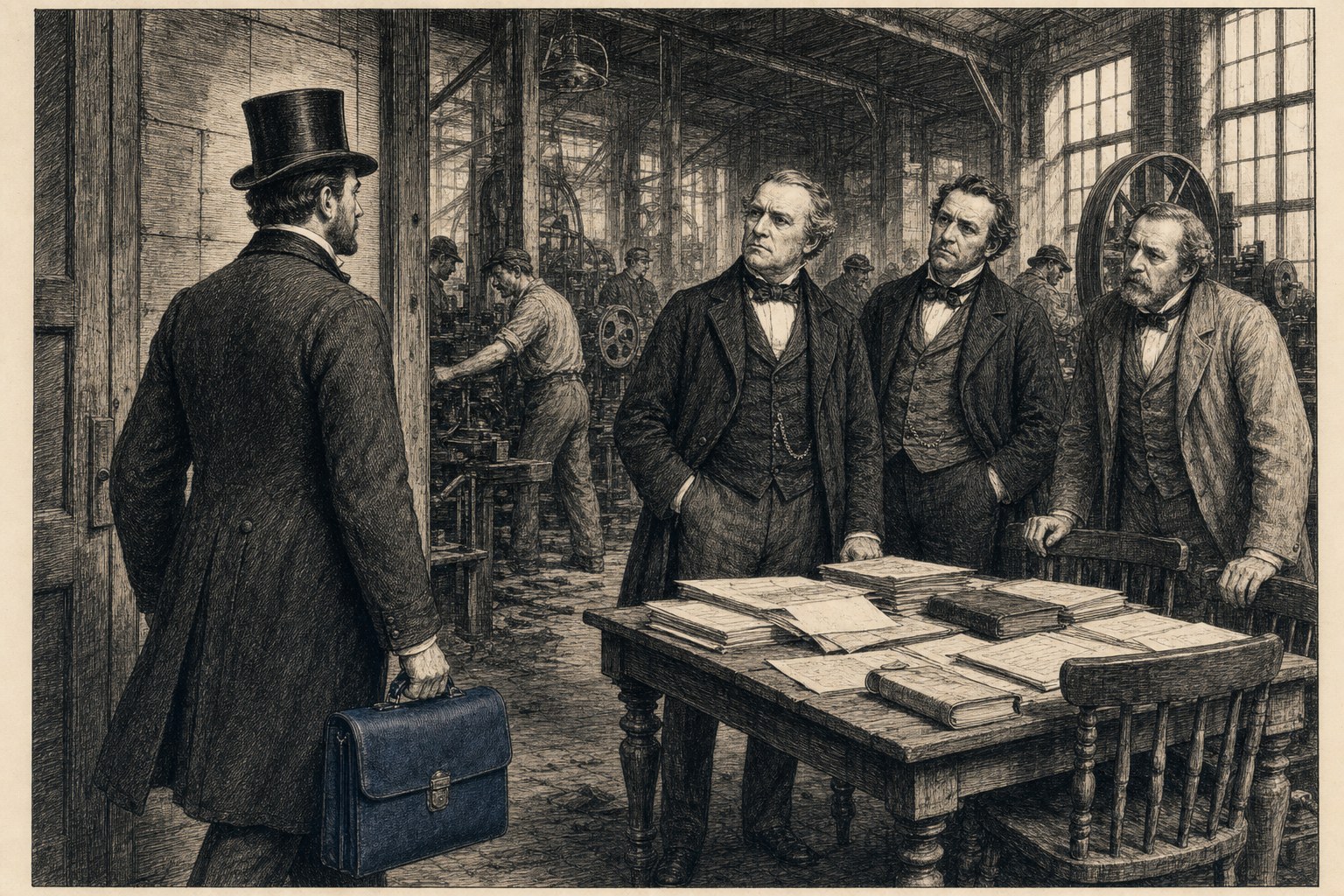
I enter the company on a Tuesday morning in November. The premises are tidy — too tidy, the kind of tidy people do when they expect to be judged. There is a receptionist who is friendlier than necessary. The director receives me five minutes early. Coffee is ready. There are printouts of financial overviews, tabbed dividers with colour-coded graphs, a printed agenda for the next three days.
They have prepared for me. They have prepared a presentation of the problem. They have a story.
I am not going to read that story. Not because it is unimportant, but because that story is precisely what will set me off on the wrong foot. Every company in trouble has a story about how it got into trouble that does not hold up. Not out of bad faith — out of survival. People in a crisis want to be believed. They want the outsider to adopt their frame, so that the solution can fit the image they already have of themselves. Whoever accepts that frame is already captured before the work begins.
What I do in three days
On the first day I walk around. Really around — the shop floor, the warehouse, the canteen, the car park. I do not ask the questions that belong in reports. I talk to the man who has been in dispatch for seventeen years. With the telephone operator who knows every customer personally because she has been answering the phone for so long. With the mechanic who knows the machines from before the last reorganisation. With the youngest sales rep, who has not yet learned what he is not allowed to say.
What I am looking for is not an explanation. I am looking for signals. Is there pride? Shame? Exhaustion? Is there still someone who genuinely believes in what the company does? Are there people who still talk about something with warmth by the coffee machine, or is it all already flat — the flatness of people who are waiting for the end and doing their work neatly in the meantime?
Are there people who still talk about something with warmth by the coffee machine, or is it all already flat — the flatness of people who are waiting for the end and doing their work neatly in the meantime?
Those signals are the real diagnosis. The figures are the consequence. A company with a shop floor that still glows but poor results is fundamentally different from a company with a shop floor where the lights are already out but the numbers are still just barely positive on paper. Both companies can look the same in a spreadsheet. In reality they are opposites.
Why the outsider sees this when insiders do not
It has nothing to do with intelligence or experience. It has to do with distance.
I have no history with this company. I do not know the director from before, when he was still idealistic. I do not know the finance director from that afternoon when the bank first said no and he kept the company going almost single-handedly. I do not know who had a falling-out over which decision, who protects whom, who has not been able to stand whom for years but keeps it professional out of courtesy.
That history is the grid through which the insiders see everything. They cannot help it. They are too long entangled in it. Every observation is filtered through what they already know, what they already feel toward the people around them, what they have told themselves to keep going.
The manager who knows a department is underperforming but has known the department head for fifteen years sees something different from what I see. He sees a friend who is having a hard time. I see a function that no longer works. He cannot draw that conclusion, because that conclusion costs him the relationship. I do not have the relationship, so the conclusion costs me nothing.
That is the mechanism. Not cleverness. Freedom.
My primal sense is not better than that of the insiders. It is purer — not clouded by loyalty, fear of social loss, shame over earlier judgements that now turn out differently in hindsight. Whoever has internally seen for two years that things were going wrong but did not say so — and that is almost always the situation — finds it hard to name it out loud now without also condemning their own silence.
I do not have that problem. I was not there two years ago. I am here now.
What I feel, and how quickly
I remember a situation at a manufacturing company in the east of the country — I will not name names, the pattern is the point. The company had two hundred employees, a product line that had once innovated but had not done so for eight years, a management team that was very pleasant and very prepared for my arrival, and figures sitting precisely in the danger zone: too good for an immediate restructuring, too bad to be certain of survival.
On the first day, after two hours of walking around, I already knew. The company was two-thirds dead.
Not the people — they were fine. But the belief was gone. The pride was gone. No one talked about the product any more without the qualifier "yes, but we also know that...". Customer service spoke about customers in terms of problems, not in terms of people. The shop floor did their work neatly and precisely, but no one did anything that had not been asked of them. No one had an idea for the following week. No one had plans they had come up with themselves.
That is a company that has already given up on itself, even if the director gives a strategy presentation on Monday with three growth scenarios.
That is a company that has already given up on itself, even if the director gives a strategy presentation on Monday with three growth scenarios.
At the same time: in one department — dispatch — there was one man. Older, somewhat stout, always with a pen behind his ear, thirty years in the company. He was the only point in the building where there was still friction. He complained. He had opinions. He made jokes that were not quite right but that made everyone laugh anyway. He was angry at management in a way that cost energy, which is only possible if you still care.
That was the living part. That was the seed. If there was anything to save, it was through him — not through the strategy presentation.
The paradox of the McKinsey consultant
Here is the most painful turn, and I say it with full conviction because I have seen it again and again.
The consultant who is least useful in a company in trouble is the consultant who works only on figures. The McKinsey-style turnaround — full data room, hundreds of interviews but then coded and deconstructed, five scenarios with assumptions, recommendations in PowerPoint form — is the most refined and least effective tool you can deploy in a crisis.
Not because that consultant is unintelligent. Not because their method is intellectually unsound. But because they measure at the top brain layer and the decisive information sits in the bottom layer.
They ask people in an interview: what is going wrong? And people in an interview give answers that fit what they think they are allowed to say, corrected for social desirability, corrected for how it will look when it is in a report, corrected for what the person across from them will think. Those are not honest answers. Those are curated answers.
I do not ask those questions. I walk alongside. I watch what people do when no one is looking. I watch what someone does when their computer freezes — do they swear and push on, or quietly wait until it sorts itself out? I watch who comes in first on a Friday morning. I look at the photos on desks and the ones that are missing. I look at the notice board — when was it last updated? I listen to what people do not say.
That yields more than three weeks in a data room.
Why insiders know but cannot say it
Here is the bitter core. The insiders feel it too. Almost always. The manager who shows me around knows that their department is dysfunctional. The director knows that two of their managers need to go. The commercial director knows that they are serving the wrong customers and neglecting the good ones. The HR manager knows that turnover is too high and that the exit interviews say nothing because people are polite when they leave.
They know. They feel it. They still have that primal sense — it is still there, built in, almost indestructible.
But they cannot act on it. Not because they are cowards — that accusation is too easy and also untrue. But because acting on that feeling costs them concretely something that costs me nothing. That manager who needs to go is also the person who helped him through a difficult period. That director who mapped out the wrong strategy — that is also the person who hired him. Those customers who need to be let go — he has built years of relationships with them and invested part of his identity in them.
That director who mapped out the wrong strategy — that is also the person who hired him.
The primal sense speaks. Self-interest speaks too. And self-interest has a bed to sleep in at home and self-interest has children in school and self-interest has a mortgage. The primal sense does not.
That is the real reason insiders cannot see what the outsider sees in three days. Not blindness — entanglement.
What comes next — the figures as confirmation
After those three days I finally go to the accounts. But I am not looking for the problem — I already have it. I am looking for confirmation of what I already know. And it is almost always there.
The department that felt empty also has the highest turnover. The director who seemed tired has the fewest customer contacts of the whole team in his diary. The product that no one found exciting any more has indeed declining margins. The customers who "were still loyal but felt different" had already been exploring an alternative — that emerged later from a supplier conversation I requested.
The figures are not the beginning of the story. They are the end of the proof. They confirm what the primal sense had already established. Whoever does it the other way around — figures first, then conclusions — misses the layer on which the real decision is made.
This is also why my report is different from what the director expects. He expects a report saying: here are the problems, here are the solutions, here are the assumptions for each variant. What he gets is a report that begins with: here is the condition of the organisation as a living system. Then: here is what the figures confirm. Only then: here are the options.
That order is not arbitrary. It is the only order that works.
The question no one asks but that determines everything
There is one question I always ask myself at the end of the third day — not to management, but to myself: is there still someone here who can bring this company back to life?
Not a plan. Not financing. A person. Someone with an antenna, with energy, with the kind of conviction that is contagious. Someone who dreams about the company at night in a way that drives them forward, not one that keeps them awake from fear.
Sometimes it is the founder who has been pushed to the sidelines and barely recognises their own child. Sometimes it is a young manager everyone has long seen as promising but who has been given nothing. Sometimes — rarely — it is an outsider who still needs to come.
If there is no one: then it is over. Then the only question is how it ends in an orderly fashion. Then my task is to say so, even if no one wants to hear it.
If there is someone: then everything else I do is clearing the path for that person. Getting the figures in order. Reshaping the structure. Moving people from the wrong position. But the core is that one person. That person is not to be found in the figures. That person is felt.
And that is exactly what the turnaround methods of the large firms never raise as a question, because it cannot be formally answered. They ask: can we get cash flow under control. They ask: are costs manageable. They ask: what is the going concern assumption. They never ask: is there still someone here who can carry this.
That is the question that determines everything. And it is the question you can only answer if you have spent three days walking around with your antenna on.
This is edition 4, article 3. It builds on edition 3, article 9 ("The Primal Sense in Professional Practice") and on articles 1 and 2 of edition 4. The series continues on openvizier.org.
It builds on edition 3, article 9 ("The Primal Sense in Professional Practice") and on articles 1 and 2 of edition 4.
The Consultant at the Near-Bankrupt Company
They have prepared a presentation of the problem. They have a story. I am not going to read that story.
"Every company in trouble has a story about how it got into trouble that does not hold up — not out of bad faith, out of survival."
What I do in three days
On the first day I walk around. The shop floor, the warehouse, the canteen. I talk to the man who has been in dispatch for seventeen years, the youngest sales rep who has not yet learned what he is not allowed to say. I am not looking for an explanation. I am looking for signals: pride, shame, exhaustion. Does anyone still believe in what the company does?
Those signals are the real diagnosis. The figures are the consequence. A company whose shop floor still glows but has poor results is the opposite of one where the lights are out but the numbers are barely positive — though both look identical in a spreadsheet.
Why the outsider sees it
It has nothing to do with intelligence. It has to do with distance. I have no history here. The manager who knows a department is failing but has known the head for fifteen years sees a friend having a hard time. I see a function that no longer works. That conclusion costs him the relationship. It costs me nothing.
That is the mechanism. Not cleverness. Freedom. My primal sense is not better than the insiders' — it is purer, not clouded by loyalty, fear of social loss, or shame over earlier silence.
The McKinsey paradox
The consultant least useful in a crisis is the one who works only on figures. The full data room, hundreds of interviews coded and deconstructed, five scenarios in PowerPoint — the most refined and least effective tool you can deploy. Because it measures at the top brain layer and the decisive information sits in the bottom.
People in an interview give curated answers, corrected for how it will look in a report. I walk alongside. I watch what people do when no one is looking, who comes in first on a Friday, when the notice board was last updated. The insiders feel it too — almost always. They know which managers must go. But self-interest has a mortgage. The primal sense does not. That is the real reason they cannot say it: not blindness, entanglement.
Close
Only then do I go to the accounts — not to find the problem, but to confirm what I already know. The empty department has the highest turnover; the tired director the fewest customer contacts. The figures are not the beginning of the story. They are the end of the proof.
"The question that determines everything: is there still someone here who can carry this? You can only answer it after three days walking around with your antenna on."