At banks, the primal sense lost
Why only those who do not need it get credit
Practice · 12 min read
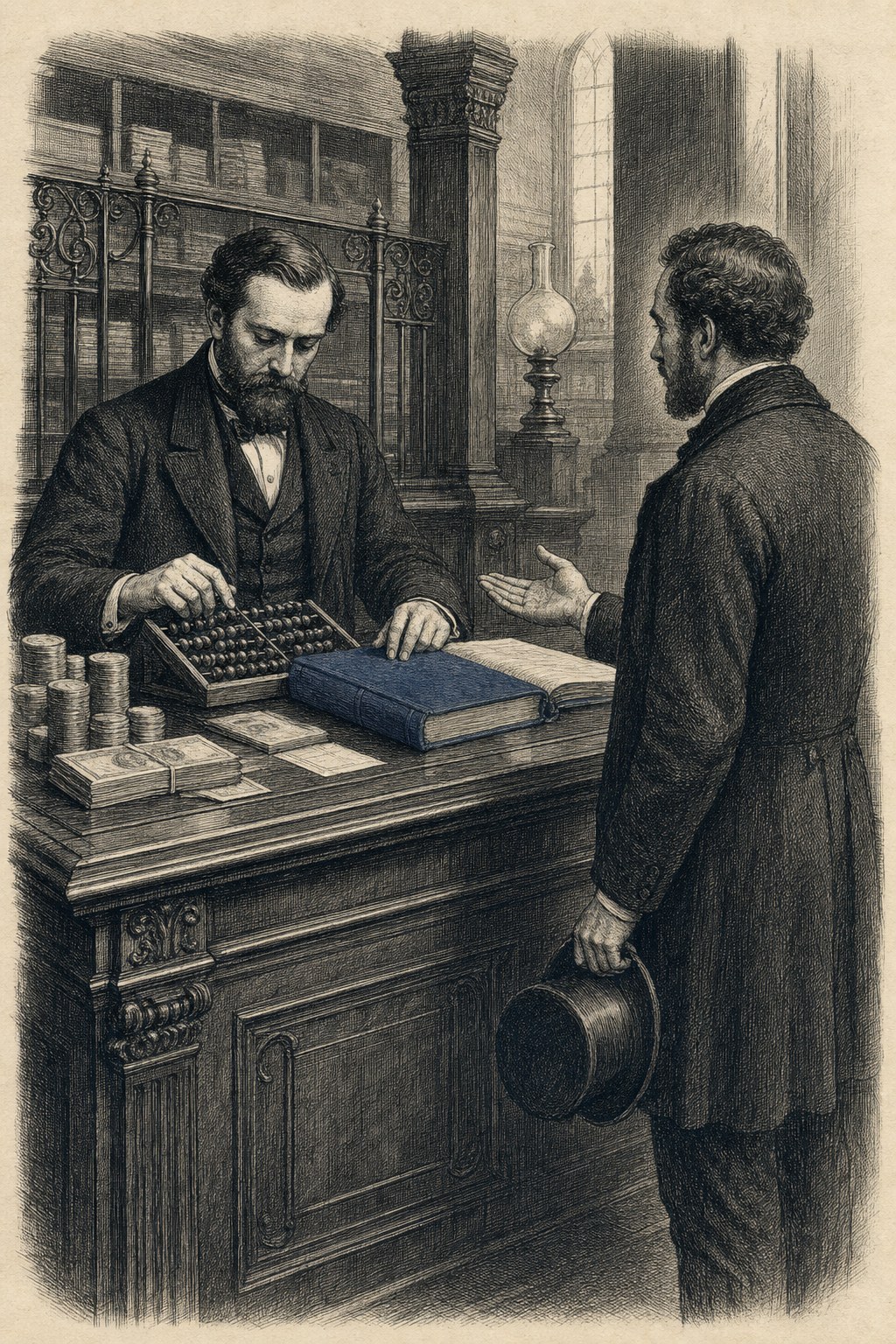
The law is simple and merciless. Those who need money do not get it. Those who do not need it are bombarded with offers. This is not an accident, not a market failure, not the shortsightedness of individual bankers. It is the logical outcome of a system that has surgically removed the primal sense from the credit decision — and then stands astonished when entrepreneurs suffocate and renewal stalls.
In edition 3 we already described the banker as the most striking example of how the primal sense can be institutionally prohibited. This article goes further. Because the village banker has not simply been replaced by a different kind of person. He has been replaced by a system that has deliberately removed the human from the decision — and calls this progress.
The banker who could still feel
There was once a banker who knew his customers. Not from a file. From life. He knew whether the farmer rose early. He knew whether the baker took his debts seriously or preferred to grow beyond his means. He knew which families would come through setbacks and which would collapse at the first difficulty.
That knowledge was not in annual figures. It was in years of relationship. In the conversation at the market. In seeing how someone responded to a bad harvest. In the judgement: this is a person who repays, and this one is not, regardless of what the balance sheet says.
And that banker was right. Not always, because no person is always right. But his error rate was acceptable, his local knowledge was authentic, and his decisions fitted the reality of the people they concerned.
But his error rate was acceptable, his local knowledge was authentic, and his decisions fitted the reality of the people they concerned.
That banker no longer exists. Not because the bank dismissed him. But because the system has made him impossible.
What Basel did to the primal sense
The Basel accords are international banking rules — Basel I, II, III, now heading toward IV — designed to make the financial system more stable after successive crises. Every crisis produces more rules. Every new rule requires more substantiation of credit decisions. More figures, more models, more documentation. And with each new layer, another piece of the space for human judgement disappears.
Formally, an account manager can still give advice. In practice, they can do nothing. Every credit recommendation above a certain amount goes to a credit committee, a risk committee, a central department. That department has no relationship with the customer, has never met the entrepreneur, may know the sector from reports. They run the model, read the score, and follow the score.
I have experienced this myself. You sit across from an account manager who can visibly see that you are the person for whom this makes sense. Who understands. Who would like to help. But who simultaneously knows that it shows red on their computer and that they cannot do anything about it. The decision has already been made before the conversation began. The conversation is ritual.
The account manager has lost their own profession. They have become a form with a face.
Risk models that block the future
A risk model does one thing: it extrapolates the past. It looks at what happened in comparable situations, with comparable sectors, with comparable turnover figures, in the past. And it assumes the future will resemble that.
This works reasonably well for those who are consolidating what already exists. A company that has done the same thing for ten years, in a stable sector, with stable margins — that company is indeed reasonably modelable on the basis of the past. Although even here reality is always richer than the score.
But for anyone doing something new, the model is actively destructive. Whoever starts a new activity has, by definition, no historical figures for that activity. Whoever enters a new market fits no comparison group. Whoever innovates is by definition deviant — and deviation is what a risk model marks as red.
Here lies the core of the problem. The model is not neutral. It is constitutionally conservative. It rewards continuity and penalises innovation. That is not coincidence — it is the logical outcome of a system that can only look backwards.
A bank that steers only on risk models finances the past by definition. The future — the new, the untested, the promising — falls outside the model and therefore gets no money.
Thirty years of experience and still no loan
This is the example I find personally most painful, because I have seen it so many times. And experienced it myself.
An entrepreneur has led a company for thirty years. Behind him lie built relationships, a proven track record, years of repaid debts, a reputation that has proved its worth with every customer, every supplier, every employee. He wants to start something new. A new company, a new activity alongside the existing one, an expansion in a direction he sees as logical.
The bank asks for three years' accounts for the new entity.
The new entity has existed for six months.
There are no three years' accounts.
The loan is refused.
The man, the human being, the entrepreneur, the thirty years of experience, the proven character — none of that is asked about. It does not fit the model. What he is worth as a person, as a bearer of risk, as a repayer, as someone with an antenna for his own market — that has no column in the spreadsheet.
And this is not an exceptional case. This is the standard. This is how the system works. Every day, with thousands of entrepreneurs, in every office of every bank.
The banker of old would have known this man. Would have known who he was. Would have extended the loan on the basis of who he knew. That was not less rational — it was more rational, because it used the full information rather than a subset of verifiable data points.
The absurdity everyone sees but no one names
What always strikes me in conversations about bank financing is that everyone — truly everyone — recognises the absurdity. The entrepreneur who cannot get the loan, the account manager who cannot give it, the risk manager who must follow the model, the bank director who cannot change the rules. They all see that the system is doing something wrong.
But no one can change it, because every step in the chain is individually logical. The account manager is right: they cannot ignore the score. The risk manager is right: they follow the guidelines. The bank director is right: they operate within the regulations. The regulator is right: they apply international standards. And international standards were established because banks caused crises.
The system is a chain of individually defensible decisions that together produce a result no one wants but everyone accepts. That is how institutional reason works. That is how the primal sense disappears — not in one big decision, but in a thousand small steps each of which is defensible on its own.
Compliance as a replacement for judgement
The account manager of today is no longer a banker. They are a compliance officer with a sales title.
Their day consists largely of filling in forms, checking KYC requirements, documenting customer conversations, ensuring every step is accounted for, supplying information for the central credit process. They are a link in a documentation process, not a decision-maker.
When they have a customer in front of them who does not fit the model — who has just too little turnover, just too little collateral, just too little history — their options are narrow. They can forward the file with a positive or negative recommendation. But their recommendation is marginal. The score is decisive.
And the score is decisive because the score is the only defence if something goes wrong. If a loan goes bad and the banker followed the score, they are covered. If they overrode the score — even if their judgement proved correct — they are vulnerable. The accountability structure rewards following the model and penalises the use of personal judgement. So everyone follows the model.
This is exactly what we described in edition 3 as the fundamental structure: whoever is held accountable for failures but gets no credit for judgements that turn out well stops making judgements and starts following procedures.
The law repeats here too
We saw it with subsidies. We see it at banks. The law is everywhere the same: the money goes to those who do not need it, and those who do are left to suffocate.
At the bank the mechanism is even more elegantly expressed. It is called risk management. It is called prudent banking. It is called regulatory compliance. All correct descriptions. But the outcome is that the entrepreneur who has been profitable for fifteen years, who long since has cash flow and collateral and a proven track record — that person gets credit they do not need. And the entrepreneur who is starting out, shifting direction, trying something new — gets nothing, precisely at the moment they need it.
Whoever started from scratch already knows this. The first phase you survive on your own money, family money, friends' money, customers who pay upfront, suppliers who wait a little longer. With everything that is not a bank, because the bank does not want you. And by the time you no longer need the bank — three years later, five years later, when the cash flow is running — the bank calls unsolicited with offers.
And by the time you no longer need the bank — three years later, five years later, when the cash flow is running — the bank calls unsolicited with offers.
The selection mechanism is also a class filter. Whoever has family capital survives the first phase. Whoever does not, does not. The inequality we later try to correct with policy is created right here.
Three brain layers in the credit decision
At the primal-sense level, the banker would feel: is this person going to repay? Is something off? Is there something the figures do not show but that is there? This layer is completely absent in the modern bank. It is not merely suppressed — it is prohibited. A banker who says "I am giving him the loan because I feel it is right" gets overruled by risk, compliance and their own manager.
At the mammalian brain level there would be a relationship. The banker would know the entrepreneur, their history, their behaviour over the years. That layer has all but vanished. Relationship management still exists as a word, but the relationship no longer influences the decision. The decision belongs to the model.
At the human brain level stand the models, the scorecards, the risk categories, the Basel guidelines, the sector analyses, the stress tests. This dominates completely. This is where decisions are made. And this layer has no anchor point in the reality of the entrepreneur — it is a system that judges itself by its own criteria.
The result is a bank that functions technically optimally and performs poorly socially. Loss percentages on the portfolio are low — because only the safest loans are extended. The contribution to renewal and entrepreneurship is minimal — because the innovators are not financed. The bank reports excellent results. Society stiffens.
What is lost that no one measures
There are enterprises that were never started because the financing was not there. Products that were never made. Services that never came into being. Jobs that were never created. Solutions to problems that still exist.
This appears nowhere in an annual report. It is the invisible side of the system. The bank measures what it has financed. It does not measure what it has blocked. Those who do not count are not counted.
But whoever truly wants to know what the banking system's contribution to society is must measure both sides. The loans that were extended and repaid. And the loans that were refused to people who would have repaid them had they received them.
That second figure does not exist. It cannot exist — it is the absent outcome, the thing that did not happen. But it is probably larger than the first.
What ought to happen
A bank that takes its social function seriously finances risk. That is its reason for existing. Not channelling money from saver to borrower where the borrower has already proved they do not need it — that is a conduit, not a bank.
A banker who takes their craft seriously develops judgement. That takes time, experience, contact with entrepreneurs, understanding of sectors, willingness to make mistakes and learn from them. That is not scalable in the way a large bank wants. But it is effective in the way a society needs.
There are good people in banks who know this. They really exist. But they operate in a system that does not want their judgement. That actively undermines their judgement. That rewards them for following models and penalises them for using their antenna.
As long as that system is intact — as long as Basel carries more weight than the banker sitting across from the entrepreneur — the law holds. Credit goes to those who do not need it. Those who do need it survive or not on their own resources.
That is not a free market. That is a system maintaining the appearance of the market while having hollowed out its substance.
This is edition 4, article 4. It builds on edition 3, article 9 (The Primal Sense in Professional Practice) and on edition 4, article 1 (The Law of the Paper Industry). The series continues on openvizier.org.
It builds on edition 3, article 9 (The Primal Sense in Professional Practice) and on edition 4, article 1 (The Law of the Paper Industry).
At Banks the Primal Sense Was Lost
The law is simple and merciless. Those who need money do not get it. Those who do not need it are bombarded with offers.
"The bank has deliberately removed the human from the decision — and calls this progress."
The banker who could still feel
There was once a banker who knew his customers — not from a file, from life. He knew whether the farmer rose early, whether the baker took his debts seriously, which families would come through setbacks. His error rate was acceptable and his decisions fitted the reality of the people they concerned.
He no longer exists. Not because the bank dismissed him, but because the system made him impossible. Every credit recommendation above a certain amount goes to a committee with no relationship to the customer. They run the model, read the score, follow the score. The account manager has become a form with a face.
Models that block the future
A risk model does one thing: it extrapolates the past. That works for whoever consolidates what already exists. But for anyone doing something new it is actively destructive. Whoever innovates is by definition deviant — and deviation is what the model marks as red.
A bank that steers only on risk models finances the past by definition. The future — the new, the untested, the promising — falls outside the model and therefore gets no money.
An entrepreneur of thirty years wants to start something new. The bank asks for three years' accounts for an entity that has existed six months. The loan is refused. This is not an exception. This is the standard.
A chain everyone defends
Everyone recognises the absurdity — the entrepreneur, the account manager, the risk manager, the director, the regulator. But no one can change it, because every step in the chain is individually logical. The score is decisive because the score is the only defence if something goes wrong. Whoever follows it is covered; whoever overrides it, even rightly, is vulnerable.
So the antenna is not merely suppressed — it is prohibited. The bank reports excellent results: loss percentages are low because only the safest loans are extended. The contribution to renewal is minimal. The bank thrives. Society stiffens.
Close
What is lost no one measures: the enterprises never started, the jobs never created, the loans refused to people who would have repaid them. That figure cannot exist — it is the absent outcome. But it is probably larger than everything the bank financed. A bank that takes its function seriously finances risk. That is its reason for existing.
"As long as Basel carries more weight than the banker sitting across from the entrepreneur, the law holds. Credit goes to those who do not need it."