The insurer against life
How risk avoidance itself became the greatest risk
Practice · 14 min read
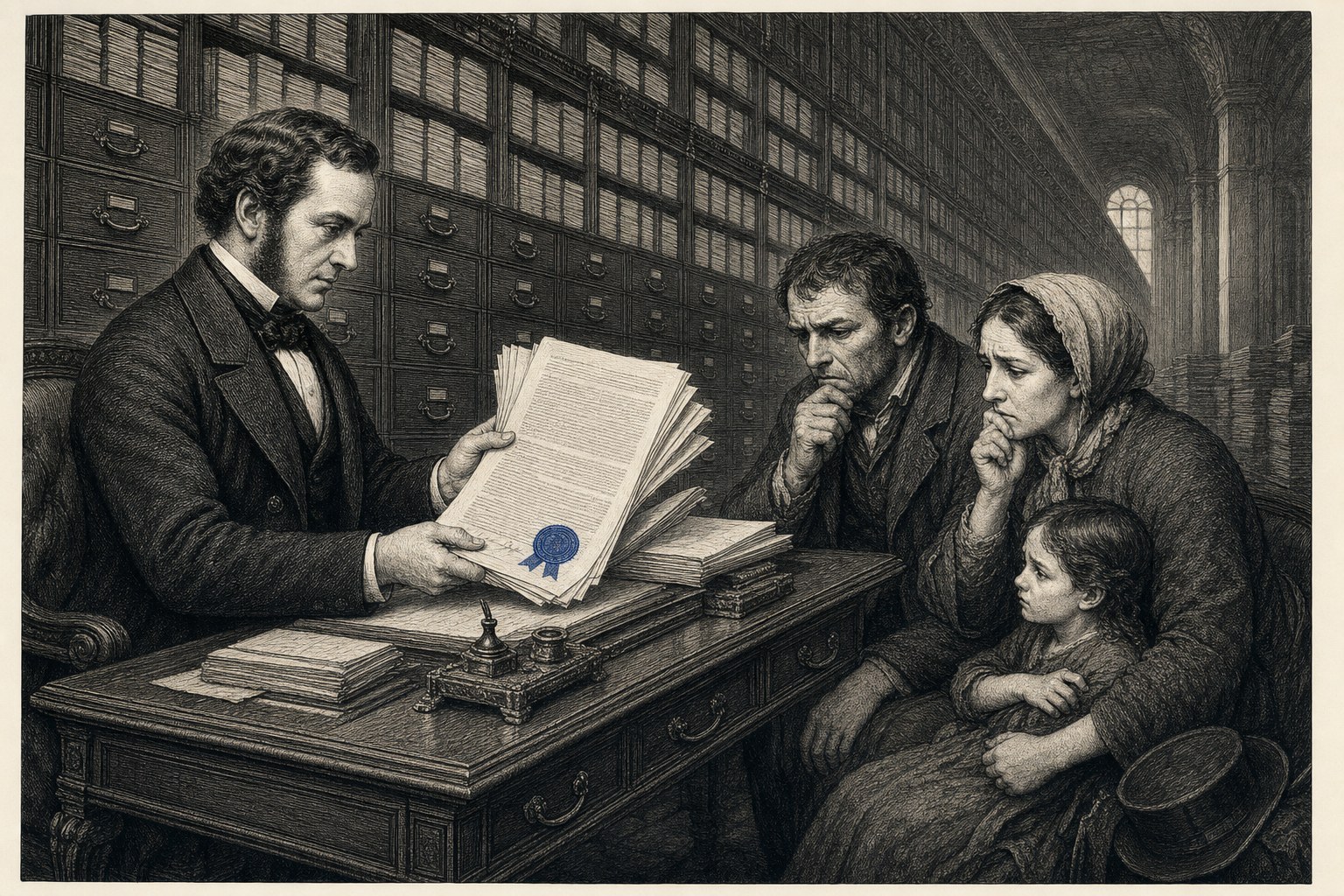
Insurance is one of the most beautiful ideas people have ever conceived. You pool your risk with others. Everyone contributes a little, so that no one is crushed by a single blow. That is solidarity in its most concrete form — no sentiment, no moral sermon, but a mechanism that works. The farmer whose barn burns down does not lose everything. The fisherman whose boat sinks can sail again. The family whose breadwinner dies has an income.
That idea is so good that it has worked for as long as people have formed communities. Guilds had mutual support funds. Maritime cities had shipping insurance as far back as the Middle Ages. Farming cooperatives shared the cost of hail damage. The idea is universal and ancient: bearing together what you cannot bear alone.
What that idea has become is its opposite. The modern insurer is an organisation that tries to write away, contract away, define away every risk — so that it has to pay out as little as possible. And the result is that more and more people have become uninsurable for more and more things, while society as a whole is unprotected for the risks that truly matter.
The original idea
Whoever studies the history of insurance sees a model that works on three principles.
The first is reciprocity. You contribute when another needs it, in the expectation that another will contribute when you need it. That is not a transaction — it is a relationship. You do not know whether you will ever draw on the pool. But you know the pool is there when you need it.
The second is community. The pool works because the participants have something in common. They know each other's risks, they understand each other's situation, they trust that no one will abuse the arrangement. The early insurance communities were literally communities — guilds, villages, professional groups. That trust was the foundation on which everything rested.
That trust was the foundation on which everything rested.
The third is solidarity through judgement. Those who managed the pool knew the situation. They could assess whether someone had acted in good faith, whether a claim was legitimate, whether someone was more reckless than the group could sustain. That judgement was human, personal, sometimes imperfect. But it was anchored in reality.
All three principles have almost completely disappeared from the modern insurance industry.
How actuarial models have modelled out the primal sense
The actuary is the mathematician of the insurance sector. Based on historical data they calculate the probability of a particular risk occurring, and what the costs are if that risk materialises. The premium is set on the basis of that calculation.
This is in itself a useful technique. But it is a technique that works through averages and groups — and that is entirely incapable of assessing the individual.
The actuary knows that two per cent of houses in a certain category suffer damage every year. They do not know which two per cent. So they distribute the costs across the whole group. That is the core of the insurance principle — correct so far.
But the next step is where things go wrong. Because the actuary wants to subdivide the groups ever further. They want to split the group into subgroups each carrying a more precise risk profile. Houses in flood-prone areas separately. Houses owned by people over seventy separately. Houses with flat roofs separately. And so on. With each division, the premium becomes more accurate — and with each division, a larger group of people becomes uninsurable or priced out of coverage.
The paradox is transparent: the more precisely the actuary can calculate the risk, the less it resembles insurance. If you know exactly that someone is going to suffer a loss, it is no longer insurance — it is a payment plan for certain costs. Insurance needs uncertainty to exist. By modelling away the uncertainty, the sector undermines its own reason for being.
But that does not stop it. Because more precise segmentation means higher premiums for high-risk groups and lower premiums for low-risk groups. And the low-risk groups — the wealthy, the healthy, those living in good areas — are also the people with alternative options. To keep those customers, their premium must stay low. So the high-risk groups are segmented away.
The climate insurance that gets cancelled
There is hardly a sharper illustration of this problem than what is now happening with climate risks.
Flooding, wildfires, extreme heat, storms — the probability is rising in large parts of the world. Precisely the areas where this risk is growing fastest are also the areas from which insurers are withdrawing. In California, major insurers have cancelled their policies in fire-prone areas. In parts of Florida, flood insurance has become almost unaffordable. In the Netherlands, awareness is growing that climate-related water damage is increasingly falling outside the standard policy.
This is rational from the insurer's perspective. The risk has risen, the premium can follow, but beyond a certain level you lose customers. And if you cannot raise the premium — due to political pressure or competition — you exit the market.
But it is morally insane. The insurance is cancelled precisely where it is most urgently needed. People who have paid premiums faithfully for decades receive a letter that their policy will not be renewed. They have no alternative. They cannot simply move their house. They are stuck with an uninsured risk they cannot bear alone.
Society as a whole then takes on the risk — through emergency funds, disaster legislation, government assistance. But that is collective solidarity without the efficiency of the insurance market. It is the worst of both worlds: the market withdraws, and the government steps in without the precision of an actuarial system.
How the insurer blocks entrepreneurship
This is the part least discussed, but with the most direct impact on entrepreneurs.
No insurance means no credit. This is a simple chain that is decisive in practice. The bank wants assurance that the assets are insured before extending a mortgage or business loan. The landlord of commercial premises wants to see liability insurance. Some clients require professional indemnity insurance as a condition of awarding a contract. Large buyers ask for proof of product liability coverage.
For those operating in an existing, well-known activity, all of this can be arranged. The insurer knows the risk profile, the premium is affordable, it is paperwork.
For those doing something new, the system is blocked. An entrepreneur making a new technology product looks for product liability insurance. The insurer has no historical data for this type of product. They cannot model the risk. They refuse, or they quote a premium that is economically unworkable.
A freelancer offering a new kind of service looks for professional indemnity cover. Their activity fits no standard category. They are sent back and forth between insurers each of whom does not want them.
A freelancer offering a new kind of service looks for professional indemnity cover.
A new sector, a new technology, a new service model — everywhere the same pattern. The unknown does not fit the model. The model refuses. The entrepreneur suffocates.
And so the circle from edition 4 article 1 and this article closes: the bank will not give a loan to those without insurance. The insurer will not give a policy to those without a proven track record. Whoever is starting something new has neither. They cannot begin.
This is not coincidence. These are two systems that, each from its own logic, produce exactly the same point of blockade. Together they form a wall around the existing that keeps the new outside.
The human brain that writes everything to death
An insurance contract is a document written to protect the insurer, not the insured.
I do not say this as cynicism. I say it as a description of what you see when you actually read a policy. The core of an insurance policy — what is covered, when, under what circumstances — is stated in relatively few words. The rest of the document consists of exclusions, conditions, definitions, reservations, procedures and clauses that limit the cases in which payment must be made.
This is the human brain layer built over the original idea of reciprocity. That original idea was simple: if this happens to you, we will help. What it now says: if this happens to you, we will help, unless definition A applies, or situation B, or circumstance C, or action D, or failure E, or force majeure F, or exclusion G under article H in appendix I, unless you gave timely notice using form J within deadline K.
The insured who has suffered a loss must prove they are entitled to a payout. Not the insurer who must prove they do not have to pay — the insured who must demonstrate they fall within the right category. And the categories are written in such a way that a significant portion of real losses falls outside.
This is not incidental. This is the system. And the system has a name: the claims department. That department was not set up to pay claims. That department was set up to assess claims, which in practice means: to filter on grounds for not paying.
I know people who discovered, after twenty years of faithful premium payments, that their loss did not fall within the policy description, for reasons that only became clear at the moment of the loss itself. That is not a misunderstanding. That is a construction.
The moral emptiness
The original insurance rested on a moral foundation. You looked after others in the community because you knew they would look after you. That was not merely reciprocity as a transaction — it was a trust that the community would stand by you.
That trust is the core of what insurance is. Without it, it is not insurance — it is a financial product wearing an insurance label.
What remains of that trust? Whoever has actually read their policy, especially when facing a large claim, and has gone through the handling process, can answer that question themselves. And whoever has not personally dealt with a large claim knows someone else who has. The stories are consistent and about the same thing: you pay for years, you expect support when it comes to it, you get a procedure.
This is not merely unpleasant. It has social consequences. When people stop trusting that the insurer is behind them, they change their behaviour. They take fewer risks — because if things go wrong, you are on your own anyway. They seek security in the existing — because the new brings uninsurable risks. They negotiate less, build less, try less.
The insurer who has hollowed out their own solidarity function has also hollowed out the willingness to take risk that is the core of any dynamic society. If no one covers anything any more, no one takes risks any more. If no one takes risks any more, no one innovates any more. Society as a whole becomes risk-averse — and thereby fragile toward the real risks it has not dared to prepare for.
Three brain layers in the insurance decision
At the primal-sense level, an insurer would feel: is this risk real and honest? Is this person acting in good faith? Is this the situation we were designed for? That layer has disappeared. The assessment of an individual has been replaced by placing an individual in a risk category. The person disappears behind their profile.
At the mammalian brain level there would be a relationship. The insurer would know the insured, understand their situation, place their claim in context. That layer exists in name with the claims handler, but that claims handler no longer has authority. They follow a protocol. The protocol is the law.
At the human brain level stand the policy conditions, the exclusion lists, the case law, the claims procedures, the review committees, the ombudsman, the complaints authority. This is the only level that still functions. And this level is not set up to help — it is set up to be able to account for the decision not to help.
And this level is not set up to help — it is set up to be able to account for the decision not to help.
A healthy insurance system would operate on all three layers. It would assess people, not merely profiles. It would maintain relationships, not merely policies. It would have procedures as a backstop, not as a front line.
What we have is one layer — the top one — that is supposed to carry the whole system. And cannot.
What ought to be different
The insurance community in its original form — the mutual, the cooperative, the guild — was small-scale and personal. That was not a shortcoming. That was the source of its strength. The members knew each other. They could assess who was acting in good faith. They could be solidary because the solidarity was visible and mutual.
Mutual insurers still exist in some sectors — particularly in agriculture there are cooperative forms of insurance that clearly distinguish themselves from the large-scale market. They are not perfect. But they are closer to the original idea.
The problem is scale. The modern economy demands insurance that does not fit within a single community. International trade, large investments, complex technology — the risks are too large and too diffuse for a local pool. And so the sector has necessarily become large-scale. But large-scale does not have to mean: devoid of people.
There are insurers who understand this and act on it practically. Who give their claims handlers the space to use judgement. Who design their underwriting procedures around dialogue rather than forms. Who combine premium differentiation with real relationships. They are small, relatively unknown, and they struggle to grow in a market that competes on price.
But they exist. And they prove it can be done differently. Not perfectly — but more humanly.
The society that has lost its own risk-bearer
The question no one asks, but everyone should ask: who now bears the risk?
If the insurer withdraws from climate risk, the government steps in. If the insurer cannot cover the small entrepreneur, that entrepreneur bears the risk themselves. If the insurer does not pay out on a claim, the individual carries the burden alone.
The collective risk-bearer has fallen away. What has replaced it is a combination of government guarantees for the large risks and individual vulnerability for the rest. That is not progress over the guild fund of the sixteenth century. That is regression — with better spreadsheets.
And the most dangerous thing of all is that no one names it in this way. The insurance sector reports customer satisfaction, premium growth, policy numbers. It does not report on what it no longer covers. It does not report on the people who have become uninsurable. It does not report on the entrepreneurs who did not start because they could not find cover.
Those absent outcomes do not exist as a category. They have no column in the annual report. And what has no column need not be accounted for.
That is how a system sustains itself, even after it has long since abandoned its original function.
This is edition 4, article 5. It builds on edition 3, article 9 (The Primal Sense in Professional Practice), edition 4, article 1 (The Law of the Paper Industry) and edition 4, article 4 (At Banks the Primal Sense Was Lost). The series continues on openvizier.org.
The Insurer Against Life
Insurance is one of the most beautiful ideas people ever conceived: bearing together what you cannot bear alone. The modern insurer has made it its opposite.
"More and more people have become uninsurable for more and more things, while society is unprotected for the risks that truly matter."
How the model writes out the person
The actuary distributes costs across a group — correct so far. But then the group is split into ever finer subgroups, each with a more precise risk profile. With each division the premium becomes more accurate, and a larger group becomes uninsurable.
The more precisely the actuary can calculate the risk, the less it resembles insurance. If you know exactly that someone will suffer a loss, it is no longer insurance — it is a payment plan. Insurance needs uncertainty to exist.
Cancelled where it is needed most
In California major insurers have cancelled policies in fire-prone areas; in Florida flood insurance has become almost unaffordable. Rational for the insurer, morally insane: the cover is withdrawn precisely where it is most urgent. People who paid faithfully for decades get a letter, and no alternative.
The same blocks entrepreneurship. No insurance means no credit. The bank wants assured assets; the client wants liability cover. For something new, the insurer has no historical data, cannot model the risk, and refuses. The bank will not lend without insurance; the insurer will not cover without a track record. Together they form a wall around the existing that keeps the new outside.
Written to protect the insurer
An insurance contract is a document written to protect the insurer, not the insured. The core — what is covered — is a few words. The rest is exclusions, conditions, reservations. The claims department was not set up to pay claims; it was set up to filter on grounds for not paying. People discover after twenty years of premiums that their loss falls outside the description. That is not a misunderstanding. That is a construction.
When people stop trusting that the insurer is behind them, they take fewer risks, build less, try less. Society as a whole becomes risk-averse — and thereby fragile toward the real risks it never dared prepare for.
Close
Who now bears the risk? The government steps in for climate; the small entrepreneur carries it alone; the individual swallows the unpaid claim. The collective risk-bearer has fallen away. That is not progress over the guild fund of the sixteenth century — it is regression, with better spreadsheets. And no one names it, because what it no longer covers has no column in the annual report.
"That is how a system sustains itself, even after it has long abandoned its original function."