The regulator who sees nothing
Inspection without primal sense is administration of the past
Practice · 11 min read
The AFM sends a letter. Seventeen pages. Questions about internal procedures, governance documentation, the compliance handbook, the recording of complaints procedures, the protocols for conflicts of interest. The financial adviser who receives the letter runs a practice with his wife, serves two hundred clients he knows personally, has not harmed a single client in twenty years, and now spends six weeks assembling a dossier that no one will ever read. Two streets away is an office that systematically sells poor-quality mortgages, makes complaints disappear internally, and has a compliance department that handles correspondence with the AFM impeccably. That office has never had a problem with the regulator.
This is not coincidence. This is how the system works.
What a regulator was meant to be
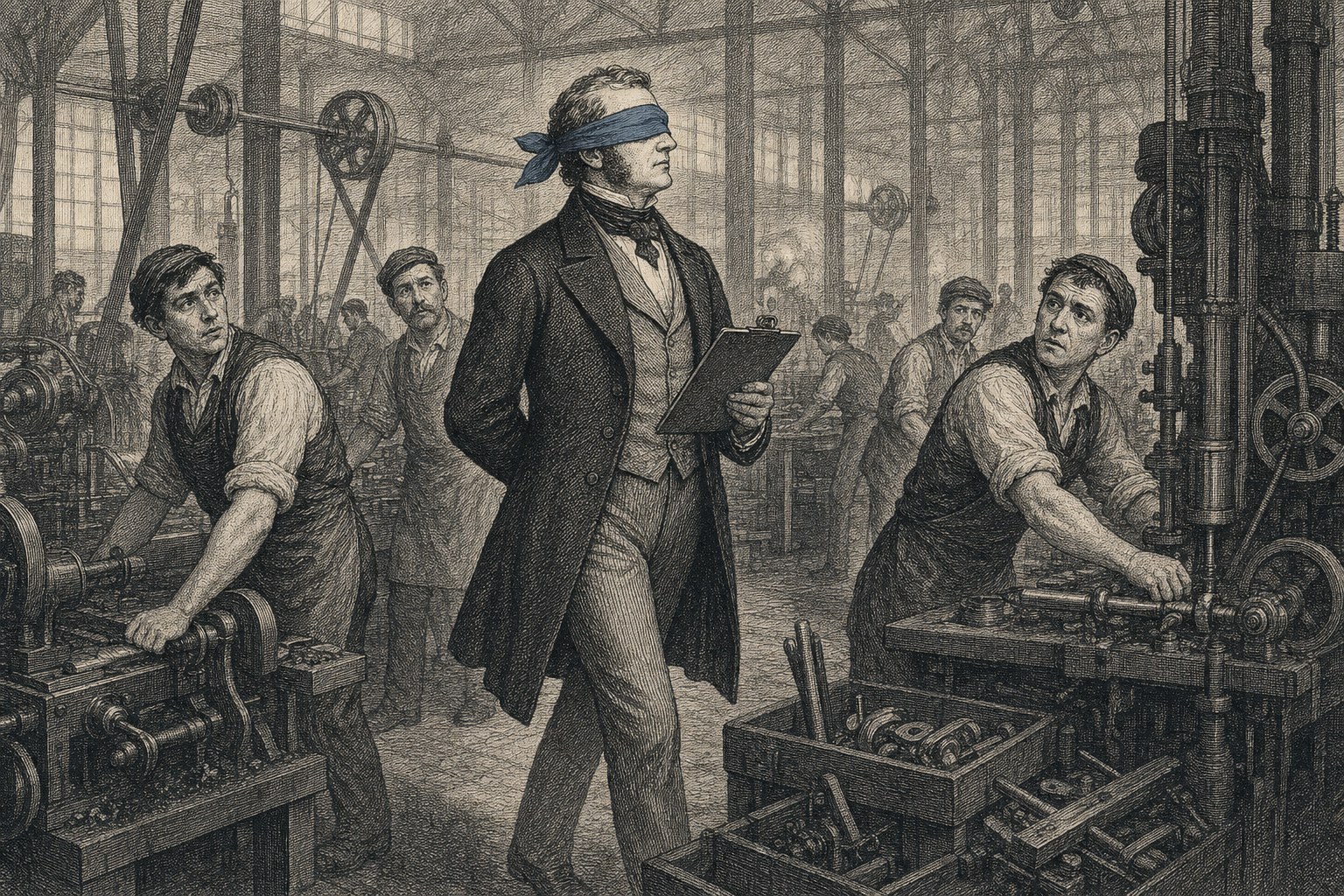
The inspector who once walked into a factory, the bank director who unexpectedly visited a branch, the official who walked into the restaurant kitchen without notice — those people did something simple and irreplaceable. They walked in. They looked. They felt who had things properly in order and who was putting on a performance. They heard from the tone of the employee whether something was not right. They saw from people's faces what the books did not say.
Oversight was once eyewitness. Someone who established with their own eyes and their own judgement whether reality matched what was claimed. That required people with backbone, who were willing to draw a conclusion, who dared to deliver a judgement that could be challenged.
Someone who established with their own eyes and their own judgement whether reality matched what was claimed.
Oversight has become something else. It is an administrative system that checks whether the documentation is present. Whether the procedures are recorded. Whether the self-evaluation has been submitted. Whether the improvement plans have been filed on time. Whether the audit reports are delivered according to specifications. Oversight measures whether the paperwork is in order, not whether reality holds up.
How a scandal produces more paper and less judgement
After every major scandal — the childcare benefit affair, Vestia, the SNS nationalisation, the gas extraction in Groningen, the abuses at youth care institutions — there is always the same response. Parliamentary questions are tabled. An inquiry committee is set up. That committee establishes that oversight was insufficient. The oversight is then expanded. More reporting obligations arrive. New criteria are introduced that must be met. Additional inspection intervals, additional documentation requirements.
And then everyone is satisfied. Decisive action has been taken. The system has been improved. Politics has shown it means business.
What no one says is that the next scandal will not be prevented by those extra forms. The next scandal grows precisely in the shadow of compliance busyness. Because while the honest small institution has its hands full with the new reporting obligations, the smart large institution simply has a department to handle them. That large institution is always in order on paper. Its compliance staff know exactly what the regulator wants to see, they deliver it on time, and they keep the actual operations well out of sight of those doing the checking.
The childcare benefit affair is the most devastating example here. The Tax Authority supervised itself through internal controls, reports, audits, management letters — all in accordance with the requirements. At the same time it was systematically destroying families on the basis of an algorithm that used ethnic origin as a risk factor. Everything was documented. Nothing was seen.
Vestia and the banks: the pattern repeats itself
At Vestia, the housing association that speculated with derivatives and ultimately dragged the entire sector into a five-billion-euro restructuring, the CFO who made the deals was completely invisible to the regulator. The Central Housing Fund checked annual accounts, governance declarations, board reports. The derivatives portfolio grew undisturbed for years, because although it appeared in the documents, it was in a format that did not trigger a warned human judgement — merely a table that did not look alarming on its own if you only looked at the table.
Anyone who had walked the corridors of Vestia would have felt it. The employees who were not allowed to speak up. The culture of one man who controlled everything. The deals with intermediaries that everyone knew were not right but for which no one was accountable. You see that when you look. It never appears in an annual account.
At the banks it was exactly the same before the 2008 crisis. The regulators in all the countries involved — DNB in the Netherlands, the FSA in the United Kingdom, the Fed in America — had access to all the documents. They had read them. The capital ratios looked acceptable on paper, because the models used to calculate the risks had been approved by those same regulators. No one had followed their nose. No one had said: this does not add up, I feel something is fundamentally wrong here. No one had placed their own judgement above the model.
No one had said: this does not add up, I feel something is fundamentally wrong here.
After the crisis came, naturally, more rules. Basel III. SIFI requirements. Stress tests. More reports, more models, more compliance. The next chapter of more paper over a problem caused by paper.
The regulator has lost their own primal sense
It is easy to say the regulators are incompetent. That is not correct. The people at the AFM, DNB, the IGJ, the NVWA, the ILT, the Inspectorate of Education — these are generally trained, serious people who take their work seriously. The problem is not the people. The problem is the system that has shaped them and that directs them daily.
An inspector at the Inspectorate of Education visits a school. They have a protocol. There are quality domains, indicators, sub-criteria, assessment scales. They speak with the management, walk through a few lessons, look at the pupil results, check the procedure for pupils with special needs. After two days they write a report. The report indicates whether the school scores sufficient, good or insufficient on each criterion. The report is honest — it matches what they have seen.
But what they have not seen is the teacher in year four who has not slept properly for three years because of her class and no one from management is doing anything about it. Is the headteacher who consistently transfers the brightest children from the most difficult home situations to special education to improve their average. Is the culture of fear that ensures no one says anything when a visit has been announced.
They do not see it because they have not been trained to see it. Or more precisely: they do see it, because they also have a primal sense, but the protocol gives them no room to write it down. What does not fit a criterion does not exist.
And here lies the real disaster: political pressure has over the past two decades forced regulators ever further in the direction of the objectifiable, the contestable, the defensible. Every subjective assessment was challenged. Every complaint about an inspector who judged "on feeling" led to an adjustment of the protocol. The regulator has learned that their own judgement is dangerous — not to society, but to themselves.
So they traded judgement for protocol. And now they check protocols.
The honest small entrepreneur is crushed flat
This mechanism works as an inverted filter. The honest small entrepreneur — the physiotherapist with one practice, the childcare facility with two locations, the bookkeeping office with ten employees — has no compliance department. They have themselves. Every new obligation from the regulator hits them directly: it is their evening, their weekend, their energy that goes into it.
They do everything right. They have never harmed a client. But they do not always have their dossier in the order the regulator demands. Their privacy policy is not in the right format. Their complaints procedure does not comply with the latest guideline. Their self-evaluation has been filled in honestly rather than strategically worded. They write down what they actually do, not what looks like what they ought to do.
That honesty costs them points.
The large institution — the health insurer, the large bookkeeping firm, the large childcare chain — has a department. That department knows what the regulator wants to see. They deliver it. The dossier is impeccable. The reality behind it need not correspond with the dossier, because the regulator checks the dossier.
The large institution — the health insurer, the large bookkeeping firm, the large childcare chain — has a department.
This is the disaster that is never named as such in any evaluation of oversight: oversight protects the large players and harms the small ones. Not because that is the intention. Because compliance burdens are regressive. A requirement that costs a large institution ten per cent of its overhead costs the small entrepreneur their evening.
And whoever has their evening consumed by papers no one reads has less time for their clients. That is the real damage: not that fraud occurs, but that the good people are crushed flat while the clever ones continue.
Self-oversight as institutional joke
The most absurd invention in the oversight landscape is the self-assessment. The institution assesses itself. It fills in whether it meets the criteria. It analyses its own shortcomings. It formulates its own improvement points. It sends this to the regulator.
The regulator reads it. And then checks whether the self-assessment has been completely filled in. Whether it was delivered on time. Whether the improvement points have been formulated in SMART terms.
What the regulator does not check is whether the self-assessment is accurate. Because for that they would have to look themselves. And they no longer do that — or not systematically, not at those who need it rather than those who do not.
An institution that systematically harms its clients is perfectly capable of submitting an impeccable self-assessment. It has, after all, learned to present its behaviour in a way that looks acceptable. That skill applies to forms just as well as to clients. The institution that genuinely serves its clients well is honest in its self-assessment, names its shortcomings, and is rewarded with a follow-up investigation.
This is not cynicism. This is structure.
What oversight ought to be
A functioning regulator needs three things. Small scale: they must know the institution before they assess it. Unannounced presence: they must see what is really there, not what is being staged. And the authority to judge: they must be able to say "something is not right here" even when the dossier is in order.
Those three things are politically unachievable under the current system. They lead to legal proceedings. They lead to parliamentary questions about arbitrariness. They lead to objection and appeal proceedings by well-organised institutions that know their legal rights.
And so the regulator buys its own peace by waiting until the dossier gives cause. They wait for a complaint to come in. They wait for a report to arrive. They wait for the paperwork to provide a reason. Then they investigate. Then they judge, with legal cover.
But the abuses that cause real harm never fit the dossier. They are never reported by those who suffer from them most, because those people do not know how to file a complaint, or dare not, or do not know their situation is reportable. They are never visible in the paperwork, because the institution committing abuses is also the one supplying the paperwork.
The oversight that society thinks it has exists on paper. In reality it has a system that supervises itself, documents its own shortcomings, and waits until the damage is large enough for a parliamentary debate. Then the cycle begins again: committee, report, new rules, more paper, less judgement.
This is edition 4, article 6. It builds on the series on the law of the paper industry (edition 4, article 1) and on the primal sense in professional practice (edition 3, article 9). The series appears on openvizier.org.
It builds on the series on the law of the paper industry (edition 4, article 1) and on the primal sense in professional practice (edition 3, article 9).
The Regulator Who Sees Nothing
The AFM sends a seventeen-page letter. The honest adviser who has harmed no client in twenty years spends six weeks on a dossier no one will read.
"Two streets away, the office that sells poor mortgages and makes complaints disappear has never had a problem with the regulator."
Oversight was once eyewitness
The inspector who walked into the kitchen without notice did something irreplaceable. He looked. He felt who had things in order and who was putting on a performance. That required people with backbone, willing to deliver a judgement that could be challenged.
Oversight has become an administrative system that checks whether the documentation is present, whether the self-evaluation was submitted on time. It measures whether the paperwork is in order — not whether reality holds up.
Every scandal makes more paper
After every affair — childcare benefits, Vestia, the banks before 2008 — the response is identical. A committee finds oversight insufficient. More reporting obligations arrive. And the next scandal grows precisely in the shadow of compliance busyness, because the smart large institution simply has a department to handle the forms while keeping operations out of sight.
The childcare benefit affair is the most devastating example. The Tax Authority supervised itself through internal controls, reports, audits — all in accordance with the requirements — while systematically destroying families on the basis of an algorithm. Everything documented. Nothing seen.
The honest small one is crushed flat
The physiotherapist, the two-location childcare facility, the ten-person bookkeeping office have no compliance department. They have themselves. Every new obligation costs them their evening. They fill in their self-evaluation honestly rather than strategically — and that honesty costs them points. The large chain has a department that knows exactly what the regulator wants to see.
Oversight protects the large players and harms the small ones. Not by intention — because compliance burdens are regressive. A requirement that costs a large firm ten per cent of overhead costs the small entrepreneur their weekend.
Close
A functioning regulator needs three things: small scale, unannounced presence, and the authority to judge — to say "something is not right here" even when the dossier is in order. All three are politically unachievable; they lead to objection and appeal by well-organised institutions. So the regulator waits until the paperwork gives cause. But the abuses that cause real harm never fit the dossier.
"The oversight society thinks it has exists on paper. In reality it waits until the damage is large enough for a parliamentary debate."