The judge without a compass
Speaking law on paragraphs instead of people
Practice · 13 min read
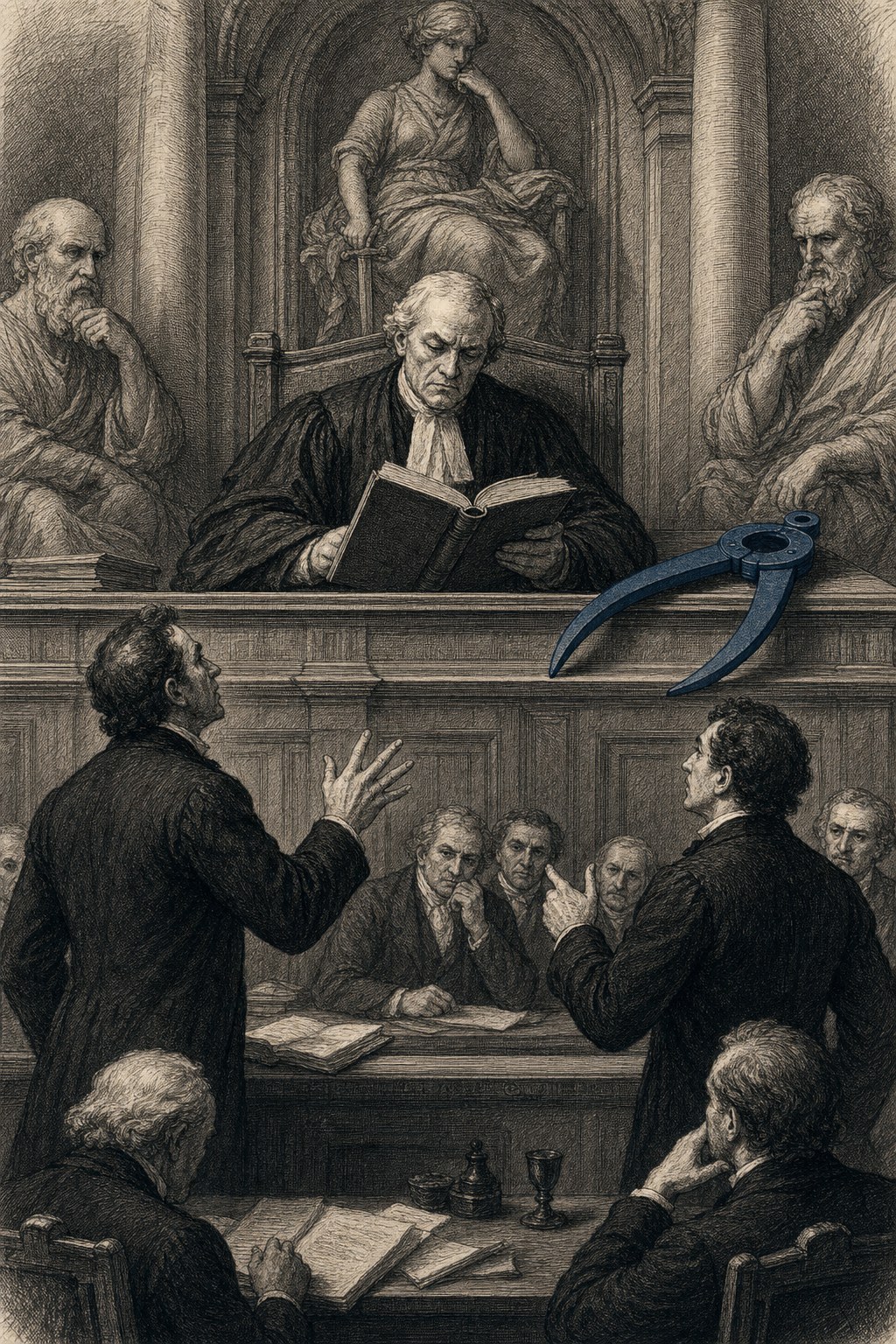
A woman asks the court to have her ex-husband removed from her home. She shows that he has repeatedly threatened her. She has messages, photographs, statements from neighbours. It has taken her a year to gather the courage to go to court. The judge looks at the documents. He establishes that the case is before him in summary proceedings, that the house is in the man's name, that she has no right of ownership, and that the interim relief she is requesting does not fit the legal basis as formulated in the writ of summons. He dismisses the claim. Technically the judgement is correct. The woman goes back home, to the man who threatens her.
This is not an edge case. This is how justice works when it has drifted from people to paragraphs.
What justice was
Administering justice has always at its core meant delivering a verdict on what really happened, who is responsible, and what must change. It is a moral act, not a technical one. It demands someone who weighs the facts, looks at the people, understands the context, and then draws a conclusion that does right by what has occurred in the world.
In early legal systems the judge was an elder, a wise person, an authority who derived their authority from their capacity to see what was really there. They were not a technician. They were an assessor. They had no code of law running to five thousand pages — they had their judgement, their reputation, their community that corrected them when they strayed too far.
That system had flaws. It was not consistent. It was vulnerable to prejudice and arbitrariness. It was sometimes unjust toward those without access to the wise person. Those objections are real.
It was sometimes unjust toward those without access to the wise person.
But the system had something the current one lacks: it could see what was there. It could respond to reality rather than to the formulation of reality.
Continental law and the disabling of judgement
The Netherlands operates under continental law — the French legacy, the Napoleonic codes, the codification of everything in written legislation. In this system the law is always the starting point. The judge applies the law. They interpret the law. They reason from the law toward the case. Their own judgement — what they feel, what they think, what common sense tells them — is in this system a risk factor, not an instrument.
The Anglo-Saxon system — the common law used in the United Kingdom and the United States — works differently. There the jury of ordinary citizens delivers a verdict on the facts. There the doctrine of precedent means that what has actually been decided in concrete cases constitutes the law, not only what is written in abstract legislation. That system also has its flaws, and romanticising it helps no one. But it has structurally more room for judgement built into it, because it was originally built around the question: what do twelve ordinary people think happened and who is responsible?
Continental law is built around a different question: which law applies, and what does that law say? If the facts do not fit the law, the problem is not the law but the formulation of the claim. That is a fundamentally different relationship with reality.
I am not saying common law is the answer to everything. I am saying that a system that treats judgement as its central instrument can drift less far from reality than a system that treats the law as its central instrument. Because reality corrects judgements — a bad judgement is not accepted by the community. The law does not correct itself. It stands there, even when it no longer fits.
The accumulation of procedural requirements as an end in itself
Whoever as an ordinary citizen begins a legal action embarks on a climb through formalities. There is a writ of summons that must meet formal requirements. There are deadlines strictly observed. There are requirements on the petitum — the specific relief claimed — which must be legally precisely formulated. There are rules about what counts as evidence and what does not, about which documents may be submitted, about when this must have been done, about how procedural documents must be organised.
None of this is bad faith on the part of the courts. It is the system that has been built up over decades to guarantee fairness. Both parties must have equal chances. Surprises at the hearing are not permitted. What is in the documents is there; what is not in them does not exist for the judge.
The result is a system where reality is translated into procedure, and where in that translation the essential can be lost. A tenant threatened with eviction who has always paid their rent, but who followed the wrong procedure in filing their defence, can lose their case on a ground that has nothing to do with the actual situation. A creditor with an evidently just claim whose bailiff made a procedural error is shut out.
The result is a system where reality is translated into procedure, and where in that translation the essential can be lost.
And here is the sobering thing: the judge sometimes knows themselves that the result is harsh. They are not blind. They are not unintelligent. But the system forbids them from saying: this is procedurally incorrect, but there is something wrong here substantively and I am going to put it right. That is not permitted. They are bound. Their judgement is only permissible within the margins the law allows them.
The Supreme Court as guardian of procedure
The Supreme Court is the highest court in the Netherlands. It does not assess the facts — that has in principle already been settled in lower courts. It assesses the law: was the law correctly applied, were the procedural rules observed, is the legal reasoning sound.
This sounds like meaningful work. In a system where legal unity and legal certainty are values, it is meaningful work. The problem is when the Supreme Court becomes a guardian of procedure over substance — when an evidently unjust outcome is upheld because the legal reasoning toward it was technically correct.
There are Supreme Court rulings that are legally impeccable and substantively bewildering. Cases where a company is responsible for a loss it caused, but not liable because the liability doctrine in Dutch law requires a technical element that is missing. Cases where someone cannot obtain justice because they chose the wrong type of legal remedy. Cases where limitation bars the substantive discussion, even when the limitation was itself the result of a lack of resources to litigate earlier.
The Supreme Court has the right to read the law as written. But if it does so in a way that consistently produces outcomes that violate the sense of justice of ordinary people, then the legal system has a problem that is not solved by more precise case law.
Justice for those who can pay for it
There is an open secret in the legal world that is rarely stated plainly: the quality of your legal representation determines your chances in the courtroom, far more than the strength of your case.
Running a procedure in the Netherlands costs money. A lot of money. A lawyer in a civil case costs between one hundred and fifty and five hundred euros per hour. A straightforward procedure costs ten thousand euros. A more complex case costs tens or hundreds of thousands of euros. Those who receive a court-appointed lawyer — the subsidised legal aid for those on low incomes — get a lawyer who is paid a fixed amount per case, regardless of its complexity, regardless of the time it takes. That amount is too low. Everyone knows this.
The consequence is that the major cases are won by whoever has the better lawyers. Not only because better lawyers are smarter — sometimes they are and sometimes they are not. But because litigating itself is a craft. Knowing the procedural rules, commanding the formulations, managing the timing of procedural steps, submitting the supplementary evidence in time, formulating the correct grounds of appeal — all of that is technical work that goes better when you do it often for clients who can afford to pay.
The consequence is that the major cases are won by whoever has the better lawyers.
A multinational company in a dispute with a small supplier knows this. It knows the supplier cannot sustain its legal representation for years. It knows that settling at a loss for the smaller party is better than litigating to the Supreme Court — because the smaller party does not have the resources to go that far. It knows that legal proceedings are sometimes deployed not to win the case but to financially exhaust the other party.
This is not a conspiracy theory. It is a description of a rational strategy that every experienced lawyer recognises.
The legal caste and its interest in complexity
There exists in the Netherlands a class of people whose livelihood depends on the complexity of the legal system. Lawyers, notaries, legal advisers, mediators, court-appointed experts, compliance officers, legal policy officials. All people whose income is directly tied to the difficulty of the system they serve.
This is not necessarily bad faith. A lawyer who genuinely believes in the importance of legal protection can simultaneously profit structurally from a system so complex that no one can navigate it without them. The two are not mutually exclusive.
But it does mean that the legal caste as a profession has no interest whatsoever in simplifying the law. Every simplification — every procedure that becomes shorter, every rule that becomes clearer, every dispute that can be resolved without a lawyer — is a loss of work for someone in that caste. The collective interest of the caste lies in more law, not less. In more procedures, not fewer. In more complexity, not less.
And the caste helps to write the laws. Lawyers sit on committees that design legislation. Lawyers write the explanatory memoranda. Judges advise on legal development. The people who profit most from the complexity are also the people who have the most influence over the degree of complexity. This is not illegitimate — no one else has the expertise. But it is a structure that sustains itself, that systematically pushes in the direction of more complexity, and that rarely has a voice saying: let us make this simpler.
What happens to trust in the rule of law
When people feel that the law is for the wealthy, that is not naivety and it is not populism. It is an observation that holds up. Not entirely, not always, not everywhere — but sufficiently to justify the feeling.
And that feeling does something to society. People who do not believe they can obtain justice start avoiding the law. They resolve conflicts themselves. They pay to settle rather than litigate, even when they are in the right. They accept injustice they could have challenged, because they know that challenging it costs tens of thousands of euros and years of their lives.
This distrust is not merely a feeling. It has behavioural consequences. It leads to under-use of legal protection by those who need it most, and to over-use by those who know the procedures and have the means to deploy them.
It also leads to something else: people who no longer experience the rule of law as their system. Who see the law as something that applies to others, not to them. Who start reasoning outside the system, because the system left them stranded on a procedural ground while their substantive case was visible to everyone in the room, including the judge who delivered the verdict.
A rule of law lives on the conviction that the law applies to everyone and that everyone can obtain justice. When that conviction erodes — not through attacks from outside but through the system itself that consistently produces outcomes that violate the sense of justice — that is a threat to the legal order that no terrorist attack and no civil unrest can equal. It is a quiet erosion that does not break things all at once but that slowly wrings out what holds a society together.
What a judge should dare to do
The judge sitting across from the woman who wants her home back — that judge also knows what is going on. They are also human. They also have a primal sense. That tells them: something is not right here, someone is in danger, the formal outcome is not the just outcome.
But their training has taught them to distrust their primal sense. Their assessment must be traceable. Their reasoning must be legally followable. Their verdict must withstand appeal. If they act on their feeling and it is contestable, their verdict is unsound. Then they are not a good judge.
So they have learned that good judging coincides with legally correct judging, even when that does not coincide with just judging.
That is the core of the disaster. Not that judges are bad people. Not that they deliberately abuse the law. But that the system has trained them to treat their own judgement as a problem and the procedure as a solution. And that they are now trapped in a system that prevents just outcomes with precisely the instruments designed to guarantee them.
This is edition 4, article 7. It builds on the series on the law of the paper industry (edition 4, article 1) and the regulator who sees nothing (edition 4, article 6). The series appears on openvizier.org.
It builds on the series on the law of the paper industry (edition 4, article 1) and the regulator who sees nothing (edition 4, article 6).
The Judge Without a Compass
A woman asks the court to remove her threatening ex-husband from her home. The relief does not fit the legal basis. The judge dismisses the claim. Technically correct. She goes back home, to the man who threatens her.
"This is how justice works when it has drifted from people to paragraphs."
Justice was a moral act
Administering justice has always meant delivering a verdict on what really happened, who is responsible, and what must change. The early judge was an assessor, not a technician — corrected by a community when he strayed. That system had real flaws: inconsistency, prejudice, arbitrariness.
But it could see what was there. It could respond to reality, rather than to the formulation of reality.
When the law is the only starting point
Continental law treats the judge's own judgement as a risk factor, not an instrument. If the facts do not fit the law, the problem is held to be not the law but the formulation of the claim. The accumulation of procedural requirements becomes an end in itself: the tenant who always paid but filed his defence wrongly loses on a ground unrelated to his situation.
The judge sometimes knows the result is harsh. He is bound. He may not say: this is procedurally incorrect, but something is wrong here substantively and I am going to put it right. That is not permitted.
Justice for those who can pay
A straightforward procedure costs ten thousand euros; a complex case, hundreds of thousands. Subsidised legal aid pays a fixed amount too low for the work. The major cases are won by whoever has the better lawyers — because litigating is itself a craft. A multinational knows the small supplier cannot sustain its representation for years, and deploys proceedings to financially exhaust the other party.
And a legal caste — lawyers, notaries, advisers — depends on the complexity of the system. It has no interest in simplification. Every clearer rule is a loss of work. The people who profit most from the complexity are also the people who help write the laws.
Close
When people feel the law is for the wealthy, that is not populism — it is an observation that holds up. They avoid the law, settle when they are in the right, accept injustice they could have challenged. A quiet erosion that does not break things all at once but slowly wrings out what holds a society together. The judge also has a primal sense. His training has taught him to distrust it.
"The system has trained judges to treat their own judgement as a problem and the procedure as a solution."