The deeper question
Why an entire society lost its primal sense
Philosophy · 14 min read
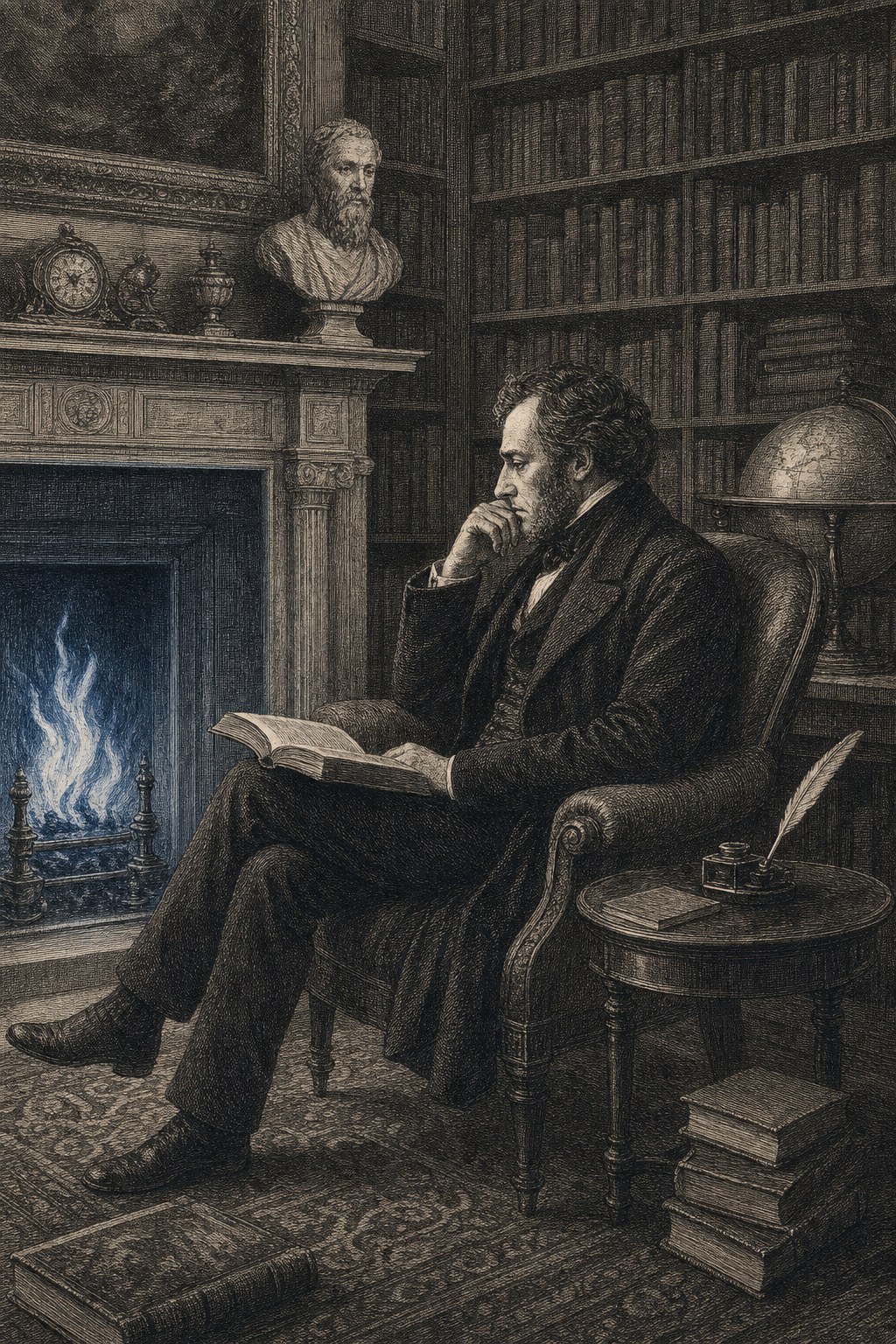
In the seven articles that preceded this one, we walked past the CEO, the consultant, the banker, the insurer, the regulator, the judge, and the paper industry. Each article described the same pattern in a different costume: judgement has been taken away from those who work, and replaced by rules administered by those who do not. The primal sense has been legally prohibited, procedurally circumvented, institutionally organised out of existence.
But that raises the question I have not yet asked out loud. How did it come to this? Who has an interest in it? And does this only concern institutions — or has it now gone deeper, into our own minds?
The Enlightenment and its price
It did not begin maliciously. It began as liberation.
The Enlightenment of the eighteenth century placed reason above feeling. That was, at the time, revolutionary and right. Europe was locked in superstition, arbitrariness, aristocratic judgement accountable to no one. The Church determined what was true. The nobility determined who had rights. The feeling of the ruler was law. There was no appeal. There was no system that checked that judgement.
The Enlightenment said: enough. We are going to reason. We are going to prove. We are going to measure and test and verify. We accept only what holds up to reason. And that was good, because reason is an instrument that tests results, exposes inconsistencies, constrains power.
And that was good, because reason is an instrument that tests results, exposes inconsistencies, constrains power.
But there was a package insert no one read. Reason is an instrument for testing, not for forming judgements in the moment. Reason tests after the fact what feeling already knew. Reason is the copy-editor, not the writer. Give the copy-editor the writer's chair and you get a text without life — because the copy-editor knows what must not appear, but not what must.
That package insert was lost. For three centuries we have treated reason as the only legitimate instrument for decisions. Feeling became synonymous with unreliability, arbitrariness, bias. And so all institutions were built for reason — and not for the judgement that precedes reason.
The industrial revolution and the end of craftsmanship
A century and a half later, the industrial revolution reinforced this mechanism in a way we still underestimate.
Before industrialisation, production was human work. Not only in the execution, but in the design of every piece. The shoemaker knew the leather, the type of wood, the foot of his customer, the use of the shoe. He made a thousand decisions a day with his fingers, his nose, his eyes. His craftsmanship was his primal sense in a professional context — built up over years, lodged in his hands. That was irreplaceable.
The factory made that redundant. Not the product — the judgement. The factory could only be run if every part of the process was controllable, repeatable, independent of the individual worker. The worker had to be made into a component of the system, not a bearer of judgement. The action must no longer depend on their feel for the material — it must depend on the procedure on the card above their head.
This was efficient. It was also the beginning of hollowing out the craft as a bearer of judgement. The factory selected for execution, not for craftsmanship. And so a generation of workers grew up who had learned that making judgements was not their job. That was the job of the engineer, the manager, the process owner.
The separation made at that time — thinking above, doing below — has never left the western institution.
The post-war state and the management of large numbers
After the Second World War, the western state grew at a pace it had not itself foreseen. Social security, healthcare, education, public housing — these were not small programmes. These were systems that had to reach, assess, and serve millions of people. And the state had no instrument for this other than bureaucracy.
Bureaucracy is not inherently bad. It is a way of limiting inequality: everyone is treated according to the same rule, no one has an advantage because of who they know. That is fair in the most elemental sense.
But it only works if the rule can capture reality. And the reality of people never fits completely in a rule. Every case is different. Every situation has a particularity the rule did not foresee. And the official who sees the particularity faces a choice: do I use my judgement, or do I follow the rule?
In a healthy system they would use their judgement, with the rule as a framework. In the system we have built, they follow the rule, and consider their own judgement dangerous. Because their judgement can be challenged. The rule cannot.
So the government official was slowly transformed from a person with a task into a process manager of rules. And as the government apparatus grew, so did the pressure to eliminate every judgement that did not fit the procedure. The state had to be manageable, auditable, demonstrably consistent. Judgement is by definition none of those things. So judgement disappeared.
The juridification of the seventies
In the nineteen-seventies this acquired a new dimension: juridification. Not only in the Netherlands — across the entire western world, law began to grow in ways no one had intended.
More laws, more regulations, more rights, more procedures, more regulators to enforce the rules, more judges to assess the procedures, more lawyers to guide the procedures, more consultants to interpret the rules. Every conflict previously resolved by human judgement — of a mayor, a contractor, a neighbour, an employer — was now referred to a procedure.
This sounds like the rule of law. And it is, partly. But it has a price rarely spoken aloud: judgement is extracted from society and relocated to the courtroom. The employer who once dared to say who worked well and who did not, no longer dares — because every judgement can become a procedure. The doctor who once dared to decide on the basis of their clinical eye, no longer dares — because every judgement can become a claim. The teacher who once dared to say who was capable and who was not, no longer dares — because every judgement can be challenged by parents who know a lawyer.
But it has a price rarely spoken aloud: judgement is extracted from society and relocated to the courtroom.
And so a society has slowly arisen in which no one dares to judge in public any more. Not because we have stopped feeling what is right. But because feeling has become unsafe. Liability has killed judgement.
The measurability fixation and the digital age
And then came the computers. And then the internet. And then the dashboards. And then the KPIs. And then the AI.
Every step in digitalisation reinforced the same mechanism. Because computers work with data. Data is what is measurable. What is measurable can be managed, optimised, compared. What is not measurable does not exist as a category in a system.
The consequence is that we have spent half a generation building systems that can measure reality, and zero time on the question of which reality we actually want to measure. We measure customer satisfaction scores and not whether the customer was genuinely helped. We measure absenteeism and not whether the people who show up still believed in what they were doing. We measure school results and not whether children learned to think. We measure subsidy output and not whether society improved.
The KPI is the most modern form of the paper judgement. It gives certainty without insight.
The AI makes this potentially definitive. A system that makes decisions on the basis of historical data makes decisions by definition on the basis of the past. It is the most perfect machine ever built for maintaining the status quo. And it is being widely deployed in credit assessment, in selection, in healthcare assessment, in admission to education. In all these cases the AI does exactly what the paper industry does, only faster and with less room for appeal.
Who has an interest in this?
This brings me to the question that is rarely asked aloud in analyses of this kind, because it is uncomfortable: who has an interest in how things have gone?
Not as a conspiracy theory — I do not believe in central planners who designed this. But as a class analysis. Because there is a class that profits from every expansion of the paper system. And that class has a name, though that name is rarely spoken in one sentence: the paper class.
Lawyers. Accountants. Compliance officers. Policy makers. Auditors. HR managers. Consultants. Subsidy advisers. Regulators. Application specialists. Grant writers. Process owners. Everyone whose professional existence is built on managing, interpreting, testing, or producing paper.
These are not bad people. But they are people whose income rises with every new law, whose contracts grow with every new scheme, whose position strengthens as procedures grow more complex. They have no interest in simplification. They have no interest in returning judgement to those who work. They have no interest in fewer forms.
They have an interest in more paper. And that is precisely what they produce.
The university is their breeding ground. The MBA and the law degree and the accountancy qualification are the factories that reproduce the paper class. Every year tens of thousands of young people go to university to learn to think in systems, rules, models, procedures. Not in people. Not in craftsmanship. Not in judgement. In paper. And they leave university equipped with exactly that instrument, ready to reinforce the paper industry.
This is a self-reinforcing system. The universities supply the paper class. The paper class populates the institutions. The institutions build more procedures. The procedures require more paper class. And so it rolls on.
What we have lost
The question about the price is more painful than the question about the cause.
The young entrepreneur who does not start because the permitting procedure takes nine months and they do not have the money to wait a year. The newly qualified doctor who leaves healthcare after three years because the administration is larger than the patient care and they did not study to fill in forms. The teacher with twenty-five years of talent in the classroom who burns out at forty because the bureaucracy has drained them dry. The craftsman with twenty-five years of knowledge who is set aside by a twenty-eight-year-old MBA who understands the procedures better but does not know the material. The child who grows up in a school that teaches them to write down the right answers, but has never taught them to feel what is good.
That is material damage. Those are companies that were never founded, patients who were helped less well, pupils steered in the wrong direction, knowledge lost with the craftsman who stopped.
But there is also damage to the soul. A generation that has learned that judging is dangerous. That has learned that it is safer to follow the procedure than to say what you see. That has learned that feeling is private and formally irrelevant. That in every meeting asks: what does the procedure say? — and not: what does my judgement say?
That generation has lost something it should never have been made to lose. Trust in its own instrument.
The answer
I am not going to give a step-by-step plan here. Step-by-step plans are the problem, not the solution.
But the direction is clear. Restore the layers. Return judgement to those who work. Wind back the paper. Trust people. Accept mistakes as the price of real decisions.
Concretely that means: an official who has a citizen in front of them must have the room to judge what the situation demands — with the law as a framework, not as a prison. A doctor who has a patient in front of them must have the room to decide on clinical judgement — with the guideline as a reference, not as a verdict. A banker who has an entrepreneur in front of them must have the room to lend on instinct — with the risk assessment as a conversation piece, not as a final judgement. A teacher who has a child in front of them must have the room to judge what that child needs — without that judgement being open to challenge by a procedure.
This does not happen by itself. It requires taking back something that was deliberately removed. It requires people in responsible positions who are willing to be accountable for their own judgement. That is more frightening than filling in a form. It is also the only way a society truly decides.
The deeper question beneath the deeper question
But here is what preoccupies me most.
Does this only concern institutions? Or have we — as individuals, as a generation — collectively learned not to trust our bottom layers?
Because the system shapes its people. And three generations raised in a system that punished judgement and rewarded procedure produces people who have stopped feeling what is right. Not only at work. Also at home. Also in relationships. Also in the consulting room. Also at the ballot box.
There is a generation that, at every feeling, asks: but is this correct? Is this proven? Can I defend this? That has stopped treating feeling as information and has started treating it as a problem to be solved. That has unlearned the primal sense — the fastest, most basic information processor we possess — as unreliable.
That is the real damage. Not only the institutions that no longer work. But the people who no longer know how to work. Who have unlearned the antenna that the four-year-old already had and that we have systematically wrung out — first at school, then at university, then in the workplace, then in the meeting room.
If that is so — and I think it is — then this is about more than a reform of subsidy rules or banking procedures. Then this is about the question of whether we as a society still know what we are. Whether we can find the way back to the instrument that comes before all other instruments. Whether we are willing to acknowledge that we have lost something that does not fit in a KPI.
That is the question behind all the other questions. And it is waiting for an answer.
This is edition 4, article 8. It builds on all previous articles of edition 4, and on edition 3 on the primal sense, the three brain layers and the 7D feeling model. The series continues on openvizier.org.
It builds on all previous articles of edition 4, and on edition 3 on the primal sense, the three brain layers and the 7D feeling model.
The Deeper Question
Seven articles, the same pattern in a different costume: judgement taken away from those who work, replaced by rules administered by those who do not.
"How did it come to this? Who has an interest in it? And does this only concern institutions — or has it gone into our own minds?"
The Enlightenment and its price
It began as liberation. The Enlightenment placed reason above feeling, and that was right: Europe was locked in superstition and arbitrary aristocratic judgement. But there was a package insert no one read.
Reason is an instrument for testing, not for forming judgements in the moment. Reason is the copy-editor, not the writer. Give the copy-editor the writer's chair and you get a text without life.
For three centuries we have treated reason as the only legitimate instrument for decisions. Feeling became synonymous with unreliability. So all institutions were built for reason — and not for the judgement that precedes it.
Factory, state, courtroom
The industrial revolution made the worker a component, not a bearer of judgement. The separation made then — thinking above, doing below — has never left the western institution. The post-war state, managing millions, turned the official into a process manager of rules: his judgement could be challenged, the rule could not.
The juridification of the seventies finished the job. Every conflict once resolved by human judgement was referred to a procedure. The employer, the doctor, the teacher no longer dare to judge in public — not because we stopped feeling what is right, but because feeling became unsafe. Liability has killed judgement. The KPI is the most modern form of the paper judgement: it gives certainty without insight.
The paper class
Not a conspiracy — a class analysis. Lawyers, accountants, compliance officers, auditors, consultants, grant writers, process owners. Not bad people, but people whose income rises with every new law and whose position strengthens as procedures grow more complex. They have no interest in fewer forms. They produce more paper.
The university is their breeding ground. The MBA, the law degree, the accountancy qualification reproduce the paper class — tens of thousands a year learning to think in systems and procedures, not in people, not in craftsmanship. The universities supply the class; the class populates the institutions; the institutions build more procedures. And so it rolls on.
Close
The direction is clear: restore the layers, return judgement to those who work, wind back the paper, accept mistakes as the price of real decisions. But the deeper question is whether we — as individuals, as a generation — have collectively learned not to trust our bottom layers. A generation that at every feeling asks: but is this provable? Can I defend this?
"This is about whether we as a society still know what we are. That is the question behind all the other questions — and it is waiting for an answer."